Unit 9 · Topic 9.8 · about 30 minutes · 7 parts · 9 scored checks, 2 of them multiple choice, plus 2 from earlier lessons
AP World History: Modern 9.8: Institutions Developing in a Globalized World
Unit 9: 8 to 10% of the multiple-choice section
What you'll be able to do
- Explain how and why globalization changed international interactions among states.
Key vocabulary
| Term | What it means | The exam trap |
|---|---|---|
| International organization | A body whose members are countries; a plain meaning, since the topic does not define it. | International means among nations, not inside one. A body that works only within one country is not one. |
| Stated goal | The aim an organization announces for itself. | A stated goal belongs to the body that announced it. A choice that gives the goal to a single member state misreads whose goal it is. |
| Facilitate | To make easier. | Making something easier does not mean it was new. Facilitating cooperation does not say countries had never cooperated before. |
| Main idea | The central point a source makes. | A main idea is the source's point, not the thing it is about. Naming a source's subject is not stating its main idea. |
 Tap to open the picture full size
Part 1 Think first An announcement of peace
Make a guess before you read. A wrong guess still helps the right idea stick.
Predict first
A new organization of many countries announces, on the day it is founded, that it will keep the world at peace. What do you guess that announcement tells a historian most surely?
In short. This topic is about the new international organizations of the period, such as the United Nations, and the aims they announced when they formed.
- New international organizations, including the United Nations, formed with the stated goal of maintaining world peace and facilitating international cooperation.
- Including means the United Nations was one of several, and the stated goal has two parts.
- A stated goal is an aim the organizations announced; the topic does not say how far they met it.
Part 2 Learn it New organizations among states
9.8a. Several organizations, one named
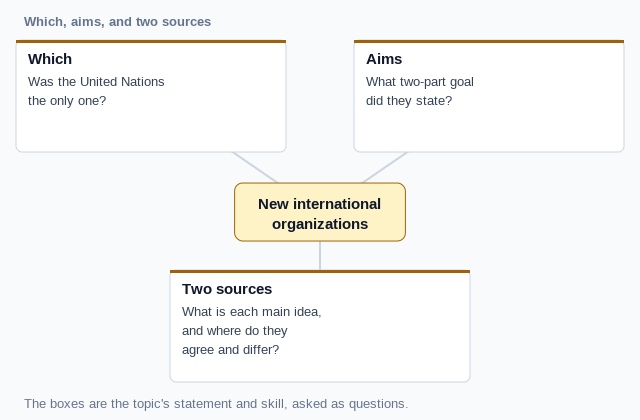
This topic has one statement: New international organizations, including the United Nations, formed with the stated goal of maintaining world peace and facilitating international cooperation.
Start with the subject. The organizations are new and international, bodies among countries rather than inside one. Including matters most: the United Nations is named as one of them, so there were others. The topic names no others.
The statement says the organizations formed. It does not say who formed them, in which years, or where, and it gives no illustrative examples. Treat any of those details as something your own evidence has to supply.
Other topics in this unit name bodies among states too. 9.4 Economics in the Global Age lists the World Trade Organization, NAFTA and ASEAN among its examples of economic institutions and regional trade agreements, which it says reflected the spread of free-market principles and practices.
Quick check · Select all
Which two does this topic say about the new international organizations? Pick two.
Select 2 answers, then check.
9.8b. A goal they stated
The goal has two parts: maintaining world peace and facilitating international cooperation. To facilitate is to make easier, so the second part is about helping countries work together.
Now the word in front of both: stated. A stated goal is the aim an organization announced. The statement reports that announcement. It says nothing about how far the organizations kept the peace or how much cooperation followed, so this lesson says nothing about that either.
The objective asks how and why globalization changed international interactions among states. Here the topic gives one how, new international organizations with a stated goal of cooperation among states, and one aim. It does not tie their forming to globalization in so many words. If you make that link in an essay, present it as your argument and back it with evidence.
Quick check · Multiple choice
According to this topic, which of these was part of the stated goal of the new international organizations, including the United Nations?
9.8c. Two sources, compared
This topic's skill is to compare the arguments or main ideas of two sources. College Board's tasks for it are three: identify the argument or main idea in each source, then ask what the similarities are between them, then what the differences are. This lesson takes them in that order.
The order protects you. A comparison written before each source is pinned down tends to borrow one source's point and hand it to the other.
Two tests keep a comparison honest. A similarity has to be true of both sources, not of one. A difference has to name what each source says, not just what one leaves out. Sources about new international organizations make good practice, because a speech at a founding and a skeptic's letter can describe the same body in very different terms.
Quick check · Multiple choice
Two sources written for this page (neither is a real source). Source 1, an official of a new international organization: "Member states now meet every year to work on problems that no state can solve alone." Source 2, a diplomat from a small member state: "Our country joined, but the largest members still decide most matters." Which is a similarity between the two sources?
Part 3 Watch it done Comparing a speech and a letter
Watch the first steps, then take the last one yourself.
Two sources written for this page (neither is real). Source 1, an imagined foreign minister at a new organization's first meeting: "We are here so that no quarrel between our countries need end in war again." Source 2, an imagined trade official writing to a colleague: "The new body will let our ports and theirs agree on shipping rules together, instead of each going alone."
Compare the main ideas of the two sources.
Step 1 · Identify each main idea
Source 1: the organization exists so that quarrels between countries do not end in war. Source 2: the organization will let countries agree on shipping rules together.
Step 2 · Find a similarity
Both describe the new body as a place where countries settle things together rather than alone or by force. That is true of each source, so it counts.
Why this step?
Why look for a difference after you have a similarity?
The skill asks for both. A similarity alone makes the sources sound the same, and a comparison is only complete once it says where they part.
Your step · Decide and justify
Finish it. Which sentence states a difference between the two sources?
What makes it a difference?
Part 4 Try it A newspaper and a farmer
Two sources written for this page (neither is real), both from one imagined member country of a new international organization.
- Source A, a newspaper editorial: "Our delegates now sit in the same hall as our old enemies. That alone is worth something."
- Source B, a farmer's letter to his brother: "The new organization meets far away, and nothing about my harvest has changed."
A student wrote the comparison below. Read every line against both sources.
Try it · Spot the error
Which line of the student's comparison goes wrong?
Part 5 Explain it How states dealt with one another
This is a self-check. Nothing you type leaves this page. Compare your answer with the model and each scoring point.
Free-response practice · Question 2 style
This is a partial long essay. Write a thesis, one sentence of context and one paragraph of evidence, not a full essay.
In the period from 1900 to the present, new international organizations, including the United Nations, formed with the stated goal of maintaining world peace and facilitating international cooperation.
Explain how international interactions among states changed in the period from 1900 to the present.
Model answer
Thesis: After 1900, states came to deal with one another more often through organizations among states, as new international organizations, including the United Nations, formed with the stated goal of maintaining world peace and facilitating international cooperation.
Context: Peoples and states around the world challenged the existing political and social order in varying ways, leading to unprecedented worldwide conflicts, which I would argue gave a stated goal of maintaining world peace its weight.
The United Nations was one of several new international organizations, and its stated goal had two parts, peace and cooperation. Economic bodies among states appeared too: changing economic institutions and regional trade agreements, such as the World Trade Organization, NAFTA and ASEAN, reflected the spread of free-market principles and practices throughout the world. New institutions of global association emerged and continued to develop throughout the century. These show a change in how states met, inside shared bodies. They show what the organizations aimed at; how far they kept the peace would need other evidence.
Score your own answer. This is a self-check, not a grade. Tick each point your answer makes.
Part 6 Check yourself Four charters and a newspaper
The table drives the first two questions. The last two come from the rest of the lesson.
Four imagined international organizations: what each one's founding charter said it was for, and what a newspaper reported ten years later. The table was written for this lesson and is not real.
| Organization | Its charter says it is for | A newspaper, ten years later |
|---|---|---|
| A | Keeping the peace among its members | Two members went to war with each other |
| B | Helping members agree on shared rules for mail and shipping | Mail now crosses every member's border |
| C | Keeping the peace, and helping members work together on health | Members still disagree on most things |
| D | Keeping a register of members' flags | The register now lists every member's flag |
Case question 1 · Sort it
Sort each sentence by what it reports: a stated goal, or a result.
A stated goal
A result
Case question 2 · Match
The topic's stated goal has two parts. Match each charter to the part, or parts, of that goal it names, if any.
The rest stand on their own and do not use the case.
Check yourself · Select all
Read the same two sources. Source 1, an official of a new international organization: "Member states now meet every year to work on problems that no state can solve alone." Source 2, a diplomat from a small member state: "Our country joined, but the largest members still decide most matters." Which two state a source's main idea correctly? Pick two.
Select 2 answers, then check.
Check yourself · Select all
A student argues: "After 1900, states increasingly dealt with one another through international organizations." Based on Topics 8.9 and 9.8, which two pieces of evidence could best support the argument? Pick two.
Select 2 answers, then check.
Part 7 Keep it Bring back earlier ideas
One question from responses to globalization, the lesson just before this one, and one from calls for reform three lessons back.
From 9.7 Resistance to Globalization After 1900 · Select all
This topic's statement names what the responses were responses to. Which two? Pick two.
Select 2 answers, then check.
From 9.5 Calls for Reform and Responses After 1900 · Multiple choice
According to this topic, what did rights-based discourses challenge?
In three lines
- New international organizations, including the United Nations, formed with the stated goal of maintaining world peace and facilitating international cooperation.
- The United Nations was one of several, and the stated goal is an aim, not a result.
- To compare two sources, this lesson identifies each main idea first, then the similarities, then the differences.
Exam strategy for this topic
- Section I Part A, Multiple Choice: 55 questions in 55 minutes.
- Section I Part B, Short Answer: 3 questions in 40 minutes.
- Section II, Document-Based Question and Long Essay: 2 questions in 100 minutes.
- This lesson's Explain it is shaped like free-response question 2, Long essay.
When a long essay asks how relations among states changed after 1900, name the United Nations as one of several new international organizations, give both parts of their stated goal, and keep the word stated.
Questions students ask
Was the United Nations the only new international organization?
The statement says new international organizations, including the United Nations, so it was one of several. The topic itself names no others; Topic 9.4 adds economic bodies such as the World Trade Organization.
Does the topic say the organizations kept the peace?
It says they formed with the stated goal of maintaining world peace and facilitating international cooperation. That is the aim they announced. How far they met it is a question the topic leaves open.
When did these organizations form?
The statement gives no date and the topic lists no examples with dates. It sits in the unit on 1900 to the present, which is as close as the topic comes.
Does the topic explain how globalization led to these organizations?
Not in so many words. It reports the organizations and their stated goal, and the objective asks about globalization. A link between the two is yours to argue, with evidence.
What does comparing two sources involve?
College Board's tasks for the skill are to identify the argument or main idea in each source, then the similarities between them, then the differences.
Course alignment, for teachers
AP World History: Modern topic 9.8, Unit 9: Globalization.
- Skill 3.C: Compare the arguments or main ideas of two sources.
This lesson maps the one essential knowledge statement of the topic, and the one learning objective with none of its own, to the part that teaches each one: 2 are checked by a scored question. The map is in the lesson file.