Unit 6 · Topic 6.1 · about 30 minutes · 7 parts · 9 scored checks, 2 of them multiple choice, plus 2 from earlier lessons
AP World History: Modern 6.1: Rationales for Imperialism from 1750 to 1900
Unit 6: 12 to 15% of the multiple-choice section
What you'll be able to do
- Explain how ideologies contributed to the development of imperialism from 1750 to 1900.
Key vocabulary
| Term | What it means | The exam trap |
|---|---|---|
| Imperialism | A state extending its rule or power over other lands and peoples. | The word names the expansion itself. A choice that calls a belief imperialism has mixed up the act and the reasons offered for it. |
| Ideology | A set of ideas about how society or government should work. | An ideology is a set of ideas, not an event. Read whether a choice describes what people believed or what they did. |
| Justify | To give reasons for accepting something. | Justifying is about reasons offered to others, not about whether the reasons were true. Read who gives the reason in a source. |
| Indigenous | Native to a place; here, the peoples already living in a land an empire came to rule. | Indigenous describes the peoples of the ruled land, not the officials or settlers who arrived. Check whose land a source describes. |
| Civilizing mission | A claim that an empire had a mission to civilize the peoples it ruled. | The phrase is a claim made to justify empire, not a fact about the peoples ruled. Read it as a claim. |
 Tap to open the picture full size
Part 1 Think first Why rule other lands?
Make a guess before you read. A wrong guess still helps the right idea stick.
Predict first
It is the 1880s. A newspaper in an industrializing country prints a long defense of its nation's new colony overseas. What do you expect the defense mostly appeals to?
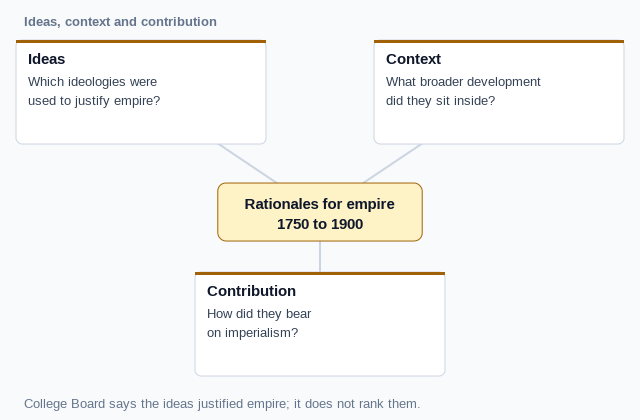
In short. From 1750 to 1900, a range of cultural, religious and racial ideologies were used to justify imperialism, as industrializing states expanded their empires.
- The ideologies named include Social Darwinism, nationalism, the concept of the civilizing mission and the desire to religiously convert indigenous populations.
- The statement says these ideas were used to justify imperialism. It does not rank them or say how far each one drove expansion.
- Their broader context is industrializing states expanding existing overseas empires and establishing new colonies and transoceanic relationships.
Part 2 Learn it Ideas that justified empire
6.1a. A range of ideas, used to justify
Between 1750 and 1900, states that ruled other peoples gave reasons for doing so. This topic's statement reads: A range of cultural, religious, and racial ideologies were used to justify imperialism, including Social Darwinism, nationalism, the concept of the civilizing mission, and the desire to religiously convert indigenous populations.
Three words carry it. Range says more than one idea was at work. Justify says what the ideas did: they were reasons given for imperialism. Including opens a list of four and marks it as a selection from that range, not a full count.
The statement sorts the ideas into three kinds, cultural, religious and racial, but it does not assign each named ideology to a kind, and this page does not either.
Quick check · Select all
Which two of these does this topic's statement name among the ideologies used to justify imperialism? Pick two.
Select 2 answers, then check.
6.1b. Hearing an ideology in a source
A source rarely labels its own ideology. You hear it in what the writer claims.
- Nationalism. 5.2 Nationalism and Revolutions in the Period from 1750 to 1900 ties it to a new sense of commonality based on language, religion, social customs and territory. Listen for pride in the nation and its standing.
- The civilizing mission. The phrase says it: a claim that rule brings civilization to the ruled.
- The desire to religiously convert indigenous populations. A call to bring a faith to the peoples already living in a ruled land.
College Board gives no gloss for Social Darwinism, so match it only where a source names it or a question gives its meaning.
One source can carry two ideas. A sermon that calls the conversion of a colony's people "our nation's duty" leans on the desire to convert and on nationalism together.
Quick check · Select all
A newspaper editorial written for this page reads: "Our nation must stand first among nations. Where our rule goes, we bring civilization to peoples who lack it." Which two ideologies named in this topic's statement does the editorial best reflect? Pick two.
Select 2 answers, then check.
6.1c. The wider story the ideas sat in
This topic's skill is explaining how a specific development is situated within a broader historical context. Here the specific development is the use of these ideologies. A broader one comes from the unit's key concepts: as states industrialized, they also expanded existing overseas empires and established new colonies and transoceanic relationships. The ideologies were reasons given for that expansion.
A context must be broader than what it explains, and it must bear on it. "Imperialism was justified with nationalism" restates the development. "Industrializing states expanded their empires, and ideologies were used to justify that expansion" places it.
Nationalism also has an older frame. In 5.1 The Enlightenment, nationalism became a major force shaping the historical development of states and empires, so its use here continues a force already at work.
Quick check · Multiple choice
Which development, from this unit's key concepts, best situates the use of these ideologies within a broader historical context?
Part 3 Watch it done Placing the civilizing mission
Watch the first steps, then take the last one yourself.
Explain how the use of the civilizing mission to justify imperialism is situated within a broader historical context, from 1750 to 1900.
Step 1 · Name the specific development
The civilizing mission is one of the ideologies the statement says were used to justify imperialism. Its use as a justification is the development to place.
Step 2 · Find a broader development it bears on
Look across the unit for something larger. The key concept on states fits: as states industrialized, they also expanded existing overseas empires and established new colonies. The civilizing mission was one of the reasons given for that expansion.
Why this step?
Why is "Writers of this period praised the civilizing mission" not a context?
It is still about the idea itself, so it restates the development. A context has to be a broader development that the idea's use sits inside.
Your step · Decide and justify
Finish it. Which sentence explains how the use of the civilizing mission is situated within that broader context?
What makes it explain how?
Part 4 Try it Context for a fair song
A song written for this page, as if sold at a city fair in an industrializing country in the 1890s:
> Our ships go out, our nation grows, > From coast to coast our banner flows; > We bring our schools, we bring our laws, > To lands that need our noble cause.
A class was asked to place the song in a broader historical context. Five students each wrote one sentence.
Try it · Sort it
Sort each student sentence by whether it places the song inside a broader development of its time.
Places the song inside a broader development of its time
Does not give a context
Part 5 Explain it Ideologies and empire, from two documents
This is a self-check. Nothing you type leaves this page. Set your answer beside the model and each scoring point.
Free-response practice · Question 1 style
A short practice in the shape of the document-based question: a thesis, one sentence of context and one paragraph that uses both documents and explains the purpose or audience of one, instead of a full essay. Both documents are written for this page and are not real.
Document 1: the fair song from Try it.
Document 2: a letter from a teacher at a mission school in a colony to the missionary society that pays for the school, 1880s: "Each Sunday more children come to our chapel. Send us more Bibles and more teachers, and this land will be won for our faith."
Using both documents, explain how ideologies contributed to the development of imperialism in the period from 1750 to 1900.
Model answer
Thesis: Ideologies contributed to imperialism by justifying it, as nationalism, the civilizing mission and the desire to religiously convert indigenous populations gave people in industrializing states reasons to accept the rule of other lands.
Context: As states industrialized in this period, they also expanded existing overseas empires and established new colonies, and the ideas in these documents were offered as reasons for that expansion.
Document 1 joins two ideologies. Its pride in a nation that "grows" reflects nationalism, and its claim to bring "our schools" and "our laws" to "lands that need" them reflects the concept of the civilizing mission. Sold at a fair at home, it presents expansion as something ordinary people should cheer. Document 2 shows the desire to religiously convert indigenous populations: the teacher counts success in children coming to chapel and in a land "won for our faith." Its audience matters. The teacher writes to the society that pays for the school and asks for more Bibles and teachers, so the letter has reason to stress success, and it shows what the writer wanted the funders to believe more surely than how many people converted. Together the documents show ideologies used to justify imperialism, both to the public at home and to those who paid for work in the colonies.
Score your own answer. This is a self-check, not a grade. Tick each point your answer makes.
Part 6 Check yourself Reading four cases for empire
The table drives the first two questions. The last two come from the rest of the lesson.
Four short sources from one industrializing country in the 1880s. All four were written for this lesson and are not real.
| Source | Written for | Its words |
|---|---|---|
| 1. A missionary society's yearly report | The society's members | "Our teachers have opened three new schools, where children learn our faith." |
| 2. A newspaper editorial | The paper's readers | "No great nation can stand aside while its rivals take the world." |
| 3. A governor's speech in a colony | Officials and local leaders | "We bring roads, laws and schools to peoples we must raise to our own way of life." |
| 4. A petition from factory owners | The national parliament | "Our mills need cotton and rubber, and new colonies can supply them." |
Case question 1 · Fill the statement
Complete the sentence about Sources 3 and 4.
Source 3 reflects , and Source is the one whose case for empire is economic, outside the statement's cultural, religious and racial kinds.
Case question 2 · Spot the error
A student wrote this summary of the table. Which line goes wrong?
The rest stand on their own and do not use the case.
Check yourself · Multiple choice
An appeal written for this page, from a missionary society in an industrialized state, asks its members for money "to bring our faith to the peoples of the lands our country now rules." Which ideology named in this topic's statement does the appeal best reflect?
Check yourself · Select all
Nationalism is one of the ideologies this topic names. Which two statements from Unit 5 best place nationalism within a broader historical context? Pick two.
Select 2 answers, then check.
Part 7 Keep it Bring back earlier ideas
One question from the Unit 5 review just before this lesson, and one from the lesson on responses to industrialization three back.
From 5.10 Continuity and Change in the Industrial Age · Multiple choice
The review says the 18th century marked the beginning of an intense period of revolution and rebellion against existing governments. Which other statement in the review describes something that often came before such revolutions?
From 5.8 Reactions to the Industrial Economy from 1750 to 1900 · Multiple choice
According to this topic, what were some governments in Asia and Africa, including the Ottoman Empire and Qing China, responding to when they sought to reform and modernize their economies and militaries?
In three lines
- A range of cultural, religious and racial ideologies were used to justify imperialism from 1750 to 1900.
- They included Social Darwinism, nationalism, the concept of the civilizing mission and the desire to religiously convert indigenous populations.
- Their context is industrializing states expanding existing overseas empires and establishing new colonies.
Exam strategy for this topic
- Section I Part A, Multiple Choice: 55 questions in 55 minutes.
- Section I Part B, Short Answer: 3 questions in 40 minutes.
- Section II, Document-Based Question and Long Essay: 2 questions in 100 minutes.
- This lesson's Explain it is shaped like free-response question 1, Document-based.
When a question asks you to situate a development in a broader context, name the larger development first, then say how the specific one bears on it, such as an idea used to justify an expansion. A same-years tie or a restatement of the source does not do that.
Questions students ask
Are the four named ideologies the only ones?
The statement says a range of ideologies were used, including the four it names, so they are examples from that range, not a full count.
What is Social Darwinism?
College Board names it in the list of ideologies used to justify imperialism but gives no definition, so this lesson matches it only where a source or a question names it.
Why does nationalism appear in Unit 5 and again here?
In 5.1 The Enlightenment, nationalism became a major force shaping the historical development of states and empires. In this topic it is one of the ideologies used to justify imperialism, so the earlier development is part of its context.
Does the statement say who held these ideas?
No. It says the ideologies were used to justify imperialism and names no group that held them. A single source can show who used one, through its author and audience.
Where do economic reasons for empire come in?
This topic's statement is about cultural, religious and racial ideologies. The need for raw materials appears in 6.4 Global Economic Development from 1750 to 1900, and economic imperialism in 6.5 Economic Imperialism from 1750 to 1900.
Course alignment, for teachers
AP World History: Modern topic 6.1, Unit 6: Consequences of Industrialization.
- Skill 4.B: Explain how a specific historical development or process is situated within a broader historical context.
This lesson maps the one essential knowledge statement of the topic, and the one learning objective with none of its own, to the part that teaches each one: 2 are checked by a scored question. The map is in the lesson file.