Unit 5 · Topic 5.4 · about 30 minutes · 7 parts · 9 scored checks, 2 of them multiple choice, plus 2 from earlier lessons
AP World History: Modern 5.4: Industrialization Spreads in the Period from 1750 to 1900
Unit 5: 12 to 15% of the multiple-choice section
What you'll be able to do
- Explain how different modes and locations of production have developed and changed over time.
Key vocabulary
| Term | What it means | The exam trap |
|---|---|---|
| Share of global manufacturing | In the general meaning, the part of everything the world manufactured that one region or group of countries produced. | A share compares one group with the world total, so read which countries a stem puts on each side before judging a rise or a fall. |
| Steam-powered production | Making goods with machines driven by steam engines. | The statement says steam-powered production developed rapidly in European countries and the U.S.; it does not say where steam power was invented. |
| First Industrial Revolution | The first stage of industrialization, the period of this topic's statement on manufacturing. | 5.5 Technology of the Industrial Age has a second industrial revolution in the second half of the 19th century, so check which one a stem names. |
| Mode of production | In the general meaning, a way goods are made, such as by hand in workshops or by machines in factories. | The objective pairs modes with locations, so a full answer says how goods were made as well as where. |
 Tap to open the picture full size
Part 1 Think first Workshops and mills
Commit to a guess before you read. A wrong guess now still helps the right idea stick.
Predict first
In the 1800s, textile workshops in India were still at work, while steam-powered mills spread in Europe and the United States. What do you expect happened to the place of countries like India in the world's manufacturing?
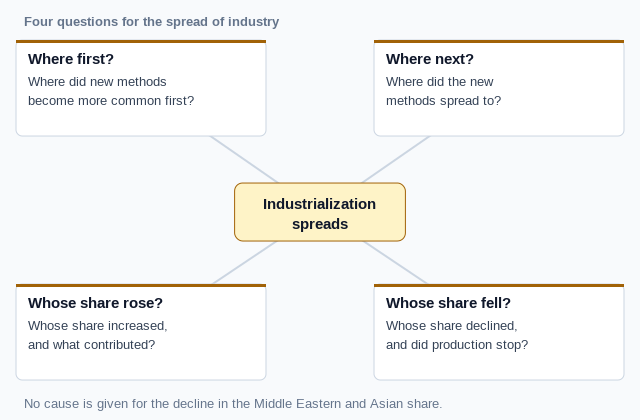
In short. New methods of industrial production became more common in parts of northwestern Europe and spread to other parts of Europe, the United States, Russia and Japan, and steam-powered production raised the European and U.S. share of global manufacturing while Middle Eastern and Asian countries kept producing goods with a declining share.
- As new methods became more common in parts of northwestern Europe, they spread to other parts of Europe and the United States, Russia and Japan.
- The rapid development of steam-powered production in European countries and the U.S. contributed to an increase in their share of global manufacturing during the first Industrial Revolution.
- Middle Eastern and Asian countries continued to produce manufactured goods, but their share of global manufacturing declined.
Part 2 Learn it Where industry spread, and whose share changed
2a. Outward from northwestern Europe
The new methods of industrial production did not appear everywhere at once. The statement says that as new methods of industrial production became more common in parts of northwestern Europe, they spread to:
- other parts of Europe
- the United States
- Russia
- Japan
Notice parts of northwestern Europe. The statement names a region, not a single country, and it does not say which parts.
Spread is a pattern over time: a method becomes common in one place, then reaches others. Japan's own path comes back in 5.6 Industrialization: Government’s Role from 1750 to 1900.
Quick check · Select all
Which three does this topic name as places new methods of industrial production spread to? Pick three.
Select 3 answers, then check.
2b. A rising share
A share is a part of a whole. Here the whole is global manufacturing, everything the world made, and each region holds some share of it.
The statement: the rapid development of steam-powered industrial production in European countries and the U.S. contributed to the increase in these regions' share of global manufacturing during the first Industrial Revolution.
That sentence is a cause and an effect. The cause is steam-powered production developing rapidly. The effect is a bigger share of the world total for European countries and the U.S. Contributed to keeps it a contribution, not the only cause.
It also names a time: the first Industrial Revolution. A second one appears in 5.5 Technology of the Industrial Age.
Quick check · Select all
Which two give a cause and its effect as this topic states them? Pick two.
Select 2 answers, then check.
2c. A falling share, and production that went on
The same statement has a second half. While Middle Eastern and Asian countries continued to produce manufactured goods, these regions' share in global manufacturing declined.
Two things are true at once here. Production went on: that is a continuity. The share of the world total fell: that is a change. When one region's share rises, the shares held elsewhere make up less of the whole.
College Board's examples of the declining share:
- shipbuilding in India and Southeast Asia
- iron works in India
- textile production in India and Egypt
The statement names steam power as a contributor to the rise in the European and U.S. share. It gives no cause for the decline of its own.
Quick check · Select all
Where does the Middle Eastern and Asian share of global manufacturing fit in a pattern of continuity or change? Pick two.
Select 2 answers, then check.
Part 3 Watch it done Place an example in a pattern
Watch the first steps, then take the last one yourself.
One of the questions College Board gives for this topic's skill: "Where does the development or process fit into a pattern of continuity or change over time?"
Apply it to textile production in India, one of College Board's examples of the declining Middle Eastern and Asian share.
Predict first
Before the steps: where does textile production in India fit?
Step 1 · Gather what the statement gives
Textile production in India is an example of the declining Middle Eastern and Asian share of global manufacturing. The statement says those countries continued to produce manufactured goods while their share declined.
Step 2 · Sort each part into continuity or change
Continued to produce: production went on, a continuity. Share declined: the region's part of the world total shrank, a change. So the example holds a continuity and a change at once.
Why this step?
Why can one example hold both?
Continuity and change here describe two different features of it: what kept happening, the making of goods, and what shifted, the region's place in the world total.
Your step · Decide and justify
Finish it with another of College Board's examples. A student writes: "Shipbuilding in Southeast Asia shows only change, because the region's share of global manufacturing declined." Is that a full account of where the example fits?
Why?
Part 4 Try it An official's letter
A letter written for this page in the voice of an official in Japan, from this topic's statements and one from 5.6 Industrialization: Government’s Role from 1750 to 1900. It is not a real document.
"The new ways of making goods were common first in parts of northwestern Europe. They have since reached other parts of Europe, the United States and Russia, and now they have reached us. Our government's reforms are meant to help them take root here."
Try it · Fill the statement
Name the pattern the letter shows and what it connects that pattern with.
The letter shows a pattern of , and it connects that pattern in Japan with .
Part 5 Explain it Locations of production, in writing
This is a self-check. Nothing you type leaves this page. Compare your answer with the model and each scoring point.
Free-response practice · Question 2 style
A short practice in the shape of the long essay question: a thesis, one sentence of context and one paragraph of evidence instead of a full essay.
Explain how the locations of industrial production changed in the period from 1750 to 1900.
Model answer
Thesis: Industrial production spread from parts of northwestern Europe to other regions, and steam-powered production shifted shares of global manufacturing toward European countries and the U.S., even though Middle Eastern and Asian countries kept producing goods.
Context: The changing map of production was part of the Industrial Revolution, which grew out of a variety of factors, and several of those factors, such as proximity to waterways and the geographical distribution of coal, iron and timber, are about place.
As new methods of industrial production became more common in parts of northwestern Europe, they spread to other parts of Europe, the United States, Russia and Japan. The rapid development of steam-powered production in European countries and the U.S. contributed to an increase in their share of global manufacturing during the first Industrial Revolution. Middle Eastern and Asian countries continued to produce manufactured goods, such as textiles in India and Egypt and ships in India and Southeast Asia, but their share of global manufacturing declined. So the location of production changed in two ways: new methods reached new places, and the balance of the world's manufacturing moved, while older production went on.
Score your own answer. This is a self-check, not a grade. Tick each point your answer makes.
Part 6 Check yourself Where production went
Use the table for the first two questions. The last two cover the whole lesson.
A student's table of this topic's statements and examples.
| Row | Pattern | Places named |
|---|---|---|
| 1 | New methods became more common first | parts of northwestern Europe |
| 2 | New methods spread to | other parts of Europe, the United States, Russia, Japan |
| 3 | Share of global manufacturing increased, with steam-powered production contributing | European countries and the U.S. |
| 4 | Share of global manufacturing declined, while production continued | Middle Eastern and Asian countries; examples: shipbuilding in India and Southeast Asia, iron works in India, textile production in India and Egypt |
Case question 1 · Spot the error
A student wrote this paragraph from the table. Which line is the first to go wrong?
Case question 2 · Sort it
Sort each claim by what the table does with it.
The table supports it
The table contradicts it
The table does not say
The rest stand on their own and do not use the case.
Check yourself · Multiple choice
In this topic's statement, where did new methods of industrial production become more common before they spread to other places?
Check yourself · Multiple choice
A chart written for this page has two lines covering the first Industrial Revolution. Line 1 shows the share of global manufacturing held by European countries and the U.S.; Line 2 shows the share held by Middle Eastern and Asian countries. Which pattern matches this topic?
Part 7 Keep it Bring back earlier ideas
One question from the lesson on how the Industrial Revolution began and one from the Enlightenment lesson, so both come round again.
From 5.3 Industrial Revolution Begins · Multiple choice
According to this topic, what did the development of the factory system do to where production happened?
From 5.1 The Enlightenment · Select all
Which two statements match what this topic says about the context in which revolutions swept the Atlantic world? Pick two.
Select 2 answers, then check.
In three lines
- New methods of industrial production became more common in parts of northwestern Europe, then spread to other parts of Europe, the United States, Russia and Japan.
- Steam-powered production contributed to a rising European and U.S. share of global manufacturing during the first Industrial Revolution.
- Middle Eastern and Asian countries kept producing manufactured goods, but their share of global manufacturing declined.
Exam strategy for this topic
- Section I Part A, Multiple Choice: 55 questions in 55 minutes.
- Section I Part B, Short Answer: 3 questions in 40 minutes.
- Section II, Document-Based Question and Long Essay: 2 questions in 100 minutes.
- This lesson's Explain it is shaped like free-response question 2, Long essay.
For a continuity and change question, look for a development that holds both. Name what went on and what shifted, and say which is which, as with production that continued while a share declined.
Questions students ask
Did India and Egypt stop making manufactured goods?
No. The statement says Middle Eastern and Asian countries continued to produce manufactured goods. What declined was their share of global manufacturing, and College Board's examples include textile production in India and Egypt.
Why did the Middle Eastern and Asian share decline?
College Board does not give a cause for the decline itself. It says steam-powered production contributed to the rise in the European and U.S. share, and that the other share declined in the same period.
Which countries of northwestern Europe came first?
The statement says parts of northwestern Europe and names no country. Write it that way rather than adding a name College Board does not give.
How did the new methods reach Japan?
This topic says only that they spread there. 5.6 Industrialization: Government’s Role from 1750 to 1900 adds that the expansion of U.S. and European influence in Asia led to internal reform in Japan that supported industrialization.
What is the difference between a mode and a location of production?
A mode is how goods are made, such as steam-powered production; a location is where. The objective asks about both, and this topic's statements give both: steam power, and the places production spread to or declined in.
Course alignment, for teachers
AP World History: Modern topic 5.4, Unit 5: Revolutions.
- Skill 5.A: Identify patterns among or connections between historical developments and processes.
This lesson maps all 2 essential knowledge statements of the topic, and the one learning objective with none of its own, to the part that teaches each one: 3 are checked by a scored question. The map is in the lesson file.