Unit 4 · Topic 4.8 · about 30 minutes · 7 parts · 10 scored checks, 2 of them multiple choice, plus 2 from earlier lessons
AP World History: Modern 4.8: Continuity and Change from 1450 to 1750
Unit 4: 12 to 15% of the multiple-choice section
What you'll be able to do
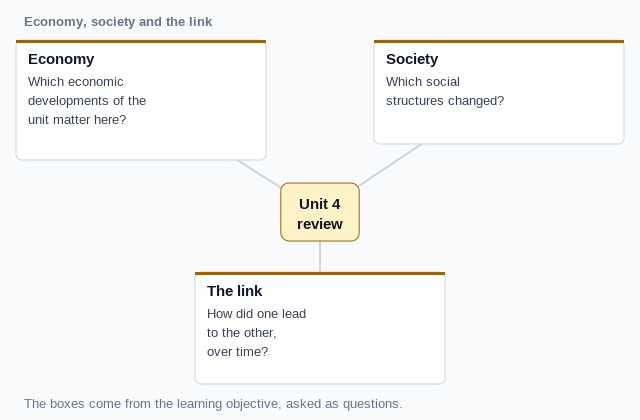
- Explain how economic developments from 1450 to 1750 affected social structures over time.
Key vocabulary
| Term | What it means | The exam trap |
|---|---|---|
| Productive systems | The ways a society makes its food and goods. | Productive systems covers both farming and manufacturing. Read which of the two a choice is about before you judge it. |
| Raw materials | Materials in their natural state, used to make goods. | Raw materials are not finished goods. A choice that calls cloth or tools raw materials has the pair the wrong way round. |
| Social structure | The way a society's groups are arranged and ranked. | A change in social structure can be about population, families or elites. Read which group a choice says was rearranged. |
| Interconnection | A joining of places so that people, goods and ideas move between them. | Here it means the Eastern and Western Hemispheres joined. It is not the older trade within Afro-Eurasia from Unit 2. |
| Intensify | To become stronger or greater. | Something that intensified may already have existed. Do not read intensified as began. |
 Tap to open the picture full size
Part 1 Think first What changed the most?
Commit to a guess before you read. A wrong guess now still helps the right idea stick.
Predict first
Ocean voyages join the hemispheres, trade grows and new plantations spread. Across the whole world, how do you expect most people's work changed?
In short. The unit's review joins three threads: ocean voyaging connected the hemispheres and transformed trade, demand for labor reshaped how people worked, and empires grew in scope while shaping and being shaped by their peoples.
- The interconnection of the Eastern and Western Hemispheres, made possible by transoceanic voyaging, transformed trade and had a significant social impact; knowledge spread from the Classical, Islamic and Asian worlds facilitated the developments that made that voyaging possible.
- Although productive systems continued to be heavily centered on agriculture, major changes occurred; the demand for labor intensified, plantations expanded, and the Atlantic slave trade developed and intensified.
- Empires achieved increased scope and influence, shaping and being shaped by the diverse populations they incorporated, and economic disputes led to rivalries and conflict between states.
Part 2 Learn it The unit in three statements
4.8a. Connection and its roots
The review opens with the unit's frame. The interconnection of the Eastern and Western Hemispheres, made possible by transoceanic voyaging, transformed trade and had a significant social impact on the world. Two effects sit in that sentence, on trade and on society, and one enabler: voyaging.
It then returns to 4.1 Technological Innovations from 1450 to 1750. Knowledge, scientific learning, and technology from the Classical, Islamic, and Asian worlds spread, facilitating European technological developments and innovation. The developments included the production of new tools, innovations in ship designs, and an improved understanding of regional wind and currents patterns, all of which made transoceanic travel and trade possible.
Read those three sentences as a chain. Knowledge spread; the spread facilitated European developments; the developments made ocean travel possible; ocean voyaging made the interconnection possible. Facilitating and made possible are enabling words. They say each step opened the way for the next, not that it forced it.
Quick check · Select all
The review says the interconnection of the Eastern and Western Hemispheres, made possible by transoceanic voyaging, had a significant social impact on the world. Which two pieces of evidence from this unit support that part of the statement? Pick two.
Select 2 answers, then check.
4.8b. Work and production
Although the world's productive systems continued to be heavily centered on agriculture, major changes occurred in agricultural labor, the systems and locations of manufacturing, gender and social structures, and environmental processes. Although sets a continuity against a list of changes. Heavily centered means farming stayed at the core.
The labor statement says why work changed. The demand for labor intensified as a result of the growing global demand for raw materials and finished products. Traditional peasant agriculture increased and changed in nature, plantations expanded, and the Atlantic slave trade developed and intensified.
The first sentence gives a cause and its effect. The second lists three things that happened, and the statement does not rank them. Notice developed and intensified: the slave trade grew in this period, and the review does not say it began here.
Quick check · Select all
Which two belong in this unit's review statement on labor from 1450 to 1750? Pick two.
Select 2 answers, then check.
4.8c. Empires, rivals and reasoning
Empires achieved increased scope and influence around the world, shaping and being shaped by the diverse populations they incorporated. The phrase runs both ways: empires acted on their peoples, and their peoples acted on them. The review gives no example of either direction, so an argument has to bring its own evidence from earlier topics.
And from 4.5 Maritime Empires Maintained and Developed: economic disputes led to rivalries and conflict between states.
This topic's skill is using historical reasoning to explain relationships among pieces of evidence. Three relationships do most of the work. One piece can cause another. One can continue despite another, or change because of it. Or two pieces can be alike or different, a comparison. Name the relationship in your own sentence, with a word such as led to, despite or like, rather than setting two facts side by side and leaving the link unsaid.
Quick check · Multiple choice
This unit's review says empires achieved increased scope and influence, "shaping and being shaped by the diverse populations they incorporated." Which piece of evidence from this unit could best support an argument that states were shaped by the populations they ruled?
Part 3 Watch it done Choosing how to organize an answer
Watch the first steps, then take the last one yourself.
College Board's sample activity for this topic gives this prompt, for the period from 1450 to 1750: "Develop an argument that explains how economic developments led to changes in social structures." It asks students to decide which historical reasoning process is best for organizing a response. Decide between causation and comparison.
Step 1 · Read what the prompt asks for
The key words are led to. The prompt wants economic developments on one side, changes in social structures on the other, and an explanation of how the first produced the second.
Step 2 · Test it with evidence
From 4.4 Maritime Empires Established: the growth of the plantation economy increased the demand for enslaved labor in the Americas, leading to significant demographic, social and cultural changes. That is an economic development leading to a social one, the shape the prompt asks for.
Why this step?
This topic's reasoning process in College Board's table is continuity and change. Why is the choice here still between causation and comparison?
Continuity and change could organize it too, by setting what changed in social structures against what stayed. The activity asks students to decide, so this step tests the prompt's "led to" against two of the processes.
Your step · Decide and justify
Finish it. Which of the two better organizes a response to this prompt?
Why does it fit better?
Part 4 Try it What each sentence links
A paragraph written for this page, as a student's draft for the review:
> (1) The growing global demand for raw materials and finished products intensified the demand for labor. (2) Existing trade networks in the Indian Ocean continued to flourish, despite some disruption from the arrival of European merchants. (3) Peasant and artisan labor intensified in India with cotton, much as it did in China with silk. (4) The establishment of Maroon societies in the Caribbean and Brazil was one case of organized resistance by enslaved persons in the Americas.
Each sentence joins two pieces of evidence. Match it to the relationship it draws.
Try it · Match
Match each sentence of the draft to the relationship it draws between its two pieces of evidence.
Part 5 Explain it Economic change, social change
This is a self-check. Nothing you type leaves this page. Compare your answer with the model and each scoring point.
Free-response practice · Question 2 style
This is a partial long essay. Write a thesis, one sentence of context and one paragraph of evidence, not a full essay.
In the period c. 1450 to c. 1750, the world's economies were transformed by new connections.
Develop an argument that explains how economic developments led to changes in social structures in the period c. 1450 to c. 1750.
Model answer
Thesis: Economic developments changed social structures mainly through labor: growing global demand for raw materials and finished products intensified the demand for labor, and the plantation economy and the Atlantic slave trade that grew with it brought demographic and social changes on both sides of the Atlantic.
Context: The interconnection of the Eastern and Western Hemispheres, made possible by transoceanic voyaging, transformed trade in this period, and the labor and trade developments of this period took place within that transformed trade.
The demand for labor intensified as a result of the growing global demand for raw materials and finished products, and plantations expanded while the Atlantic slave trade developed and intensified. In the Americas, the growth of the plantation economy increased the demand for enslaved labor, leading to significant demographic, social and cultural changes. In Africa, the trade of enslaved persons brought demographic changes, part of some notable gender and family restructuring. Widening global economic opportunities also contributed to new political and economic elites, as with the rise of the Casta system in the Americas. So the economic demand of this period reached into who worked, who was moved and who held status.
Score your own answer. This is a self-check, not a grade. Tick each point your answer makes.
Part 6 Check yourself Relating the review's evidence
The table drives the first two questions. The last three come from the rest of the lesson.
A student gathered evidence from the unit for a review essay. The table was written for this lesson and gives the pieces in no particular order, without saying how they relate.
| Row | Evidence |
|---|---|
| 1 | Transoceanic voyaging connected the Eastern and Western Hemispheres |
| 2 | Economic disputes between states |
| 3 | Knowledge, scientific learning and technology from the Classical, Islamic and Asian worlds spread |
| 4 | New tools, ship designs and an improved understanding of regional wind and currents patterns |
| 5 | The Moroccan conflict with the Songhai Empire |
Case question 1 · Put it in order
Rows 1, 3 and 4 belong to one chain in the review, with one more step at its end. Put the four steps in the order the review links them, first cause first.
Case question 2 · Fill the statement
Rows 2 and 5 are related too. Complete the sentence that relates them.
Row 5 is of the pattern in row 2: the review says disputes of that kind led to rivalries and between states.
The rest stand on their own and do not use the case.
Check yourself · Multiple choice
Which of these shows an economic development leading to a change in social structure, as this unit's statements give it?
Check yourself · Select all
Which two pieces of evidence from this unit show something that continued, rather than something new, from 1450 to 1750? Pick two.
Select 2 answers, then check.
Check yourself · Select all
Which three pairs show a cause and its effect as this unit's statements link them? Pick three.
Select 3 answers, then check.
Part 7 Keep it Bring back earlier ideas
One question from the social hierarchies lesson just before this one, and one from the Columbian Exchange lesson earlier in the unit.
From 4.7 Changing Social Hierarchies from 1450 to 1750 · Multiple choice
According to this topic, what contributed to the formation of new political and economic elites?
From 4.3 Columbian Exchange · Multiple choice
In this topic's statement on disease, what led to the transfer of disease vectors and the spread of diseases such as smallpox, measles and malaria?
In three lines
- Knowledge that spread from the Classical, Islamic and Asian worlds facilitated the developments that made transoceanic voyaging possible, and the interconnection it brought transformed trade and society.
- Productive systems stayed heavily centered on agriculture, while the demand for labor intensified, plantations expanded and the Atlantic slave trade grew.
- Empires grew in scope, shaping and being shaped by their peoples, and economic disputes led to rivalries and conflict between states.
Exam strategy for this topic
- Section I Part A, Multiple Choice: 55 questions in 55 minutes.
- Section I Part B, Short Answer: 3 questions in 40 minutes.
- Section II, Document-Based Question and Long Essay: 2 questions in 100 minutes.
- This lesson's Explain it is shaped like free-response question 2, Long essay.
When a prompt or question asks how pieces of evidence relate, name the relationship in a word: led to, despite, or like. Then check that the link is one the evidence supports, not just two true facts placed next to each other.
Questions students ask
Why does this topic repeat statements from earlier topics?
It is the unit's review. College Board lists it as the Unit 4 key concepts, so it gathers broad statements and some of the earlier topics' own, such as the spread of knowledge from 4.1 Technological Innovations from 1450 to 1750 and economic disputes from 4.5 Maritime Empires Maintained and Developed.
Which reasoning process fits the sample prompt?
College Board leaves that for students to decide. Its prompt asks how economic developments led to changes in social structures, which causation organizes well. The topic's own reasoning process, continuity and change, would organize it by setting what changed in social structures against what stayed.
Did agriculture stop being the center of the economy?
No. The review says productive systems continued to be heavily centered on agriculture, although major changes occurred in labor, manufacturing, gender and social structures, and environmental processes.
What does "shaping and being shaped" mean?
That empires acted on the diverse populations they incorporated and were acted on by them. The review gives no example, so an argument has to bring evidence from earlier topics and say how it shows either direction.
Did the Atlantic slave trade begin in this period?
The review says it developed and intensified in this period. It does not say when it began.
Course alignment, for teachers
AP World History: Modern topic 4.8, Unit 4: Transoceanic Interconnections.
- Skill 6.C: Use historical reasoning to explain relationships among pieces of historical evidence.
This lesson maps all 7 essential knowledge statements of the topic, and the one learning objective with none of its own, to the part that teaches each one: 8 are checked by a scored question. The map is in the lesson file.