Unit 7 · Topic 7.1 · about 30 minutes · 7 parts · 9 scored checks, 2 of them multiple choice, plus 2 from earlier lessons
AP World History: Modern 7.1: Shifting Power After 1900
Unit 7: 8 to 10% of the multiple-choice section
What you'll be able to do
- Explain how factors from inside and outside states contributed to change in various states after 1900.
Key vocabulary
| Term | What it means | The exam trap |
|---|---|---|
| Global political order | The way power is arranged among the states of the world. | It is about power among states, not the order in which events happened, so do not read it as a timeline. |
| Land-based empire | An empire whose territory is mostly one connected stretch of land. This is a plain meaning, not College Board's. | Land-based describes how an empire's territory lies, not how large the empire is or how strong its army was. |
| Maritime empire | An empire whose territories are reached by sea. This is a plain meaning, not College Board's. | An empire with a long coast is not maritime for that reason; the word describes territories reached across the sea. |
| Internal and external factors | Causes that come from inside a state, and causes that come from outside it. | The words sort causes by where they come from, not by how much they mattered, so a factor is not internal because it was the biggest. |
| Political crisis | A breakdown in how a state is governed. This is a plain meaning, not College Board's. | A crisis is a condition a state is in, not a single event such as a battle or a treaty. |
 Tap to open the picture full size
Part 1 Think first A map of empires, drawn in 1900
Commit to a guess before you read. A wrong guess now still helps the right idea stick.
Predict first
It is 1900. A mapmaker draws every empire of the day and plans to sell the same map for the next hundred years. How well will the map hold up?
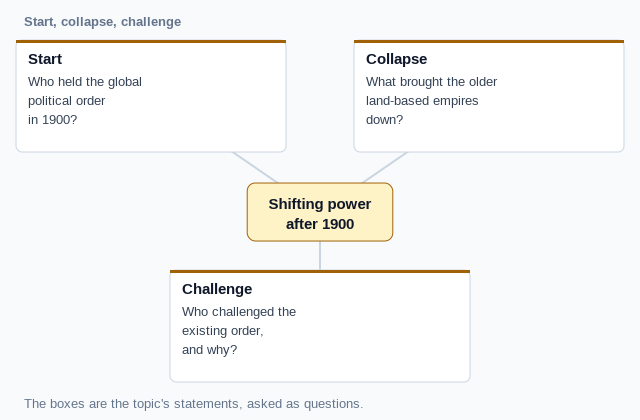
In short. After 1900 the global political order shifted: the West dominated it at the beginning of the 20th century, but both land-based and maritime empires gave way to new states by the century's end.
- The older, land-based Ottoman, Russian, and Qing empires collapsed due to a combination of internal and external factors, and the changes in Russia eventually led to communist revolution.
- States around the world challenged the existing political and social order, including the Mexican Revolution that arose as a result of political crisis.
- Context places one development inside a wider process, such as one empire's fall inside the giving way of empires across the century.
Part 2 Learn it How power shifted
2a. Two snapshots of one century
Picture the world's power in two snapshots taken a century apart.
At the beginning of the 20th century, the West dominated the global political order. By the century's end, both land-based and maritime empires gave way to new states.
The word but joins the two snapshots in one statement, and the change between them is what this topic is about. Notice both. Land-based empires, whose territory was mostly one connected stretch of land, did not give way alone. Maritime empires, whose territories were reached by sea, gave way too. Those two meanings are plain ones, not College Board's.
The statement gives the start, the end and the direction of the change. It does not say how quickly each empire gave way or what each new state was like, and this page adds neither.
Quick check · Multiple choice
According to this topic, which describes the global political order at the beginning of the 20th century?
2b. Three older empires collapse
A second statement narrows the view to three older, land-based empires: the Ottoman, the Russian and the Qing. They collapsed due to a combination of internal and external factors.
An internal factor comes from inside a state, from its own rulers, officials or people. An external factor comes from outside it, from other states and their armies, for instance. A combination means the two kinds worked together, so a full explanation names one of each.
One more sentence follows, about Russia alone: these changes in Russia eventually led to communist revolution. Eventually marks time passing between the changes and the revolution.
The theme behind the topic puts the idea more widely: a variety of internal and external factors contribute to state formation, expansion, and decline. Neither line says which factors were internal or external for each empire.
Quick check · Select all
Which two describe the collapse of the Ottoman, Russian, and Qing empires as this topic describes it? Pick two.
Select 2 answers, then check.
2c. Challenges to the existing order
The third statement widens the view again. States around the world challenged the existing political and social order, and it names one case: the Mexican Revolution, which arose as a result of political crisis.
Two phrases carry the meaning.
Including marks the Mexican Revolution as one example of a wider pattern, not the only challenge there was.
Political crisis is a breakdown in how a state is governed (a plain meaning, not College Board's), and the statement gives it as what the revolution arose from.
The topic gives no other example and no detail of the revolution's course, so this page adds none.
Quick check · Multiple choice
According to this topic, the Mexican Revolution arose as a result of what?
Part 3 Watch it done Place one collapse in a wider setting
Watch the first steps, then take the last one yourself.
The prompt: "Explain how the collapse of the Russian empire is situated within a broader historical context."
A student has this lesson's statements as notes. Build the context in steps.
Step 1 · Name the specific development
The development is the collapse of the Russian empire, one of the three older, land-based empires that collapsed due to a combination of internal and external factors.
Step 2 · Find a process wider than the event
The notes hold two wider processes. The other older empires, the Ottoman and the Qing, collapsed too. And across the whole century, land-based and maritime empires alike gave way to new states. The second is the wider of the two, so it frames the event best.
Why this step?
Why not use the communist revolution as the context?
The changes in Russia eventually led to the revolution, so it comes after the development as a result. Context reaches out to a wider pattern the development sits inside; a result reaches forward from it.
Your step · Decide and justify
Finish it. The student writes: "Russia's collapse was one case of a change that ran through the whole century, as empires on land and empires reached by sea alike gave way to new states." Does the sentence situate the collapse within a broader historical context?
Why?
Part 4 Try it An imagined empire's last years
An imagined empire, written for this page. It is not a real place. Six events from its last years are below, and each one is a factor in its fall.
Try it · Sort it
Sort each event in the imagined empire's last years by the kind of factor it is.
Internal factor
External factor
Part 5 Explain it Internal and external factors, from documents
This is a self-check. Nothing you type leaves this page. Compare your answer with the model, line by line, and with each scoring point.
Free-response practice · Question 1 style
A short practice in the shape of the document-based question: a thesis, one sentence of context and one paragraph that uses both documents and explains the sourcing of one, instead of a full essay. Both documents are written for this page and describe the imagined empire from Try it.
Document 1: a provincial governor's letter to the court: "No tax money has left this province since the old emperor died. The people here obey whichever prince's army is nearest."
Document 2: a notice the ministers posted in the capital: "By the treaty signed after our defeat, the coastal ports pass to the allied powers. Let no subject blame the court for this peace."
Using both documents and what you know from this topic, explain how internal and external factors contributed to change in states after 1900.
Model answer
Thesis: After 1900, internal and external factors worked together to change older states, as when the Ottoman, Russian and Qing empires collapsed due to a combination of the two, and the documents show both kinds at work in one imagined empire.
Context: Before 1900, industrializing states had enlarged the overseas empires they already held and set up new colonies, and the West entered the 20th century dominating the global political order inside which the older land-based empires collapsed.
Document 1 shows internal factors: the governor reports that tax money no longer reaches the capital and that people obey rival princes' armies, so the empire's own rule was breaking down. Document 2 shows an external factor: a lost war ends in a treaty that hands the coastal ports to other powers. The ministers' purpose matters here. They post the notice for the empire's own subjects and tell them not to blame the court, so they present the loss as the work of outside powers and say nothing of the troubles the governor reports. Read together, the documents show the pattern of the older empires: a combination of internal and external factors, not one kind alone. In Russia such changes went further, since they eventually led to communist revolution.
Score your own answer. This is a self-check, not a grade. Tick each point your answer makes.
Part 6 Check yourself One imagined empire, start to finish
Use the table for the first two questions. The last two cover the whole lesson.
A second imagined empire, written for this page. It is not a real place, and it is not the empire from Try it.
| Stage | What happens |
|---|---|
| Early in the century | Officials at court quarrel over who will rule, and peasants in several provinces rise against heavy taxes. |
| The middle years | After a defeat, a treaty gives the empire's frontier lands to the armies of rival states. |
| By the century's end | The empire is gone, and new states rule the lands it once held. |
Case question 1 · Fill the statement
Complete a student's reading of the table.
Pressure from outside the empire shows in , and the change the topic's first statement describes shows in .
Case question 2 · Spot the error
A student wrote this paragraph about the table. Which line is the first to go wrong?
The rest stand on their own and do not use the case.
Check yourself · Select all
Which two does this topic say about the older, land-based empires? Pick two.
Select 2 answers, then check.
Check yourself · Select all
A student is writing about the collapse of one of the older, land-based empires after 1900. Which two developments from this topic could best situate that collapse within a broader historical process? Pick two.
Select 2 answers, then check.
Part 7 Keep it Bring back earlier ideas
One question from the review of Unit 6 and one from the lesson on economic imperialism, so both come round again.
From 6.8 Causation in the Imperial Age · Select all
A student argues that the period from 1750 to 1900 brought little challenge to existing governments. Which two statements from this unit could best be used to modify the argument? Pick two.
Select 2 answers, then check.
From 6.5 Economic Imperialism from 1750 to 1900 · Select all
This topic says trade in some commodities was organized in a way that gave certain merchants and companies a distinct economic advantage. Which two places does it name as where those merchants and companies were based? Pick two.
Select 2 answers, then check.
In three lines
- The West dominated the global political order at the start of the 20th century, but land-based and maritime empires gave way to new states by its end.
- The Ottoman, Russian, and Qing empires collapsed from internal and external factors combined, and the changes in Russia eventually led to communist revolution.
- States around the world challenged the existing order, including the Mexican Revolution, which arose from political crisis.
Exam strategy for this topic
- Section I Part A, Multiple Choice: 55 questions in 55 minutes.
- Section I Part B, Short Answer: 3 questions in 40 minutes.
- Section II, Document-Based Question and Long Essay: 2 questions in 100 minutes.
- This lesson's Explain it is shaped like free-response question 1, Document-based.
When a prompt asks how internal and external factors contributed, name at least one of each, say which is which, and show them working together. For context, reach for a process wider than the event and say how the event fits inside it.
Questions students ask
Does College Board say which factors were internal and which external for each empire?
No. It says the Ottoman, Russian, and Qing empires collapsed due to a combination of internal and external factors and lists none of them. If you name one in an essay, say which kind you are calling it.
What did the changes in Russia lead to?
The statement says these changes in Russia eventually led to communist revolution. It gives no date and no detail of the revolution itself.
Did maritime empires give way too, or only land-based ones?
Both. The first statement says both land-based and maritime empires gave way to new states by the century's end. The three older empires it names are land-based ones.
Was the Mexican Revolution the only challenge to the existing order?
The statement says states around the world challenged the existing political and social order, including the Mexican Revolution. Including marks it as one example, and the topic names no other.
How is context different from a cause?
A cause says why a development happened. Context places the development inside a broader process and says how the two are related, such as one empire's collapse inside the giving way of empires across the century.
Course alignment, for teachers
AP World History: Modern topic 7.1, Unit 7: Global Conflict.
- Skill 4.B: Explain how a specific historical development or process is situated within a broader historical context.
This lesson maps all 3 essential knowledge statements of the topic, and the one learning objective with none of its own, to the part that teaches each one: 4 are checked by a scored question. The map is in the lesson file.