Unit 9 · Topic 9.2 · about 30 minutes · 7 parts · 9 scored checks, 2 of them multiple choice, plus 2 from earlier lessons
AP World History: Modern 9.2: Technological Advances and Limitations After 1900: Disease
Unit 9: 8 to 10% of the multiple-choice section
What you'll be able to do
- Explain how environmental factors affected human populations over time.
Key vocabulary
| Term | What it means | The exam trap |
|---|---|---|
| Persisted | Carried on; went on existing. | Persisted is a word of continuity. Read whether a choice keeps the disease going or quietly ends it. |
| Epidemic | An outbreak of disease that spreads widely among people at one time. | Epidemic says how a disease spread, not what caused it. A choice can call an outbreak an epidemic and still say nothing about poverty or age. |
| Incidence | How often a disease occurs in a population. | Higher incidence is a count of cases. It is not, on its own, a claim that a disease grew more deadly. |
| Longevity | Length of life. | Longevity is years lived, not a measure of health or wealth. Read it as how long people live. |
| Social disruption | Upset to how a society normally runs; the topic gives the phrase without examples, so this is its plain meaning. | The disruption is to society, not to the disease. It names what happened to people's lives, not how the illness spread. |
 Tap to open the picture full size
Part 1 Think first A doctor's list, a century apart
Make a guess before you read. A wrong guess still helps the right idea stick.
Predict first
In 1900 a doctor in a large city writes down every disease she treated that year. A doctor in the same city does the same in 2000. How do you expect the second list to compare with the first?
In short. This topic is about what disease, and the medicine and science that answered it, did to populations around the world after 1900.
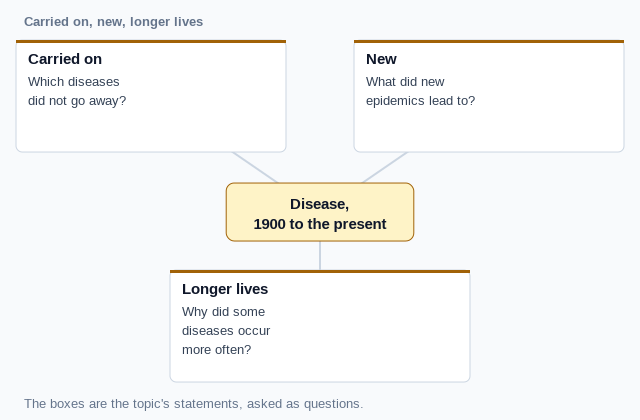
- Diseases associated with poverty persisted while other diseases emerged as new epidemics and threats to human populations, in some cases leading to social disruption.
- These outbreaks spurred technological and medical advances.
- Some diseases occurred at higher incidence merely because of increased longevity.
Part 2 Learn it Disease after 1900
9.2a. What carried on, and what was new
The topic opens wide: Diseases, as well as medical and scientific developments, had significant effects on populations around the world. Disease and the answers to it come as a pair.
Then it splits disease in two. Diseases associated with poverty persisted while other diseases emerged as new epidemics and threats to human populations.
Persisted is a continuity: these diseases carried on into the period. The topic's examples are malaria, tuberculosis and cholera. Emerged is a change: new epidemics appeared. Its examples are the 1918 influenza pandemic, Ebola and HIV/AIDS.
While holds the two halves together. Both were true at once, so a century of new medicine did not make the older diseases disappear.
Quick check · Select all
Which two does this topic say about disease after 1900? Pick two.
Select 2 answers, then check.
9.2b. Outbreaks and what followed
The same sentence says what the new epidemics led to: they were threats to human populations, in some cases leading to social disruption. Keep in some cases. It makes disruption a result some outbreaks had, not one every outbreak had.
The next sentence turns the story around: These outbreaks spurred technological and medical advances. Spurred means pushed forward. The outbreaks did not only harm; they also drove work on new technology and medicine.
College Board's sample activity for this topic starts from photographs of the 1918 influenza pandemic. It asks students to list the continuities and changes that help explain the photographs, then build a concept web linking the pandemic to at least two other major changes or continuities of the early 20th century. That is this topic's skill at work: one development explained through its links to others.
Quick check · Select all
Which two does this topic say about the diseases that emerged as new epidemics after 1900, and their outbreaks? Pick two.
Select 2 answers, then check.
9.2c. Longer lives, more of some diseases
The last sentence is the shortest and the easiest to misread: Some diseases occurred at higher incidence merely because of increased longevity.
Incidence is how often a disease occurs. Longevity is how long people live. Merely says the rise has a plain explanation: more people living to older ages. The topic's examples are heart disease and Alzheimer's disease.
So a rise in these diseases is not, by itself, a sign that people grew less healthy. It can come from more people living long enough to have them.
Here is a link this lesson makes, not one the topic prints: 9.1 Advances in Technology and Exchange After 1900 says medical innovations, including vaccines and antibiotics, increased the ability of humans to survive and live longer lives. Longer lives are what this sentence starts from, so the two topics can be related.
Quick check · Multiple choice
A historian finds that heart disease was recorded far more often in one country in 2000 than in 1950. Based on this topic, which explanation could best support an argument about the rise?
Part 3 Watch it done Relating longer lives to disease
Watch the first steps, then take the last one yourself.
Explain how medical innovations after 1900 relate to the rise of some diseases.
Step 1 · Name the first development
Medical innovations, including vaccines and antibiotics. From 9.1 Advances in Technology and Exchange After 1900: they increased the ability of humans to survive and live longer lives.
Step 2 · Find what the second development starts from
Read the third section's sentence for its cause. It names one cause for a rise in some diseases, and that cause is the place where the two developments meet.
Why this step?
Why is this a link the student makes rather than one the topic prints?
No one statement names both medical innovations and the diseases of longevity. The link comes from setting the two statements side by side, so an essay should present it as its own argument.
Your step · Decide and justify
Finish it. Which sentence explains how the two developments relate?
What makes it explain the relation?
Part 4 Try it A health officer's report
A report written for this page (it is not a real source), by the health officer of an imagined city, 1995:
> A new fever reached the city in the spring. For four months the schools and the main market stood closed, and many families left for the countryside. By autumn our laboratory had built a test for the fever, the first in the region. In the riverside districts, where families too poor to buy clean water draw it from the river, cholera returns every summer, as it did when I was a boy. At the other end of life, more of our citizens now reach eighty, and the hospital's ward for weak hearts has doubled in size.
A class was asked to explain how one development in the report relates to another. Six students each wrote one sentence.
Try it · Sort it
Sort each student sentence by whether it explains a relation between two developments that the report supports.
Explains a supported relation
Does not
Part 5 Explain it Disease and populations after 1900
This is a self-check. Nothing you type leaves this page. Set your answer beside the model and each scoring point.
Free-response practice · Question 2 style
This is a partial long essay. Write a thesis, one sentence of context and one paragraph of evidence, not a full essay.
In the period from 1900 to the present, diseases, as well as medical and scientific developments, had significant effects on populations around the world.
Explain how diseases affected human populations in the period from 1900 to the present.
Model answer
Thesis: Disease after 1900 shows both continuity and change, because diseases associated with poverty persisted while new epidemics emerged as threats to human populations, and longer lives made some other diseases more common.
Context: Disease had reshaped populations long before 1900, when European colonization of the Americas spread diseases endemic in the Eastern Hemisphere, including smallpox, measles and malaria, and some of them substantially reduced the indigenous populations; malaria was still among the diseases of poverty that persisted after 1900.
The continuity is in the diseases associated with poverty, such as malaria, tuberculosis and cholera, which persisted. The change is in the new epidemics, such as the 1918 influenza pandemic, Ebola and HIV/AIDS, which emerged as threats to human populations and in some cases led to social disruption. These outbreaks also spurred technological and medical advances, so they changed medicine as well as populations. A third effect came from longer lives: heart disease and Alzheimer's disease occurred at higher incidence merely because of increased longevity, so their rise reflects more people reaching old age.
Score your own answer. This is a self-check, not a grade. Tick each point your answer makes.
Part 6 Check yourself A doctor's yearbook
The table drives the first two questions. The last two come from the rest of the lesson.
Five rows from a doctor's yearbook for an imagined country, 2005. The yearbook was written for this lesson and is not real, and it gives the diseases no names.
| Row | Illness | The doctor's note |
|---|---|---|
| 1 | A fever carried by mosquitoes | Still common in villages with no clean water and no clinic, as it was a century ago. |
| 2 | An illness first recorded in 1985 | Spread through the capital; for a year many shops closed and travel between towns stopped. |
| 3 | A memory illness of old age | Recorded far more often now that more people live past eighty. |
| 4 | A cough that wastes the body | Still found in the most crowded quarters, where families cannot afford a doctor. |
| 5 | The illness of 1985, again | Its outbreak led the country to open a national laboratory, which built a test for it. |
Case question 1 · Match
Match each row of the yearbook to the development in this topic it is an instance of.
Case question 2 · Spot the error
A student wrote this summary of the yearbook. Which line goes wrong?
The rest stand on their own and do not use the case.
Check yourself · Multiple choice
Under which heading does this topic list malaria, tuberculosis, and cholera?
Check yourself · Select all
Which two does this topic say had significant effects on populations around the world? Pick two.
Select 2 answers, then check.
Part 7 Keep it Bring back earlier ideas
One question from new technologies, the lesson just before this one, and one from the end of the Cold War three lessons back.
From 9.1 Advances in Technology and Exchange After 1900 · Multiple choice
Which choice states this topic's claim about more effective forms of birth control most accurately?
From 8.8 End of the Cold War · Multiple choice
According to this topic, which development in the United States helped lead to the end of the Cold War?
In three lines
- Diseases associated with poverty persisted while other diseases emerged as new epidemics, in some cases leading to social disruption.
- These outbreaks spurred technological and medical advances.
- Some diseases occurred at higher incidence merely because of increased longevity.
Exam strategy for this topic
- Section I Part A, Multiple Choice: 55 questions in 55 minutes.
- Section I Part B, Short Answer: 3 questions in 40 minutes.
- Section II, Document-Based Question and Long Essay: 2 questions in 100 minutes.
- This lesson's Explain it is shaped like free-response question 2, Long essay.
When a long essay asks about disease after 1900, put a disease of poverty and a new epidemic side by side, and you have a continuity and a change in one sentence.
Questions students ask
Why is disease in a topic about technological advances?
The topic's title says advances and limitations. Diseases associated with poverty persisted, which a student can read as a limit, and the new epidemics' outbreaks spurred technological and medical advances.
Did medicine fail to stop disease after 1900?
The topic does not say medicine failed. It says diseases associated with poverty persisted and new epidemics emerged, and that the outbreaks spurred advances. It gives no reason why the diseases of poverty carried on.
What does merely mean in the sentence on longevity?
It means only or simply. The higher incidence of some diseases needs no cause beyond more people living longer.
Did every new epidemic disrupt society?
No. The topic says the new epidemics led to social disruption in some cases, so disruption was one possible result, not a rule.
What does College Board suggest for studying the 1918 influenza pandemic?
Its sample activity has students look at photographs of the pandemic, list continuities and changes that help explain them, and build a concept web linking it to at least two other major changes or continuities of the early 20th century. It also lists a classroom resource for the topic titled The Spanish Flu and Its Legacy.
Course alignment, for teachers
AP World History: Modern topic 9.2, Unit 9: Globalization.
- Skill 5.B: Explain how a historical development or process relates to another historical development or process.
This lesson maps all 2 essential knowledge statements of the topic, and the one learning objective with none of its own, to the part that teaches each one: 3 are checked by a scored question. The map is in the lesson file.