Unit 6 · Topic 6.6 · about 30 minutes · 7 parts · 9 scored checks, 2 of them multiple choice, plus 2 from earlier lessons
AP World History: Modern 6.6: Causes of Migration in an Interconnected World
Unit 6: 12 to 15% of the multiple-choice section
What you'll be able to do
- Explain how various environmental factors contributed to the development of varied patterns of migration from 1750 to 1900.
- Explain how various economic factors contributed to the development of varied patterns of migration from 1750 to 1900.
Key vocabulary
| Term | What it means | The exam trap |
|---|---|---|
| Demographics | The size and makeup of a population. | Demographics describes a population; it is not itself a movement. Read whether a choice is about who lived somewhere or about who left. |
| Internal and external migrants | Internal migrants move within their own country; external migrants move to another one. | External does not mean overseas: a move across a land border counts too. Ask whether the move crosses into another country. |
| Urbanization | The growth of cities, as more of a population comes to live in them. | Urbanization is about the share of people living in cities, not the size of any one city. |
| Coerced and semicoerced labor migration | Movement of workers who were forced, or partly forced, to go and to labor. | The statement says the economy continued to rely on it, so this kind of migration was not new in the period. |
 Tap to open the picture full size
Part 1 Think first Why so many left
Choose before you read. The guess is yours to test, not a score.
Predict first
In the 1800s the numbers of migrants increased significantly, across oceans and into cities. What do you expect was behind so much movement?
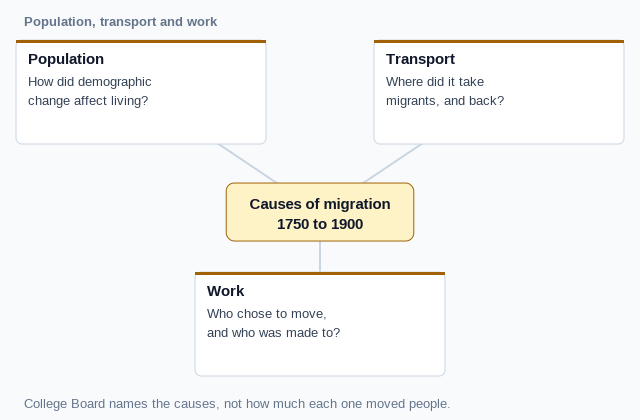
In short. From 1750 to 1900, changes in population, new modes of transportation and a global capitalist economy that drew both free and coerced workers produced varied patterns of migration.
- Migration in many cases was influenced by changes in demographics in both industrialized and unindustrialized societies that presented challenges to existing patterns of living.
- Because of new modes of transportation, both internal and external migrants increasingly relocated to cities, and many could return, periodically or permanently, to their home societies.
- Many individuals chose freely to relocate, often in search of work, while the new global capitalist economy continued to rely on coerced and semicoerced labor migration.
Part 2 Learn it What moved people
6.6a. Population and ways of living
Start with numbers of people. Migration in many cases was influenced by changes in demographics in both industrialized and unindustrialized societies that presented challenges to existing patterns of living.
Demographics is the size and makeup of a population. When it changed, the old ways a family or village lived could stop working, and in many cases people moved.
Two qualifiers matter. In many cases means demographic change did not lie behind every move. Both industrialized and unindustrialized means the pressure was not confined to factory countries; a farming society could feel it too.
College Board files this statement under the theme of humans and the environment, and the learning objective calls it an environmental factor. The statement itself names a change in population, not a climate or a landscape.
Quick check · Select all
Which two statements best explain how changes in demographics related to migration, according to this topic? Pick two.
Select 2 answers, then check.
6.6b. New transport, to cities and home again
The second statement is about how people moved, and it reads as a chain. Because of the nature of new modes of transportation, both internal and external migrants increasingly relocated to cities. This pattern contributed to the significant global urbanization of the 19th century. Transport led to moves into cities, and those moves contributed to the growth of cities worldwide.
An internal migrant moves within their own country; an external migrant moves to another one. The statement puts both kinds on the road to cities.
It ends with a second effect. The new methods of transportation also allowed for many migrants to return, periodically or permanently, to their home societies. College Board's examples of return: Japanese agricultural workers in the Pacific, Lebanese merchants in the Americas and Italian industrial workers in Argentina.
That chain is the shape of this topic's skill, explaining how one development relates to another. Each link says how one change led to the next.
Quick check · Multiple choice
According to this topic, what did the new methods of transportation allow many migrants to do, besides relocating to cities?
6.6c. Work, chosen and coerced
College Board files the last two statements under the economy. First, many individuals chose freely to relocate, often in search of work. Often leaves room for other reasons.
Second, the new global capitalist economy continued to rely on coerced and semicoerced labor migration, including enslavement, Chinese and Indian indentured servitude, and convict labor. Coerced means forced; semicoerced means partly forced, as when a worker is bound to labor for a term of years. Continued says this reliance carried on from before.
College Board also lists, as examples of migrants, the Irish to the United States and British engineers and geologists to South Asia and Africa, without saying what moved each group.
The two statements describe one economy drawing two kinds of migration. A sentence that connects them explains how the same demand for labor was met by people who chose to go and by people who did not.
Quick check · Multiple choice
Which of these does this topic name as a form of coerced or semicoerced labor migration?
Part 3 Watch it done Connecting a village's growth to its journeys
Watch the first steps, then take the last one yourself.
A note written for this page, from the elder of a farming village: "Our families have grown, and the fields no longer feed every son. The young men take the new steamer to the port city, and some come home each harvest." Explain how the developments in the note relate to one another.
Step 1 · Name each development
The note gives three: the families have grown past what the fields can feed; young men travel by steamer to a city; and some of them come home each harvest.
Step 2 · Look for the links
A connection says how one development led to or shaped another, not only that both happened. Ask what pushed the young men out, and what made the trip and the return possible.
Why this step?
Why is putting the three events in order not yet a connection?
Order shows what came first. A connection says how one development caused or shaped the next.
Your step · Decide and justify
Finish it. Which sentence explains how the note's developments relate?
What makes that sentence a connection?
Part 4 Try it Four travelers, four connections
Four short accounts written for this page, of travelers in the 1880s:
> A. A clerk takes the new railway from his market town to the capital, where the offices are hiring. > > B. A laborer from southern China signs a paper that binds him to five years on a sugar estate across the ocean before he may leave it. > > C. A cloth trader from Lebanon who sells in Brazil sails back to his village every few winters. > > D. A family leaves a crowded village, where the fields no longer feed everyone, to farm land across the ocean.
Each traveler's move relates to one larger development from this topic. Read what happens in each account, not only its words.
Try it · Match
Match each traveler to the development the move relates to.
Part 5 Explain it Free and bound workers, from documents
This is a self-check. Nothing you type leaves this page. Hold your answer up to the model and each scoring point.
Free-response practice · Question 1 style
A short practice in the shape of the document-based question: a thesis, one sentence of context and one paragraph that uses both documents and explains the purpose or audience of one, instead of a full essay. Both documents are written for this page and are not real.
Document 1: the four travelers' accounts from Try it.
Document 2: a notice posted by a labor recruiter in a South Asian port: "Workers wanted for the sugar estates overseas. Passage paid. Five years' labor owed on arrival."
Using both documents, explain how various economic factors contributed to the development of varied patterns of migration in the period from 1750 to 1900.
Model answer
Thesis: The demand for labor in a global capitalist economy produced more than one pattern of migration, drawing some people to relocate freely in search of work while binding others to labor far from home.
Context: Railroads, steamships and the telegraph opened interior regions to development and led to increased trade and migration, and both documents depend on that new transport: the clerk rides the railway to the capital, and the recruiter pays the workers' passage to estates overseas.
In Document 1, the clerk chooses to take the railway to the capital because "the offices are hiring," a free move in search of work. The laborer from southern China, by contrast, signs a paper that binds him to five years on a sugar estate before he may leave, a semicoerced move. Document 2 shows the same pattern from the employers' side: the recruiter offers "passage paid" but requires "five years' labor owed on arrival," terms like those of indentured servitude. Its purpose is to fill the estates with workers, so it puts the free passage first and the years owed after it. Together the documents show one economy relying on both chosen and semicoerced labor migration.
Score your own answer. This is a self-check, not a grade. Tick each point your answer makes.
Part 6 Check yourself Six groups of migrants
The table drives the first two questions. The last two come from the rest of the lesson.
A student listed groups from College Board's examples and statements for this topic. The table was written for this lesson.
| Row | Migrants |
|---|---|
| 1 | Japanese agricultural workers in the Pacific, who returned home |
| 2 | Lebanese merchants in the Americas, who returned home |
| 3 | Italian industrial workers in Argentina, who returned home |
| 4 | Irish to the United States |
| 5 | British engineers and geologists to South Asia and Africa |
| 6 | Chinese and Indian indentured servants |
Case question 1 · Spot the error
A student wrote this summary of the table. Which line goes wrong?
Case question 2 · Fill the statement
Use rows 1 to 4 to complete the sentences.
Row 4's Irish moved from one country to another, which makes them migrants. Rows 1 to 3 add something row 4 does not show, a return home, which the statement credits to .
The rest stand on their own and do not use the case.
Check yourself · Select all
Which two statements best explain how migration related to the growth of cities, according to this topic? Pick two.
Select 2 answers, then check.
Check yourself · Select all
A historian, in a sentence written for this page, claims: "Some migrants of this period chose their journeys, and others did not." Which two statements from this topic best support the claim? Pick two.
Select 2 answers, then check.
Part 7 Keep it Bring back earlier ideas
One question from the economic imperialism lesson just before this one, and one from the resistance lesson three back.
From 6.5 Economic Imperialism from 1750 to 1900 · Multiple choice
According to this topic, where did industrialized states and businesses within those states primarily practice economic imperialism?
From 6.3 Indigenous Responses to State Expansion from 1750 to 1900 · Multiple choice
A petition written for this page is sent by leaders of a colony to the parliament of the empire that rules it: "We are loyal subjects, and we ask only that our people have a voice in the laws that govern us." Which choice best explains how the petition's audience limits its use as a source?
In three lines
- Changes in demographics in both industrialized and unindustrialized societies in many cases influenced migration.
- New modes of transportation drew internal and external migrants to cities, contributing to global urbanization, and let many return home.
- Many people chose freely to move, often for work, while the global capitalist economy continued to rely on coerced and semicoerced labor migration.
Exam strategy for this topic
- Section I Part A, Multiple Choice: 55 questions in 55 minutes.
- Section I Part B, Short Answer: 3 questions in 40 minutes.
- Section II, Document-Based Question and Long Essay: 2 questions in 100 minutes.
- This lesson's Explain it is shaped like free-response question 1, Document-based.
When a question asks how one development relates to another, name both and put the link between them in words such as because or which led to. Two facts side by side, however accurate, do not yet explain a relationship.
Questions students ask
Why are population and transportation called environmental factors?
College Board files both statements under the theme of humans and the environment, and the learning objective calls them environmental factors. The statements themselves name changes in demographics and new modes of transportation, not a climate or a landscape.
Did every migrant choose to go?
No. Many individuals chose freely to relocate, often in search of work, while the new global capitalist economy continued to rely on coerced and semicoerced labor migration.
Did the Irish and the British engineers choose freely?
College Board lists them as examples of migrants without saying what moved each group, so this lesson does not sort them as free or coerced.
Which new modes of transportation does the statement mean?
It does not name them. It says their nature drew internal and external migrants to cities and allowed many migrants to return home. The railway and steamer in this lesson's documents are written for the page.
How is this topic different from 6.7?
This topic asks what caused migration. 6.7 Effects of Migration turns to its effects, on the societies migrants left, on their culture abroad and on the societies that received them.
Course alignment, for teachers
AP World History: Modern topic 6.6, Unit 6: Consequences of Industrialization.
- Skill 5.B: Explain how a historical development or process relates to another historical development or process.
This lesson maps all 4 essential knowledge statements of the topic, and the 2 learning objectives with none of their own, to the part that teaches each one: 5 are checked by a scored question and 1 by the written response. The map is in the lesson file.