Unit 5 · Topic 5.8 · about 35 minutes · 7 parts · 9 scored checks, 2 of them multiple choice, plus 2 from earlier lessons
AP World History: Modern 5.8: Reactions to the Industrial Economy from 1750 to 1900
Unit 5: 12 to 15% of the multiple-choice section
What you'll be able to do
- Explain the causes and effects of calls for changes in industrial societies from 1750 to 1900.
Key vocabulary
| Term | What it means | The exam trap |
|---|---|---|
| Labor union | An organization of workers formed to bargain for better pay and conditions. | A union is a workers' organization, while the political parties the statement names next are a different body, so keep the two apart. |
| Ideology | A set of ideas about how society or government should work. | The statement names Marx's among various ideologies, so it does not make his the only one. |
| Socialism | A set of ideas that favors shared or public control of the economy. | This topic pairs socialism with communism and gives no difference between them, so do not rest an answer on one. |
| Elite | A small group with more power, wealth or status than others. | Only some members of established elite groups resisted, so the statement does not set every elite against reform. |
| Audience | The people a source is written for. | A source can reach more readers than it was written for, so name the audience its own words address. |
 Tap to open the picture full size
Part 1 Think first Two views of one city
Commit to an answer first, then see how the lesson treats it.
Predict first
Two writers described the same industrial city, Manchester. One wrote a book on the condition of England's working class; the other wrote the preface to a business directory for the city. Do you expect their descriptions to match?
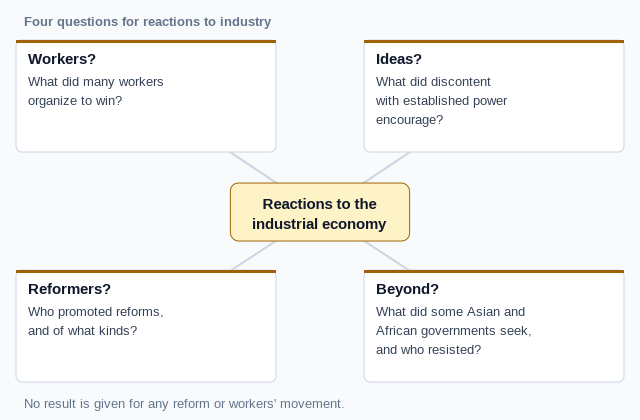
In short. Workers organized, reformers pressed for change and new ideologies grew in industrial societies, while some governments in Asia and Africa sought reform that others resisted.
- In industrialized states, many workers organized themselves, often in labor unions, and discontent with established power structures encouraged ideologies including those of Karl Marx, socialism and communism.
- In response to the changes industrial capitalism brought, some governments, organizations, and individuals promoted political, social, educational, and urban reforms.
- Some governments in Asia and Africa, including the Ottoman Empire and Qing China, sought to reform and modernize their economies and militaries, and those efforts were often resisted.
Part 2 Learn it Calls for change, and answers to them
2a. Workers and new ideologies
Industrial capitalism changed how people worked and lived, and some of them pushed back.
In industrialized states, many workers organized themselves, often in labor unions, to improve working conditions, limit hours, and gain higher wages. Many is not all, and often makes unions a common way to organize, not the only one. The statement goes on: workers' movements and political parties emerged in different areas, promoting alternative visions of society.
New ideas grew from the same unrest. Discontent with established power structures encouraged the development of various ideologies, including those espoused by Karl Marx, and the ideas of socialism and communism. Including makes Marx's ideologies some among several.
This topic gives causes and goals here. It gives no result of any union, party or ideology.
Quick check · Multiple choice
A program written for this page is issued by a workers' political party in an industrialized state and addressed to voters: "Our party stands for a different kind of society, one built around the people who labor." Which choice best explains the program's purpose?
2b. Reformers and four kinds of reform
Calls for change also came from outside the workers' movements. In response to the social and economic changes brought about by industrial capitalism, some governments, organizations, and individuals promoted various types of political, social, educational, and urban reforms.
The cause sits in the opening words: the changes that industrial capitalism brought. The actors come in three kinds, and some limits each one. The reforms come in four kinds.
The statement names no single reform and does not say what any reform achieved. A school built or a street cleaned would be an example you bring, not one College Board gives.
Quick check · Select all
In response to the social and economic changes brought about by industrial capitalism, some governments, organizations, and individuals promoted reforms. Which three of these are kinds of reform this topic names? Pick three.
Select 3 answers, then check.
2c. Reform, and resistance, beyond the industrialized states
The last statement looks outward. In response to the expansion of industrializing states, some governments in Asia and Africa, including the Ottoman Empire and Qing China, sought to reform and modernize their economies and militaries.
Sought gives an aim, not a result. Then the statement adds a second sentence: reform efforts were often resisted by some members of government or established elite groups.
So reform met opposition from inside, and often, though the statement does not say how the resisting was done or how it turned out. Japan's internal reform in 5.6 Industrialization: Government’s Role from 1750 to 1900 also answered influence from outside, and College Board names no resistance there.
Quick check · Multiple choice
According to this topic, what were some governments in Asia and Africa, including the Ottoman Empire and Qing China, responding to when they sought to reform and modernize their economies and militaries?
Part 3 Watch it done Read a source for who, why and for whom
Two steps are worked; the third is yours.
A memorial written for this page, from a court official in Qing China to the emperor. It is not a real document.
"The foreign powers grow stronger every year, and their ships and factories outmatch ours. Unless Your Majesty reforms the army and the treasury, we cannot meet them."
Explain its historical situation, point of view, purpose and audience.
Predict first
Before the steps: will a memorial from one court official give the view of every Qing official?
Step 1 · Writer, audience, and situation
The writer is a court official, a member of government, and the audience is the emperor. The situation fits one of this topic's statements: in response to the expansion of industrializing states, some governments in Asia and Africa, including Qing China, sought to reform and modernize their economies and militaries.
Step 2 · Point of view
The official sees the growing strength of foreign powers as a threat, and reform of the army and the treasury as the answer to it.
Why this step?
Why does it matter that the writer is a member of government?
The statement says reform efforts were often resisted by some members of government. This official argues for reform, so the memorial shows one side of a divided government, not the view of every official.
Your step · Decide and justify
Finish it. A student writes: "The memorial's purpose is to persuade the emperor to order reform, and it dwells on growing foreign strength because the emperor is the one who can act on that danger." Does the sentence explain the memorial's purpose and audience?
Why?
Part 4 Try it A mill owner's letter
A letter written for this page from a mill owner in an industrialized town to the town's newspaper. It is not a real document.
"To the editor: The men of my mill have joined a union and now demand fewer hours at the same pay. If every mill in town gives way, our goods will cost more and orders will go elsewhere. I ask the good people of this town not to lend their support to these demands."
Try it · Fill the statement
Finish a student's sourcing of the letter.
Writing to , the owner's purpose is .
Part 5 Explain it Calls for change, from documents
This is a self-check. Nothing you type leaves this page. Compare your answer with the model, line by line, and with each scoring point.
Free-response practice · Question 1 style
A short practice in the shape of the document-based question: a thesis, one sentence of context and one paragraph that uses both documents and explains the sourcing of one, instead of a full essay. Both documents are written for this page and are not real.
Document 1: the mill owner's letter from Try it.
Document 2: a petition from the workers of a cotton mill to their town council: "We work from dark to dark. We ask the council for a law that limits the working day, so that we may see our families in daylight."
Using both documents, explain the causes and effects of calls for change in industrial societies in the period from 1750 to 1900.
Model answer
Thesis: Calls for change in industrial societies grew out of the social and economic changes industrial capitalism brought, as workers organized to limit hours and win other gains and sought reforms from those in power, and such calls could meet opposition from employers.
Context: These calls arose within the development of industrial capitalism, which led to increased standards of living for some, and the social and economic changes it brought were what reformers of the period responded to.
In industrialized states, many workers organized themselves, often in labor unions, to improve working conditions, limit hours and gain higher wages. Document 2 shows that aim: the workers ask for a law that limits the working day. Because the petition is addressed to the town council, the body that can pass such a law, its purpose is to win a reform from those in power, a reform of the kind some governments, organizations and individuals promoted in response to industrial capitalism. Document 1 shows one effect of such calls: opposition. The owner writes to the newspaper's readers rather than to his workers, so his purpose is to turn the town against the union's demands, which is why he stresses lost orders instead of the workers' hours. So calls for change grew from the changes of industrial capitalism, and, as Document 1 shows, they could meet opposition from employers.
Score your own answer. This is a self-check, not a grade. Tick each point your answer makes.
Part 6 Check yourself Three sources, sourced
The first two questions use the three sources. The other two range across the lesson.
Three short sources written for this page. None of them is a real document.
| Source | Who wrote it | Written for | What it says |
|---|---|---|---|
| A | A workers' newspaper in an industrialized city | its readers, most of them workers | "Join with your fellow workers. Alone you are ignored; together we can shorten the working day." |
| B | A reform society in a factory town | the town's school board | "Our town has outgrown its schools. Build new ones, and open them in the evening for those who work by day." |
| C | A high official at the Ottoman court | other officials at court | "These new reforms of the army and the treasury overturn the ways of our fathers. They should be stopped." |
Case question 1 · Fill the statement
Finish the student's sourcing of Source C.
Source C is resistance from inside the government: a high official writes to and sees the new reforms as .
Case question 2 · Spot the error
A student wrote this paragraph about the three sources. Which line is the first to go wrong?
The rest stand on their own and do not use the case.
Check yourself · Select all
A pamphlet written for this page, addressed to factory workers, reads: "The power of owners and old rulers rests on our labor. Read Karl Marx, and join the cause of socialism." Which two statements could best explain the pamphlet's audience and historical situation? Pick two.
Select 2 answers, then check.
Check yourself · Select all
A letter written for this page is from a city reformer to the town council: "Our town has been remade by industry. Pass reforms for its schools and its streets." Which two statements best explain the letter's point of view and purpose? Pick two.
Select 2 answers, then check.
Part 7 Keep it Bring back earlier ideas
One question from the lesson on economic developments and one from the lesson on government's role.
From 5.7 Economic Developments and Innovations in the Industrial Age · Select all
Which two does this topic give as results of the development of industrial capitalism? Pick two.
Select 2 answers, then check.
From 5.6 Industrialization: Government’s Role from 1750 to 1900 · Select all
Which two does this topic give as effects of internal reform in Japan? Pick two.
Select 2 answers, then check.
In three lines
- Many workers in industrialized states organized themselves, often in labor unions, and discontent with established power structures encouraged ideologies including Marx's, socialism and communism.
- Some governments, organizations, and individuals promoted political, social, educational, and urban reforms in response to the changes industrial capitalism brought.
- Some governments in Asia and Africa, including the Ottoman Empire and Qing China, sought reform, and some members of government or elite groups often resisted it.
Exam strategy for this topic
- Section I Part A, Multiple Choice: 55 questions in 55 minutes.
- Section I Part B, Short Answer: 3 questions in 40 minutes.
- Section II, Document-Based Question and Long Essay: 2 questions in 100 minutes.
- This lesson's Explain it is shaped like free-response question 1, Document-based.
In sourcing, naming the author is only the start. Say how who wrote the source, for whom and why shapes what it says, and then say why that matters to your argument.
Questions students ask
What do Engels's book and the Wheelan and Co. directory say about Manchester?
Their texts are not on this page. College Board's sample activity gives groups of three the descriptions of Manchester from Friedrich Engels's The Condition of the Working-Class in England in 1844 and from the preface to the Wheelan and Co. business directory, and asks them to discuss the differences, how the authors' point of view, purpose and intended audience might explain them, and which description is most accurate and why.
Did all workers join labor unions?
No. The statement says many workers organized themselves, often in labor unions, so unions were one common way to organize.
What did the workers' movements and reforms achieve?
This topic gives their causes and goals but not their results. An answer about effects has to argue from other evidence and say so.
Who resisted the Ottoman and Qing reforms?
The statement says reform efforts were often resisted by some members of government or established elite groups. It does not say how, or how the resistance turned out.
What is the difference between socialism and communism?
The statement names both as ideas that discontent with established power structures encouraged, beside the ideologies of Karl Marx, and does not tell them apart.
Course alignment, for teachers
AP World History: Modern topic 5.8, Unit 5: Revolutions.
- Skill 2.B: Explain the point of view, purpose, historical situation, and/or audience of a source.
This lesson maps all 4 essential knowledge statements of the topic, and the one learning objective with none of its own, to the part that teaches each one: 5 are checked by a scored question. The map is in the lesson file.