Unit 1 · Topic 1.2 · about 30 minutes · 7 parts · 13 scored checks, 5 of them multiple choice
AP U.S. History 1.2: Native American Societies Before European Contact
Unit 1: 4 to 6% of the multiple-choice section
What you'll be able to do
- Explain how and why different Native societies in North America interacted with their natural environments before European contact, and identify the development that a region's evidence shows.
Key vocabulary
| Term | What it means | The exam trap |
|---|---|---|
| Maize | Corn, a crop first grown in present-day Mexico. | Maize and corn are the same plant; treat the two words as one crop. |
| Irrigation | Bringing water to crops by canals or ditches instead of relying on rain alone. | Irrigation is water moved to fields by people, not rain or a river's own flooding. |
| Mobile lifestyle | A way of life in which a group moves through the year to where food and water can be found. | Mobile is not aimless; groups followed seasonal routes they knew well. |
| Mixed economy | An economy that combines farming with hunting, fishing and gathering. | Mixed refers to the ways of getting food, not to a mix of peoples. |
| Social diversification | A society coming to have more kinds of work and more differences in rank among its members. | It describes roles inside one society, not the number of different societies on a continent. |
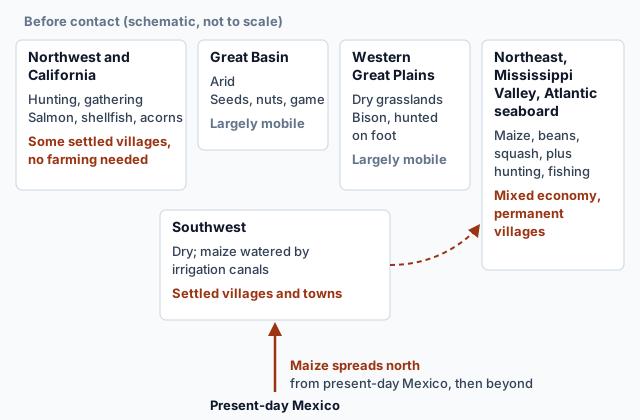 Tap to open the picture full size
Part 1 Think first What did the charter leave out?
Commit to a guess first. Being wrong now makes the right idea stick better.
Predict first
In 1584 Queen Elizabeth I of England licensed Walter Raleigh to find and hold "remote, heathen and barbarous lands, countries, and territories, not actually possessed of any Christian Prince, nor inhabited by Christian People." Neither the queen nor Raleigh had seen North America. When archaeologists study what the peoples of North America left behind from before contact, what picture do you expect them to find?
In short. Before European contact, Native societies in North America lived in ways shaped by their environments and by their own choices: maize farming spread north from present-day Mexico, people in dry lands lived largely mobile lives, eastern societies mixed farming with hunting in permanent villages, and Pacific societies drew on the ocean.
- Maize cultivation spread from present-day Mexico into the American Southwest and beyond, supporting settlement, irrigation and more varied roles in society.
- In the dry Great Basin and the grasslands of the western Great Plains, societies developed largely mobile lifestyles.
- In the Northeast, the Mississippi Valley and the Atlantic seaboard, farming mixed with hunting supported permanent villages, while in the Northwest and California hunting, gathering and the ocean's resources supported some settled communities.
Part 2 Learn it Societies and their environments
2a. Maize moves north
Maize, or corn, was first grown in present-day Mexico. Over many centuries, farmers carried it north into the present-day American Southwest, where it was being grown by about 4,000 years ago, and later beyond.
Maize changed the societies that grew it. A reliable crop let people stay in one place, so villages and towns grew. In a dry land, crops needed more water than rain gave, so people built irrigation: the Hohokam of present-day Arizona dug long canals to carry river water to their fields. Ancestral Puebloans built large stone buildings of many rooms at Chaco Canyon, in present-day New Mexico. Stored food also let some people spend their time on work other than farming, such as building, trading or leading, so these societies grew more varied in their roles and ranks.
Historians link four changes to maize here: economic growth, settled villages, irrigation, and a wider range of roles in society, which they call social diversification.
Quick check · Multiple choice
Which best explains how the spread of maize changed societies in the present-day American Southwest?
2b. Moving with the land: the Great Basin and the western Plains
Not every region could support maize farming. The Great Basin, between the Sierra Nevada and the Wasatch Mountains of present-day Utah, is arid: little rain falls, and its rivers do not reach the sea. Societies there, such as the Shoshone and the Paiute, developed largely mobile lifestyles. Small groups moved through the year to wherever food was ready, gathering seeds and nuts and hunting small animals.
The grasslands of the western Great Plains were dry too, but they fed great herds of bison. Societies there followed the herds and hunted them on foot, with dogs to haul their belongings. Horses came only later, after the Spanish brought them to the Americas.
Mobile does not mean simple. Moving well meant knowing when each plant ripened, where water lay and how the herds traveled, knowledge passed down for generations.
Quick check · Fill the statement
Complete the sentences about the Great Basin before European contact.
In the Great Basin, too little rain fell for reliable , so many societies there developed largely lifestyles, gathering seeds and nuts and hunting small animals.
2c. Fields and villages in the East
In the Northeast, the Mississippi River Valley and along the Atlantic seaboard, rain fell more reliably, and forests and rivers were rich in game and fish. Many societies there built mixed economies: they farmed maize, beans and squash, and they also hunted, fished and gathered wild foods. Fields near home favored permanent villages.
In present-day New York, the Haudenosaunee (Iroquois) lived in villages of longhouses, long bark-covered buildings shared by related families, and women tended the fields. In the Mississippi Valley, Mississippian societies built towns with large earthen mounds. The largest, Cahokia, near present-day St. Louis, grew into a large town after about 1050 and had been largely abandoned by about 1400, long before Europeans arrived. Around the Chesapeake Bay, the Powhatan peoples grew maize in villages near the rivers and hunted and fished nearby.
Mixing the two ways of getting food spread the risk. If a harvest was poor, the game and fish were still there.
Quick check · Multiple choice
Which village shows the mixed economy that favored permanent villages in the East?
2d. The ocean's harvest: the Northwest and California
Along the Pacific, societies supported themselves by hunting and gathering, and in some areas the ocean was rich enough to support settled communities without growing crops like maize.
In the Northwest, rivers filled with salmon each year, and people caught, dried and stored them in large numbers. With that store of food, and the shellfish and sea mammals of the coast, many peoples lived in permanent villages of large plank houses built from cedar.
In present-day California, many peoples gathered acorns, a staple food once they were ground and soaked to remove their bitter taste, and they fished, hunted and collected shellfish. Many lived in settled villages.
This breaks an easy rule. Farming is one way to support a permanent village, but not the only way. In the right environment, the wild resources of the land and the sea did the same work.
Quick check · Sort it
Each card describes a society before European contact. Tap a card, then the way of living it fits best.
Largely mobile
Permanent villages
Part 3 Watch it done Identify the development behind the evidence
Watch each step, then do the last one yourself.
Archaeologists in present-day Arizona have traced long canals, dug centuries before Europeans arrived, that carried river water across the desert to farm fields. Identify the historical development this evidence shows.
Predict first
Before the steps, what do you think the canals were mostly for?
Step 1 · Name the region and its environment
Arizona is in the Southwest, a dry region where rain alone could not water crops reliably.
Why this step?
Why start with the environment instead of the canals?
This topic is about how societies interacted with their environments. The environment tells you what problem the evidence was solving, here too little water for crops.
Step 2 · Ask what the evidence needed
Long canals took many people and many seasons to dig and keep clear. People who build them stay where the canals are, and they use the water to farm, here mostly maize, the crop that had spread north from present-day Mexico.
Your step · Decide and justify
Finish it. Which development does the evidence show?
Which evidence best supports your answer?
Part 4 Try it Region by region, on your own
Put the regions together, then check a student's writing on one of them.
Try it · Match
Match each region to the way of life its societies developed before European contact.
Try it · Spot the error
A student writes about the western Great Plains before European contact. Which line is the first to go wrong?
Part 5 Explain it Write it like a document-based answer
Nothing you type leaves this page. Check your answer against the model and each scoring point.
Free-response practice · Question 1 style
A short practice in the shape of the document-based question: three documents instead of seven, and a thesis with one body paragraph instead of a full essay. The first two documents are archaeological evidence, described in words because the societies that made them left no writing.
Evaluate the extent to which the natural environment determined how Native societies in North America lived before European contact.
Document 1. Archaeological evidence from present-day Arizona, from centuries before European contact: long irrigation canals, dug by the Hohokam, carried river water across the desert to fields of maize and other crops.
Document 2. Archaeological evidence from the Mississippi River Valley near present-day St. Louis: the remains of Cahokia, a Mississippian town with large earthen mounds built by hand, in a region where people farmed maize. The town had been largely abandoned before Europeans arrived.
Document 3. Charter of Elizabeth I of England to Walter Raleigh, March 25, 1584: Raleigh may find and hold "remote, heathen and barbarous lands, countries, and territories, not actually possessed of any Christian Prince, nor inhabited by Christian People."
Write a thesis, one sentence of historical context, and one paragraph that uses at least two documents and explains the purpose, audience, point of view or situation of one of them.
Model answer
Thesis: The environment shaped how Native societies lived to a large extent, setting which foods and ways of life were possible, but it did not determine them, because societies also chose how to use and transform their land.
Context: over thousands of years, Native peoples migrated and settled across North America, a continent of very different environments, from deserts and grasslands to forests and coasts.
In the dry Southwest, Hohokam farmers did not simply accept the desert; they dug canals to bring river water to their maize (Document 1), transforming the land around them. In the Mississippi Valley, where rain was more reliable, maize farming supported Cahokia, where people built large earthen mounds by hand (Document 2). Both societies grew maize, yet one needed canals and the other did not, so the environment shaped the methods while people chose the crop and the scale of what they built. Document 3 adds little to this argument, and its source shows why. The 1584 English charter calls the lands it grants "heathen and barbarous," but it names no place, and it was written in England to license Raleigh's claims by people who had not seen North America. Its purpose was to justify claiming land, so it shows English assumptions, not how Native societies used their environments, which is why the argument rests on the archaeological evidence.
Score your own answer. This is a self-check, not a grade. Tick each point your answer makes.
Part 6 Check yourself Three societies, three environments
The case questions use the table. The others mix the ideas from the whole lesson.
Each row describes a kind of society that lived in North America before European contact, without naming it.
| Society | Environment | Main foods | Where people lived |
|---|---|---|---|
| A | Dry basin with little rain, whose rivers never reach the sea | Seeds, nuts and small animals | Small camps, moved through the year |
| B | Coast with rivers full of salmon each year | Salmon, shellfish and sea mammals | Permanent villages of cedar plank houses |
| C | Forest with reliable rain and many rivers | Maize, beans, squash, deer and fish | Permanent villages of bark longhouses |
Case question 1 · Multiple choice
Which statement about Society B is best supported by the table?
Case question 2 · Multiple choice
Which development best explains Society A's way of life?
The rest stand on their own and do not use the case.
Check yourself · Select all
Which two developments did the spread of maize cultivation support in the present-day American Southwest? Select two.
Select 2 answers, then check.
Check yourself · Put it in order
Put these developments in the order they happened, earliest first.
Part 7 Keep it Bring back earlier ideas
This lesson goes deeper into the Native societies that Topic 1.1 set out, so Keep it returns to Topic 1.1's big picture of the whole period.
Bring it back · Multiple choice
In 1494 Spain and Portugal agreed to divide newly found lands along a line drawn from pole to pole west of the Cape Verde Islands. Which development does this agreement best show?
Bring it back · Fill the statement
Complete the sentences about the years after 1492.
After 1492, maize and potatoes from the Americas became food crops in Europe, while horses and smallpox crossed to the Americas. This movement is called the . Smallpox and other new diseases caused Native populations to .
In three lines
- Maize spread north from present-day Mexico and supported settlement, irrigation and more varied roles in the Southwest.
- Arid lands in the Great Basin and the western Plains favored largely mobile lifestyles, while mixed farming and hunting supported permanent villages in the East.
- In the Northwest and California, hunting, gathering and the ocean's resources supported some settled communities without farming.
Exam strategy for this topic
- Section I Part A, Multiple Choice: 55 questions in 55 minutes.
- Section I Part B, Short Answer: 3 questions in 40 minutes.
- Section II, Document-Based Question and Long Essay: 2 questions in 100 minutes.
- This lesson's Explain it is shaped like free-response question 1, Document-based.
When a question gives you evidence about a Native society, name the region and its environment first; then say how the society used or changed that environment.
Questions students ask
How do historians know about societies that left no written records?
Mostly from archaeology, the study of what people left behind, such as canals, mounds, houses and tools, and from the histories Native nations have passed down.
What happened to Cahokia?
Cahokia, near present-day St. Louis, was the largest Mississippian town. It had been largely abandoned before Europeans reached the region, so no European saw it at its height.
Why does the lesson keep saying present-day Mexico or present-day Arizona?
Those borders did not exist before contact. The modern names only help you find the places on a map you know.
Why does a lesson about Native societies start with an English charter?
The charter shows how its English authors described lands they had never seen. Setting it beside the evidence of what was there teaches you to ask who wrote a source and why.
Where can I read the 1584 charter in full?
The Avalon Project at Yale Law School prints it in full, and the excerpt in this lesson was checked against that copy: Charter to Sir Walter Raleigh, 1584 (Avalon Project).
Course alignment, for teachers
AP U.S. History topic 1.2, Unit 1: Period 1: 1491–1607.
- Skill 1.A: Identify a historical concept, development, or process.
This lesson maps all 4 essential knowledge statements of the topic, and the one learning objective with none of its own, to the part that teaches each one: 5 are checked by a scored question. The map is in the lesson file.