Unit 9 · Topic 9.7 · about 30 minutes · 7 parts · 13 scored checks, 5 of them multiple choice
AP U.S. History 9.7: Causation in Period 9
Unit 9: 4 to 6% of the multiple-choice section
What you'll be able to do
- Explain the relative significance of the effects of change in the period after 1980 on American national identity, and corroborate, qualify or modify a claim about that significance with evidence that supports it and evidence that cuts against it.
Key vocabulary
| Term | What it means | The exam trap |
|---|---|---|
| National identity | The shared sense of who belongs to a nation and what it stands for. | National identity is how people understand the nation, not the official list of its laws. |
| Corroborate | To support a claim with evidence that agrees with it, ideally from a different source. | Two documents by the same speaker corroborate less than two from different points of view. |
| Qualify | To limit a claim with evidence that shows an exception, without giving the claim up. | Qualifying a claim narrows it; it does not mean the claim is wrong. |
| Modify | To rewrite a claim so that it fits evidence the first version could not explain. | A modified claim keeps what the evidence supports and changes only what it cannot. |
| Interventionist foreign policy | A foreign policy ready to act abroad, by diplomacy or by force, to shape events in other parts of the world. | Intervention describes how active a policy is abroad, not whether it is wise. |
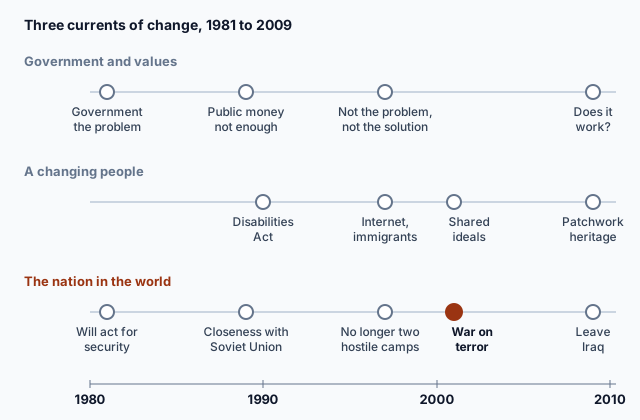 Tap to open the picture full size
Part 1 Think first Which change mattered most?
Commit to a guess first. Being wrong now makes the right idea stick better.
Predict first
On January 20, 1981, Ronald Reagan said in his first inaugural address: "In this present crisis, government is not the solution to our problem; government is the problem." Twenty years later, on January 20, 2001, George W. Bush said that "every immigrant, by embracing these ideals, makes our country more, not less, American." Which change after 1980 do you think did most to shape how Americans saw their nation?
In short. After 1980 a conservative movement, new technology and a changing population, and a new role in the world after the Cold War and the attacks of 2001 all changed how Americans described their nation, and judging which mattered most means testing a claim against evidence that cuts the other way.
- Conservative calls for a reduced role for government and for traditional social values advanced after 1980, and later presidents answered them in their own terms.
- New technology enhanced the economy while manufacturing decreased, and the population continued to shift, with cultural and political consequences presidents described in different ways.
- The end of the Cold War and the war on terrorism after September 11, 2001, redefined the nation's role in the world and raised debates about safety and civil liberties.
Part 2 Learn it Weighing the changes after 1980
2a. A claim, and the evidence that tests it
National identity is the shared sense of who Americans are and what their nation stands for. The AP U.S. History course framework names three broad changes after 1980 that bear on it: a newly ascendant conservative movement, technological, economic and demographic change, and a new role in the world after the Cold War.
A claim about which change mattered most is tested with evidence. Evidence that supports the claim corroborates it. Evidence that shows a limit or an exception qualifies it. When the exception forces a rewrite, you modify the claim.
Here is the move on one claim: Reagan wanted to do away with the federal government. Some of his words corroborate it. In his first inaugural, on January 20, 1981, he said "In this present crisis, government is not the solution to our problem; government is the problem," and promised to "curb the size and influence of the Federal establishment." The same speech qualifies it: "it is not my intention to do away with government." The better claim is narrower. Reagan called for a smaller federal government, not none.
Conservative beliefs in a reduced role for government and in traditional social values advanced in U.S. politics after 1980. Reagan tied the nation's freedom to faith: "We are a nation under God, and I believe God intended for us to be free."
Quick check · Sort it
Claim: after 1980, the idea that government should do less became common ground in American politics. Tap a card, then say whether it corroborates or qualifies the claim.
Corroborates the claim
Qualifies the claim
2b. Technology, the economy and work
The course framework says that new developments in science and technology enhanced the economy and transformed society, while manufacturing decreased. Clinton's second inaugural address, on January 20, 1997, marked how fast the change came: "Ten years ago, the Internet was the mystical province of physicists; today, it is a commonplace encyclopedia for millions of schoolchildren."
Read that line as a source before you use it. A president at his inauguration is celebrating what the nation has done, so the line shows confidence about technology, not how every American fared.
Then match each source to the change it actually shows. Barack Obama's inaugural address of January 20, 2009, came during a financial crisis. He said "Our economy is badly weakened" and called it "a consequence of greed and irresponsibility on the part of some, but also our collective failure to make hard choices." That is a different economic change from the shift away from manufacturing, so it cannot stand in for it. A complex argument says which change each source shows, and for whom.
Sources: Clinton, Second Inaugural, 1997 (Avalon Project); Obama, Inaugural, 2009 (Avalon Project).
Quick check · Fill the statement
Complete a student's notes on one claim.
Claim: after 1980, new technology made the American economy stronger. The course framework's statement that science and technology enhanced the economy the claim. Its statement that manufacturing decreased in the same years the claim.
2c. A changing people
The U.S. population continued to undergo demographic shifts that had significant cultural and political consequences. Presidents described what those shifts meant for the nation.
George W. Bush, on January 20, 2001: "America has never been united by blood or birth or soil." Americans are bound instead by shared ideals, and "every immigrant, by embracing these ideals, makes our country more, not less, American." Obama, in 2009: "For we know that our patchwork heritage is a strength, not a weakness. We are a nation of Christians and Muslims, Jews and Hindus, and non-believers." Clinton, in 1997: "Our rich texture of racial, religious and political diversity will be a Godsend in the 21st century."
Now test a broader claim: in these years the nation simply grew more united. Bush's own speech qualifies it. He said "The ambitions of some Americans are limited by failing schools and hidden prejudice and the circumstances of their birth," so that "it seems we share a continent, but not a country." His point is unequal opportunity, not immigration, yet it is still evidence of division beside the ideal. He went on: "We do not accept this, and we will not allow it."
Read each speech as a source, too. An inaugural address speaks to the whole nation on the day a new president takes office, and its purpose is to unite.
Sources: G. W. Bush, Inaugural, 2001 (Avalon Project); Obama, Inaugural, 2009 (Avalon Project); Clinton, Second Inaugural, 1997 (Avalon Project).
Quick check · Multiple choice
Claim: after 1980, demographic change gave Americans a more unified sense of national identity. Which piece of evidence best qualifies the claim?
2d. The nation in the world
The end of the Cold War and new challenges to U.S. leadership forced the nation to redefine its foreign policy and its role in the world. The course framework says the Reagan administration promoted an interventionist foreign policy that continued in later administrations, even after the Cold War ended. Reagan's first inaugural paired a pledge that "peace is the highest aspiration of the American people" with a warning: "Our reluctance for conflict should not be misjudged as a failure of will. When action is required to preserve our national security, we will act."
On September 20, 2001, after the attacks, President George W. Bush told Congress "Our war on terror begins with al Qaeda, but it does not end there." The course framework says the war on terrorism raised questions about civil liberties and human rights. The USA PATRIOT Act shows both sides. On October 25, 2001, Senator Russ Feingold of Wisconsin told the Senate the nation must not weaken itself "by giving up the cherished freedoms that they seek to destroy," and said "I will vote against this bill." Signing the act the next day, Bush called it "an essential step in defeating terrorism, while protecting the constitutional rights of all Americans."
Sources: Reagan, First Inaugural, 1981 (Avalon Project); Address to Congress, September 20, 2001 (Avalon Project); Senate debate, October 25, 2001 (Avalon Project); Patriot Act signing, October 26, 2001 (Avalon Project).
Quick check · Match
Match each statement to what it shows about the nation's role in the world.
Part 3 Watch it done Modify a claim about September 11, 2001
Watch each step, then do the last one yourself.
Claim: the attacks of September 11, 2001, were the most significant change after 1980 for American national identity. Modify the claim so that it accounts for evidence on both sides.
Predict first
Before the steps, what do you think a modified claim will do?
Step 1 · Find evidence that corroborates
On September 20, 2001, President George W. Bush told Congress and the nation that "night fell on a different world, a world where freedom itself is under attack." He said "Tonight we are a country awakened to danger and called to defend freedom." U.S. foreign policy then focused on fighting terrorism around the world, including lengthy, controversial conflicts in Afghanistan and Iraq.
Why this step?
Why look for evidence against a claim you are trying to defend?
A claim that ignores the strongest evidence against it is easy to knock down. Facing that evidence and setting a limit to fit it is what makes an argument complex.
Step 2 · Find evidence that qualifies
Some changes did not come from the attacks. In 1997, years before them, Clinton described the spread of the Internet and the nation's racial and religious diversity.
Your step · Decide and justify
Finish it. Which modified claim best fits the evidence in the two evidence steps above?
Which evidence best supports the limit in your answer?
Part 4 Try it One law that cuts the other way
Evidence from an unexpected place can modify a claim. Take this one: after 1980, conservative calls for a reduced role for government advanced in U.S. politics. The course framework supports it, and so do the inaugural addresses of 1981 and 1989.
Now add a law. The Americans with Disabilities Act was approved on July 26, 1990. In its findings, Congress wrote that "historically, society has tended to isolate and segregate individuals with disabilities." Among its purposes, the act set out "to provide a clear and comprehensive national mandate for the elimination of discrimination against individuals with disabilities" and "to ensure that the Federal Government plays a central role in enforcing the standards established in this Act on behalf of individuals with disabilities."
Before you answer, ask what the act does to the claim: confirm it, limit it, or disprove it.
Source: Americans with Disabilities Act, 1990 (Avalon Project).
Try it · Multiple choice
Which revision of the claim best accounts for the Americans with Disabilities Act?
Try it · Spot the error
A student writes a paragraph weighing the act. Which line is the first to go wrong?
Part 5 Explain it Write it like a document-based answer
Nothing you type leaves this page. Check your answer against the model and each scoring point.
Free-response practice · Question 1 style
A short practice in the shape of the document-based question: three documents instead of seven, and a thesis with one body paragraph instead of a full essay.
Evaluate the extent to which presidents' descriptions of American national identity changed from 1981 to 2009.
Document 1. Ronald Reagan, first inaugural address, January 20, 1981: "In this present crisis, government is not the solution to our problem; government is the problem." And: "We are a nation under God, and I believe God intended for us to be free."
Document 2. George W. Bush, inaugural address, January 20, 2001: "America has never been united by blood or birth or soil." And: "every immigrant, by embracing these ideals, makes our country more, not less, American."
Document 3. Barack Obama, inaugural address, January 20, 2009: "The question we ask today is not whether our government is too big or too small, but whether it works." And: "For we know that our patchwork heritage is a strength, not a weakness. We are a nation of Christians and Muslims, Jews and Hindus, and non-believers."
Write a thesis, one sentence of historical context, and one paragraph that uses at least two documents and explains the purpose, audience, point of view or situation of one of them.
Model answer
Thesis: From 1981 to 2009 presidents changed what they stressed about national identity, from a nation defined against too much government to one defined by the variety of its people, while the idea that Americans are bound by shared ideals stayed constant.
Context: in these years the Cold War ended, immigration from Latin America and Asia increased dramatically, and the attacks of September 11, 2001, turned U.S. foreign policy toward fighting terrorism.
In 1981 Reagan named government itself as "the problem" and rooted American freedom in faith (Document 1), ideas the conservative movement carried into national politics. By 2001 Bush defined Americans by ideals rather than "blood or birth or soil" and said immigrants make the country "more, not less, American" (Document 2), an emphasis that fits the demographic shifts of the period. In 2009 Obama set aside the size of government as the question (Document 3) and named a nation of many faiths. Each document is an inaugural address, given to the whole nation by a new president whose purpose is to unite it, so each stresses what Americans share and can understate the divisions of its time. Beyond these documents, the Americans with Disabilities Act of 1990 gave the federal government a central role in enforcing rights, which shows that calls for smaller government in Document 1 did not settle every question about government's place in national life. The belief in a nation bound by ideals continued; what presidents said those ideals required, and whom they named as part of the nation, changed.
Score your own answer. This is a self-check, not a grade. Tick each point your answer makes.
Part 6 Check yourself Safety and ideals after 2001
The case questions use the two excerpts. The others mix the ideas from the whole lesson.
Both excerpts come from presidents speaking to the nation, seven years apart. Sources: Address to Congress, September 20, 2001 (Avalon Project); Obama, Inaugural, 2009 (Avalon Project).
| Document | Excerpt |
|---|---|
| George W. Bush, Address to a Joint Session of Congress and the American People, September 20, 2001 | "Tonight we are a country awakened to danger and called to defend freedom." And: "We are in a fight for our principles, and our first responsibility is to live by them. No one should be singled out for unfair treatment or unkind words because of their ethnic background or religious faith." |
| Barack Obama, Inaugural Address, January 20, 2009 | "we reject as false the choice between our safety and our ideals" And: "We will begin to responsibly leave Iraq to its people, and forge a hard-earned peace in Afghanistan." |
Case question 1 · Multiple choice
Which claim do both excerpts corroborate?
Case question 2 · Multiple choice
Obama rejects "the choice between our safety and our ideals." How does his line qualify a claim that after 2001 Americans agreed on how to fight terrorism?
The rest stand on their own and do not use the case.
Check yourself · Put it in order
Put these statements about the nation's role in the world in the order they were made, earliest first.
Check yourself · Select all
Which two statements corroborate a claim that presidents after 1980 described immigrants and religious diversity as part of what makes the nation American? Select two.
Select 2 answers, then check.
Part 7 Keep it Bring back earlier ideas
This lesson stands on the challenges of the 21st century from Topic 9.6 and the migration of Topic 9.5.
Bring it back · Multiple choice
In his inaugural address of January 20, 2009, Obama said "each day brings further evidence that the ways we use energy strengthen our adversaries and threaten our planet." Which 21st-century debate does the line reflect?
Bring it back · Fill the statement
Complete the sentences about migration after 1980.
After 1980, population shifted toward the South and the West, and the political, economic and cultural influence of those regions . International migration from increased dramatically, and the new immigrants supplied the economy with an important labor force.
In three lines
- After 1980 conservative calls for smaller government and traditional values advanced, and later presidents answered them in their own terms.
- New technology, less manufacturing and a more diverse population changed how Americans described their nation, in praise and in warning.
- The end of the Cold War and the war on terrorism redefined the nation's role in the world, and a strong claim about any change admits evidence that cuts the other way.
Exam strategy for this topic
- Section I Part A, Multiple Choice: 55 questions in 55 minutes.
- Section I Part B, Short Answer: 3 questions in 40 minutes.
- Section II, Document-Based Question and Long Essay: 2 questions in 100 minutes.
- This lesson's Explain it is shaped like free-response question 1, Document-based.
When a question asks which change was most significant, name one, compare it with another, and add one piece of evidence that limits your claim. A claim that states its own limit is harder to knock down.
Questions students ask
Is there a right answer to which change after 1980 mattered most?
No single answer is correct. These changes can be weighed differently, and an answer is judged on how well it supports its claim and how it deals with evidence on the other side.
What is the difference between qualifying and modifying a claim?
Qualifying adds a limit while keeping the claim: smaller government advanced, with exceptions. Modifying rewrites the claim to fit new evidence: calls for smaller government advanced while the federal role in protecting rights also grew.
Why does this lesson use so many inaugural addresses?
Each new president speaks to the whole nation about what it stands for, so the addresses of 1981, 1989, 1997, 2001 and 2009 show how leaders described national identity at set moments. Their purpose is to unite, so read them for what leaders wanted Americans to share, not as a record of what every American believed.
Does this lesson take a side in the political debates of these years?
No. Each view is quoted from the person who stated it, and the course framework's own words describe the debates. Your job is to weigh the evidence, not to agree with any speaker.
Where can I read these documents in full?
Each excerpt links to its full text at the Avalon Project at Yale Law School, the primary-source collection this lesson was checked against.
Course alignment, for teachers
AP U.S. History topic 9.7, Unit 9: Period 9: 1980–Present.
- Skill 6.D: Corroborate, qualify, or modify an argument using diverse and alternative evidence in order to develop a complex argument.
This lesson maps all 8 essential knowledge statements of the topic, and the one learning objective with none of its own, to the part that teaches each one: 9 are checked by a scored question. The map is in the lesson file.