Unit 8 · Topic 8.15 · about 30 minutes · 7 parts · 14 scored checks, 5 of them multiple choice
AP U.S. History 8.15: Continuity and Change in Period 8
Unit 8: 10 to 17% of the multiple-choice section
What you'll be able to do
- Explain the extent to which the events of 1945 to 1980 reshaped American national identity, and build an argument that corroborates, qualifies or modifies a claim about it.
Key vocabulary
| Term | What it means | The exam trap |
|---|---|---|
| National identity | How a people understands who they are as a nation: what it stands for and what it is for. | Identity is about shared self-understanding, not about any one law or policy. |
| Corroborate | To support a claim with more evidence, ideally of a different kind. | Repeating the same evidence in new words does not corroborate; it needs new evidence. |
| Qualify | To keep a claim but limit it, showing where it holds and where it does not. | Qualifying is not rejecting; the claim survives with a limit. |
| Modify | To change a claim because evidence that challenges it requires a different argument. | Modifying changes the claim itself; qualifying only narrows it. |
| Liberalism | In this period, anti-communism abroad joined with confidence that government could reach social goals at home. | It came under attack from the left as well as the right, so do not name only one side. |
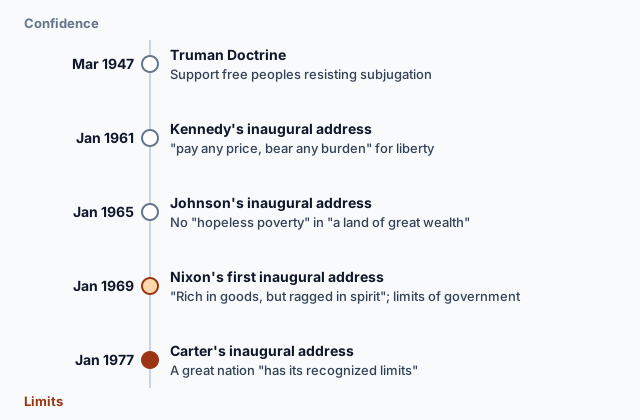 Tap to open the picture full size
Part 1 Think first Any price, or recognized limits?
Commit to a guess first. Being wrong now makes the right idea stick better.
Predict first
In 1961 John F. Kennedy promised Americans would "pay any price, bear any burden, meet any hardship, support any friend, oppose any foe" for liberty. In 1977 Jimmy Carter said Americans had learned that "even our great Nation has its recognized limits, and that we can neither answer all questions nor solve all problems." What do you think did most to change the tone?
In short. Between 1945 and 1980 Americans came to see their nation as the leader of the free world and, through law, as a nation committed to equal rights, but war, protest and division left many by the late 1970s doubting how much their government and their country could do.
- Cold War leadership, from the Truman Doctrine to Kennedy’s pledge to pay any price, became part of how Americans saw their country, and Vietnam set off a debate over how far that leadership and presidential power should reach.
- Civil rights laws and court decisions moved the nation toward its promise of equality, slowly; responding to social conditions and to the African American movement, women, Latinos, American Indians, Asian Americans and LGBTQ+ people organized, and an environmental movement grew out of pollution and accidents.
- Prosperity bred optimism and liberals trusted government to reach social goals, but by the 1970s liberalism was under attack from the left and from a resurgent conservative movement, and after Vietnam, the oil embargo and Watergate, presidents spoke of limits.
Part 2 Learn it What 1945 to 1980 did to national identity
2a. Leader of the free world
National identity is how a people understands who they are as a nation: what they stand for, and what their country is for. After 1945 the United States answered an uncertain world by taking the lead, and that leadership became part of how Americans saw themselves.
On March 12, 1947, President Harry Truman told Congress that "it must be the policy of the United States to support free peoples who are resisting attempted subjugation by armed minorities or by outside pressures." Policymakers fought a cold war with the Soviet Union to limit communism's military power and influence, build a free-market world economy and an international security system. In 1961 Kennedy pledged to "pay any price, bear any burden, meet any hardship, support any friend, oppose any foe" for liberty.
Leadership also brought argument at home, about the power of the federal government and how to pursue its goals while protecting civil liberties. The Red Scare was one such debate; Vietnam was another. In 1964 Congress gave the president broad power to widen the war, and in January 1971 it repealed that resolution to limit President Nixon's power to continue it.
Sources: Truman Doctrine; Kennedy's inaugural; Tonkin Gulf Resolution (all National Archives).
Quick check · Match
Match each event to what it shows about the nation’s role in the world.
2b. Rights won, slowly
Civil rights activists and political leaders sought to fulfill the promises of Reconstruction, and they won real legal and political victories. On May 17, 1954, the Supreme Court ruled unanimously in Brown v. Board of Education that the separate but equal doctrine "has no place in the field of public education." The Civil Rights Act of 1964 and the Voting Rights Act of 1965 followed.
Progress toward racial equality was slow. The Voting Rights Act was signed 95 years after the Fifteenth Amendment was ratified, and a decade after Brown most Black children in the South still attended segregated schools. Yet once the act passed, change came fast: by the end of 1966 only four of 13 southern states had fewer than half of their African American citizens registered to vote.
Responding to social conditions and to the African American movement, other movements organized, which the course framework lists: feminists and LGBTQ+ activists, and Latino, American Indian and Asian American movements that continued older struggles. An environmental movement grew out of pollution and accidents. In 1971 the Twenty-sixth Amendment gave the vote to citizens eighteen years of age or older, pressed partly because young men could be drafted for Vietnam before they could vote.
Sources: Brown v. Board of Education; Voting Rights Act; Amendment XXVI (all National Archives).
Quick check · Fill the statement
Complete the notes on rights from 1945 to 1980.
Civil rights activists sought to fulfill the promises of . They won legal victories such as Brown v. Board of Education, but progress toward racial equality was . Their movement inspired others, such as the movement.
2c. Liberalism, and its critics
Liberalism shaped postwar politics and court decisions. Its high point was Lyndon Johnson's Great Society. In 1965 he said: "In a land of great wealth, families must not live in hopeless poverty."
Then it came under attack from two sides. From the left, critics said liberal leaders did too little to change racial and economic inequality and waged an immoral war in Vietnam. From the right, a resurgent conservative movement, first seen nationally in Barry Goldwater's 1964 presidential campaign, challenged liberal laws and court decisions and sought to limit the federal government.
Events in the 1970s shook trust further. In 1973 an Arab oil embargo brought gas shortages, and years of rising prices and unemployment followed. On August 9, 1974, President Nixon resigned in the Watergate scandal. Nixon had already said in 1969, while promising to keep pressing forward at home: "But we are approaching the limits of what government alone can do." In 1977 Jimmy Carter said Americans had learned that "even our great Nation has its recognized limits, and that we can neither answer all questions nor solve all problems."
Sources: Johnson, 1965, Nixon, 1969 and Carter, 1977 (Avalon Project); Watergate and the Constitution (National Archives).
Quick check · Multiple choice
Johnson in 1965 promised federal action against poverty. Carter in 1977 said the nation could not "solve all problems." What does the change between them show?
2d. Rich in goods, divided in spirit
Rapid economic and social change made many Americans optimistic after the war. Federal spending, the baby boom and new technology drove growth, and Nixon could say in 1969: "We have shared our wealth more broadly than ever." The baby boom, the move to the suburbs and the Sun Belt, and after 1965 new immigrants from around the world also changed who Americans were and where they lived.
But new social developments, together with Cold War fears, changed American culture and set off political and moral debates that sharply divided the nation: over civil rights, the war, the counterculture, and what the country should value. Nixon described both sides in one sentence: "We have found ourselves rich in goods, but ragged in spirit; reaching with magnificent precision for the moon, but falling into raucous discord on earth."
A complex argument does not stop at one side. It can corroborate a claim with more evidence, qualify it by showing where it holds and where it does not, or modify it by changing the claim to fit evidence that challenges it.
Quick check · Sort it
A student claims that from 1945 to 1980 prosperity made Americans confident and united. Tap each piece of evidence, then what it does to the claim.
Corroborates the claim
Qualifies or challenges it
Part 3 Watch it done Qualify a claim about world leadership
Watch each step, then do the last one yourself.
Claim: from 1945 to 1980, Americans came to see their nation as the leader of the free world. Corroborate it, then qualify it.
Predict first
Before the steps, will the evidence mostly support this claim or mostly sink it?
Step 1 · Corroborate
The claim has strong support. Truman in 1947 made support for free peoples resisting outside pressure the policy of the United States. Kennedy in 1961 promised to pay any price for liberty, while adding, "Let us never negotiate out of fear. But let us never fear to negotiate." In 1969 Nixon said that after a period of confrontation the nation was entering an era of negotiation, a new method, but still leadership.
Why this step?
Why corroborate before you qualify?
A qualification only makes sense once the claim is shown to be partly true. Supporting it first tells the reader what part of it you keep.
Step 2 · Look for limits
Vietnam tested the claim. In 1971 Congress repealed the resolution that had let the president widen the war, to limit his power to continue it, and in November 1973 it passed the War Powers Resolution on when a president may send forces into combat.
Your step · Decide and justify
Finish it. Which revision qualifies the claim?
Which evidence best supports your answer?
Part 4 Try it Test a claim about equality
Claim: from 1945 to 1980, the United States fulfilled its promise of equal rights. A complex argument tests a claim like this against the strongest evidence on both sides before deciding how much of it to keep.
Try it · Multiple choice
Which piece of evidence best qualifies the claim, rather than corroborating it?
Try it · Spot the error
A student writes a complex argument about national identity. Which line is the first to go wrong?
Part 5 Explain it Write it like a document-based answer
Nothing you type leaves this page. Check your answer against the model and each scoring point.
Free-response practice · Question 1 style
A short practice in the shape of the document-based question: three documents instead of seven, and a thesis with one body paragraph instead of a full essay.
Evaluate the extent to which the events of 1945 to 1980 reshaped American national identity.
Document 1. John F. Kennedy, inaugural address, January 20, 1961: Americans will "pay any price, bear any burden, meet any hardship, support any friend, oppose any foe" for liberty.
Document 2. National Archives, on the Equal Rights Amendment: "The Equal Rights Amendment (ERA), originally passed by Congress in 1972 with a deadline for ratification by March 1979, gained much support from women and men who felt social change could be garnered through legislation. 35 state legislatures approved the amendment for ratification, however 38 was the magic number needed."
Document 3. Jimmy Carter, inaugural address, January 20, 1977: Americans have learned that "even our great Nation has its recognized limits, and that we can neither answer all questions nor solve all problems." And: "Let our recent mistakes bring a resurgent commitment to the basic principles of our Nation, for we know that if we despise our own government we have no future."
Write a thesis, one sentence of historical context, and one paragraph that uses at least two documents and explains the purpose, audience, point of view or situation of one of them.
Model answer
Thesis: The events of 1945 to 1980 reshaped American national identity more in confidence than in ideals: Americans went from promising to pay any price abroad to doubting their own government, and they widened who could claim the nation’s rights, though that widening stayed contested and incomplete.
Context: after World War II the United States took the lead against the Soviet Union in the Cold War, and postwar prosperity made many Americans optimistic.
In 1961 Kennedy promised Americans would "pay any price" for liberty (Document 1), a confidence that deepened American commitment in Vietnam. By 1977, after that war, the oil embargo and the Watergate scandal, Carter said the nation "has its recognized limits" (Document 3). Carter was a new president speaking to the whole nation, and his purpose was to restore trust, so he names limits in order to promise a fresh start. Yet his appeal to "the basic principles of our Nation" shows what had not changed. The fight over the Equal Rights Amendment points the same way from outside the White House (Document 2): it won wide support, but 35 state legislatures approved it, three short of the 38 it needed. Who counted as an equal American was being redefined and still fought over, which is why the period changed the nation’s confidence more than its founding ideals.
Score your own answer. This is a self-check, not a grade. Tick each point your answer makes.
Part 6 Check yourself Four presidents, four moods
The case questions use the table. The others mix the ideas from the whole lesson.
Each excerpt is from an inaugural address. Sources: Kennedy (National Archives); Johnson, Nixon and Carter (Avalon Project).
| President and year | Excerpts |
|---|---|
| Kennedy, 1961 | "pay any price, bear any burden, meet any hardship, support any friend, oppose any foe to assure the survival and the success of liberty" and "Let us never negotiate out of fear. But let us never fear to negotiate." |
| Johnson, 1965 | "In a land of great wealth, families must not live in hopeless poverty." |
| Nixon, 1969 | "After a period of confrontation, we are entering an era of negotiation." and "But we are approaching the limits of what government alone can do." |
| Carter, 1977 | "even our great Nation has its recognized limits, and that we can neither answer all questions nor solve all problems" |
Case question 1 · Multiple choice
Kennedy and Nixon both speak of negotiation. What changed in emphasis between their excerpts?
Case question 2 · Multiple choice
Which change across the four rows does the table best show?
The rest stand on their own and do not use the case.
Check yourself · Put it in order
Put these events in the order they happened, earliest first.
Check yourself · Select all
Which two pieces of evidence show the nation sharply divided by the late 1960s? Select two.
Select 2 answers, then check.
Check yourself · Sort it
Each card is a criticism of 1960s liberalism. Tap a card, then the side it came from.
From the left
From the right
Part 7 Keep it Bring back earlier ideas
This lesson stands on the Red Scare of Topic 8.3 and the decline of trust in government in Topic 8.14.
Bring it back · Multiple choice
During the Red Scare after World War II, what did Americans debate?
Bring it back · Fill the statement
Read the situation, then complete the sentences.
Suppose a poll in the late 1970s finds that fewer Americans than a decade earlier trust the government to solve the nation’s problems. Historians would point to the oil embargo of 1973, a political that drove a president from office in 1974, and foreign policy such as the long war in Vietnam.
In three lines
- Cold War leadership became part of American identity, and Vietnam set off a lasting debate over how far it, and presidential power, should reach.
- Civil rights laws moved the nation toward equality, slowly, and other movements for rights and justice organized beside them.
- Prosperity bred optimism and liberals trusted government, but war, Watergate and economic trouble left presidents speaking of limits by the 1970s.
Exam strategy for this topic
- Section I Part A, Multiple Choice: 55 questions in 55 minutes.
- Section I Part B, Short Answer: 3 questions in 40 minutes.
- Section II, Document-Based Question and Long Essay: 2 questions in 100 minutes.
- This lesson's Explain it is shaped like free-response question 1, Document-based.
For the complexity point, write the claim, support it, then add a sentence that begins with what the claim leaves out, and give the evidence that shows it.
Questions students ask
What does national identity mean on this topic?
How Americans understood their country: its role in the world, who counted as a full citizen, and what government should do. The question asks how far the events of 1945 to 1980 changed those answers.
Did the United States give up world leadership after Vietnam?
No. The Cold War went on, and Nixon spoke of an era of negotiation rather than of retreat. What changed was confidence in how far that leadership, and presidential power, should reach.
Why use inaugural addresses as evidence?
Each speaks to the whole nation at a turning point, so it shows how a president described the country. Each also has a purpose, usually to unite and reassure, which limits what it can prove.
What is the difference between qualifying and modifying?
Qualifying keeps the claim and adds a limit. Modifying changes the claim, because the evidence against it is too strong to keep it as it was.
Where can I read these documents in full?
Each excerpt links to its full text at the National Archives or the Avalon Project at Yale Law School, the primary-source collections this lesson was checked against.
Course alignment, for teachers
AP U.S. History topic 8.15, Unit 8: Period 8: 1945–1980.
- Skill 6.D: Corroborate, qualify, or modify an argument using diverse and alternative evidence in order to develop a complex argument.
This lesson maps all 10 essential knowledge statements of the topic, and the one learning objective with none of its own, to the part that teaches each one: 11 are checked by a scored question. The map is in the lesson file.