Unit 7 · Topic 7.5 · about 30 minutes · 7 parts · 13 scored checks, 5 of them multiple choice
AP U.S. History 7.5: World War I: Military and Diplomacy
Unit 7: 10 to 17% of the multiple-choice section
What you'll be able to do
- Explain the causes and consequences of U.S. involvement in World War I, and read the war's documents for their point of view, purpose, historical situation and audience.
Key vocabulary
| Term | What it means | The exam trap |
|---|---|---|
| Neutrality | A nation's policy of taking no side in a war between other nations. | Neutral in law is not the same as having no ties to either side; check the dates and the dealings. |
| Unrestricted submarine warfare | Sinking ships in a war zone without warning, whatever their flag or cargo. | It was a German policy that started, paused and resumed, so give its date when you use it as a cause. |
| Zimmermann telegram | A coded German message of 1917 proposing a military alliance with Mexico against the United States. | It was an offer, decoded and published by others, not an attack on the United States. |
| American Expeditionary Forces | The U.S. Army forces sent to Europe in World War I. | How long and how much a force fought are separate questions from how much its arrival mattered. |
| League of Nations | The world organization created by the Treaty of Versailles to provide collective security among its members. | Do not confuse it with the United Nations, founded after World War II. |
 Tap to open the picture full size
Part 1 Think first What changed after 1916?
Commit to a guess first. Being wrong now makes the right idea stick better.
Predict first
In 1916 Woodrow Wilson won a second term, largely because of the slogan "He kept us out of war." On April 2, 1917, he asked Congress to declare war on Germany. What do you think did most to change his course?
In short. The United States stayed neutral in World War I until 1917, then entered it in answer to German submarine warfare and Wilson's call to defend humanitarian and democratic principles, breaking with its tradition of staying out of European affairs; American troops arrived at a crucial moment and helped tip the war to the Allies, but the Senate refused the Treaty of Versailles and the League of Nations.
- Wilson declared neutrality in 1914; German submarine warfare and the Zimmermann telegram led him to ask for war in April 1917, which he framed as making the world "safe for democracy."
- The American Expeditionary Forces played a relatively limited role in combat, but their arrival, as Germany shifted troops west after Russia left the war, helped tip the balance to the Allies.
- Wilson helped write the peace, and his League of Nations went into the Treaty of Versailles, but the Senate never adopted the treaty and the United States never joined the League.
Part 2 Learn it Into the war, and out of the peace
2a. From neutrality to war
When war broke out in Europe in 1914, Wilson declared the nation neutral and asked Americans to stay impartial in thought as well as deed. Neutrality fit an old tradition. In 1796 George Washington's Farewell Address advised: "It is our true policy to steer clear of permanent alliances with any portion of the foreign world."
Neutrality grew harder to keep. On May 7, 1915, a German submarine sank the Lusitania, and 128 Americans died. Trade tied the country to Britain and France: munitions shipments to them rose from about 6 million dollars in 1914 to almost 500 million in 1917, and American bankers lent the Allies over 2 billion dollars.
In early 1917 two blows landed. Germany announced that it would renew unrestricted submarine warfare on February 1. Then came the Zimmermann telegram, a secret German message to Mexico that British codebreakers decoded and that the American press published on March 1. It opened: "We intend to begin on the first of February unrestricted submarine warfare." It went on to propose a German alliance with Mexico if the United States entered the war. On April 6, 1917, Congress declared war on Germany. Entering a European war broke with the tradition of noninvolvement that Washington had urged.
Sources: Washington's Farewell Address (Avalon Project); War Message (National Archives); Zimmermann Telegram (National Archives).
Quick check · Put it in order
Put these events in the order they happened, earliest first.
2b. Wilson's case: humanity and democracy
On April 2, 1917, Wilson asked a joint session of Congress for war. He named the losses: "American ships have been sunk, American lives taken." But he widened the case to principles he said every people shared.
The first principle was humanitarian: the protection of human life. "The present German submarine warfare against commerce is a warfare against mankind," he said, and he condemned "the wanton and wholesale destruction of the lives of noncombatants, men, women, and children."
The second was democratic: government answerable to the governed. "The world must be made safe for democracy," he declared, and Americans would fight "for democracy, for the right of those who submit to authority to have a voice in their own Governments, for the rights and liberties of small nations."
He also denied any gain for the nation: "We have no selfish ends to serve. We desire no conquest, no dominion." The nation was told it was going to war for the sake of the world, not for land or power.
Quick check · Sort it
Each card is a phrase from Wilson's war message. Tap a card, then the principle it appeals to.
Humanitarian: protecting human life
Democratic: government answerable to the people
2c. Over there: tipping the balance
Congress passed the Selective Service Act of 1917 to raise the American Expeditionary Forces. Britain, France and Germany had been fighting since 1914, so compared with their armies the American Expeditionary Forces played a relatively limited role in combat.
Timing made that role matter. Russia signed an armistice with Germany in December 1917, which freed Germany to move its troops to the Western Front. If Germany could launch a huge offensive before the Americans came to the aid of its war-weary enemies, Germany could win. American troops arrived at that crucial moment, and the entry of the United States helped tip the balance of the war in favor of the Allies. Units such as the 369th Infantry, an all-black regiment, helped stop the German offensive and spent 191 days in combat, longer than any other American unit.
Aid mattered too. Wilson's war message promised the Allies "the extension to those governments of the most liberal financial credit." The fighting ended with an armistice on November 11, 1918.
Sources: The 369th Infantry (National Archives); War Message (National Archives); Zimmermann Telegram (National Archives).
Quick check · Multiple choice
Which statement best describes the military effect of American entry into World War I?
2d. Wilson's peace and the Senate's answer
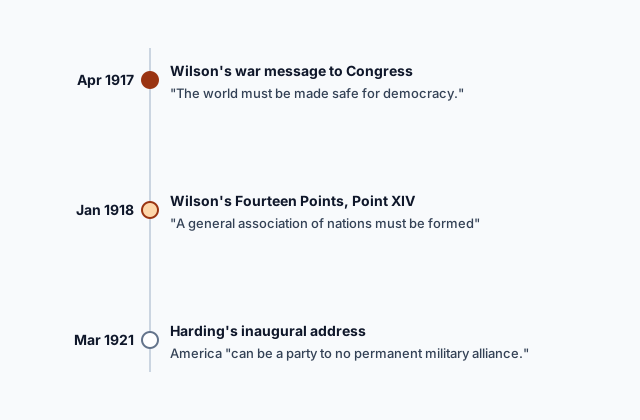
On January 8, 1918, Wilson told Congress his Fourteen Points for peace. The first called for "Open covenants of peace, openly arrived at, after which there shall be no private international understandings of any kind but diplomacy shall proceed always frankly and in the public view." The last was the capstone: "A general association of nations must be formed under specific covenants for the purpose of affording mutual guarantees of political independence and territorial integrity to great and small states alike."
Wilson took a deep part in the peace negotiations. To his dismay, most of his points were scuttled by the leaders of Britain and France, who were mostly interested in regaining what they had lost and punishing Germany. His capstone survived: a world organization, the League of Nations, went into the Treaty of Versailles, signed June 28, 1919.
The treaty still needed the U.S. Senate. Wilson campaigned tirelessly to overcome opposition there, but the Senate never adopted the treaty, and the United States never joined the League of Nations. The man most responsible for the League could not bring his own country into it.
Sources: Fourteen Points (National Archives); Avalon Project index (treaty date).
Quick check · Fill the statement
Complete the summary of the peace.
Wilson's last point called for a general association of nations, and that idea went into the Treaty of Versailles as the . Despite Wilson's campaign, the U.S. Senate the treaty.
Part 3 Watch it done Source Wilson's war message
Watch each step, then do the last one yourself.
In his war message of April 2, 1917, Wilson said: "The world must be made safe for democracy." Later he added: "We have no selfish ends to serve. We desire no conquest, no dominion." Explain how the speech's audience and purpose shape these claims.
Predict first
Before the steps, whom do you think Wilson most needed to persuade that day?
Step 1 · Place it in time
In 1916 Wilson had won reelection on the slogan "He kept us out of war." Since then Germany had renewed unrestricted submarine warfare and the Zimmermann telegram had been printed. The speech asked for a war the same voters had been told they were being kept out of.
Why this step?
Why does the 1916 slogan matter for reading a 1917 speech?
A speaker who must reverse a popular position has a strong reason to give the change the highest possible justification. Knowing the slogan tells you what the speech had to overcome.
Step 2 · Name the audience and purpose
Only Congress can declare war, so the speech was addressed to a joint session, but Wilson also needed the public that had reelected him. His purpose was to win a declaration of war and to persuade Americans that the war served humanity and democracy rather than national gain.
Your step · Decide and justify
Finish it. How does the speech's purpose limit its use as evidence of why the United States went to war?
Which evidence best supports your answer?
Part 4 Try it A new president looks back
Warren G. Harding took office on March 4, 1921. His inaugural address said: "The recorded progress of our Republic, materially and spiritually, in itself proves the wisdom of the inherited policy of noninvolvement in Old World affairs." He went on: "we seek no part in directing the destinies of the Old World. We do not mean to be entangled." America, he said, "can be a party to no permanent military alliance. It can enter into no political commitments, nor assume any economic obligations which will subject our decisions to any other than our own authority."
Try it · Multiple choice
What does Harding's speech show about continuity and change in American foreign policy?
Try it · Select all
Which two facts help explain why Harding could speak of noninvolvement as settled policy in 1921? Select two.
Select 2 answers, then check.
Part 5 Explain it Write it like a document-based answer
Nothing you type leaves this page. Check your answer against the model and each scoring point.
Free-response practice · Question 1 style
A short practice in the shape of the document-based question: three documents instead of seven, and a thesis with one body paragraph instead of a full essay.
Evaluate the extent to which World War I changed the role of the United States in world affairs between 1914 and 1921.
Document 1. Woodrow Wilson, war message to Congress, April 2, 1917: "The world must be made safe for democracy." And: "We have no selfish ends to serve. We desire no conquest, no dominion."
Document 2. Woodrow Wilson, the Fourteen Points, January 8, 1918, Point XIV: "A general association of nations must be formed under specific covenants for the purpose of affording mutual guarantees of political independence and territorial integrity to great and small states alike."
Document 3. Warren G. Harding, inaugural address, March 4, 1921: America "can be a party to no permanent military alliance. It can enter into no political commitments, nor assume any economic obligations which will subject our decisions to any other than our own authority."
Write a thesis, one sentence of historical context, and one paragraph that uses at least two documents and explains the purpose, audience, point of view or situation of one of them.
Model answer
Thesis: World War I changed the American role in the world for a few years, as the nation broke with its tradition of noninvolvement to fight in Europe and proposed a world organization, but by 1921 it had largely returned to that tradition, since the Senate refused the treaty and the League.
Context: since Washington's Farewell Address of 1796 advised that it was "our true policy to steer clear of permanent alliances with any portion of the foreign world," the nation had stayed out of European alliances, and in 1914 Wilson declared it neutral.
Wilson told Congress the war would make the world "safe for democracy" and claimed "no selfish ends" (Document 1). His purpose was to win a declaration of war and the support of a public that had reelected him on the slogan that he kept the country out of war, so he cast entry in terms of principle; the speech shows the case he chose to make more than every cause, such as war trade with the Allies. In 1918 he went further and called for "a general association of nations" to guarantee the independence of "great and small states alike" (Document 2), a permanent commitment no earlier president had proposed. The change did not last. Although that association, the League of Nations, went into the Treaty of Versailles, the Senate never adopted the treaty, and Harding refused any "permanent military alliance" (Document 3), calling noninvolvement inherited policy. The war was a departure, and its aftermath brought a return.
Score your own answer. This is a self-check, not a grade. Tick each point your answer makes.
Part 6 Check yourself A peace plan for more than one audience
The case questions use the two excerpts and the note. The others mix the ideas from the whole lesson.
Wilson gave the Fourteen Points to Congress on January 8, 1918, ten months before the armistice. The National Archives notes that the points were broadcast around the world and showered from rockets and shells behind enemy lines. Source: President Wilson's 14 Points (National Archives).
| Point | Excerpt |
|---|---|
| I | "Open covenants of peace, openly arrived at, after which there shall be no private international understandings of any kind but diplomacy shall proceed always frankly and in the public view." |
| XIV | "A general association of nations must be formed under specific covenants for the purpose of affording mutual guarantees of political independence and territorial integrity to great and small states alike." |
Case question 1 · Multiple choice
Besides Congress, which audience was the Fourteen Points speech most clearly meant to reach?
Case question 2 · Multiple choice
Point XIV's idea went into the Treaty of Versailles. Why did it still not bring the United States into the association it proposed?
The rest stand on their own and do not use the case.
Check yourself · Spot the error
A student explains the American contribution to the war. Which line is the first to go wrong?
Check yourself · Match
Match each event to what followed from it.
Part 7 Keep it Bring back earlier ideas
This lesson's debate over the nation's role abroad began with Topic 7.2, and Wilson's language of democracy echoes the Progressives of Topic 7.4.
Bring it back · Sort it
Tap each Progressive Era change, then the aim it most directly served.
Expand democracy
Regulate the economy
Bring it back · Multiple choice
Around 1900, which argument would an anti-imperialist have used against taking territory overseas?
In three lines
- Neutral from 1914, the United States entered World War I in 1917 after German submarine warfare and the Zimmermann telegram, as Wilson called for defending humanitarian and democratic principles and broke with the tradition of noninvolvement.
- The American Expeditionary Forces played a relatively limited combat role, but their arrival as Germany shifted troops west helped tip the war to the Allies.
- Wilson shaped the peace and the League of Nations, but the Senate refused the Treaty of Versailles and the League.
Exam strategy for this topic
- Section I Part A, Multiple Choice: 55 questions in 55 minutes.
- Section I Part B, Short Answer: 3 questions in 40 minutes.
- Section II, Document-Based Question and Long Essay: 2 questions in 100 minutes.
- This lesson's Explain it is shaped like free-response question 1, Document-based.
When a question asks about the consequences of World War I for American foreign policy, set the entry into the war against the Senate's refusal of the treaty. A paragraph that shows both the departure and the return explains more than one that shows only one.
Questions students ask
Why did the United States enter World War I in 1917 and not earlier?
Wilson declared neutrality in 1914. The sinking of the Lusitania in 1915 strained it, but the decisive pressures came in early 1917: Germany renewed unrestricted submarine warfare on February 1, and the Zimmermann telegram, proposing a German alliance with Mexico, was published on March 1. Congress declared war on April 6, 1917.
What did Wilson mean by making the world safe for democracy?
In his war message he said Americans would fight for the right of people to have a voice in their own governments and for the rights and liberties of small nations, and he claimed the nation sought no conquest or dominion.
Did the American army win the war?
No single army did. The American Expeditionary Forces played a relatively limited combat role, but they arrived as Germany moved troops west after Russia's armistice in December 1917, and the American entry helped tip the balance to the Allies.
Did the United States join the League of Nations?
No. Wilson's capstone point became the League of Nations in the Treaty of Versailles, but the Senate never adopted the treaty, and the United States never joined the League.
Where can I read these documents in full?
Each excerpt links to its full text at the National Archives or the Avalon Project at Yale Law School, the primary-source collections this lesson was checked against.
Course alignment, for teachers
AP U.S. History topic 7.5, Unit 7: Period 7: 1890–1945.
- Skill 2.C: Explain the significance of a source’s point of view, purpose, historical situation, and/or audience, including how these might limit the use(s) of a source.
This lesson maps all 3 essential knowledge statements of the topic, and the one learning objective with none of its own, to the part that teaches each one: 4 are checked by a scored question. The map is in the lesson file.