Unit 1 · Topic 1.6 · about 30 minutes · 7 parts · 13 scored checks, 5 of them multiple choice
AP U.S. History 1.6: Cultural Interactions Between Europeans, Native Americans, and Africans
Unit 1: 4 to 6% of the multiple-choice section
What you'll be able to do
- Explain how and why European and Native American views of each other developed and changed from 1491 to 1607, and identify the evidence a source, such as a royal charter, uses to support its argument.
Key vocabulary
| Term | What it means | The exam trap |
|---|---|---|
| Worldview | A people's overall picture of how the world works, including their beliefs about religion, family, land and power. | Native societies differed from one another; check whether a claim is about one people or many. |
| Sovereignty | A people's right to govern themselves without outside control. | Defending sovereignty could mean negotiating as well as fighting; do not equate it with war alone. |
| Cultural adoption | Taking up a useful practice, tool or crop from another culture. | Adopting one part of a culture does not mean accepting the rest of it. |
| Valladolid debate | A Spanish debate held in 1550 and 1551 over how Native peoples should be treated. | Keep the two sides straight by what each argued, not by which one sounds more modern. |
| Justification | A reason someone gives to show that an action is right, such as a charter's reason for claiming land. | A justification shows the speaker's point of view; it is not evidence that the reason was true. |
 Tap to open the picture full size
Part 1 Think first A gift or a sale?
Commit to a guess first. Being wrong now makes the right idea stick better.
Predict first
Picture a European trader and a Native leader on the Atlantic coast in the 1500s. The leader gives the trader a bundle of furs and expects gifts in return, now and on later visits, to keep the friendship between their peoples alive. The trader hands over some metal knives and treats the deal as a finished sale. What is the most likely result?
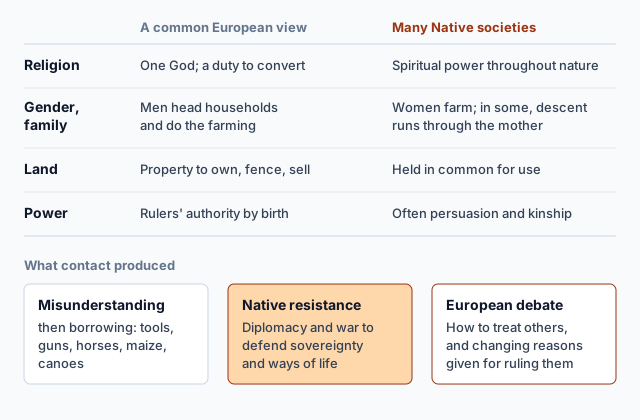
In short. After contact, Europeans and Native Americans held different worldviews and often misunderstood each other, then borrowed what was useful from each other's cultures; Native peoples defended their independence through diplomacy and war, while Europeans debated how to treat non-Europeans and built changing religious, cultural and racial justifications for ruling them.
- Europeans and Native Americans held different views of religion, gender roles, family, land use and power, and early trade was full of misunderstanding.
- Over time each side adopted useful parts of the other's culture, and Native peoples defended their sovereignty, economies, beliefs and ways of life through diplomacy and military resistance.
- European religious and political leaders debated how non-Europeans should be treated, and justified subjugating Native Americans and Africans on religious, cultural and, over time, racial grounds.
Part 2 Learn it How Europeans and Native Americans saw each other
2a. Different worldviews
Europeans and Native Americans each brought their own picture of how the world worked, and in their dealings each side asserted it. Native societies differed widely from one another, so read each contrast below as true of many Native peoples, not all of them.
- Religion. Europeans were Christians who worshiped one God and saw converting others as a duty. Many Native religions found spiritual power throughout the natural world.
- Gender roles and family. In many Native societies women did most of the farming, and in some, families traced descent through the mother's line and women held real political influence. Europeans expected men to head households and do the farm work.
- Land use. Many Native peoples held land in common and claimed the right to use it, to farm, hunt or fish. Europeans treated land as property that an owner could fence, sell or pass on.
- Power. European monarchs claimed authority from God and passed it on by birth. Outside the great empires of Mexico and Peru, many Native leaders led by persuasion and kinship ties more than by command.
Each side judged the other by its own picture. A European who expected men to farm could see Native men who hunted as idle, and miss that Native women ran the fields.
Quick check · Sort it
Each card states a view about how the world works. Tap a card, then the group that commonly held it.
A common European view
A view held in many Native societies
2b. Misunderstanding, then borrowing
In the early years of contact and trade, each group tried to make sense of the other with its own ideas, and mutual misunderstandings were common. A Native community that let newcomers use a stretch of land could believe it had shared the land, while the newcomers believed they now owned it. An exchange one side saw as a gift binding two peoples together, the other might treat as a sale that ended on the spot.
Over time, Europeans and Native Americans each adopted useful parts of the other's culture. Native peoples took up European metal tools, kettles, cloth and guns, and many peoples of the plains later built their way of life around the horse, an animal Europeans brought. Europeans learned to grow maize and other American crops, traveled in Native canoes and along Native trails, and leaned on Native knowledge of the land to survive.
Borrowing did not mean agreement. A people could adopt the other side's tools and still reject its religion or its claims to land.
Quick check · Multiple choice
A Native leader lets a group of European settlers plant crops on a stretch of land near his village. Years later the settlers forbid his people to hunt there, and he protests that the land was never given away. Which explanation best fits the conflict?
2c. Native resistance: diplomacy and war
As Europeans took more Native land and demanded more Native labor, Native peoples worked to defend their sovereignty (their right to govern themselves), their economic prosperity, their religious beliefs, and their ideas about the roles of men and women. They used diplomacy and they used war, often both.
Diplomacy. Native leaders negotiated, traded and made alliances, often to gain an edge over their own rivals. When Hernán Cortés's force moved inland toward the Aztec capital in 1519, the Tlaxcalans, longtime enemies of the Aztec, first fought the Spanish and then allied with them. The alliance served Tlaxcalan goals, though no Native ally could control what the Spanish did with the victory.
Military resistance. Many Native peoples fought invaders directly. The Aztec fought the Spanish for their capital. Hernando de Soto's expedition through the Southeast, which began in 1539, met armed resistance from many Native peoples along its route.
Both choices were ways of acting, not just reacting. Native nations weighed their own interests, and their rivalries with one another, when they decided how to meet the newcomers.
Quick check · Fill the statement
Complete the notes on how Native peoples defended themselves.
The Tlaxcalans' choice to make peace and ally with Cortés against their Aztec rivals is an example of . Native peoples who fought the soldiers of Hernando de Soto's expedition used .
2d. The European debate, and the charters' justifications
Long contact with Native Americans and Africans set off a debate among European religious and political leaders over how non-Europeans should be treated. In Spain it came to a head at Valladolid in 1550 and 1551. Bartolomé de las Casas, a friar who had once held an encomienda, argued that Native peoples were rational human beings who should be brought to Christianity peacefully. Juan Ginés de Sepúlveda, a scholar, argued that their ways of life made it just to conquer them by war.
Europeans also built justifications for ruling over others, and these changed over time. Some were religious: lands of non-Christians were open to Christian rulers. Some were cultural: Native ways of life were called uncivilized. Over time, racial justifications grew too, especially for enslaving Africans.
The charter Elizabeth I granted Walter Raleigh on March 25, 1584, shows the religious argument at work. It licensed him to find and hold "remote, heathen and barbarous lands, countries, and territories, not actually possessed of any Christian Prince, nor inhabited by Christian People." Those words are the charter's point of view, not a description of the people who lived there. The evidence it offers for England's right to such lands is the religion of the people living on them. It cites no agreement with them at all.
Source: Charter to Sir Walter Raleigh, 1584 (Avalon Project).
Quick check · Match
Match each argument a European might have made in the 1500s to the kind of argument it is.
Part 3 Watch it done Find the evidence in the Virginia charter
Watch each step, then do the last one yourself.
The First Charter of Virginia, granted by King James I on April 10, 1606, approves a colony because it would aid in "propagating of Christian Religion to such People, as yet live in Darkness and miserable Ignorance of the true Knowledge and Worship of God, and may in time bring the Infidels and Savages, living in those parts, to human Civility." What evidence does the passage give for approving the colony?
Predict first
Before the steps, what kind of reason do you think the passage gives?
Step 1 · Find the claim
The charter's claim is that the king should approve the colony, which it presents as a noble work. Everything else in the passage is there to support that claim.
Why this step?
Why find the claim before the evidence?
Evidence is only evidence for something. Until you know what a source argues, you cannot tell which of its words are doing the supporting.
Step 2 · Read the words that support it
The passage says the colony would spread Christianity to people it describes as living in ignorance of God, and would bring them, in its words, "to human Civility." Those words are the charter's view of Native peoples, written by English rulers, not a description of how Native people lived.
Your step · Decide and justify
Finish it. What evidence does this passage give for approving the colony?
Which part of the charter shows it?
Part 4 Try it Evidence or judgment?
A source's evidence and its conclusion are not the same thing. Some sources report what their authors saw and then judge it by their own customs. Try a new case, then check a student's reading of the Raleigh charter.
Try it · Multiple choice
Suppose a European missionary in the early 1600s writes that in the Native town he visited, the men spent their days hunting and fishing while the women worked the fields, and he concludes that the men were lazy. What does the account show best?
Try it · Spot the error
A student writes about the evidence in Elizabeth I's 1584 charter to Walter Raleigh. Which line is the first to go wrong?
Part 5 Explain it Write it like a document-based answer
Nothing you type leaves this page. Check your answer against the model and each scoring point.
Free-response practice · Question 1 style
A short practice in the shape of the document-based question: three documents instead of seven, and a thesis with one body paragraph instead of a full essay.
Evaluate the extent to which European rulers justified their claims in the Americas on religious grounds between 1492 and 1607.
Document 1. Privileges granted by Ferdinand and Isabella of Spain to Christopher Columbus, April 30, 1492: Columbus is going "to discover and subdue some Islands and Continent in the ocean."
Document 2. Charter granted by Elizabeth I of England to Walter Raleigh, March 25, 1584: Raleigh may find and hold "remote, heathen and barbarous lands, countries, and territories, not actually possessed of any Christian Prince, nor inhabited by Christian People."
Document 3. The First Charter of Virginia, granted by James I of England, April 10, 1606: the colony would aid in "propagating of Christian Religion to such People, as yet live in Darkness and miserable Ignorance of the true Knowledge and Worship of God, and may in time bring the Infidels and Savages, living in those parts, to human Civility." The same charter allows the colonists to "dig, mine, and search for all Manner of Mines of Gold, Silver, and Copper."
Write a thesis, one sentence of historical context, and one paragraph that uses at least two documents and explains the purpose, audience, point of view or situation of one of them.
Model answer
Thesis: European rulers leaned heavily on religious justifications for their claims in the Americas, and they joined cultural ones to them, but religion rarely stood alone, because the same documents also aimed at wealth and conquest.
Context: Spanish conquests in the 1500s brought Spain great wealth from American gold and silver, and rival European nations such as England sought their own colonies, in part to compete with Spain.
In 1584 Elizabeth I let Raleigh claim lands the charter itself labels "heathen and barbarous" and "not actually possessed of any Christian Prince" (Document 2), so the evidence for England's right was the religion of the people living there. The Virginia charter of 1606 goes further, joining religion to a cultural judgment: the colony would spread "Christian Religion" and bring "the Infidels and Savages" to "human Civility" (Document 3). That is the charter's point of view, written by an English king for English colonists and investors, so its words show how England justified the colony, not how Native peoples lived. The same charter lets the colonists "dig, mine, and search" for gold and silver, and in 1492 Columbus went to "discover and subdue" (Document 1), which suggests religious language framed ventures that also sought wealth and power.
Score your own answer. This is a self-check, not a grade. Tick each point your answer makes.
Part 6 Check yourself Two English charters
The case questions use the two excerpts. The others mix the ideas from the whole lesson.
Both excerpts come from royal charters that licensed English colonies in North America, twenty-two years apart. The words are the charters', and they show the point of view of the English rulers who issued them. Sources: Charter to Sir Walter Raleigh, 1584 (Avalon Project); First Charter of Virginia, 1606 (Avalon Project).
| Document | Excerpt |
|---|---|
| Charter to Walter Raleigh, granted by Elizabeth I, March 25, 1584 | "remote, heathen and barbarous lands, countries, and territories, not actually possessed of any Christian Prince, nor inhabited by Christian People" |
| First Charter of Virginia, granted by James I, April 10, 1606 | "propagating of Christian Religion to such People, as yet live in Darkness and miserable Ignorance of the true Knowledge and Worship of God, and may in time bring the Infidels and Savages, living in those parts, to human Civility" |
Case question 1 · Multiple choice
What evidence do both excerpts use to support England's claims in the Americas?
Case question 2 · Multiple choice
A historian wants to use the 1606 excerpt as evidence. For which purpose is it most useful?
The rest stand on their own and do not use the case.
Check yourself · Select all
Which two are examples of Europeans or Native Americans adopting a useful part of the other's culture? Select two.
Select 2 answers, then check.
Check yourself · Fill the statement
Complete the notes on the debate at Valladolid.
At Valladolid in 1550 and 1551, argued that Native peoples were rational human beings who should be brought to Christianity peacefully, while argued that their ways of life made it just to conquer them by war.
Part 7 Keep it Bring back earlier ideas
This lesson stands on Spain's labor and caste systems from Topic 1.5 and the Columbian Exchange from Topic 1.4.
Bring it back · Multiple choice
In Spain's American empire, which person would most likely hold the highest office in a colony's government?
Bring it back · Sort it
Each card names something carried across the Atlantic in the Columbian Exchange. Tap a card, then the way it traveled.
From the Americas to Europe
From Europe to the Americas
In three lines
- Europeans and many Native societies held different views of religion, gender roles, family, land use and power, and early contact was full of misunderstanding before each side borrowed from the other.
- Native peoples defended their sovereignty, economies, beliefs and ways of life through diplomacy and military resistance.
- European leaders debated how to treat non-Europeans, and justified ruling them on religious, cultural and, over time, racial grounds, as the English charters' own words show.
Exam strategy for this topic
- Section I Part A, Multiple Choice: 55 questions in 55 minutes.
- Section I Part B, Short Answer: 3 questions in 40 minutes.
- Section II, Document-Based Question and Long Essay: 2 questions in 100 minutes.
- This lesson's Explain it is shaped like free-response question 1, Document-based.
When a question asks what evidence a source uses, quote the words that do the supporting, then say whose point of view they show. A charter's judgment of Native peoples is evidence about the charter's authors.
Questions students ask
Did all Native Americans share one worldview?
No. Native societies ranged from the great empires of Mexico and Peru to small farming and hunting communities, and their beliefs differed. The contrasts in this lesson describe views held in many Native societies, not in all.
Why does this lesson quote words like heathen and savages?
Because the charters used them. The lesson quotes them as evidence of how English rulers saw Native peoples and justified their claims. They are the charters' judgments, not facts about the people who lived in the Americas.
Did Native peoples only resist Europeans?
No. Many traded with Europeans, adopted useful European goods, and made alliances to gain an edge over their own rivals, as the Tlaxcalans did with the Spanish in 1519. Diplomacy and war were both ways of defending their sovereignty.
What was the Valladolid debate about?
It was a Spanish debate in 1550 and 1551 over how Native peoples should be treated. Bartolomé de las Casas argued that they were rational human beings who should be converted peacefully; Juan Ginés de Sepúlveda argued that war against them was just.
Where can I read the charters?
Each excerpt links to its full text at the Avalon Project at Yale Law School. The older charters keep their original wording, and every excerpt here is copied exactly as the archive prints it.
Course alignment, for teachers
AP U.S. History topic 1.6, Unit 1: Period 1: 1491–1607.
- Skill 3.B: Identify the evidence used in a source to support an argument.
This lesson maps all 4 essential knowledge statements of the topic, and the one learning objective with none of its own, to the part that teaches each one: 5 are checked by a scored question. The map is in the lesson file.