Unit 8 · Topic 8.13 · about 30 minutes · 7 parts · 13 scored checks, 4 of them multiple choice
AP U.S. History 8.13: The Environment and Natural Resources from 1968 to 1980
Unit 8: 10 to 17% of the multiple-choice section
What you'll be able to do
- Explain how and why environmental and energy policies developed and changed from 1968 to 1980, and identify the pattern that connects environmental accidents, public action and new federal laws.
Key vocabulary
| Term | What it means | The exam trap |
|---|---|---|
| Environmental movement | The movement that grew in the late 1960s and 1970s to combat pollution and protect natural resources through laws and public pressure. | It worked through laws and public action together; it was not only protests, and not only government. |
| Environmental Protection Agency | The independent federal agency, in effect from December 2, 1970, that gathered pollution powers from other agencies to enforce environmental laws. | The EPA enforces laws Congress passes; it was created by a reorganization plan, not by the Clean Air Act. |
| National energy policy | A federal plan for how the country produces, allocates and uses energy, which oil crises in the 1970s pushed Washington to attempt. | The phrase describes a goal the government kept working toward, through a series of offices, not one law passed at a single moment. |
| Three Mile Island | The nuclear power plant in Pennsylvania where an accident on March 28, 1979, resulted in the escape of radiation. | It was an accident at a power plant, not a weapons test; it belongs to the debates over energy and the environment. |
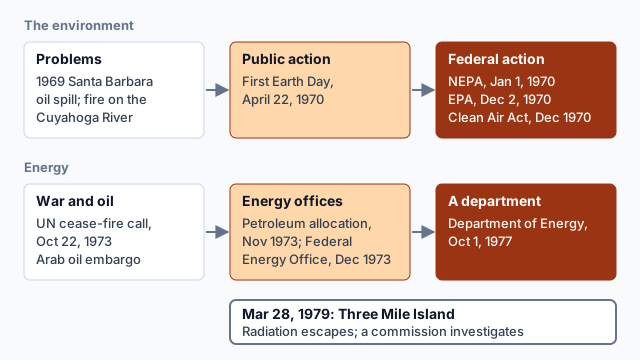 Tap to open the picture full size
Part 1 Think first Which came first?
Commit to a guess first. Being wrong now makes the right idea stick better.
Predict first
Between 1969 and 1970, an oil spill fouled the coast near Santa Barbara, California, the first Earth Day was held across the country, and Washington created the Environmental Protection Agency. In what order do you think they came?
In short. Environmental accidents of the late 1960s and 1970s turned a growing concern into a movement and a run of new federal laws and agencies, while the 1973 oil embargo and the 1979 oil shock pushed Washington to build a national energy policy.
- An oil spill off Santa Barbara, a fire on the Cuyahoga River and the first Earth Day in 1970 turned concern about pollution into a major political issue.
- The federal government answered with new programs and rules: the National Environmental Policy Act, the Environmental Protection Agency, and the Clean Air, Clean Water and Endangered Species Acts.
- Cold War rivalry, support for Israel and dependence on oil tied the United States to the Middle East; the 1973 embargo and the 1979 shock led to new energy offices and a Department of Energy.
Part 2 Learn it The environment and energy, 1968 to 1980
2a. Accidents that built a movement
Only eight days into his presidency in 1969, Richard Nixon faced an oil spill off the coast of Santa Barbara, California. A fire on the Cuyahoga River in Cleveland, among other events, drew more attention to pollution.
Ideas had prepared the ground. Rachel Carson's Silent Spring (1962) had warned of the harm done by pesticides, and many Americans, more prosperous and more suburban than before, had come to care about clean air, clean water and open land. Accidents focused that concern. Environmental problems and accidents led to a growing environmental movement, which aimed to use legislative and public efforts to combat pollution and protect natural resources.
The first Earth Day took place on April 22, 1970. In the National Archives' words, "the nationwide demonstration spurred a dramatic rise in public concern about environmental issues." An article in the National Archives' magazine puts the change plainly: "What had at best been a minor issue during the 1968 presidential campaign by 1970 became a major political issue." Concern was not new; Nixon's first inaugural address in January 1969, days before the spill, had already listed "protecting our environment and enhancing the quality of life" among many goals. What the spill and Earth Day changed was how much the issue counted.
Sources: Nixon on the Home Front (Prologue, National Archives); Earth Day (National Archives); Nixon's first inaugural address (Avalon Project).
Quick check · Sort it
Each card is an event from the years around 1970. Tap a card, then the part of the pattern it belongs to.
A problem or accident
A public or government response
2b. Washington writes environmental law
The federal government answered with new environmental programs and regulations. On January 1, 1970, Nixon signed the National Environmental Policy Act, which sought to establish a national environmental policy and created a Council on Environmental Quality. In December 1970 he signed the Clean Air Act of 1970, which called for drastic reductions in harmful emissions from automobiles and other sources.
Enforcing those laws needed an agency. Authority over pollution had grown piecemeal, spread among many parts of the government. The Environmental Protection Agency (EPA), an independent agency, took effect on December 2, 1970, and brought those powers together. The Clean Water and Endangered Species Acts followed later in the decade.
The new rules had opponents. Four automakers sued the EPA to extend the deadlines for cleaner cars, aided by oil companies who resisted the phase-out of leaded gasoline. Nixon himself watched the politics. On January 7, 1972, in a conversation recorded in the Oval Office, he told EPA Administrator Russell Train: "The environment thing must not be allowed to become a fad of the elitist." He went on: "The environment thing, to really mean something to this country, has got to reach down to that blue-collar guy and the rest and so forth."
Sources: Nixon on the Home Front (Prologue); Records of the EPA; Earth Day (National Archives).
Quick check · Multiple choice
Why did the federal government create the Environmental Protection Agency in 1970?
2c. The Middle East and two oil shocks
Ideological, military and economic concerns shaped American involvement in the Middle East. The ideological concern was the Cold War: keeping Soviet influence out of the region. The military concern included support for Israel and arms for friendly governments such as the Shah's Iran. The economic concern was oil, which the American economy imported in growing amounts.
The concerns collided in October 1973. Egypt and Syria attacked Israel, and the United States sent Israel military aid. On October 22 the United Nations Security Council called for a cease-fire. Arab oil producers answered American aid to Israel with an oil embargo, cutting off shipments to the United States. World oil prices roughly quadrupled, and Americans waited in long lines for scarce gasoline.
A second shock came in 1979. Revolution in Iran overthrew the Shah, an American ally, and oil prices jumped again. Gas lines returned that summer.
Diplomacy was part of the response too. The Camp David Accords of 1978, which Carter brokered between Egypt and Israel, begin by noting "After four wars during 30 years" between Israel and its neighbors.
Sources (the embargo and the 1979 shock are well established but not printed on these archive pages): Resolution 338; Camp David Accords (Avalon Project).
Quick check · Fill the statement
Complete the notes on the oil shocks of the 1970s.
In October 1973 Arab oil producers answered American aid to with an oil embargo against the United States. In 1979 revolution in overthrew an American ally and set off a second jump in oil prices.
2d. Toward a national energy policy
The oil crises sparked attempts at a national energy policy, and the federal records show Washington building one energy office after another. Planning had started before the October war, as shortages and price controls strained supplies. A National Energy Office was set up on April 18, 1973, to advise the President, and a law of April 30, 1973, gave the government power to allocate petroleum. The Office of Petroleum Allocation, created November 6, 1973, carried out that law.
The embargo turned planning into a crisis. A Federal Energy Office became an independent agency on December 4, 1973, and a Federal Energy Administration took over the earlier offices in June 1974. In 1977 Congress created a cabinet Department of Energy, in effect October 1, 1977, consolidating the federal energy agencies.
Source: General Records of the Department of Energy (National Archives).
Quick check · Put it in order
Put these federal energy steps in the order they happened, earliest first.
Part 3 Watch it done Find the pattern
Watch each step, then do the last one yourself.
In 1969 there was an oil spill off Santa Barbara. In 1970 the EPA came into being. In 1979 radiation escaped at the Three Mile Island nuclear plant, and two weeks later President Carter created a commission to investigate. Identify the pattern that connects these events.
Predict first
Before the steps, what do you think connects them?
Step 1 · Line up the dates
Santa Barbara spill: 1969. First Earth Day: April 22, 1970. EPA in effect: December 2, 1970. Three Mile Island accident: March 28, 1979. Commission created by executive order: April 11, 1979.
Why this step?
Why line up dates before naming a pattern?
A pattern is a sequence that repeats. You can only see a repeat once the events are in order, and the order tells you what could have caused what.
Step 2 · Sort each event by kind
The spill and the nuclear accident are problems. Earth Day is the public's response. The EPA and the commission are the government's responses.
Your step · Decide and justify
Finish it. Which pattern connects the events?
Which evidence best supports your answer?
Part 4 Try it Three Mile Island
On April 11, 1979, President Carter created a commission by executive order "to issue an investigative report on the March 28, 1979, accident at the Unit 2 nuclear power plant on Three Mile Island, PA, that had resulted in the escape of radiation." Its chairman was college president John G. Kemeny, and it delivered its final report on October 30, 1979. The accident joined the debates over energy and the environment in a single event.
Another case from the same years: at Love Canal, in Niagara Falls, New York, families learned in 1978 that their neighborhood sat on buried toxic waste. In December 1980 Congress passed the law known as Superfund to clean up such sites. That case is well established but is not printed on the archive pages used here.
Source: Records of the President's Commission on the Accident at Three Mile Island (National Archives).
Try it · Spot the error
A student writes about the pattern of environmental policy in the 1970s. Which line is the first to go wrong?
Try it · Fill the statement
Recall Nixon's 1972 conversation with the head of the EPA, from Learn it, and complete the notes.
Nixon told the EPA's administrator the environment must not become a fad of the elitist, and that it had to reach the blue-collar worker. He spoke in private, so the conversation's was narrow, which is why it can show reasoning a public speech might hide. It shows Nixon weighing the movement's .
Part 5 Explain it Write it like a document-based answer
Nothing you type leaves this page. Check your answer against the model and each scoring point.
Free-response practice · Question 1 style
A short practice in the shape of the document-based question: three documents instead of seven, and a thesis with one body paragraph instead of a full essay.
Evaluate the extent to which environmental problems and accidents drove federal environmental policy from 1969 to 1980.
Document 1. Richard Nixon, first inaugural address, January 20, 1969, listing among the nation's goals the work "in protecting our environment and enhancing the quality of life."
Document 2. Richard Nixon to EPA Administrator Russell Train, conversation recorded in the Oval Office, January 7, 1972: "The environment thing must not be allowed to become a fad of the elitist." And: "The environment thing, to really mean something to this country, has got to reach down to that blue-collar guy and the rest and so forth."
Document 3. Executive order of April 11, 1979, creating a presidential commission "to issue an investigative report on the March 28, 1979, accident at the Unit 2 nuclear power plant on Three Mile Island, PA, that had resulted in the escape of radiation."
Write a thesis, one sentence of historical context, and one paragraph that uses at least two documents and explains the purpose, audience, point of view or situation of one of them.
Model answer
Thesis: Environmental problems and accidents did much to drive federal policy from 1969 to 1980, because they turned a minor concern into a major political issue, though concern came first and presidents shaped the laws with an eye on voters.
Context: an oil spill off Santa Barbara in 1969 and a fire on the Cuyahoga River drew attention to pollution, and the first Earth Day in 1970 spurred a dramatic rise in public concern.
Nixon listed "protecting our environment" among his goals in January 1969 (Document 1), days before the Santa Barbara spill, so concern did not wait for an accident. But it was one goal in a long list. The Prologue account says the issue had been minor in the 1968 campaign and was a major one by 1970; within that year Nixon signed the Clean Air Act and the EPA began work. His private words in 1972 show a second force (Document 2). Speaking to one official in a recorded conversation, not to the public, he could say plainly that the issue must reach "that blue-collar guy" to matter, which reveals that political appeal shaped his choices. Accidents still set the agenda late in the decade: two weeks after Three Mile Island, Carter created a commission to investigate it (Document 3). Accidents raised the stakes, and politics shaped the answer.
Score your own answer. This is a self-check, not a grade. Tick each point your answer makes.
Part 6 Check yourself Building an energy policy
The case questions use the table. The others mix the ideas from the whole lesson.
The table lists federal energy offices from the National Archives' history of the Department of Energy's records. Source: General Records of the Department of Energy (National Archives).
| Date | Office | Its job, as the record describes it |
|---|---|---|
| April 1973 | National Energy Office | To advise the President on energy matters |
| November 1973 | Office of Petroleum Allocation | To administer the petroleum allocation provisions of a law of April 30, 1973 |
| December 1973 | Federal Energy Office | Made an independent agency |
| June 1974 | Federal Energy Administration | An independent agency absorbing the earlier offices |
| October 1977 | Department of Energy | Consolidating the functions of the energy agencies |
Case question 1 · Multiple choice
Which pattern does the table show?
Case question 2 · Select all
Which two conclusions does the table, read with the rest of the lesson, support? Select two.
Select 2 answers, then check.
The rest stand on their own and do not use the case.
Check yourself · Match
Match each federal step to what it did.
Check yourself · Fill the statement
Complete the sentences about the environmental movement.
The environmental movement used public pressure and to fight and protect natural resources.
Part 7 Keep it Bring back earlier ideas
This lesson stands on the protest movements of Topic 8.12 and the Great Society of Topic 8.9.
Bring it back · Multiple choice
How did domestic opposition to American foreign policy change during the Vietnam War?
Bring it back · Multiple choice
What did Lyndon Johnson's Great Society try to do?
In three lines
- Environmental accidents such as the Santa Barbara spill and the Cuyahoga fire built a movement, and the first Earth Day turned concern into pressure.
- The federal government answered with new laws and the EPA, against resistance from some industries, and accidents like Three Mile Island kept shaping policy.
- Cold War, military and oil concerns tied the United States to the Middle East, and the 1973 embargo and the 1979 shock pushed Washington toward a national energy policy.
Exam strategy for this topic
- Section I Part A, Multiple Choice: 55 questions in 55 minutes.
- Section I Part B, Short Answer: 3 questions in 40 minutes.
- Section II, Document-Based Question and Long Essay: 2 questions in 100 minutes.
- This lesson's Explain it is shaped like free-response question 1, Document-based.
When a question asks for a pattern or connection, name at least two events that repeat the same sequence, such as an accident followed by a federal response, and give a date for each.
Questions students ask
Was the environmental movement a protest movement or a political one?
Both. It aimed to use legislative and public efforts to combat pollution, so it worked through demonstrations like the first Earth Day and through laws like the Clean Air Act.
Why did a Republican president sign so many environmental laws?
Public concern had risen sharply after events like the Santa Barbara spill and the first Earth Day. Nixon's recorded words from 1972 show he also saw the issue in political terms, insisting it reach blue-collar Americans and not only the upper-middle class.
What does the Middle East have to do with the environment?
The tie is energy. In 1973 Arab oil producers answered American aid to Israel with an oil embargo, and in 1979 revolution in Iran set off a second price shock. Those crises sparked attempts at a national energy policy, the second half of this topic.
Where does the date of the 1973 cease-fire call come from?
From the Avalon Project at Yale Law School, which prints Security Council Resolution 338 and dates it October 22, 1973. Each excerpt and date in this lesson links to an archive you can check.
Course alignment, for teachers
AP U.S. History topic 8.13, Unit 8: Period 8: 1945–1980.
- Skill 5.A: Identify patterns among or connections between historical developments and processes.
This lesson maps all 2 essential knowledge statements of the topic, and the one learning objective with none of its own, to the part that teaches each one: 3 are checked by a scored question. The map is in the lesson file.