Unit 6 · Topic 6.3 · about 30 minutes · 7 parts · 13 scored checks, 5 of them multiple choice
AP U.S. History 6.3: Westward Expansion: Social and Cultural Development
Unit 6: 10 to 17% of the multiple-choice section
What you'll be able to do
- Explain the causes and effects of the settlement of the West from 1877 to 1898, and compare the arguments or main ideas of two sources: the 1868 Treaty of Fort Laramie and the 1887 Dawes Act, and two presidents' statements of Indian policy.
Key vocabulary
| Term | What it means | The exam trap |
|---|---|---|
| Boomtown | A town that grew almost overnight around a mine, a rail line or another new source of work. | A boomtown is defined by how fast it grew, not by how long it lasted. |
| Reservation | Land set apart by the United States for the use of an American Indian nation. | A reservation set apart by treaty was a promise the government did not always keep, as the Black Hills show. |
| Tribal sovereignty | An American Indian nation's right to govern itself and its land. | Sovereignty is about who governs, not only about who owns the land. |
| Assimilation | Absorbing a group into the ways of life of the dominant society; here, federal policy pressing American Indians to give up their own ways. | Government documents call this civilization; read that word as the authors' view, not a neutral description. |
| Allotment | Under the Dawes Act, dividing reservation land held in common into individual plots. | Allotment broke up a tribe's shared land; it did not add land to the tribe. |
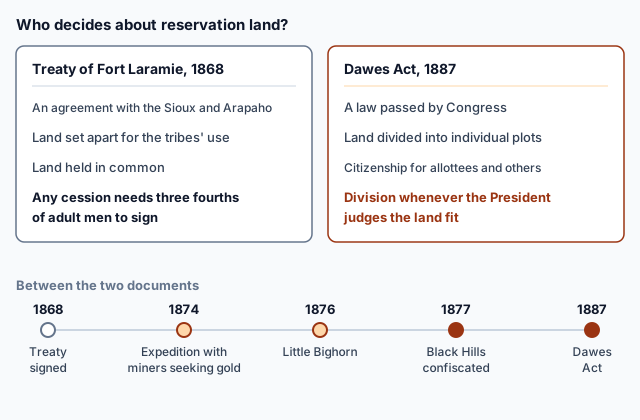 Tap to open the picture full size
Part 1 Think first What happened to a promise?
Commit to a guess first. Being wrong now makes the right idea stick better.
Predict first
In the Treaty of Fort Laramie, signed April 29, 1868, the United States set apart the Great Sioux Reservation, including the Black Hills, "for the absolute and undisturbed use and occupation of the Indians herein named." Six years later an army expedition entered the Black Hills with miners seeking gold. What do you think happened next?
In short. Migrants seeking land and independence moved West to farm, ranch, mine and build railroads; as the bison were decimated, competition for land turned violent, and the United States broke treaties, used military force, confined American Indians to reservations and pressed assimilation, while many American Indians kept their cultures and tribal identities.
- Migrants went to rural areas and boomtowns for work on the railroads, in mining, farming and ranching, hoping for self-sufficiency and independence.
- The 1868 Treaty of Fort Laramie set apart the Black Hills "for the absolute and undisturbed use and occupation of the Indians herein named," but after gold was found the government confiscated them in 1877.
- The Dawes Act of 1887 broke reservation land held in common into individual allotments, part of an assimilation policy that denied tribal sovereignty; many American Indians still preserved their cultures and tribal identities.
Part 2 Learn it Settlement and its costs
2a. Who moved West, and why
Larger numbers of migrants moved West after the Civil War. Many hoped for self-sufficiency and independence, often in the form of land or a business of their own. They went to rural areas to farm and ranch, and to boomtowns, places that grew almost overnight around a mine or a new rail line.
The railroads needed workers. To build the first transcontinental line, the Union Pacific employed more than 8,000 Irish, German and Italian immigrants, while the Central Pacific's workforce included over 10,000 Chinese laborers. Mining drew others: in 1874 miners seeking gold went with an army expedition into the Black Hills. Farmers came under the Homestead Act of 1862, which offered 160 acres to a settler who lived on the land for five years; the National Archives notes that most homesteaders came from nearby, such as Iowans moving to Nebraska and Minnesotans to South Dakota. Cattle owners and miners were among those who received much of the public land the government handed out.
Sources: Pacific Railway Act (National Archives); Homestead Act (National Archives); Treaty of Fort Laramie (National Archives).
Quick check · Match
Match each group of migrants to the work it did in the West.
2b. Competition for land and the bison
As migrants poured in, competition for land and resources grew among white settlers, American Indians and Mexican Americans, and violent conflict increased.
Railroads crossed American Indians' ancestral lands, and the builders met conflict there. The 1862 Pacific Railway Act had already promised that "The United States shall extinguish as rapidly as may be the Indian titles to all lands falling under the operation of this act." In the 1868 Treaty of Fort Laramie, the Sioux and Arapaho agreed that "they will withdraw all opposition to the construction of the railroads now being built on the Plains."
The same treaty shows what the American bison meant. The tribes kept hunting rights in their older territory, but only "so long as the buffalo may range thereon in such numbers as to justify the chase." As the bison population was decimated, that right lost its value, and competition for the land that remained grew sharper.
In the Southwest, Mexican Americans were drawn into the same contest. The 1848 Treaty of Guadalupe Hidalgo, which ended the war with Mexico, promised to protect the property of Mexican nationals living inside the new borders, but the U.S. Senate struck out Article X, which guaranteed Mexican land grants. When settlers and railroads arrived after the Civil War, Mexican American landholders had no treaty article guaranteeing their grants.
Sources: Pacific Railway Act (National Archives); Treaty of Fort Laramie (National Archives); Treaty of Guadalupe Hidalgo (National Archives).
Quick check · Multiple choice
In 1868 the Sioux and Arapaho kept the right to hunt outside their reservation "so long as the buffalo may range thereon in such numbers as to justify the chase." How did the decimation of the bison affect this promise?
2c. A broken treaty, military force and reservations
The Treaty of Fort Laramie opened with a promise: "From this day forward all war between the parties to this agreement shall forever cease." It set apart the Great Sioux Reservation, including the Black Hills, which are sacred to the Sioux people. Article XII said no cession of reservation land would be valid unless "executed and signed by at least three fourths of all the adult male Indians occupying or interested in the same."
The promise did not hold. In 1874 an army expedition led by George A. Custer entered the Black Hills with miners seeking gold. Once gold was found, miners moved onto Sioux hunting grounds, and the army was ordered against Sioux bands hunting there under their treaty rights. In 1876 Custer's detachment met an encampment of Sioux and Cheyenne at the Little Bighorn River and was destroyed. The United States kept fighting until the government confiscated the Black Hills in 1877. Confiscation is taking without consent, the opposite of the signed cession Article XII required. To this day, the National Archives notes, ownership of the Black Hills remains in legal dispute between the U.S. government and the Sioux Nation.
The Black Hills fit a wider pattern: the government violated treaties, answered resistance with military force, confined American Indians to reservations and denied tribal sovereignty, a nation's right to govern itself.
Quick check · Put it in order
Put these events in the order they happened, earliest first.
2d. Assimilation policy, and what endured
Historians call the goal of federal policy from the 1870s through the 1880s assimilation: absorbing American Indians into white American ways of life. Words like civilization and wards show the authors' view that American Indian ways of life should be replaced. In 1885 President Grover Cleveland called American Indians "wards of the Government" whose "education and civilization" should be promoted.
The Dawes Act, approved on February 8, 1887, put assimilation into law. It let the President break up reservation land held in common by a tribe into allotments for individuals, "To each head of a family, one-quarter of a section." Section 6 made citizens of every American Indian "to whom allotments shall have been made under the provisions of this act," and of any who lived apart from the tribe and "has adopted the habits of civilized life, is hereby declared to be a citizen of the United States." Accepting an allotment itself brought citizenship. The National Archives notes that many did not want to take up farming, and American Indian communities lost vast acreage. From 1893, a federal commission's negotiations with the Cherokee, Creek, Choctaw, Chickasaw and Seminole nations led to acts that allotted their common land in exchange for abolishing their tribal governments.
Yet many American Indians preserved their cultures and tribal identities despite these policies, and they attempted to develop self-sustaining economic practices of their own.
Sources: Cleveland's First Inaugural Address (Avalon Project); Dawes Act (National Archives).
Quick check · Fill the statement
Complete a student's notes on the Dawes Act.
The Dawes Act broke up reservation land held into allotments for . Its goal was , and it weakened tribal governments.
Part 3 Watch it done Compare two sources on reservation land
Watch each step, then do the last one yourself.
Compare the main ideas of Article XII of the Treaty of Fort Laramie (1868) and Section 1 of the Dawes Act (1887) about the future of reservation land.
Predict first
Before the steps, what do you expect the two documents to disagree about most?
Step 1 · State each main idea
Article XII: no cession of reservation land is valid unless "executed and signed by at least three fourths of all the adult male Indians occupying or interested in the same." Section 1 of the Dawes Act: the President may divide a reservation into allotments "whenever in his opinion any reservation or any part thereof of such Indians is advantageous for agricultural and grazing purposes."
Why this step?
Why state each source's main idea before comparing?
A comparison needs a common question. Once you know what each source says, you can ask both the same thing: who decides what happens to the land?
Step 2 · Name the point of comparison
Both sources govern reservation land the tribe holds in common. The treaty is an agreement between the United States and the Sioux and Arapaho; the Dawes Act is a law Congress passed on its own.
Your step · Decide and justify
Finish it. How do the two sources differ on who decides the future of reservation land?
The treaty half of the difference needs its own evidence. Which evidence shows it?
Part 4 Try it Two presidents on Indian policy
Compare two inaugural addresses, each a president's statement to the whole nation at the start of a term. They show the government's view, not the view of American Indian nations.
On March 4, 1873, Ulysses S. Grant listed among his goals: "by a humane course, to bring the aborigines of the country under the benign influences of education and civilization. It is either this or war of extermination." Aborigines was Grant's word for American Indians. He went on: "Can not the Indian be made a useful and productive member of society by proper teaching and treatment?"
On March 4, 1885, Grover Cleveland called for American Indians to be treated "as wards of the Government and their education and civilization promoted with a view to their ultimate citizenship." A ward is a person under another's legal care.
Sources: Grant's Second Inaugural Address (Avalon Project); Cleveland's First Inaugural Address (Avalon Project).
Try it · Multiple choice
Which main idea do the two addresses share?
Try it · Spot the error
A student compares the two addresses. Which line is the first to go wrong?
Part 5 Explain it Write it like a document-based answer
Nothing you type leaves this page. Check your answer against the model and each scoring point.
Free-response practice · Question 1 style
A short practice in the shape of the document-based question: three documents instead of seven, and a thesis with one body paragraph instead of a full essay.
Evaluate the extent to which federal policy toward American Indians changed between 1868 and 1887.
Document 1. Treaty of Fort Laramie, between the United States and the Sioux and Arapaho, April 29, 1868, Article II: the reservation is set apart "for the absolute and undisturbed use and occupation of the Indians herein named." Article VII: "In order to insure the civilization of the Indians entering into this Treaty, the necessity of education is admitted."
Document 2. Grover Cleveland, First Inaugural Address, March 4, 1885: "The conscience of the people demands that the Indians within our boundaries shall be fairly and honestly treated as wards of the Government and their education and civilization promoted with a view to their ultimate citizenship."
Document 3. Dawes Act, approved February 8, 1887, Section 1: the President may divide a reservation into allotments "whenever in his opinion any reservation or any part thereof of such Indians is advantageous for agricultural and grazing purposes."
Write a thesis, one sentence of historical context, and one paragraph that uses at least two documents and explains the purpose, audience, point of view or situation of one of them.
Model answer
Thesis: Between 1868 and 1887 federal policy changed greatly in how it treated American Indian nations, from making treaties with them as groups holding land in common to passing laws that broke that land into individual plots, though the aim of changing American Indian ways of life ran through the whole period.
Context: railroads, mining strikes and settlers pushed into the West in these decades, and as the bison were decimated, competition for land grew violent.
In 1868 the United States set apart a reservation "for the absolute and undisturbed use and occupation" of the Sioux and Arapaho (Document 1), dealing with them as nations whose land was their own. Yet the same treaty already spoke of "the civilization of the Indians," so the goal of assimilation was there from the start. By 1885 Cleveland described American Indians as "wards of the Government" (Document 2). He was speaking to the whole nation at his inauguration, so he framed the policy as what "the conscience of the people demands"; the address shows how the government wanted voters to see its aims, not how American Indians saw them. Two years later the Dawes Act let the President divide reservations "whenever in his opinion" the land suited farming (Document 3), with no requirement in that section for the tribe's consent. The goal held steady; the respect for tribal sovereignty did not.
Score your own answer. This is a self-check, not a grade. Tick each point your answer makes.
Part 6 Check yourself A promise and what followed
The case questions use the table. The others mix the ideas from the whole lesson.
Two articles of the 1868 treaty, set beside the National Archives' summary of the years after it. Source: Treaty of Fort Laramie (National Archives).
| Source | What it says |
|---|---|
| Treaty, Article I, 1868 | "From this day forward all war between the parties to this agreement shall forever cease." |
| Treaty, Article II, 1868 | The reservation is set apart "for the absolute and undisturbed use and occupation of the Indians herein named." |
| National Archives summary, 1874 to today | An army expedition with miners enters the Black Hills; once gold is found, miners move onto Sioux hunting grounds; in 1876 Custer's detachment is destroyed at the Little Bighorn River; the government confiscates the Black Hills in 1877; ownership remains in legal dispute between the U.S. government and the Sioux Nation today. |
Case question 1 · Multiple choice
Which conclusion does the table best support?
Case question 2 · Multiple choice
Which evidence in the table best supports the claim that the Sioux resisted the loss of the Black Hills, then and since?
The rest stand on their own and do not use the case.
Check yourself · Select all
Which two developments sharpened competition for land and resources in the West? Select two.
Select 2 answers, then check.
Check yourself · Sort it
Tap a card, then say whether it describes federal policy or American Indians keeping their identity.
Federal assimilation policy
American Indians keeping their identity
Part 7 Keep it Bring back earlier ideas
This lesson stands on the railroads and markets of Topic 6.2 and the migrations of Period 6 from Topic 6.1.
Bring it back · Multiple choice
After the Civil War, what was the main economic effect of government subsidies for railroads and telegraph lines?
Bring it back · Fill the statement
Read the sentence, then complete it.
Larger numbers of migrants moved to the West in search of and economic opportunity, frequently provoking competition and conflict.
In three lines
- Migrants seeking self-sufficiency went West to build railroads, mine, farm and ranch, in rural areas and boomtowns.
- As the bison were decimated, competition for land turned violent; the government broke the Fort Laramie treaty, used military force and confined American Indians to reservations.
- The Dawes Act and other assimilation policies denied tribal sovereignty, yet many American Indians preserved their cultures and tribal identities.
Exam strategy for this topic
- Section I Part A, Multiple Choice: 55 questions in 55 minutes.
- Section I Part B, Short Answer: 3 questions in 40 minutes.
- Section II, Document-Based Question and Long Essay: 2 questions in 100 minutes.
- This lesson's Explain it is shaped like free-response question 1, Document-based.
When a question asks you to compare two sources, state each one's main idea in a sentence, then name one point where they agree or differ and explain it using who wrote each source and when.
Questions students ask
Why does this lesson quote government documents rather than American Indian voices?
The primary-source collections this lesson was checked against, the National Archives and the Avalon Project, hold the treaties, laws and presidential addresses of these years. Those texts show what the U.S. government said and intended. They are evidence of their authors' views, not of how American Indians saw these events.
Why do the documents use words like civilization and wards?
Their authors assumed American Indian ways of life should be replaced by white American ones. The words are part of the evidence: they show the view behind assimilation policy.
What happened to the Black Hills?
The 1868 treaty set them apart as part of the Great Sioux Reservation. After an army expedition with miners entered in 1874 and gold was found, war followed, and the government confiscated the land in 1877. The National Archives notes that ownership is still in legal dispute between the U.S. government and the Sioux Nation.
What did the Dawes Act do to tribal land?
It let the President break up reservation land held in common into individual allotments, such as one-quarter of a section for each head of a family. The National Archives notes that American Indian communities lost vast acreage as a result.
Where can I read these documents in full?
Each excerpt links to its full text at the National Archives or the Avalon Project at Yale Law School.
Course alignment, for teachers
AP U.S. History topic 6.3, Unit 6: Period 6: 1865–1898.
- Skill 3.C: Compare the arguments or main ideas of two sources.
This lesson maps all 4 essential knowledge statements of the topic, and the one learning objective with none of its own, to the part that teaches each one: 5 are checked by a scored question. The map is in the lesson file.