Unit 4 · Topic 4.1 · about 30 minutes · 7 parts · 11 scored checks, 4 of them multiple choice, plus 2 from earlier lessons
AP U.S. History 4.1: Contextualizing Period 4
Unit 4: 10 to 17% of the multiple-choice section
What you'll be able to do
- Explain the context in which the republic developed from 1800 to 1848, and describe the broader development a specific event of the period belongs to.
Key vocabulary
| Term | What it means | The exam trap |
|---|---|---|
| Contextualization | Placing a specific event inside the broader development around it, to explain why it happened when and how it did. | Context is a broad development, not a single fact; one earlier event without the larger process it belongs to is not yet context. |
| Suffrage | The right to vote. | Suffrage is the right, not the act of voting; a law can grant it to people who never use it. |
| Market revolution | The change, in the first half of the 1800s, to producing and selling goods for distant markets. | The name covers farming and commerce as well as factories, so do not limit it to industry. |
| Second Great Awakening | A Protestant religious revival in the decades of Period 4. | Do not confuse it with the Great Awakening of the colonial era; this one came after independence. |
| Missouri Compromise | The 1820 law on Missouri's entry into the Union and on slavery in the rest of the Louisiana land. | It is a law about land bought from France, not the Northwest Ordinance's land north of the Ohio River. |
 Tap to open the picture full size
Part 1 Think first Two voting rules, 43 years apart
Commit to a guess first. Being wrong now makes the right idea stick better.
Predict first
North Carolina's constitution of December 18, 1776, let a man vote for the state senate only if he was "possessed of a freehold within the same county of fifty acres of land", that is, if he owned fifty acres. Alabama's Constitution of 1819 said: "Every white male person of the age of twenty-one years, or upwards, who shall be a citizen of the United States" could vote once he had lived in the state a year. What do you think best explains the difference between the two rules?
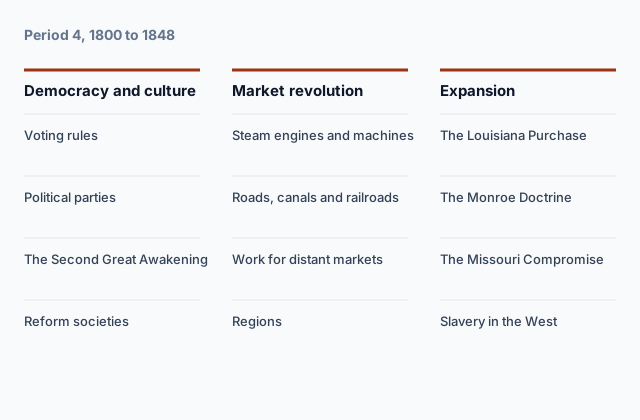
In short. Contextualizing Period 4 means placing the events of 1800 to 1848 inside the larger developments around them: a more participatory democracy and new cultures, a market revolution in the economy, and expansion across the continent that reopened the question of slavery.
- Voting moved from a system based on owning property toward voting by all adult white men, parties grew, and many Americans pursued reform through voluntary groups outside government.
- New machines, roads, canals and railroads expanded farming and manufacturing, changed work and family life, and tied regions together while pulling them in different directions.
- The nation acquired land in the West and sought foreign trade, and the new land set off contests over whether slavery would spread into it.
Part 2 Learn it Four stories that frame 1800 to 1848
2a. Context is the bigger story
Contextualization means placing a specific event inside a broader development that was under way when it happened. The broader development can reach back before the event, or run alongside it in another place at the same time.
Take Alabama's 1819 voting rule. On its own it is one state's law. In context it belongs to the nation's move toward a more participatory democracy: from voting based on owning property to voting by all adult white men, a change that came with the growth of political parties.
The context also reaches back. After independence, many new state constitutions kept property qualifications for voting. North Carolina's 1776 constitution let a man vote for its senate only if he was "possessed of a freehold within the same county of fifty acres of land." Against that background, Alabama's rule, with no land test at all, is a change. Its words "every white male person" show what had not changed: women, African Americans and American Indians stayed outside it.
Sources: Constitution of North Carolina, 1776 (Avalon Project); Constitution of Alabama, 1819 (Avalon Project).
Quick check · Fill the statement
Complete a student's notes giving context for Alabama's 1819 voting rule.
The specific development is Alabama's rule letting white male citizens aged 21 or older vote after a year in the state. The broader development it belongs to is . An earlier pattern that it changed is .
2b. Many cultures, and reform outside government
Americans in these years embraced a new national culture that mixed American elements, European influences and regional tastes. At the same time, various groups developed distinct cultures of their own. Enslaved and free African Americans built communities and strategies to protect their dignity and their families. Large numbers of international migrants settled in industrializing Northern cities. Southern business leaders kept relying on growing and exporting staple crops, which helped build a distinct Southern identity.
Americans also tried to make their society match their ideals, and increasing numbers did it mainly outside government. Many were inspired by new religious and intellectual movements, above all the Second Great Awakening, a revival among Protestants. They formed voluntary organizations: temperance societies that urged people to give up drinking, antislavery and abolitionist groups, and a women's rights movement that stated its ideals at the Seneca Falls Convention, which Elizabeth Cady Stanton and Lucretia Mott organized in July 1848. Over time its members argued over whether to narrow its goals to white women.
So the context for any single reform society is this wider habit of organizing outside government, joined to the religious energy of the revivals.
Source: Woman Suffrage and the 19th Amendment (National Archives).
Quick check · Match
Match each development of 1800 to 1848 to the larger pattern it shows.
2c. The market revolution
Innovations in technology, farming and commerce sped up the American economy. Textile machinery, steam engines, interchangeable parts, the telegraph and new farm tools made production more efficient, and roads, canals and railroads carried goods farther. Laws and courts supported the new transportation. New York had given Robert Fulton and Robert Livingston a monopoly on steamboats in its waters. Thomas Gibbons, who held federal permission to use the waterways, was shut out of New York Bay and sued. In Gibbons v. Ogden, decided March 2, 1824, the Supreme Court ruled against the monopoly: Congress has the power to regulate commerce among the states. "Commerce among the states cannot stop at the external boundary line of each state," Chief Justice John Marshall wrote.
The changes reached daily life. More Americans worked for wages or made goods for distant markets instead of farming mainly for their own households. A larger middle class and a small, wealthy business elite grew, and so did a population of laboring poor. Ideals of home life drew a sharper line between public and private spheres.
Economic ties helped unify the nation, yet transportation linked the North and the Midwest more closely than it linked them to the South, and the regions grew in different directions.
Source: Gibbons v. Ogden (National Archives).
Quick check · Sort it
Tap a card, then say whether it helped drive the market revolution or was one of its effects on American life.
Helped drive it
An effect on American life
2d. New land, and the slavery question
Expansion in Period 4 had roots in Period 3. In the 1780s and 1790s settlers moved beyond the Appalachians and sought free navigation of the Mississippi River. On July 13, 1787, the Confederation Congress adopted the Northwest Ordinance for the territory north of the Ohio River. It provided a method for admitting new states, promised "The utmost good faith shall always be observed towards the Indians," and declared: "There shall be neither slavery nor involuntary servitude in the said territory." The promise to the Indians did not hold; the course framework notes problems over treaties and the seizure of American Indian lands.
On April 30, 1803, the United States bought 828,000 square miles west of the Mississippi from France and doubled its size. The land was home to thousands of American Indians across dozens of tribes. Struggling to create an independent place among the world's powers, the nation kept seeking territory across the continent and foreign trade.
New land reopened an old question: would slavery spread into it? When Missouri sought statehood, controversy arose in Congress. In the National Archives' summary, the Missouri Compromise of 1820 admitted Missouri as a slave state and Maine as a free state, and it banned slavery in the rest of the Louisiana land north of 36 degrees 30 minutes latitude.
Sources: Northwest Ordinance (National Archives); Louisiana Purchase Treaty (National Archives); Missouri Compromise (National Archives).
Quick check · Multiple choice
A historian wants context for the Louisiana Purchase of 1803. Which statement describes a broader development already under way, rather than an effect of the purchase?
Part 3 Watch it done Give context for the Monroe Doctrine
Watch each step, then do the last one yourself.
On December 2, 1823, in his seventh annual message to Congress, President James Monroe declared that "the American continents, by the free and independent condition which they have assumed and maintain, are henceforth not to be considered as subjects for future colonization by any European powers." Describe a broader historical context for this warning.
Predict first
Before the steps, what kind of larger development do you think the warning belongs to?
Step 1 · Name the specific development
Monroe's warning is one statement, made on one day, in a message to Congress. It tells European powers to start no new colonies anywhere in the Americas.
Why this step?
Why pin down the specific development before looking for context?
Context is always context for something. Until you say exactly what you are explaining, you cannot tell which broader development fits it and which only sits nearby.
Step 2 · Look back and around
Twenty years earlier the United States had bought the Louisiana land from France and doubled its size, and it kept seeking territory and trade across the continent. Look around as well as back. In the same message Monroe reported talks, proposed by Russia, over rights on the "northwest coast of this continent", and he warned Europe against interfering with "the Governments who have declared their independence and maintain it", the new nations of the hemisphere.
Your step · Decide and justify
Finish it. Which broader context best fits Monroe's warning?
Which evidence best supports your answer?
Part 4 Try it More voters, 1824 to 1840
A National Archives study of politics from 1824 to 1840 gives these figures. In 1824, 26 percent of eligible voters took part in the presidential election; in 1840 the turnout rate was 80 percent. In 1824, 356,037 popular votes were cast for the four leading candidates; in 1840, 2,409,474 were cast for the three major candidates. The nation's population, just over 5.3 million in 1800, passed 17 million in 1840.
Source: The Two-Party System, 1824 to 1840 (National Archives).
Try it · Multiple choice
Which broader development best explains the rise in turnout from 1824 to 1840?
Try it · Spot the error
A student writes a context paragraph for the turnout figures. Which line is the first to go wrong?
Part 5 Explain it Write it like a document-based answer
Nothing you type leaves this page. Check your answer against the model and each scoring point.
Free-response practice · Question 1 style
A short practice in the shape of the document-based question: three documents instead of seven, and a thesis with one body paragraph instead of a full essay.
Evaluate the extent to which westward expansion united the United States between 1800 and 1848.
Document 1. Thomas Jefferson, Third Annual Message to Congress, October 17, 1803: control of the Mississippi would "secure an independent outlet for the produce of the western States."
Document 2. Missouri Compromise, 1820, Section 8: in the land ceded by France "which lies north of thirty-six degrees and thirty minutes north latitude," outside the new state of Missouri, slavery "shall be, and is hereby, forever prohibited."
Document 3. James K. Polk, Inaugural Address, March 4, 1845, on adding Texas: "as it shall be extended the bonds of our Union, so far from being weakened, will become stronger." In the same address he regretted that "misguided persons have occasionally indulged in schemes and agitations whose object is the destruction of domestic institutions existing in other sections."
Write a thesis, two or three sentences of historical context, and one paragraph that uses at least two documents and explains the purpose, audience, point of view or situation of one of them.
Model answer
Thesis: Westward expansion gave Americans shared interests in western land and trade, but it divided them over whether slavery would spread, so it united the nation less than the presidents who pursued it claimed.
Context: before 1800, settlers had crossed the Appalachians and sought free use of the Mississippi, and the Northwest Ordinance of 1787 had set out how new states would join the Union while banning slavery north of the Ohio River. Period 4 carried both patterns west of the Mississippi.
Jefferson told Congress the Mississippi would "secure an independent outlet for the produce of the western States" (Document 1), tying western farmers to the nation's commerce. Yet by 1820 Congress had to draw a line across the same land, north of which slavery was "forever prohibited" (Document 2), after Missouri's request for statehood set off a controversy in Congress. In 1845 Polk promised that expansion would make the bonds of the Union "stronger" (Document 3). He spoke as a new president seeking support for adding Texas, so he had reason to stress unity, and his own complaint about "schemes and agitations" against slavery shows the division he hoped to quiet. Expansion gave Americans common interests and a question that split them by region.
Score your own answer. This is a self-check, not a grade. Tick each point your answer makes.
Part 6 Check yourself Two laws on slavery in the West
The case questions use the two excerpts. The others mix ideas from the whole lesson.
Two federal laws, a generation apart, on slavery in western land. Sources: Northwest Ordinance (National Archives); Missouri Compromise (National Archives).
| Law | Excerpt |
|---|---|
| Northwest Ordinance, adopted July 13, 1787, for the territory north of the Ohio River | "There shall be neither slavery nor involuntary servitude in the said territory" |
| Missouri Compromise, 1820, Section 8 | In the land ceded by France "which lies north of thirty-six degrees and thirty minutes north latitude," outside Missouri, slavery "shall be, and is hereby, forever prohibited" |
Case question 1 · Multiple choice
What continuity do the two laws show?
Case question 2 · Multiple choice
Which broader development best explains why Congress needed the 1820 law?
The rest stand on their own and do not use the case.
Check yourself · Put it in order
Put these in the order they happened, earliest first.
Check yourself · Select all
Which two statements describe how economic development shaped the nation's regions from 1800 to 1848? Select two.
Select 2 answers, then check.
Part 7 Keep it Bring back earlier ideas
This lesson stands on Period 3. These two questions bring back Topic 3.4, the ideas behind independence.
From 3.4 Philosophical Foundations of the American Revolution · Put it in order
Put these events in the order they happened, earliest first.
From 3.4 Philosophical Foundations of the American Revolution · Match
Match each phrase from the documents of 1775 and 1776 to the work it does in the colonists' argument.
In three lines
- Context is a broad development under way before or during an event; a later event is an effect, not context.
- From 1800 to 1848 voting widened to adult white men, parties grew, Americans built many cultures, and reformers organized outside government.
- The market revolution reshaped work and regions, and expansion west raised the question of slavery's spread, as the Missouri Compromise shows.
Exam strategy for this topic
- Section I Part A, Multiple Choice: 55 questions in 55 minutes.
- Section I Part B, Short Answer: 3 questions in 40 minutes.
- Section II, Document-Based Question and Long Essay: 2 questions in 100 minutes.
- This lesson's Explain it is shaped like free-response question 1, Document-based.
When a question or essay asks for context, name a broad development under way before or during the event, then write one sentence saying how it shaped that event.
Questions students ask
What years does Period 4 cover?
1800 to 1848, the years the course framework gives for Period 4, its fourth of nine periods of United States history.
Is context the same as background?
Close, but context has a job. It is a broader development you connect to a specific event to explain it. Background that you never connect to the event does not do that work.
Why does this lesson keep going back before 1800?
Context can come from change or continuity with earlier developments. Voting rules, westward migration and the Northwest Ordinance's ban on slavery all began in Period 3 and shaped what happened after 1800.
Who could vote under Alabama's 1819 constitution?
White male citizens of the United States aged 21 or older who had lived in the state for a year before an election, with a shorter residence rule for their county or town. The rule set no property test, and it left out women, African Americans and American Indians.
Where can I read these documents in full?
Each excerpt links to its full text at the National Archives or the Avalon Project at Yale Law School, the primary-source collections this lesson was checked against.
Course alignment, for teachers
AP U.S. History topic 4.1, Unit 4: Period 4: 1800–1848.
- Skill 4.A: Identify and describe a historical context for a specific historical development or process.
This lesson maps all 11 essential knowledge statements of the topic, and the one learning objective with none of its own, to the part that teaches each one: 12 are checked by a scored question. The map is in the lesson file.