Unit 3 · Topic 3.2 · about 30 minutes · 7 parts · 12 scored checks, 4 of them multiple choice
AP U.S. History 3.2: The Seven Years’ War (The French and Indian War)
Unit 3: 10 to 17% of the multiple-choice section
What you'll be able to do
- Explain the causes and effects of the Seven Years' War (the French and Indian War).
Key vocabulary
| Term | What it means | The exam trap |
|---|---|---|
| French and Indian War | The name used in the colonies for the Seven Years' War in North America, fought by Britain against France and the American Indian nations allied with France. | The name lists Britain's opponents in North America; it does not mean a war between the French and American Indians. |
| American Indian autonomy | The power of native nations to govern their own lands and affairs. | Autonomy is about control of land and decisions, not about cutting off trade. |
| Cede | To give up land or rights to another power, usually in a treaty. | Read who cedes to whom; the verb tells you which side lost the land. |
| Revenue | Money a government collects, such as from taxes and duties. | A law can regulate trade or raise revenue; read its stated purpose before you decide which. |
| Proclamation of 1763 | The British king's order, issued in October 1763, that reserved lands beyond the colonies for American Indians. | A proclamation is a royal order, not an act of Parliament, so do not credit it to Parliament. |
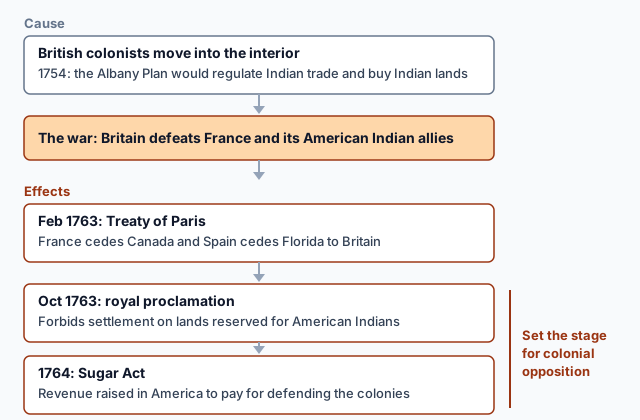 Tap to open the picture full size
Part 1 Think first Winning too much?
Commit to a guess first. Being wrong now makes the right idea stick better.
Predict first
In 1763 Britain ended a long war in North America by taking Canada from France and Florida from Spain. Within a year, Parliament was passing new taxes on its American colonies. Why do you think a winning empire turned to taxing its own colonists?
In short. The Seven Years' War, called the French and Indian War in the colonies, grew from British colonists pushing into the interior of North America against French and American Indian interests, and Britain's victory in 1763 brought it vast new lands at tremendous expense, which led to new efforts to raise revenue and to keep colonists out of the West.
- British colonists moving inland threatened French trade networks with American Indians and American Indian autonomy.
- In the peace of 1763 France gave Canada to Britain and Spain gave Florida, and Britain soon set out to raise revenue in America to pay for defending its larger empire.
- Britain's proclamation of 1763 tried to keep colonists off lands reserved for American Indians, which many colonists opposed, while native groups kept trading with Europeans and resisted settlers on their lands.
Part 2 Learn it Causes and effects of the Seven Years' War
2a. Rivals for the interior
By the middle of the 18th century the rivalry between Britain and France in North America was sharpening. The cause was growth. The population of the British colonies was rising, and colonists were moving into the interior of the continent. That threatened the trade networks the French had built with American Indians, and it threatened American Indian autonomy, the power of native nations to govern their own lands and affairs.
The colonists' plans show where their attention was turning. In 1754 a plan of union, which the Avalon Project credits to Benjamin Franklin and Thomas Hutchinson, proposed that "one general government may be formed in America, including all the said colonies, within and under which government each colony may retain its present constitution." Its president-general and grand council would "make such laws as they judge necessary for regulating all Indian trade" and "make all purchases from Indians, for the crown, of lands not now within the bounds of particular Colonies."
Read that last phrase closely. The lands in question lay beyond the colonies' borders, in the interior that France and American Indian nations held or traded across. Competition for that interior is what turned rivalry into war.
Quick check · Multiple choice
Which development most directly intensified the rivalry between Britain and France in North America in the mid-18th century?
2b. A huge victory at a huge cost
Britain won. The peace treaty signed at Paris on February 10, 1763, ended what it calls "a long and bloody war." Its terms gave Britain a major expansion of territory:
- France: "his Most Christian Majesty cedes and guaranties to his said Britannick Majesty, in full right, Canada, with all its dependencies." The Most Christian King was the king of France.
- Spain, also a party to the treaty: "his Catholick Majesty cedes and guaranties, in full right, to his Britannick Majesty, Florida."
- The boundary between British and French lands became "a line drawn along the middle of the River Mississippi," "except the town of New Orleans and the island in which it is situated, which shall remain to France."
The spellings are as printed. The victory came at tremendous expense, and the larger empire cost more to defend. That set the stage for imperial efforts to raise revenue from the colonies and to consolidate control over them. In 1764 the Sugar Act declared that "it is just and necessary, that a revenue be raised" in America. The war's cost was still felt years later. In 1768 Boston merchants listed among their burdens "the large sums collected by the officers of the customs for duties on goods imported" and, separately, "the heavy taxes levied to discharge the debts contracted by the government in the late war."
Sources: Treaty of Paris, 1763; Sugar Act, 1764; Boston Non-Importation Agreement, 1768.
Quick check · Match
Match each term of the 1763 peace, or its result, to what it meant.
2c. Closing the West
After the victory, imperial officials tried to keep colonists from moving west. A royal proclamation of October 7, 1763, spoke of "the extensive and valuable Acquisitions in America, secured to our Crown by the late Definitive Treaty of Peace," and then reserved lands beyond the colonies for American Indians:
"We do hereby strictly forbid, on Pain of our Displeasure, all our loving Subjects from making any Purchases or Settlements whatever, or taking Possession of any of the Lands above reserved."
Settlers already there were told "forthwith to remove themselves from such Settlements." The proclamation gave its reasons: it was "essential to our Interest, and the Security of our Colonies" that American Indian nations not be disturbed, and "great Frauds and Abuses have been committed in purchasing Lands of the Indians."
The policy generated colonial opposition. Many colonists had expected the war to open those lands to them. Native groups, for their part, sought two things at once: to keep trading with Europeans, and to resist colonists moving onto tribal lands.
Quick check · Sort it
After 1763, each card is a goal one group pursued. Tap a card, then the group it belongs to.
British imperial officials
Many colonists
Many American Indian nations
Part 3 Watch it done Trace an effect: from the war to a revenue law
Watch each step, then do the last one yourself.
Parliament passed the Sugar Act in 1764, a year after the peace with France. Explain how the act was an effect of the Seven Years' War.
Predict first
Before the steps, which link between the war and the act do you expect to find?
Step 1 · Name what the war changed
The war ended with Britain holding Canada and Florida and with a boundary on the Mississippi. It also left Britain with a large expense and a much bigger territory to defend.
Why this step?
Why name what the war changed before reading the act?
A cause has to come before its effect and has to connect to it. Naming the war's results first gives you something specific to look for when you read the act.
Step 2 · Find the act's stated reason
The act's opening says the king's lands in America, "which, by the peace, have been so happily enlarged," need a revenue "for defraying the expences of defending, protecting, and securing the same" (spelling as printed). Defraying means paying for.
Your step · Decide and justify
Finish it. How was the Sugar Act an effect of the Seven Years' War?
Which evidence best supports your answer?
Part 4 Try it Build the chain
Explaining a war means connecting what came before it to what came after it. Put the chain in order, then find the weak link in a student's paragraph.
Try it · Put it in order
Put these links in order, from first cause to last effect.
Try it · Spot the error
A student explains the effects of the war. Which line is the first to go wrong?
Part 5 Explain it Write it like a document-based answer
Nothing you type leaves this page. Check your answer against the model and each scoring point.
Free-response practice · Question 1 style
A short practice in the shape of the document-based question: three documents instead of seven, and a thesis with one body paragraph instead of a full essay.
Evaluate the extent to which the Seven Years' War changed the relationship between Britain and its North American colonies.
Document 1. Albany Plan of Union, 1754: "one general government may be formed in America, including all the said colonies, within and under which government each colony may retain its present constitution."
Document 2. Royal proclamation of October 7, 1763: "We do hereby strictly forbid, on Pain of our Displeasure, all our loving Subjects from making any Purchases or Settlements whatever, or taking Possession of any of the Lands above reserved."
Document 3. The Sugar Act, passed by Parliament in 1764: the king's lands in America, "which, by the peace, have been so happily enlarged," require that "it is just and necessary, that a revenue be raised."
Write a thesis, one sentence of historical context, and one paragraph that uses at least two documents and explains the purpose, audience, point of view or situation of one of them.
Model answer
Thesis: The Seven Years' War changed the relationship between Britain and its colonies to a great extent, because a victory won at great cost turned colonies that each kept their own governments inside the empire into colonies told where they could settle and asked to pay for their defense.
Context: in the mid-18th century, British colonists moving into the interior threatened French trade with American Indians, and that rivalry became the war.
In 1754 colonial leaders imagined a union inside the empire in which "each colony may retain its present constitution" (Document 1), so their own governments would stay as they were. After the victory, the empire spoke in a different voice. The king's proclamation of 1763 forbade "Purchases or Settlements whatever" on the reserved lands (Document 2). Its audience was the king's "loving Subjects," and its purpose was to order them, not to bargain with them, which shows how far London now meant to direct colonial life. A year later Parliament said that because the empire had been "so happily enlarged," a revenue had to be raised in America (Document 3). The treaty had ended "a long and bloody war," and that cost, with the new lands to defend, is what turned Parliament toward the colonies' purses. Colonists who had shared in the victory now faced limits on land and demands for money.
Score your own answer. This is a self-check, not a grade. Tick each point your answer makes.
Part 6 Check yourself The king's line in the West
The case questions use the two excerpts. The others mix the ideas from the whole lesson.
Both excerpts come from the royal proclamation of October 7, 1763. Source: The Royal Proclamation, 1763 (Avalon Project).
| Passage | Excerpt |
|---|---|
| The reason | "it is just and reasonable, and essential to our Interest, and the Security of our Colonies, that the several Nations or Tribes of Indians with whom We are connected, and who live under our Protection, should not be molested or disturbed" |
| The rule | "We do hereby strictly forbid, on Pain of our Displeasure, all our loving Subjects from making any Purchases or Settlements whatever, or taking Possession of any of the Lands above reserved" |
Case question 1 · Multiple choice
The excerpts most directly reflect which effect of the Seven Years' War?
Case question 2 · Multiple choice
According to the first excerpt, why should American Indian nations be left undisturbed?
The rest stand on their own and do not use the case.
Check yourself · Fill the statement
Complete the sentences about the results of the war.
Britain's victory over France brought it vast new . Paying for the war and for defending those lands led Parliament to seek from the colonies.
Check yourself · Select all
After 1763, which two goals did many American Indian nations pursue in their dealings with Europeans and colonists? Select two.
Select 2 answers, then check.
Part 7 Keep it Bring back earlier ideas
This lesson stands on the big picture of Period 3 from Topic 3.1 and on the alliances between Europeans and American Indians from Period 2.
Bring it back · Multiple choice
After independence, Britain and Spain still held territory in North America and European wars threatened American shipping. What challenge did this continued European presence pose for the United States?
Bring it back · Fill the statement
Complete the sentences about the colonial era before 1754.
French, Dutch, British and Spanish colonies American Indian groups. Those groups often sought alliances with Europeans against .
In three lines
- British colonists moving into the interior threatened French trade with American Indians and American Indian autonomy, and the rivalry became the Seven Years' War.
- Britain won Canada and Florida in 1763 at tremendous expense, which led to imperial efforts to raise revenue and tighten control.
- The proclamation of 1763 tried to keep colonists out of the West, colonists opposed it, and native groups kept trading with Europeans while resisting settlers on their lands.
Exam strategy for this topic
- Section I Part A, Multiple Choice: 55 questions in 55 minutes.
- Section I Part B, Short Answer: 3 questions in 40 minutes.
- Section II, Document-Based Question and Long Essay: 2 questions in 100 minutes.
- This lesson's Explain it is shaped like free-response question 1, Document-based.
When a question asks for an effect of the Seven Years' War, name the effect and link it to the war in one step: the cost, the new land, or the new limits on settlement.
Questions students ask
Who fought in the Seven Years' War in North America?
Britain and its colonists fought France and the American Indian nations allied with France. Spain was also a party to the peace treaty, and it gave up Florida to Britain.
What did Britain gain in 1763?
France gave up Canada, Spain gave up Florida, and the boundary with what France kept became the middle of the Mississippi River, with New Orleans remaining French.
Why did the war lead to new taxes?
The victory cost a great deal, and the larger empire had to be defended. In 1764 Parliament's Sugar Act said a revenue had to be raised in America to pay for defending the colonies.
What was the Albany Plan of Union?
A plan of 1754, which the Avalon Project credits to Benjamin Franklin and Thomas Hutchinson, for one general government over the colonies, inside the British Empire, with power over Indian trade and the purchase of western lands.
Why are some words in the quotations spelled oddly?
Every excerpt is copied exactly as the archive prints it, so you can check it against the source linked beside it. Spellings like "Britannick" and "expences" are 18th century forms.
Course alignment, for teachers
AP U.S. History topic 3.2, Unit 3: Period 3: 1754–1800.
- Skill 1.B: Explain a historical concept, development, or process.
This lesson maps all 3 essential knowledge statements of the topic, and the one learning objective with none of its own, to the part that teaches each one: 4 are checked by a scored question. The map is in the lesson file.