Unit 4 · Topic 4.6 · about 30 minutes · 7 parts · 13 scored checks, 5 of them multiple choice
AP U.S. History 4.6: Market Revolution: Society and Culture
Unit 4: 10 to 17% of the multiple-choice section
What you'll be able to do
- Explain how and why innovation in technology, agriculture, and commerce affected various segments of American society over time, and explain how one of those changes relates to another.
Key vocabulary
| Term | What it means | The exam trap |
|---|---|---|
| Semi-subsistence agriculture | Farming mainly to feed and supply one's own household rather than to sell. | The term describes where most of a family's living came from, not whether the family farmed. |
| Middle class | The group between the wealthy and the poor, whose numbers grew with manufacturing. | Class here is about how a family earned its living and lived, not about a legal rank. |
| Laboring poor | The large and growing population of working people who stayed poor. | Having a job did not lift a family out of this group. |
| Domestic ideals | Beliefs about how a home and family should be run and what roles men and women should play in them. | An ideal states what people thought should be, so read evidence about it for whose view it was. |
| Separate spheres | The idea that life divided into a public sphere and a private one, each assigned to one sex. Textbooks often call it the cult of domesticity. | It was an ideal for middle-class homes, not a description of how most women lived. |
 Tap to open the picture full size
Part 1 Think first Wages instead of a harvest
Commit to a guess first. Being wrong now makes the right idea stick better.
Predict first
In the 1830s a young woman leaves her family's New England farm, where the family grows most of its own food and trades a little of its surplus with neighbors, to work in a textile mill in Lowell, Massachusetts. What changes most about how she makes her living?
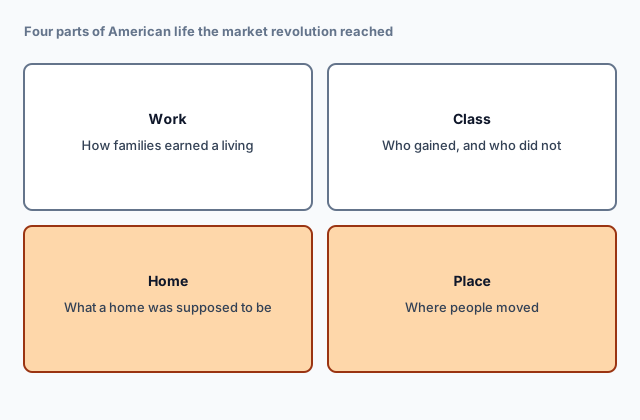
In short. The market revolution reshaped American society. More people earned a living producing for distant markets, migrants filled Northern cities while Americans settled the Ohio and Mississippi valleys, classes grew further apart, and middle-class ideals divided life into a public sphere and a private one.
- Growing numbers of Americans, especially factory workers, stopped living mainly off what their own farms produced and earned their living producing goods for distant markets.
- Manufacturing raised the standard of living for some, creating a larger middle class and a small, wealthy business elite, and also a large and growing population of laboring poor.
- Domestic ideals cast the home as a private sphere for women and work and politics as a public sphere for men, an ideal that fit some families far better than others.
Part 2 Learn it How the market revolution changed society
2a. From the family farm to the market
Semi-subsistence agriculture means a farm family grows and makes most of what it needs and trades a small surplus close to home. In the market revolution, growing numbers of Americans left that way of life and supported themselves by producing goods for distant markets.
Factory workers, women and men, were the clearest case: they earned wages making goods they would never use and bought food and clothing they once would have grown or made. In Lowell, Massachusetts, women worked in the textile mills. Harriet Robinson worked there from 1834 to 1848 and later wrote an account of it, and in December 1845 a mill worker named Mary Paul wrote to her father about her life in Lowell.
Farms changed too. A farm family that planted more wheat than it could eat, harvested it with a reaper and sent it east to sell was producing for the market as surely as a mill hand.
Source: the AP U.S. History course framework, Topics 4.5 and 4.6.
Quick check · Multiple choice
Which change best shows a family moving away from semi-subsistence agriculture?
2b. Winners, workers and a new middle
The growth of manufacturing made some Americans much better off and raised their standard of living. It also divided society in new ways.
A larger middle class grew: families of shopkeepers, clerks and professionals who lived on salaries or profits and did not do manual labor for wages. At the top stood a small but wealthy business elite of mill owners, merchants and bankers. And a large and growing population of laboring poor, people who depended on wages and owned little else, worked in the mills, workshops and docks.
Prosperity reached beyond white families: in 1841 Joseph Willson described the leisure activities of prosperous African American families in Philadelphia, a sign that some Black Philadelphians had joined the comfortable classes. Workers organized to defend their interests. The Working Men's Party, the subject of an 1830 lecture by Edward Everett, focused on the political interests of working-class men, and on February 27, 1846, the Lowell Female Labor Reform Association, which the course framework calls the first union for working women, set out its goals in a preamble and constitution. Wage workers who organize are a sign of a large group living on wages alone.
Source: the AP U.S. History course framework, Topic 4.6.
Quick check · Fill the statement
Place each person in the society the market revolution made.
A mill owner who grew rich from textile profits belonged to the . A clerk whose salary let his family live in comfort belonged to the . A dock worker paid by the day, with nothing saved, belonged to the .
2c. Separate spheres
When paid work moved out of the household and into mills, shops and offices, ideas about the home changed with it, especially in middle-class families. The domestic ideals of the time drew a line between two spheres: a public sphere of business, politics and paid work, seen as belonging to men, and a private sphere of home and family, seen as belonging to women.
Organized manufacture had begun early (in 1789 Samuel Slater proposed a manufacturing venture to the merchant Moses Brown), and by the late 1820s advice books addressed wives and mothers as the managers of the home. One was Lydia Maria Child's The American Frugal Housewife, published in 1829, a popular book of recipes, money-saving tips and home remedies. Child herself was also an abolitionist and a women's rights activist, so the author of a household guide did not keep to a private sphere.
The ideal fit some families better than others. A family that could live on a man's salary could keep a wife at home. A family of mill hands or day laborers needed women's wages too.
Source: the AP U.S. History course framework, Topics 4.5 and 4.6.
Quick check · Sort it
Under the domestic ideals of the period, which sphere was each activity assigned to? Tap a card, then its sphere.
Public sphere
Private sphere
2d. People on the move
The market revolution also moved people. Large numbers of migrants from abroad went to industrializing Northern cities. Famine in Ireland drove many of them. Counting ship passenger lists held by the National Archives, the writer Mark Holan found more than 410,000 Irish passengers arriving in New York from January 1846 through December 1851, and he estimates up to 1.5 million Irish reached the United States in the famine years of 1845 to 1855. A National Archives teaching page adds that by the 1850s, just after this period, seven-eighths of all immigrants settled in the North, where they found 72 percent of the nation's manufacturing capacity.
At the same time many Americans moved west of the Appalachians, where canals, steamboats and railroads could carry a farm's crops to distant buyers, and built thriving new communities along the Ohio and Mississippi rivers. Cincinnati, on the Ohio, was one; the Scottish traveler James Flint wrote about it and about Ohio, Kentucky and Indiana after his travels there from 1818 to 1820. The English emigrant Rebecca Burlend, who came with her family in 1831, described the trip up the Mississippi from New Orleans to St. Louis.
Sources: Mark Holan, Prologue, Winter 2017 to 2018 (National Archives); Eli Whitney's Patent for the Cotton Gin (National Archives). Flint and Burlend are from the course framework.
Quick check · Match
Match each group to where its move took it or the work it found there.
Part 3 Watch it done Connect two developments
Watch each step, then do the last one yourself.
Explain how the growth of paid work outside the home relates to the rise of domestic ideals that separated a public sphere from a private one.
Predict first
Before the steps, which do you think came first?
Step 1 · Describe the first development
Manufacturing and trade moved paid work out of the household and into mills, shops and offices. In many middle-class families, the husband's work now happened somewhere else.
Why this step?
Why describe each development on its own before linking them?
A connection is only as clear as the two things it connects. If either development is vague, the link between them will be vague too.
Step 2 · Describe the second development and the link
Domestic ideals came to cast the home as a private sphere for women and work and politics as a public sphere for men. Now decide which way the link runs, and what evidence shows it.
Your step · Decide and justify
Finish it. Which relationship between the two developments does the evidence support?
Which evidence best supports your answer?
Part 4 Try it A president on the westward movement
On March 4, 1845, President James K. Polk said in his inaugural address: "But eighty years ago our population was confined on the west by the ridge of the Alleghanies." (Spelling as printed; the Alleghenies are part of the Appalachian Mountains.) Since then, he went on, "our people, increasing to many millions, have filled the eastern valley of the Mississippi" and were already settling valleys whose rivers flow to the Pacific. "The world beholds the peaceful triumphs of the industry of our emigrants." Polk was speaking of Americans who had moved west.
Source: Inaugural Address of James K. Polk (Avalon Project).
Try it · Multiple choice
Which development from this lesson connects most directly to the movement Polk describes?
Try it · Spot the error
A student writes about Polk's words. Which line is the first to go wrong?
Part 5 Explain it Write it like a document-based answer
Nothing you type leaves this page. Check your answer against the model and each scoring point.
Free-response practice · Question 1 style
A short practice in the shape of the document-based question: three documents instead of seven, and a thesis with one body paragraph instead of a full essay.
Evaluate the extent to which the market revolution changed where Americans lived and how they earned a living in the first half of the nineteenth century.
Document 1. James Monroe, inaugural address, March 4, 1817: "Our manufactures find a generous encouragement by the policy which patronizes domestic industry, and the surplus of our produce a steady and profitable market by local wants in less-favored parts at home."
Document 2. James K. Polk, inaugural address, March 4, 1845: "But eighty years ago our population was confined on the west by the ridge of the Alleghanies." (spelling as printed) And: "our people, increasing to many millions, have filled the eastern valley of the Mississippi."
Document 3. Ship passenger lists held by the National Archives, as counted by Mark Holan in the Archives' Prologue magazine (2017): more than 410,000 Irish passengers arrived in New York from January 1846 through December 1851.
Write a thesis, one sentence of historical context, and one paragraph that uses at least two documents and explains the purpose, audience, point of view or situation of one of them.
Model answer
Thesis: The market revolution moved large numbers of people into Northern cities and western river valleys and drew many into earning a living from the market, but the change reached some groups far more than others: mill workers and new immigrants lived by wages, while many farm families still grew much of what they ate and sold only a surplus.
Context: new roads, canals and railroads, backed by lawmakers and courts, made it possible to ship goods from the interior to Eastern cities and to sell farm crops far from where they were grown.
In 1817 Monroe described farmers selling "the surplus of our produce" to buyers in other parts of the country (Document 1), a picture of farms that sold only what they did not use. By 1845 Polk said Americans had "filled the eastern valley of the Mississippi" (Document 2). As a new president speaking to the nation, while claiming Oregon and arguing for Texas, he had reason to present westward settlement as a triumph, so his words show how he wanted the movement seen, not a measured record. Meanwhile more than 410,000 Irish passengers landed in New York from 1846 through 1851 (Document 3), and most immigrants settled in the North, where the factories were. People moved on a large scale, but Monroe's word surplus is a reminder that much farm work still fed the farm family first.
Score your own answer. This is a self-check, not a grade. Tick each point your answer makes.
Part 6 Check yourself Who came, and where they went
The case questions use the figures in the table. The others mix the ideas from the whole lesson.
The Irish figures are Mark Holan's, from ship passenger lists held by the National Archives; the 1850s figures, from just after this period, are from a National Archives teaching page. Sources: Prologue, Winter 2017 to 2018; Eli Whitney's Patent for the Cotton Gin, whose account of the cotton gin's effects gives the two figures for the 1850s.
| Measure | Figure |
|---|---|
| Irish passengers arriving in New York, January 1846 to December 1851 | More than 410,000 |
| Irish arriving in the United States in the famine years, 1845 to 1855 | Up to 1.5 million |
| Share of immigrants who settled in the North, 1850s (just after this period) | Seven-eighths |
| North's share of the nation's manufacturing capacity, 1850s (just after this period) | 72 percent |
Case question 1 · Multiple choice
Which conclusion do the figures in the table best support?
Case question 2 · Multiple choice
Using the table and the lesson, which effect on Northern cities is most likely?
The rest stand on their own and do not use the case.
Check yourself · Put it in order
Put this chain in order, from first cause to last effect.
Check yourself · Select all
Which two were major destinations of people on the move in this period? Select two.
Select 2 answers, then check.
Part 7 Keep it Bring back earlier ideas
This lesson stands on the transportation and law of Topic 4.5 and the foreign policy of Topic 4.4.
Bring it back · Fill the statement
Read the situation, then complete the sentences.
A Midwest wheat farmer in the 1840s ships grain to market by canal and railroad. The roads, canals and railroads he uses tie the Midwest most closely to the . Lawmakers and courts helped build such links: in 1824 the Supreme Court struck down a New York steamboat that kept out boats licensed under federal law.
Bring it back · Multiple choice
On December 2, 1823, President Monroe declared that the American continents were no longer open to future colonization by European powers. Which aim of U.S. policy in this period does that declaration fit?
In three lines
- More Americans, especially factory workers, earned their living producing for distant markets rather than off their own farms.
- Manufacturing built a larger middle class and a wealthy business elite, and a growing population of laboring poor, swelled by migrants to Northern cities.
- Middle-class domestic ideals split life into a public sphere and a private one, an ideal many working women could not live by.
Exam strategy for this topic
- Section I Part A, Multiple Choice: 55 questions in 55 minutes.
- Section I Part B, Short Answer: 3 questions in 40 minutes.
- Section II, Document-Based Question and Long Essay: 2 questions in 100 minutes.
- This lesson's Explain it is shaped like free-response question 1, Document-based.
When a question asks how two developments relate, name the relationship (one caused the other, or both came from the same cause) and give one specific example that shows the link.
Questions students ask
What did Lowell, Massachusetts, have to do with the market revolution?
Lowell's textile mills, on the Merrimack River, gave the Lowell System its name. Women worked in its mills for wages, making cloth for distant buyers, which made Lowell a leading example of Americans leaving farm work for work in the market.
Did the market revolution make Americans richer?
Some of them. Manufacturing raised the standard of living for some and built a larger middle class and a small, wealthy business elite. It also produced a large and growing population of laboring poor.
Where did immigrants go in this period?
Most went to industrializing Northern cities. A National Archives teaching page notes that in the 1850s, just after this period, seven-eighths of all immigrants settled in the North, where 72 percent of the nation's manufacturing capacity was.
Who was Harriet Robinson?
A worker in the textile mills of Lowell, Massachusetts, from 1834 to 1848, who later wrote an account of that work. The course framework cites it as printed in the Massachusetts Bureau of Statistics of Labor's report for 1883.
Course alignment, for teachers
AP U.S. History topic 4.6, Unit 4: Period 4: 1800–1848.
- Skill 5.B: Explain how a historical development or process relates to another historical development or process.
This lesson maps all 4 essential knowledge statements of the topic, and the one learning objective with none of its own, to the part that teaches each one: 5 are checked by a scored question. The map is in the lesson file.