Unit 6 · Topic 6.2 · about 30 minutes · 7 parts · 13 scored checks, 5 of them multiple choice
AP U.S. History 6.2: Westward Expansion: Economic Development
Unit 6: 10 to 17% of the multiple-choice section
What you'll be able to do
- Explain the causes and effects of the settlement of the West from 1877 to 1898, and explain a historical development as a chain of causes and effects: how federal aid to railroads opened western markets, and how farmers responded to machines, falling prices and the railroads.
Key vocabulary
| Term | What it means | The exam trap |
|---|---|---|
| Subsidy | Government aid, in money or land, given to a private business for a public goal. | A subsidy helps a private company; it does not make the company government-owned. |
| Transcontinental railroad | A railroad line that crosses the continent; the first was finished at Promontory, Utah, in 1869. | Congress eventually authorized four, so the first one was not the only one. |
| Mechanization | The use of machines in place of hand and animal labor, which raised farm output in this period. | More output helped lower prices, so mechanization did not simply make farmers richer. |
| Cooperative | A group whose members buy, sell or bargain together, such as the buying and selling groups farmers formed. | A cooperative is owned by its members, not by a railroad or a bank. |
| Rebate | Money a railroad paid back to a favored shipper, which lowered that shipper's real rate. | Rebates went to large shippers, which is why small farmers saw them as unfair. |
 Tap to open the picture full size
Part 1 Think first Who paid for the railroad?
Commit to a guess first. Being wrong now makes the right idea stick better.
Predict first
In 1862 Congress passed an act "To aid in the construction of a railroad and telegraph line from the Missouri River to the Pacific Ocean, and to secure to the Government the use of the same for postal, military, and other purposes." Private companies had been reluctant to build such a line on their own. What do you think the act offered them?
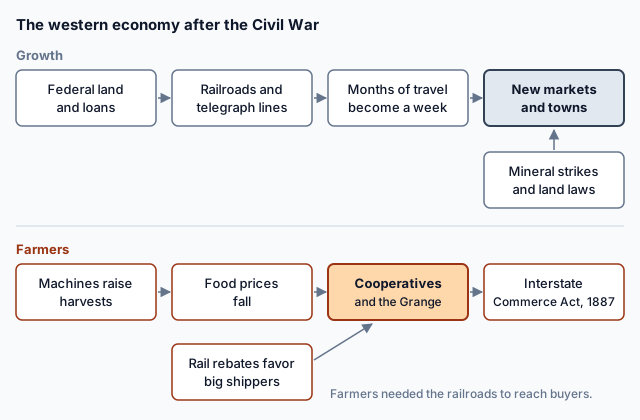
In short. After the Civil War, federal land, loans and land laws helped build the railroads, mines and towns that opened western markets, while machines raised harvests, food prices fell, and farmers who depended on the railroads organized and pushed for regulation.
- Government subsidies paid for railroads and telegraph lines, and in 1873 President Grant wanted "cheap routes of transit throughout the land" so western products could reach buyers.
- Transcontinental railroads, mineral strikes and land policy created new communities and centers of trade in the West, though most public land went to companies and speculators rather than homesteaders.
- Mechanization raised harvests and helped push food prices down; farmers who depended on the railroads formed cooperatives, organized in groups such as the Grange and pressed for laws like the Interstate Commerce Act of 1887.
Part 2 Learn it How the western economy grew
2a. Public aid for rails and wires
After the Civil War, government subsidies for transportation and communication helped open new markets in North America. A subsidy is government aid, in money or land, given to a private business for a public goal.
The pattern was set by the Pacific Railway Act of July 1, 1862. It paid for a telegraph line as well as a railroad, and it gave the builders loans and land. The National Archives notes that private companies had been reluctant to take on the task without federal help. On May 10, 1869, the last spike was driven at Promontory, Utah, and a journey of several months shrank to about one week. Congress eventually authorized four transcontinental railroads.
The goal was markets, and later presidents kept it in view. Eleven years after the first subsidy, in his second inaugural address on March 4, 1873, President Ulysses S. Grant still named among his goals "the construction of cheap routes of transit throughout the land, to the end that the products of all may find a market and leave a living remuneration to the producer." A remuneration is a payment. Grant's reasoning runs as a chain: cheap transportation lets goods reach distant buyers, and distant buyers mean a living for the people who grow, raise or dig those goods. His words state an aim, not a result.
Sources: Pacific Railway Act (National Archives); Grant's Second Inaugural Address (Avalon Project).
Quick check · Put it in order
Put the links of this chain in order, from the government's decision to its effect on western producers.
2b. Rails, gold and land laws build towns
Transcontinental railroads, the discovery of mineral resources and government land policy worked together. They promoted economic growth and created new communities and centers of trade in the West.
Minerals. Mineral strikes drew people fast. In 1874 an army expedition led by George A. Custer entered the Black Hills, land the 1868 Treaty of Fort Laramie had set aside for the exclusive use of the Sioux, and miners seeking gold went with it. Once gold was found, the National Archives notes, miners were soon moving onto Sioux hunting grounds. Topic 6.3 follows what that rush cost the Sioux.
Land policy. The Homestead Act, passed on May 20, 1862, was titled "An Act to secure Homesteads to actual Settlers on the Public Domain." It offered 160 acres of public land to a settler who lived on it for five years and paid a small filing fee. The National Archives adds two cautions. Comparatively few laborers and farmers could afford to build a farm and buy tools, seed and livestock. And most land the General Land Office handed out went to speculators, cattle owners, miners, loggers and railroads: of some 500 million acres between 1862 and 1904, only 80 million went to homesteaders.
Sources: Treaty of Fort Laramie (National Archives); Homestead Act (National Archives).
Quick check · Multiple choice
Of some 500 million acres the General Land Office handed out between 1862 and 1904, only 80 million went to homesteaders. Most went to speculators, cattle owners, miners, loggers and railroads. What does this show about how land policy shaped the western economy?
2c. More crops, lower prices, and farmers who organized
Improvements in mechanization, the use of machines in place of hand and animal labor, such as gang plows pulled by steam-powered tractors, helped farmers raise far more crops. The bigger harvests contributed to falling food prices: good news for city families who bought food, hard news for farmers, who earned less for each crop.
Farm markets were consolidating, and farmers depended on the railroads to reach buyers. The National Archives explains that a railroad held a natural monopoly where it was the only line and gave rebates to large shippers, practices especially harmful to farmers, who lacked the shipment volume to win better rates.
Many farmers answered by organizing local and regional cooperatives, groups that buy, sell or bargain together for their members. The best known farmers' organization, the Grange, started in the 1860s, and in the 1870s Granger-controlled state legislatures in the West and South acted against railroad monopolies. Then in 1886 the Supreme Court's Wabash decision struck down an Illinois rate law and left the regulation of commerce between states to Congress alone. On February 4, 1887, Congress passed the Interstate Commerce Act, which declared that "every unjust and unreasonable charge for such service is prohibited and declared to be unlawful." Railroads became the first industry subject to federal regulation, though in practice the law was not very effective.
Sources: Interstate Commerce Act (National Archives); the course framework's examples of mechanization.
Quick check · Fill the statement
Complete a student's notes on farmers in the West.
Machines let farmers raise more crops, and food prices . Railroads gave rebates to large shippers, so a farmer shipping small loads paid rates. To answer both pressures, many farmers formed .
Part 3 Watch it done Explain a process: from federal aid to western towns
Watch each step, then do the last one yourself.
Explain how federal aid to railroads opened new markets for the West's farmers, ranchers and miners.
Predict first
Before the steps, where do you think an explanation of this process should begin?
Step 1 · Name the first link
The cause is a policy. Congress gave railroad companies loans and public land, beginning with the Pacific Railway Act of 1862, and eventually authorized four transcontinental lines.
Why this step?
Why begin with the policy rather than the railroad?
A process explanation needs its first cause. The National Archives notes that private companies were reluctant to build without federal help, so the aid is what set everything after it in motion.
Step 2 · Follow it one step
The lines were built. Once the first transcontinental line was finished in 1869, a journey of several months took about one week, for people and for freight.
Your step · Decide and justify
Finish it. What is the next link between faster travel and new markets?
Which evidence best supports your answer?
Part 4 Try it When prices fell: small farms in 1897
Falling prices were not the farmers' only trouble. This was a time of financial panics and downturns. On March 4, 1897, President William McKinley opened his first term with this description: "The depression of the past four years has fallen with especial severity upon the great body of toilers of the country, and upon none more than the holders of small farms." A few lines later he added: "Agriculture has languished and labor suffered. The revival of manufacturing will be a relief to both." Read that as a president with a program: his remedy for farmers was manufacturing and, elsewhere in the same address, a revised tariff, so the address shows farm distress through his point of view.
Source: McKinley's First Inaugural Address (Avalon Project).
Try it · Multiple choice
Which development from this lesson best explains why small farmers were already struggling when the depression McKinley described arrived?
Try it · Spot the error
A student explains how farmers responded to the railroads. Which line is the first to go wrong?
Try it · Sort it
Tap a card, then the part of the story it belongs to.
Promoted growth in the West
Farmers' response to railroads and markets
Part 5 Explain it Write it like a document-based answer
Nothing you type leaves this page. Check your answer against the model and each scoring point.
Free-response practice · Question 1 style
A short practice in the shape of the document-based question: three documents instead of seven, and a thesis with one body paragraph instead of a full essay.
Evaluate the extent to which federal policy shaped the economic development of the West in the decades after the Civil War.
Document 1. Ulysses S. Grant, Second Inaugural Address, March 4, 1873: among his goals the President lists "the construction of cheap routes of transit throughout the land, to the end that the products of all may find a market and leave a living remuneration to the producer."
Document 2. Interstate Commerce Act, approved February 4, 1887, Section 1: "every unjust and unreasonable charge for such service is prohibited and declared to be unlawful."
Document 3. William McKinley, First Inaugural Address, March 4, 1897: "The depression of the past four years has fallen with especial severity upon the great body of toilers of the country, and upon none more than the holders of small farms."
Write a thesis, one sentence of historical context, and one paragraph that uses at least two documents and explains the purpose, audience, point of view or situation of one of them.
Model answer
Thesis: Federal policy shaped the West's economy to a large extent by paying for the railroads that opened distant markets, but it did much less to protect the farmers who depended on those railroads, whose fortunes still rose and fell with prices and depressions.
Context: after the Civil War, large-scale industrial production, new technology and pro-growth government policies drove rapid economic development across the country.
In 1873 Grant still named cheap transportation a national goal so that "the products of all may find a market" (Document 1); Congress had already backed that aim with land and loans to railroad companies since 1862. Grant was a President setting out his program at the start of a second term, so his words show what policy was meant to do, not what it had done. The railroads did open markets, but farmers who shipped small loads paid more than large shippers, and in 1887 Congress declared "every unjust and unreasonable charge" unlawful (Document 2). That law came after years of pressure from Granger legislatures, and in practice it was not very effective. A decade later McKinley still said the depression had fallen hardest on "the holders of small farms" (Document 3). Federal policy built the system; it did not shield farmers from the markets that system created.
Score your own answer. This is a self-check, not a grade. Tick each point your answer makes.
Part 6 Check yourself Congress takes on the railroads
The case questions use the two sections of the 1887 act. The others mix the ideas from the whole lesson.
Two sections of the Interstate Commerce Act, approved February 4, 1887. A common carrier is a company, here a railroad, that carries passengers or goods for anyone who pays. Source: Interstate Commerce Act (National Archives).
| Section | What it says |
|---|---|
| Section 1 | "every unjust and unreasonable charge for such service is prohibited and declared to be unlawful" |
| Section 2 | A railroad that charges one shipper less than another for a like service, "by any special rate, rebate, drawback, or other device," falls under this rule: "such common carrier shall be deemed guilty of unjust discrimination, which is hereby prohibited and declared to be unlawful" |
Case question 1 · Multiple choice
Section 2 most directly answers the complaint of which group?
Case question 2 · Multiple choice
Granger state laws against railroad monopolies came first, in the 1870s. Which best explains why Congress passed a national law in 1887?
The rest stand on their own and do not use the case.
Check yourself · Match
Match each development to the effect it had.
Check yourself · Select all
Which two developments most directly created new communities and centers of trade in the West? Select two.
Select 2 answers, then check.
Part 7 Keep it Bring back earlier ideas
This lesson stands on the forces of Period 6 from Topic 6.1 and the Civil War laws that boosted westward migration from Topic 5.2.
Bring it back · Multiple choice
Which set of forces best explains the rapid economic development and business consolidation in the United States after the Civil War?
Bring it back · Fill the statement
Read the sentences, then complete them.
During and after the Civil War, westward migration was boosted by new laws promoting western and economic development. The Homestead Act of 1862, for example, offered settlers acres of public land.
In three lines
- Federal land, loans and land laws paid for the railroads and telegraph lines that opened new markets in the West.
- Railroads, mineral strikes and government policy created new communities and centers of trade, though most public land went to companies and speculators.
- Machines raised harvests and helped push food prices down, and farmers who depended on the railroads formed cooperatives and pushed for regulation.
Exam strategy for this topic
- Section I Part A, Multiple Choice: 55 questions in 55 minutes.
- Section I Part B, Short Answer: 3 questions in 40 minutes.
- Section II, Document-Based Question and Long Essay: 2 questions in 100 minutes.
- This lesson's Explain it is shaped like free-response question 1, Document-based.
When a question asks you to explain a process, write it as a chain: name the first cause, the step it set off, and the result, and say how each link leads to the next.
Questions students ask
The topic covers 1877 to 1898, so why does this lesson start in 1862?
The laws that paid for the railroads and gave out land were passed during the Civil War, and their effects ran through the decades this topic covers. Congress eventually authorized four transcontinental railroads, and most of the West's growth came after the first was finished in 1869.
Who built the first transcontinental railroad?
The National Archives notes that the Union Pacific, employing more than 8,000 Irish, German and Italian immigrants, built west from Omaha, Nebraska, beginning in 1863, while the Central Pacific, whose workforce included over 10,000 Chinese laborers, built east from Sacramento, California.
Did the Homestead Act give most western land to small farmers?
No. The National Archives reports that of some 500 million acres the General Land Office handed out between 1862 and 1904, only 80 million went to homesteaders. Most went to speculators, cattle owners, miners, loggers and railroads.
Did the Interstate Commerce Act solve the farmers' problems with the railroads?
It made railroads the first industry subject to federal regulation, but the National Archives judges that in practice the law was not very effective. Farmers' troubles continued into the depression of the 1890s.
Where can I read these documents in full?
Each excerpt links to its full text at the National Archives or the Avalon Project at Yale Law School, the primary-source collections this lesson was checked against.
Course alignment, for teachers
AP U.S. History topic 6.2, Unit 6: Period 6: 1865–1898.
- Skill 1.B: Explain a historical concept, development, or process.
This lesson maps all 4 essential knowledge statements of the topic, and the one learning objective with none of its own, to the part that teaches each one: 5 are checked by a scored question. The map is in the lesson file.