Unit 5 · Topic 5.5 · about 30 minutes · 7 parts · 13 scored checks, 5 of them multiple choice
AP U.S. History 5.5: Sectional Conflict: Regional Differences
Unit 5: 10 to 17% of the multiple-choice section
What you'll be able to do
- Explain how immigrants from Ireland, Germany and elsewhere changed American culture from 1844 to 1877, and why their arrival provoked an anti-Catholic nativist movement.
- Explain how the North's free labor and the South's dependence on enslaved labor, along with the arguments of abolitionists and of slavery's defenders, raised tension between the regions before the Civil War, and read their documents for point of view, purpose, situation and audience.
Key vocabulary
| Term | What it means | The exam trap |
|---|---|---|
| Nativism | Hostility to immigrants, and the effort to protect the power and culture of people born in the country against newcomers. | Nativism in this period targeted particular newcomers; read which group a source is aiming at. |
| Free labor | Work done by people who are paid wages and free to quit, move or buy land. | Free labor describes how workers are paid and whether they can leave, not whether they are rich. |
| Free-soil movement | A movement in the North that opposed the spread of slavery into the western territories, portraying it as incompatible with free labor. | Read what a free-soiler objects to, and why, before you give him the views of another movement. |
| Abolitionist | A person who wanted slavery ended. | A highly visible movement is not the same as a large one; check how many people a source speaks for. |
| Positive good argument | The claim that slavery was good for both the enslaved and the free, not only a necessary evil. | Defenders of slavery used several grounds at once; name the one a passage actually uses. |
 Tap to open the picture full size
Part 1 Think first What did he expect to find?
Commit to a guess first. Being wrong now makes the right idea stick better.
Predict first
In September 1838 Frederick Douglass escaped from slavery in Maryland and reached New Bedford, a Massachusetts port. He later wrote that before he arrived, "Regarding slavery as the basis of wealth, I fancied that no people could become very wealthy without slavery." What do you think he found among New Bedford's working people?
In short. In the years before the Civil War the North and the South grew apart: Irish and German immigrants filled Northern cities and met an anti-Catholic nativist movement, the North's free labor economy stood against the South's dependence on enslaved labor, and abolitionists and slavery's defenders argued in terms the other side could not accept.
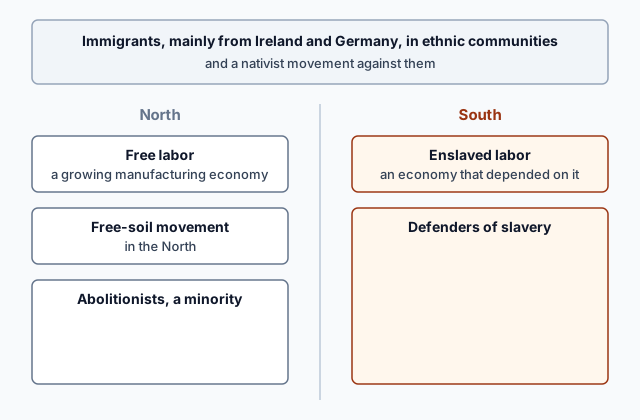
- Immigrants, mainly from Ireland and Germany, often settled in ethnic communities that kept their languages and customs, and nativists tried to limit their political power and cultural influence.
- Some Northerners opposed slavery's spread not on principle but because it would undermine free labor, and a free-soil movement grew from that argument.
- Abolitionists, Black and white and a minority in the North, made moral arguments, helped people escape and sometimes accepted violence; defenders of slavery answered with racial doctrine, a claim that slavery was a positive good, and the Constitution.
Part 2 Learn it How the regions grew apart
2a. Newcomers and nativists
Large numbers of migrants kept arriving from Europe and Asia in these years, mainly from Ireland and Germany. Many settled in ethnic communities, neighborhoods of people from the same homeland, where they could keep parts of their languages and customs: the language spoken at home, the way they worshiped, the holidays they kept. In many American cities whole neighborhoods now lived partly in another language.
Many of the newcomers were Catholic in a mostly Protestant country. A strongly anti-Catholic nativist movement arose. Nativists aimed to limit new immigrants' political power, their votes and their hold on public office, and their cultural influence over American life.
Immigrants who became citizens could vote, so parties had reason to court them. In June 1860, a Democratic Party divided over slavery still promised protection to all citizens, "whether at home or abroad, and whether native or foreign born." That pledge to naturalized citizens ran against what nativists wanted.
Quick check · Multiple choice
A nativist in the 1850s would most likely support which proposal?
2b. Free labor and enslaved labor
The North's growing manufacturing economy relied on free labor: people who worked for wages and could quit, move or save to buy land. The Southern economy depended on enslaved labor. Mississippi's leaders said so when they left the Union: "Our position is thoroughly identified with the institution of slavery." They added: "Its labor supplies the product which constitutes by far the largest and most important portions of commerce of the earth."
The difference did not make every Northerner an enemy of slavery. Some Northerners did not object to slavery on principle. They argued that slavery would undermine the free labor market: a white worker or farmer could not compete with labor that was never paid. From that argument a free-soil movement arose. It portrayed the spread of slavery into the West as incompatible with free labor, and it wanted the territories kept for free workers.
So a Northerner could oppose slavery's spread without caring much about the people held in slavery. Free labor did not mean equal treatment, either. In New Bedford, Douglass was hired as a calker, a trade he knew, but "I was informed that every white man would leave the ship if I struck a blow upon her."
Sources: Mississippi's declaration of the causes of secession (Avalon Project); My Bondage and Freedom (Avalon Project).
Quick check · Spot the error
A student writes a paragraph on the free-soil movement. Which line is the first to go wrong?
2c. Abolitionists
Abolitionists, who wanted slavery ended, were a minority in the North, both African American and white. They ran a highly visible campaign in three ways.
They made moral arguments. Douglass, who had escaped slavery, spoke at Rochester on July 5, 1852, and asked: "What to the American slave is your Fourth of July? I answer, a day that reveals to him, more than all other days in the year, the gross injustice and cruelty to which he is the constant victim."
They helped people escape. After his own flight Douglass met David Ruggles, "the first officer on the under-ground railroad with whom I met after reaching the north," who sent him on to New Bedford.
Some were willing to use violence. On the night of October 16, 1859, John Brown, a white abolitionist, led a raid on Harper's Ferry, Virginia. An account published that year describes "the forcible seizure of the national Arsenal, the capture, imprisonment and killing of the people." Before he was sentenced, Brown told the court about an earlier raid into Missouri, where, he claimed, he "took slaves without the snapping of a gun on either side, moving them through the country, and finally leaving them in Canada." Of Harper's Ferry he said: "I designed to have done the same thing again on a larger scale."
Sources: My Bondage and Freedom (Avalon Project); Life, Trial and Execution of Captain John Brown (Avalon Project).
Quick check · Match
Match each piece of evidence to what it shows about the abolitionist campaign.
2d. Defenders of slavery
Defenders of slavery answered on three grounds. This lesson reads them in a late source: the declaration Texas issued, dated February 2, 1861, to justify its secession. Writing at the moment of the break, Texas put all three in plain words.
Racial doctrine is the claim that one race is by nature above another. The Texas declaration says people of African descent "were rightfully held and regarded as an inferior and dependent race."
The positive good argument went past calling slavery a necessary evil. It said slavery was good for everyone in it. Texas called slavery "mutually beneficial to both bond and free." Texas also appealed to history and religion, saying slavery "is abundantly authorized and justified by the experience of mankind, and the revealed will of the Almighty Creator."
The third ground was the Constitution and states' rights: slavery, and each state's right to keep it, were protected by the nation's founding law. The constitutional part of the case was heard years earlier from the president himself. In his inaugural address of March 4, 1853, Franklin Pierce, who defended the settlement of 1850, said: "I believe that involuntary servitude, as it exists in different States of this Confederacy, is recognized by the Constitution." By "Confederacy" he meant the Union.
Sources: Texas declaration of causes, 1861 (Avalon Project); Inaugural Address of Franklin Pierce (Avalon Project).
Quick check · Select all
Which two passages defend slavery by a claim about race or about slavery's effect on people, rather than by law or religion? Select two.
Select 2 answers, then check.
Part 3 Watch it done Source Douglass's Fourth of July question
Watch each step, then do the last one yourself.
Frederick Douglass spoke at Rochester on July 5, 1852, and asked: "What to the American slave is your Fourth of July? I answer, a day that reveals to him, more than all other days in the year, the gross injustice and cruelty to which he is the constant victim." Explain how the speech's audience and purpose shape this claim.
Predict first
Before the steps, whom do you think Douglass was speaking to?
Step 1 · Name the speaker and his point of view
On September 3, 1838, Douglass left Baltimore and slavery behind. By 1852 he was speaking against slavery as a man who had lived inside it, and his question asks what the holiday means to people still enslaved.
Why this step?
Why does the speaker's own past matter here?
Point of view is where a speaker stands. A man who had been enslaved can speak about what the holiday means to the enslaved in a way his listeners could not.
Step 2 · Read the question's form
Douglass does not ask what the holiday means to Americans in general. He asks about "your Fourth of July." A speaker who says "your" sets himself apart from the people in front of him. Who were they, and what had they just celebrated?
Your step · Decide and justify
Finish it. How do the audience and purpose shape Douglass's claim?
Which evidence best supports your answer?
Part 4 Try it Source a defense of slavery
A Declaration of the Causes which Impel the State of Texas to Secede from the Federal Union, dated February 2, 1861, says people of African descent "were rightfully held and regarded as an inferior and dependent race," and it calls slavery "mutually beneficial to both bond and free." It adds that slavery "is abundantly authorized and justified by the experience of mankind, and the revealed will of the Almighty Creator."
Sources: Texas declaration of causes, 1861 (Avalon Project); Confederate States of America papers (Avalon Project).
Try it · Multiple choice
Which best describes the purpose of the Texas declaration?
Try it · Fill the statement
Complete a historian's notes on the Texas declaration.
Calling slavery "mutually beneficial to both bond and free" presents it as a . Calling people of African descent "an inferior and dependent race" rests on a .
Part 5 Explain it Write it like a document-based answer
Nothing you type leaves this page. Check your answer against the model and each scoring point.
Free-response practice · Question 1 style
A short practice in the shape of the document-based question: three documents instead of seven, and a thesis with one body paragraph instead of a full essay.
Evaluate the extent to which differences over slavery divided the North and the South in the years before the Civil War.
Document 1. Frederick Douglass, My Bondage and Freedom, 1855, describing his arrival in New Bedford, Massachusetts, after escaping slavery: "Regarding slavery as the basis of wealth, I fancied that no people could become very wealthy without slavery." And: "Yet Mr. Johnson was a working man, and his hands were hardened by honest toil."
Document 2. Mississippi's declaration of the causes of its secession, written to justify "the momentous step which our State has taken of dissolving its connection with the government of which we so long formed a part": "Our position is thoroughly identified with the institution of slavery." And: "Its labor supplies the product which constitutes by far the largest and most important portions of commerce of the earth."
Document 3. John Brown, speaking to the court before he was sentenced for the raid on Harper's Ferry, 1859: "I designed to have done the same thing again on a larger scale." And: "I never did intend murder or treason, or the destruction of property, or to excite or incite the slaves to rebellion, or to make insurrection."
Write a thesis, one sentence of historical context, and one paragraph that uses at least two documents and explains the purpose, audience, point of view or situation of one of them.
Model answer
Thesis: Differences over slavery divided the North and the South to a great extent, because the two economies rested on different kinds of labor, though many Northerners opposed slavery's spread for economic reasons rather than on the moral grounds abolitionists used.
Context: after the Mexican-American War added vast western lands, Congress fought over whether slavery could spread there, and the Compromise of 1850's fugitive slave law carried the fight into the free states.
Douglass had believed slavery was "the basis of wealth," but in New Bedford he found free workers like Mr. Johnson, whose "hands were hardened by honest toil" (Document 1). Mississippi's leaders, by contrast, said their "position is thoroughly identified with the institution of slavery" (Document 2), and they wrote to justify leaving the Union, so they had every reason to stress how much slavery mattered. Brown claimed he meant only to free people as he had in Missouri (Document 3), but he spoke as a defendant before sentencing, and an account published that year describes the seizure of a federal arsenal and the killing of people at Harper's Ferry. A raid by a small band of a minority movement shows how far a few would go, not what most Northerners wanted. The regions were divided most deeply by their economies, and the moral campaign was carried by a minority.
Score your own answer. This is a self-check, not a grade. Tick each point your answer makes.
Part 6 Check yourself Two views of labor
The case questions use the two excerpts. The others mix the ideas from the whole lesson.
One excerpt is from Frederick Douglass's 1855 book, describing what he found in New Bedford, Massachusetts, after he escaped slavery in 1838. The other is from the declaration Mississippi issued to justify its secession; the Avalon Project's copy prints no date. Sources: My Bondage and Freedom (Avalon Project); Mississippi's declaration (Avalon Project).
| Document | Excerpt |
|---|---|
| Frederick Douglass, My Bondage and Freedom, 1855 | "Regarding slavery as the basis of wealth, I fancied that no people could become very wealthy without slavery." In New Bedford he found "the very laboring population of New Bedford living in better houses, more elegantly furnished" than the slaveholders he had known. Of his host: "Yet Mr. Johnson was a working man, and his hands were hardened by honest toil." |
| Mississippi, declaration of the causes of secession | "Our position is thoroughly identified with the institution of slavery" ... "Its labor supplies the product which constitutes by far the largest and most important portions of commerce of the earth." |
Case question 1 · Multiple choice
The two excerpts most directly reflect which difference between the regions?
Case question 2 · Multiple choice
Douglass's excerpt is most useful to a historian as evidence of which of the following?
The rest stand on their own and do not use the case.
Check yourself · Put it in order
Put these events in the order they happened, earliest first.
Check yourself · Sort it
Tap each example, then the side it belongs to.
Immigrant community life
Nativist effort
Part 7 Keep it Bring back earlier ideas
This lesson stands on the lands taken in Topic 5.3 and the settlement of 1850 in Topic 5.4.
Bring it back · Multiple choice
Suppose a Mexican American family in New Mexico has grazed sheep on shared land for generations. After 1848, under U.S. rule, newcomers and new courts challenge the family's claim to that land. Which development does this situation illustrate?
Bring it back · Fill the statement
Complete the sentences about the settlement of 1850.
The Compromise of 1850 admitted California as a state. It also passed a stricter law, the part of the bargain that soon angered many in the North.
In three lines
- Immigrants, mainly from Ireland and Germany, built ethnic communities that kept their languages and customs, and an anti-Catholic nativist movement tried to limit their power.
- The North's free labor economy stood against the South's dependence on enslaved labor, and a free-soil movement opposed slavery's spread to protect free labor.
- Abolitionists, a visible minority, argued, aided escapes and sometimes used violence; defenders of slavery used racial doctrine, the positive good argument and the Constitution.
Exam strategy for this topic
- Section I Part A, Multiple Choice: 55 questions in 55 minutes.
- Section I Part B, Short Answer: 3 questions in 40 minutes.
- Section II, Document-Based Question and Long Essay: 2 questions in 100 minutes.
- This lesson's Explain it is shaped like free-response question 1, Document-based.
When a document comes from an abolitionist or a defender of slavery, say who is speaking and to whom, then explain how that audience shapes what the document stresses.
Questions students ask
Were most Northerners abolitionists?
No. Abolitionists were a minority in the North. Many more Northerners opposed the spread of slavery into the West because it would undermine free labor, which is the free-soil position.
Who was Frederick Douglass?
He escaped from slavery in Maryland in 1838, became an abolitionist speaker, and wrote My Bondage and Freedom, published in 1855. This lesson quotes that book and the Rochester oration printed in it.
Why does this lesson quote documents from 1861?
When Texas and Mississippi left the Union they wrote down their reasons. Those declarations state the arguments of slavery's defenders in their own words, so they are clear evidence of what those arguments were.
Why did immigrants settle in ethnic communities?
Living near people from the same homeland let them keep elements of their languages and customs, from the language spoken at home to the way they worshiped.
Where can I read these documents in full?
Each excerpt links to its full text at the Avalon Project at Yale Law School, the primary-source collection this lesson was checked against.
Course alignment, for teachers
AP U.S. History topic 5.5, Unit 5: Period 5: 1844–1877.
- Skill 2.B: Explain the point of view, purpose, historical situation, and/or audience of a source.
This lesson maps all 5 essential knowledge statements of the topic, and the 2 learning objectives with none of their own, to the part that teaches each one: 7 are checked by a scored question. The map is in the lesson file.