Unit 8 · Topic 8.10 · about 30 minutes · 7 parts · 13 scored checks, 4 of them multiple choice
AP U.S. History 8.10: The African American Civil Rights Movement (1960s)
Unit 8: 10 to 17% of the multiple-choice section
What you'll be able to do
- Explain how and why various groups responded to calls for the expansion of civil rights from 1960 to 1980, and how one development of the 1960s movement related to another.
- Explain the various ways in which the federal government responded to the calls for the expansion of civil rights.
Key vocabulary
| Term | What it means | The exam trap |
|---|---|---|
| Direct action | Protest in public, such as a sit-in, a boycott or a march, that forces an issue instead of waiting for officials to act. | Direct action can be nonviolent; the word means acting in person, not using force. |
| Civil disobedience | Openly breaking a law you consider unjust and accepting the penalty, to show the law's injustice. | Civil disobedience is public and accepts arrest; secretly breaking a law is not civil disobedience. |
| Federal examiner | An official sent under the Voting Rights Act with the power to register qualified citizens to vote. | Examiners registered voters; they did not run elections or count votes. |
| Black Power | A movement of the 1960s and 1970s that emphasized racial pride, economic empowerment and the creation of political and cultural institutions. | Black Power was a debate inside the civil rights movement, not a movement against civil rights. |
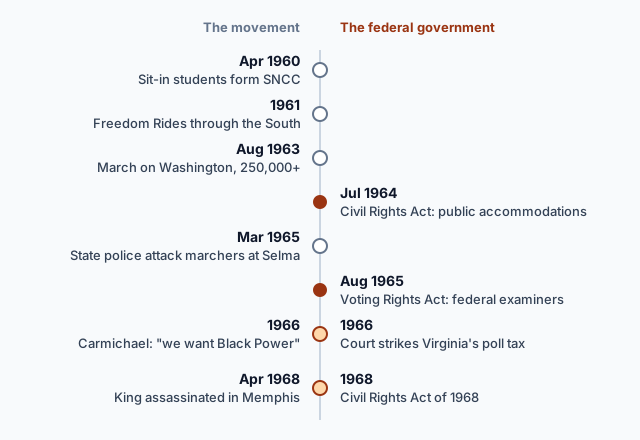 Tap to open the picture full size
Part 1 Think first What moved Congress?
Commit to a guess first. Being wrong now makes the right idea stick better.
Predict first
Congress's civil rights law of 1957 was too weak to stop voting discrimination by local officials. Seven years later, in 1964, Congress outlawed segregation in theaters, restaurants and hotels, and in 1965 it sent federal examiners to register voters. What do you think did most to bring about that change?
In short. In the 1960s activists led by Martin Luther King Jr. and student groups used sit-ins, marches and nonviolent protest alongside court challenges, and the violence they met helped push the federal government to pass the Civil Rights Act of 1964 and the Voting Rights Act of 1965 while the Supreme Court widened rights, though continuing resistance sparked unrest and, after 1965, a sharper debate over nonviolence.
- Direct action, such as the 1960 sit-ins, the 1961 Freedom Rides and the 1963 March on Washington, worked alongside legal challenges, and King's activism rested on nonviolence and civil disobedience.
- Congress, the president and the Court each acted: the Civil Rights Act outlawed segregation in public accommodations, the Voting Rights Act sent federal examiners to register voters, and Warren Court decisions such as Gideon and Miranda widened individual liberties.
- After 1965 some activists, such as SNCC's Stokely Carmichael, called for Black Power, which stressed racial pride, economic empowerment and institutions of their own.
Part 2 Learn it The movement and the federal response
2a. Many strategies, one goal
Activists used more than one tool. The National Archives sums them up: "Individuals and civil rights organizations challenged segregation and discrimination using a variety of activities, including protest marches, boycotts, and refusal to abide by segregation laws." Lawsuits like the ones behind Brown v. Board of Education were legal challenges. Sit-ins, marches and boycotts were direct action, protest in public that forces an issue.
In the early 1960s Black college students sat in at segregated restaurants. In April 1960 Ella Baker, an official of the Southern Christian Leadership Conference (SCLC), brought some of them together, and they formed the Student Nonviolent Coordinating Committee (SNCC). In 1961 the Congress of Racial Equality (CORE), led by James Farmer, organized the Freedom Rides, sending Black and white riders on interstate buses through the South to test a Supreme Court ruling against segregated interstate travel. Riders were beaten and jailed, and SNCC students carried the rides on.
Martin Luther King Jr., president of the SCLC, became the movement's best-known leader. In the National Archives' words, "The cornerstones of his activism were based on non-violence and civil disobedience, both of which were inspired by his Christian faith and the teachings of Mahatma Gandhi." Civil disobedience is openly breaking an unjust law and accepting the penalty.
Sources: March on Washington program; SNCC; King (all National Archives).
Quick check · Sort it
Each card is a step activists took. Tap a card, then the kind of strategy it was.
Legal challenge in court
Direct action in public
2b. Congress acts at last
In the spring of 1963 King and local activists marched against segregation in Birmingham, Alabama. King was jailed and wrote his Letter from Birmingham Jail, and the nation watched on television as police turned dogs and fire hoses on young marchers. That June President John F. Kennedy, in a televised address, urged the nation to guarantee equal treatment of every American regardless of race, and he proposed a civil rights bill. On August 28 more than 250,000 people joined the March on Washington for Jobs and Freedom. After Kennedy's assassination, Lyndon Johnson pressed the bill. Southern Democrats filibustered it, but Senate Minority Leader Everett Dirksen brought enough Republicans to its side, and it passed the Senate 73 to 27. Johnson signed it on July 2, 1964. It outlawed segregation in businesses such as theaters, restaurants and hotels.
Voting was next. In the Freedom Summer of 1964, volunteers registered voters in Mississippi, where three civil rights workers, James Chaney, Andrew Goodman and Michael Schwerner, were murdered. On March 7, 1965, Alabama state police attacked peaceful voting rights marchers at Selma while news cameras filmed. Johnson signed the Voting Rights Act on August 6, 1965. In covered places with a record of discrimination it suspended literacy tests and sent federal examiners, officials with the power to register qualified citizens to vote.
Sources: Civil Rights Act; Voting Rights Act; Congress and the Voting Rights Act (all National Archives).
Quick check · Put it in order
Put these events in the order they happened, earliest first.
2c. The Court widens rights
The Supreme Court widened rights in a series of decisions. Under Chief Justice Earl Warren it kept to the course it set in Brown for about fifteen years, deciding cases on race relations, criminal justice, the political process and the separation of church and state. Some decisions backed the new civil rights laws: in 1966, in South Carolina v. Katzenbach, it upheld the Voting Rights Act. Others protected individual liberties, above all the rights of people accused of crimes. The 24th Amendment (1964) had already abolished poll taxes in national elections; in 1966 the Court struck down Virginia's poll tax in state elections too.
| Case | Year | What the Court held |
|---|---|---|
| Mapp v. Ohio | 1961 | Evidence police seize illegally cannot be used in state courts |
| Engel v. Vitale | 1962 | Official prayer in public schools violates the First Amendment |
| Gideon v. Wainwright | 1963 | States must provide a lawyer to poor defendants charged with serious crimes |
| Heart of Atlanta Motel v. United States | 1964 | Congress could ban segregation in public accommodations, upholding the Civil Rights Act |
| Reynolds v. Sims | 1964 | State legislative districts must have roughly equal populations |
| Harper v. Virginia State Board of Elections | 1966 | Virginia's poll tax is unconstitutional under the 14th Amendment |
| Miranda v. Arizona | 1966 | Police must tell suspects of their rights before questioning them |
| Loving v. Virginia | 1967 | State bans on interracial marriage are unconstitutional |
Quick check · Multiple choice
Which pair of Supreme Court decisions most directly expanded the rights of people accused of crimes?
2d. Resistance, unrest and the debate over nonviolence
Laws did not end resistance. Freedom Riders were beaten, civil rights workers were murdered in Mississippi, and marchers were attacked at Selma. Anger over poverty, police and segregated housing boiled over in urban uprisings, in Watts, Los Angeles, in 1965 and in Newark and Detroit in 1967. In 1968 King was assassinated in Memphis on April 4, riots followed in Washington, DC, and Congress passed the Civil Rights Act of 1968.
The debate was over method. King held that nonviolent protest aimed at integration would win the nation's conscience. Others argued for armed self-defense and Black self-reliance. Malcolm X of the Nation of Islam had long criticized nonviolence before he was killed in February 1965, and the Deacons for Defense and Justice armed themselves to protect activists. In 1966 SNCC's new chairman, Stokely Carmichael, rallied marchers by chanting "we want Black Power," and the Black Panther Party for Self-Defense was founded in Oakland. The National Archives describes Black Power: "It emphasized racial pride, economic empowerment, and the creation of political and cultural institutions." In 1967 SNCC expelled its white members.
Sources: Black Power; SNCC; 1968 (all National Archives).
Quick check · Select all
Which two developments are evidence of the growing debate among activists over nonviolence after 1965? Select two.
Select 2 answers, then check.
Part 3 Watch it done Connect Selma to the Voting Rights Act
Watch each step, then do the last one yourself.
On March 7, 1965, Alabama state police attacked peaceful voting rights marchers at Selma. On August 6, 1965, President Johnson signed the Voting Rights Act. Explain how the first development relates to the second.
Predict first
Before the steps, what do you think the violence at Selma most changed?
Step 1 · Say what was already true before Selma
Congress had passed civil rights acts in 1957, 1960 and 1964, but none was strong enough to stop local officials from keeping Black citizens off the voting rolls. Voting had always been run by state and local officials.
Why this step?
Why start with what the earlier laws could not do?
A connection between two developments is a change. To see what one event changed, you first need to know how things stood before it.
Step 2 · Look at the reaction to Selma
News cameras filmed the attack, and the nation saw it. The question before Congress became whether the federal government should take over the power to register voters, which state and local officials had always held.
Your step · Decide and justify
Finish it. How does the violence at Selma relate to the Voting Rights Act?
Which evidence best supports your answer?
Part 4 Try it Read the March on Washington program
The official program for the March on Washington for Jobs and Freedom lists who spoke at the Lincoln Memorial on August 28, 1963. A. Philip Randolph, a longtime civil rights activist, had first proposed the march. The day ended with the march leaders meeting President Kennedy at the White House. Some of the program's entries:
| Speaker | Organization, as the program lists it |
|---|---|
| The Very Rev. Patrick O'Boyle (invocation) | Archbishop of Washington |
| A. Philip Randolph (opening remarks) | Director, March on Washington for Jobs and Freedom |
| John Lewis | Student Nonviolent Coordinating Committee |
| Walter Reuther | United Automobile, Aerospace and Agricultural Implement Workers of America, AFL-CIO |
| Roy Wilkins | National Association for the Advancement of Colored People |
| Rabbi Joachim Prinz | American Jewish Congress |
| The Rev. Dr. Martin Luther King, Jr. | Southern Christian Leadership Conference |
Try it · Multiple choice
What does this list of speakers suggest about how the movement worked in 1963?
Try it · Spot the error
A student writes a paragraph on the program. Which line is the first to go wrong?
Part 5 Explain it Write it like a document-based answer
Nothing you type leaves this page. Check your answer against the model and each scoring point.
Free-response practice · Question 1 style
A short practice in the shape of the document-based question: three documents instead of seven, and a thesis with one body paragraph instead of a full essay.
Evaluate the extent to which civil rights activism shaped the federal civil rights laws of 1964 and 1965.
Document 1. Official program, March on Washington for Jobs and Freedom, Lincoln Memorial, August 28, 1963. Its speakers include A. Philip Randolph, director of the march; John Lewis of the Student Nonviolent Coordinating Committee; Walter Reuther of the United Automobile Workers; Roy Wilkins of the NAACP; and Martin Luther King Jr. of the Southern Christian Leadership Conference.
Document 2. Civil Rights Act of 1964, Title II, signed by President Lyndon Johnson, July 2, 1964: "All persons shall be entitled to the full and equal enjoyment of the goods, services, facilities, and privileges, advantages, and accommodations of any place of public accommodation."
Document 3. Voting Rights Act of 1965, Section 2, signed by President Johnson, August 6, 1965: "No voting qualification or prerequisite to voting, or standard, practice, or procedure shall be imposed or applied by any State or political subdivision to deny or abridge the right of any citizen of the United States to vote on account of race or color."
Write a thesis, one sentence of historical context, and one paragraph that uses at least two documents and explains the purpose, audience, point of view or situation of one of them.
Model answer
Thesis: Civil rights activism largely shaped the laws of 1964 and 1965, setting both what they covered and when they passed, though presidents and congressional leaders still had to carry them past a Southern filibuster.
Context: in the 1950s the Supreme Court had ruled school segregation unconstitutional, but resistance in the South and a weak 1957 law left segregation and disfranchisement largely in place.
The March on Washington's program (Document 1) shows a coalition of SNCC, the NAACP, the SCLC, a major union and religious leaders, and its purpose was to press the federal government, whose president met the march leaders at the end of the day. The Civil Rights Act's guarantee of "full and equal enjoyment" of places of public accommodation (Document 2) answers the sit-ins at segregated restaurants that students had staged in the early 1960s, and Kennedy proposed the bill only after the nation watched Birmingham police attack young marchers. The Voting Rights Act's ban on any practice used to "deny or abridge the right of any citizen of the United States to vote on account of race or color" (Document 3) followed the state police attack on marchers at Selma by five months, and its federal examiners answered the doubt Selma raised that local officials would enforce the law. Leaders such as Senator Dirksen still mattered, since the 1964 bill passed only after a filibuster was overcome, but the issues the laws addressed were the ones activists had forced into view.
Score your own answer. This is a self-check, not a grade. Tick each point your answer makes.
Part 6 Check yourself What the Voting Rights Act changed
The case questions use the table. The others mix the ideas from the whole lesson.
The National Archives reports these results of the Voting Rights Act. Sources: Voting Rights Act (National Archives); Congress and the Voting Rights Act (National Archives).
| Measure | As the National Archives reports it |
|---|---|
| Signed into law | August 6, 1965 |
| New Black voters registered by the end of 1965 | A quarter of a million |
| Share of those registered by officials the act sent | One-third |
| Southern states with fewer than 50 percent of African Americans registered, end of 1966 | Four out of 13 |
Case question 1 · Multiple choice
Which part of the Voting Rights Act most directly explains the one-third figure in the table?
Case question 2 · Fill the statement
Complete a historian's notes on the table.
The registrations in the table came after the act moved the power to register voters in covered places from to . When the act was challenged, the Supreme Court it in South Carolina v. Katzenbach, so the change lasted.
The rest stand on their own and do not use the case.
Check yourself · Match
Match each federal measure to what it did.
Check yourself · Sort it
Each card is a federal action of the 1960s. Tap a card, then the branch of government that took it.
President
Congress
Supreme Court
Part 7 Keep it Bring back earlier ideas
This lesson stands on the first federal steps against segregation from Topic 8.6 and the Great Society from Topic 8.9.
Bring it back · Multiple choice
In 1948 a president ordered equal treatment in the armed services, and in 1954 the Supreme Court ruled on segregated public schools. What do the two measures show about federal action before the 1960s?
Bring it back · Fill the statement
Read the situation, then complete the sentence.
In 1964 and 1965 a senator votes for Medicare, federal aid to schools in poor districts and a ban on discrimination in public places, all parts of Lyndon Johnson's Great Society, a program meant to end and to eliminate .
In three lines
- Activists, most notably Martin Luther King Jr., fought discrimination with legal challenges, direct action and nonviolent protest.
- The president, Congress and the Supreme Court answered with the Civil Rights Act of 1964, the Voting Rights Act of 1965 and decisions that widened civil rights and liberties.
- Continuing resistance sparked unrest, and after 1965 activists debated more sharply whether nonviolence worked.
Exam strategy for this topic
- Section I Part A, Multiple Choice: 55 questions in 55 minutes.
- Section I Part B, Short Answer: 3 questions in 40 minutes.
- Section II, Document-Based Question and Long Essay: 2 questions in 100 minutes.
- This lesson's Explain it is shaped like free-response question 1, Document-based.
When a question asks how one development relates to another, give the order of events, then name what the first changed that made the second possible or likely.
Questions students ask
What was the difference between the Civil Rights Act and the Voting Rights Act?
The Civil Rights Act of 1964 outlawed segregation in businesses such as theaters, restaurants and hotels, banned job discrimination and created the Equal Employment Opportunity Commission. The Voting Rights Act of 1965 suspended literacy tests in covered places with a record of discrimination and sent federal examiners to register voters.
Why did the 1964 bill take so long to pass?
Opponents bottled it up in the House Rules Committee, and in the Senate Southern Democrats tried to talk it to death in a filibuster. Senator Everett Dirksen brought enough Republicans to its side, and it passed the Senate 73 to 27.
Did everyone in the movement agree with King about nonviolence?
No. After 1965 the debate grew sharper. Malcolm X had long criticized nonviolence, the Deacons for Defense and Justice armed themselves, and in 1966 SNCC's Stokely Carmichael called for Black Power and the Black Panther Party for Self-Defense was founded. King held to nonviolence until he was assassinated in April 1968.
How did the Supreme Court expand rights in these years?
Under Chief Justice Earl Warren the Court decided cases on race relations, criminal justice, the political process and religion in schools. Gideon v. Wainwright (1963) guaranteed lawyers to poor defendants, Miranda v. Arizona (1966) required police to tell suspects their rights, Harper (1966) struck down Virginia's poll tax, and Loving v. Virginia (1967) ended state bans on interracial marriage.
Where can I read these documents in full?
Each excerpt links to its full text at the National Archives, which holds the Civil Rights Act, the Voting Rights Act and the official program of the March on Washington.
Course alignment, for teachers
AP U.S. History topic 8.10, Unit 8: Period 8: 1945–1980.
- Skill 5.B: Explain how a historical development or process relates to another historical development or process.
This lesson maps all 4 essential knowledge statements of the topic, and the 2 learning objectives with none of their own, to the part that teaches each one: 6 are checked by a scored question. The map is in the lesson file.