Unit 2 · Topic 2.5 · about 30 minutes · 7 parts · 12 scored checks, 4 of them multiple choice
AP U.S. History 2.5: Interactions Between American Indians and Europeans
Unit 2: 6 to 8% of the multiple-choice section
What you'll be able to do
- Explain how and why interactions between various European nations and American Indians changed over time, and identify the point of view, purpose, historical situation and audience of the colonial documents that describe them.
Key vocabulary
| Term | What it means | The exam trap |
|---|---|---|
| Accommodation | Two peoples adjusting to one another, through trade, alliance or shared rules, so they can live side by side. | Accommodation is not the same as friendship; ask what each side gained from it. |
| Alliance | An agreement between two powers to support each other, such as a European colony and an American Indian nation. | Ask who sought the alliance and against whom, not only who signed it. |
| Metacom's War | A war in New England between English colonists and American Indians, also called King Philip's War. | Name what the war was fought over, not only the side that started the fighting. |
| Pueblo Revolt | An act of American Indian resistance against Spanish colonizers in the Southwest, named for the Pueblo peoples. | Do not stop at the revolt itself; ask what Spanish colonizers did afterward. |
| Point of view | Where a source's author stands, and how that position shapes what the source says and leaves out. | Point of view is about the author, not about the events the source describes. |
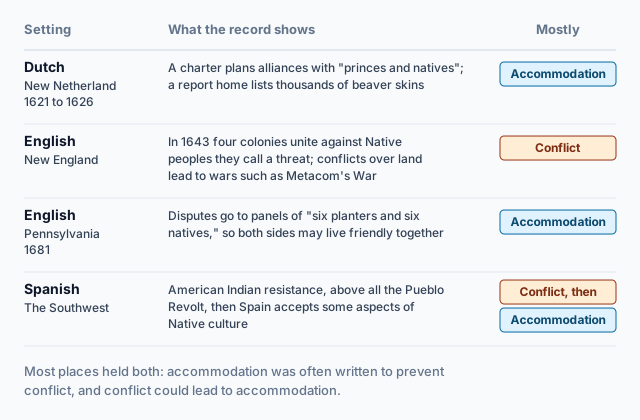 Tap to open the picture full size
Part 1 Think first Six planters and six natives
Commit to a guess first. Being wrong now makes the right idea stick better.
Predict first
In July 1681, months after the king granted him Pennsylvania, William Penn, the colony's proprietor and governor, set terms with the people buying land there. One of them reads: "That all differences, between the planters and the natives, shall also be ended by twelve men, that is, by six planters and six natives." Why do you think he wrote that rule?
In short. From 1607 to 1754, European colonies and American Indian nations both accommodated and fought one another: rival European powers allied with and armed Native groups, who sought allies of their own, while British expansion onto Native land led to wars such as Metacom's War, and resistance in the Southwest, above all the Pueblo Revolt, pushed Spain to accept some Native ways.
- French, Dutch, British and Spanish colonies allied with and armed American Indian groups, and those groups sought European allies against other American Indian groups.
- British conflicts with American Indians over land, resources and political boundaries led to military confrontations such as Metacom's War (King Philip's War) in New England.
- American Indian resistance to Spanish colonizing, particularly after the Pueblo Revolt, led the Spanish to accommodate some aspects of American Indian culture in the Southwest.
Part 2 Learn it Accommodation and conflict
2a. Allies, trade and rivals
European powers competed with one another in North America, and American Indian nations were not bystanders to that contest. Their interactions held both accommodation, adjusting to one another to live and trade side by side, and conflict.
French, Dutch, British and Spanish colonies allied with American Indian groups and armed them. Those groups, in turn, frequently sought European allies against other American Indian groups. An alliance served each side's own aims.
The Dutch planned for alliances from the start. In 1621 the States-General of the United Netherlands chartered the Dutch West India Company to trade in Africa and the Americas and allowed it to "make contracts, engagements and alliances with the princes and natives of the countries comprehended therein." The French and Dutch sent relatively few colonists, so they relied on trade alliances, and sometimes marriage, with American Indians to acquire furs for Europe (Topic 2.2).
A charter is a plan, written by a European government for its own company. It shows what the Dutch intended, not how Native leaders understood the alliances they made.
Source: Charter of the Dutch West India Company, 1621 (Avalon Project).
Quick check · Multiple choice
Which statement best describes the part American Indian groups played in alliances with European colonies in this period?
2b. Land, resources and boundaries
English colonization brought comparatively large numbers of men and women who farmed land taken from Native Americans and lived apart from them (Topic 2.2). British conflicts with American Indians over land, resources and political boundaries led to military confrontations, such as Metacom's War, also called King Philip's War, in New England.
The colonists' documents tell these conflicts from one side. In 1643 four New England governments, Massachusetts, New Plymouth, Connecticut and New Haven, joined as the United Colonies of New England. Their articles give several reasons: settlements "further dispersed upon the sea coasts and rivers than was at first intended," and this one: "the natives have formerly committed sundry Insolence and outrages upon several Plantations of the English and have of late combined themselves against us." The natives, they added, had heard of "those sad distractions in England" that kept help from coming. Its members also agreed to decide together "how all the Jurisdictions may carry it towards the Indians, that they neither grow insolent nor be injured without due satisfaction, lest war break in upon the Confederates through such miscarriages."
The opening names Native actions as outrages and does not mention the land English colonists had taken. Who wrote a document, and why, shapes what it says.
Source: Articles of Confederation of the United Colonies of New England, 1643 (Avalon Project).
Quick check · Fill the statement
Complete a historian's notes on the 1643 articles of the United Colonies of New England.
The articles call Native actions "Insolence and outrages" and leave out the land colonists had taken. That choice of words shows the of the English colonies that wrote them. The articles were written to join four colonies in a league for their common defense, which is their .
2c. Resistance and accommodation in the Southwest
Spain's colonies worked differently. Spanish efforts to extract wealth from the land led to institutions that subjugated Native populations and set out to convert them to Christianity (Topic 2.2). American Indians resisted those colonizing efforts in North America, and the course framework singles out one act of that resistance, the Pueblo Revolt.
The revolt changed the terms. After it, Spanish colonizers accommodated some aspects of American Indian culture in the Southwest. A colonizing power that had set out to subjugate and convert now made room for some Native ways.
This is the kind of change over time the topic asks about. Interactions did not stay fixed: what American Indians did, here armed resistance, changed what Europeans did next. The same pattern runs the other way in New England, where colonists' push onto Native land brought war.
Source: the AP U.S. History course framework. No primary text of the revolt is quoted here.
Quick check · Decide and justify
Did Spanish relations with American Indians in the Southwest stay the same after the Pueblo Revolt?
Which reason best supports your answer?
Part 3 Watch it done Source a Dutch report on Manhattan
Watch each step, then do the last one yourself.
On November 5, 1626, P. Schagen wrote from Amsterdam that a ship had arrived from New Netherland. "They have purchased the island Manhattes from the Indians for the value of 60 guilders," he reported. Identify the report's audience and what it can and cannot show.
Predict first
Before the steps, whose view of the Manhattan deal do you think this report gives?
Step 1 · Name the author and the audience
The letter opens "High and Mighty Lords" and closes "Your High Mightinesses' obedient, P. Schagen." A Dutch writer is reporting upward, to the lords he serves, about a colony the Dutch had founded.
Why this step?
Why does it matter that he writes to the people above him?
Someone reporting to superiors chooses what news to send and how to frame it. Knowing the audience tells you what the writer wanted them to think, and whose voice is missing.
Step 2 · Read what he chose to report
He reports that "our people are in good heart and live in peace there," the purchase, the harvest, and a cargo list that begins with "7246 beaver skins".
Your step · Decide and justify
What can this report show about the Manhattan purchase, and why?
Which fact about the source best supports your answer?
Part 4 Try it Source a plan of government
Carolina's lords proprietors wrote the colony's Fundamental Constitutions, dated March 1, 1669, as a plan for governing it. In section 97 they explain why the colony would allow more than one church. It opens:
"But since the natives of that place, who will be concerned in our plantation, are utterly strangers to Christianity, whose idolatry, ignorance, or mistake gives us no right to expel or use them ill"
The sentence goes on. Settlers coming from other places will hold different religious opinions, and the colony will not keep them out. And tolerance will serve a further aim: "that Jews, heathens, and other dissenters from the purity of Christian religion may not be scared and kept at a distance from it," but may, "by good usage and persuasion," be won over to Christianity.
Source: Fundamental Constitutions of Carolina, 1669 (Avalon Project).
Try it · Multiple choice
What does the phrase "idolatry, ignorance, or mistake" reveal about this source?
Try it · Spot the error
A student writes a sourcing paragraph on section 97. Which line is the first to go wrong?
Part 5 Explain it Write it like a document-based answer
Nothing you type leaves this page. Check your answer against the model and each scoring point.
Free-response practice · Question 1 style
A short practice in the shape of the document-based question: three documents instead of seven, and a thesis with one body paragraph instead of a full essay.
Evaluate the extent to which relations between European colonists and American Indians in the 1600s were marked by accommodation rather than conflict.
Document 1. Charter of the Dutch West India Company, issued by the States-General of the United Netherlands, June 3, 1621: the company may "make contracts, engagements and alliances with the princes and natives of the countries comprehended therein."
Document 2. Articles of Confederation of the United Colonies of New England (Massachusetts, New Plymouth, Connecticut and New Haven), May 19, 1643: "the natives have formerly committed sundry Insolence and outrages upon several Plantations of the English and have of late combined themselves against us."
Document 3. Concessions to the Province of Pennsylvania, agreed upon by William Penn, proprietor and governor, July 11, 1681: "That all differences, between the planters and the natives, shall also be ended by twelve men, that is, by six planters and six natives; that so we may live friendly together as much as in us lieth, preventing all occasions of heart-burnings and mischief."
Write a thesis, one sentence of historical context, and one paragraph that uses at least two documents and explains the purpose, audience, point of view or situation of one of them.
Model answer
Thesis: In the 1600s, relations between European colonists and American Indians held both accommodation and conflict, but accommodation was most often a way to secure trade or head off war, so even the most accommodating arrangements assumed conflict was close.
Context: rival European powers competed for trade and territory in North America, and English colonists, who arrived in large numbers to farm, settled on land taken from Native Americans.
The Dutch charter of 1621 planned for alliances with "the princes and natives" (Document 1), the trade alliances the Dutch, with few colonists, relied on to acquire furs. The New England colonies of 1643, by contrast, named Native peoples who had "combined themselves against us" among their reasons for uniting (Document 2). Their purpose was to justify a military league, so their account of Native "outrages" gives only the colonists' side and leaves out the land colonists had taken. Penn's panels of "six planters and six natives" (Document 3) were accommodation, but he set them up for "preventing all occasions of heart-burnings and mischief." Accommodation was real, and it was built to manage conflict.
Score your own answer. This is a self-check, not a grade. Tick each point your answer makes.
Part 6 Check yourself Two English colonies write about their neighbors
The case questions use the two excerpts. The others mix the ideas from the whole lesson.
Both excerpts come from English colonies, 38 years apart. Sources: 1643 articles (Avalon Project); 1681 concessions (Avalon Project).
| Document | Excerpt |
|---|---|
| Articles of the United Colonies of New England, May 19, 1643 | "the natives have formerly committed sundry Insolence and outrages upon several Plantations of the English and have of late combined themselves against us" ... "how all the Jurisdictions may carry it towards the Indians, that they neither grow insolent nor be injured without due satisfaction, lest war break in upon the Confederates through such miscarriages" |
| Concessions to the Province of Pennsylvania, William Penn, July 11, 1681 | "And forasmuch, as it is usual with the planters to over-reach the poor natives of the country, in trade, by goods not being good of the kind, or debased with mixtures, with which they are sensibly aggrieved, it is agreed, whatever is sold to the Indians, in consideration of their furs, shall be sold in the market place, and there suffer the test, whether good or bad; if good, to pass; if not good, not to be sold for good, that the natives may not be abused, nor provoked." |
Case question 1 · Multiple choice
Which best describes a difference in point of view between the two excerpts?
Case question 2 · Multiple choice
What do the two excerpts have in common?
The rest stand on their own and do not use the case.
Check yourself · Sort it
Tap a card, then the kind of interaction it shows.
Accommodation
Conflict
Check yourself · Select all
Which two situations fit the causes of British conflicts with American Indians that this topic names? Select two.
Select 2 answers, then check.
Part 7 Keep it Bring back earlier ideas
This lesson stands on how the European powers colonized from Topic 2.2 and on how trade changed American Indian communities from Topic 2.4.
Bring it back · Match
Match each colonial scene to the European colonizing pattern it fits best.
Bring it back · Fill the statement
Read the situation, then complete the sentences.
Suppose a Native town trades with Europeans for years, sending out furs and taking in metal tools and cloth. The goods coming in its people's ways of living. The epidemic diseases that travel along the same trade routes its population.
In three lines
- European rivals allied with and armed American Indian groups, and those groups sought European allies against other American Indian groups.
- British conflicts with American Indians over land, resources and political boundaries led to wars such as Metacom's War in New England.
- Resistance to Spain, above all the Pueblo Revolt, led to Spanish accommodation of some aspects of American Indian culture in the Southwest.
Exam strategy for this topic
- Section I Part A, Multiple Choice: 55 questions in 55 minutes.
- Section I Part B, Short Answer: 3 questions in 40 minutes.
- Section II, Document-Based Question and Long Essay: 2 questions in 100 minutes.
- This lesson's Explain it is shaped like free-response question 1, Document-based.
When a question asks about a source's point of view or purpose, quote the words that show it, then say what the source leaves out because of who wrote it and why.
Questions students ask
Were relations between Europeans and American Indians mostly peaceful or mostly violent?
Both, and the balance changed by place and over time. Rival European colonies made alliances and traded with American Indian groups, while British expansion onto Native land led to wars such as Metacom's War, and resistance in the Southwest led Spain to accommodate some Native ways.
Why is Metacom's War also called King Philip's War?
The course framework gives both names for the same war in New England. Use either on the exam, and say what it was fought over: land, resources and political boundaries.
Did the Dutch really buy Manhattan for 60 guilders?
A Dutch report of November 1626 says the Dutch purchased the island from the Indians for the value of 60 guilders. That is the Dutch account, sent to Dutch lords. It does not tell you how the sellers understood the deal.
Why do the quoted documents use words like natives and idolatry?
Every excerpt is copied exactly as the archive prints it, and the words show the writers' point of view. Reading them for what they reveal about the authors is the skill this lesson practices.
Where can I read these documents in full?
Each excerpt links to its full text at the Avalon Project at Yale Law School, the primary-source collection this lesson was checked against.
Course alignment, for teachers
AP U.S. History topic 2.5, Unit 2: Period 2: 1607–1754.
- Skill 2.A: Identify a source’s point of view, purpose, historical situation, and/or audience.
This lesson maps all 3 essential knowledge statements of the topic, and the one learning objective with none of its own, to the part that teaches each one: 4 are checked by a scored question. The map is in the lesson file.