Unit 6 · Topic 6.9 · about 30 minutes · 7 parts · 13 scored checks, 5 of them multiple choice
AP U.S. History 6.9: Responses to Immigration in the Gilded Age
Unit 6: 10 to 17% of the multiple-choice section
What you'll be able to do
- Explain the various responses to immigration in the period over time, and explain how one response, such as the debate over citizenship or the settlement house movement, relates to another development of the period.
Key vocabulary
| Term | What it means | The exam trap |
|---|---|---|
| Assimilation | The process of newcomers becoming like the society around them in language, customs and outlook. | Assimilation was rarely all or nothing; many immigrants kept parts of the culture they brought and took on parts of the one they found. |
| Americanization | Efforts to make immigrants adopt American language, customs and civic ideas, by settlement workers, schools or laws. | Americanization is an effort to change newcomers, not to keep them out; exclusion is a different response. |
| Naturalization | The legal process by which a person born abroad becomes a citizen. | The 14th Amendment names naturalized persons as citizens but does not say who may be naturalized; Congress sets that rule, and in 1882 it wrote a bar on naturalizing Chinese into law. |
| Social Darwinism | A later name for theories that justified the success of those at the top of society as both appropriate and inevitable. | Not every argument for limited government is Social Darwinism; the term is for claims that success at the top is deserved and natural. |
| Settlement house | A center in a city neighborhood where reformers, many of them women like Jane Addams, helped immigrants adapt to U.S. language and customs. | Settlement workers helped immigrants adapt; they did not decide who could enter the country or become a citizen. |
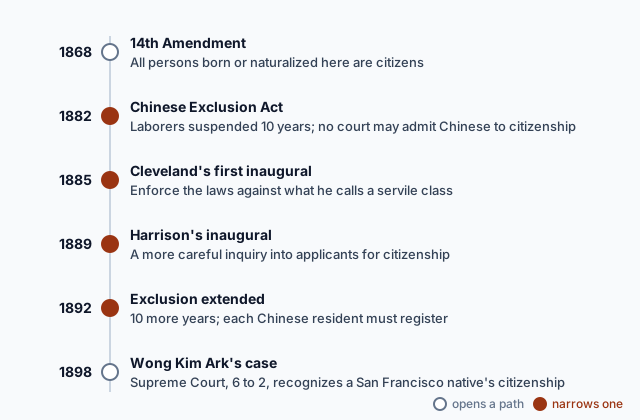 Tap to open the picture full size
Part 1 Think first Keep them out, or make them American?
Commit to a guess first. Being wrong now makes the right idea stick better.
Predict first
In 1882 Congress suspended the coming of Chinese laborers. In 1889 President Harrison asked for a more careful inquiry into people applying for citizenship. In the same years, many women worked in settlement houses to help immigrants adapt to American life. What do these three responses have in common?
In short. As international migration grew, Americans argued over who should be let in and who could become a citizen, and over assimilation and Americanization, while many immigrants worked out compromises between the cultures they brought and the one they found; social commentators defended those at the top as deserving, and settlement house workers such as Jane Addams helped immigrants adapt.
- Congress suspended the coming of Chinese laborers in 1882 and barred courts from admitting Chinese to citizenship, and presidents called for stricter naturalization.
- Theories later called Social Darwinism justified the success of those at the top as appropriate and inevitable.
- Many women, like Jane Addams, worked in settlement houses to help immigrants adapt to U.S. language and customs.
Part 2 Learn it Responses to the newcomers
9a. Who can come, and who can become American?
As migration grew, so did debates over assimilation, newcomers becoming like the people already here, and Americanization, efforts to make them so.
One answer was to keep people out. The Chinese Exclusion Act of May 6, 1882 suspended the coming of Chinese laborers for ten years, and it went further: "no State court or court of the United States shall admit Chinese to citizenship." When it expired in 1892, Congress extended it for ten years and required each Chinese resident to register and obtain a certificate of residence. The course framework places the Contract Labor Law, approved February 26, 1885, in the same trend of restrictive immigration laws that began in the 1880s.
Another answer was to set terms for becoming a citizen. In 1889 President Benjamin Harrison said: "Our naturalization laws should be so amended as to make the inquiry into the character and good disposition of persons applying for citizenship more careful and searching." He wanted from each applicant "a good knowledge by him of our institutions."
Immigrants answered too. Many negotiated compromises between the cultures they brought and the culture they found. In a case reported in January 1885, Mary and Joseph Tape won a court challenge in California against school officials who had refused to admit their daughter to a primary school because of her Chinese heritage.
Sources: Chinese Exclusion Act (National Archives); Harrison's inaugural address (Avalon Project).
Quick check · Sort it
Tap a card, then the response it shows.
Shut some newcomers out
Bring newcomers in, on some terms
9b. A theory that the top deserved to be there
Some social commentators of the period advocated theories later described as Social Darwinism. These theories justified the success of those at the top of the socioeconomic structure as both appropriate and inevitable: the people at the top belonged there, and nothing could or should change it. The course framework points to William Graham Sumner, whose 1883 book What Social Classes Owe to Each Other argued for letting the principle of laissez-faire capitalism, a free market with little government interference, govern social relations.
Read the label with care. The name Social Darwinism was attached later, which is why the course says the theories were later described that way.
A related idea about government reached the presidency. In his second inaugural address, on March 4, 1893, President Grover Cleveland said that "while the people should patriotically and cheerfully support their Government its functions do not include the support of the people." Cleveland says nothing here about who deserves success. His point is narrower: government should not support people. That is a claim about limited government, not a Social Darwinist theory, but it shows how widely the case against public help was made.
Source: Cleveland's second inaugural address (Avalon Project).
Quick check · Multiple choice
Which statement would a social commentator advancing the theories later called Social Darwinism most likely make?
9c. Settlement houses
A settlement house was a center in a city neighborhood where reformers offered help to the people around them. Many women, like Jane Addams, worked in settlement houses to help immigrants adapt to U.S. language and customs. The course framework's examples include Addams's Hull House, Denison House, whose director planned temporary work relief for immigrant women in 1894, and Cleveland's Hiram House, founded in the late nineteenth century. In her memoir Twenty Years at Hull House, which the course framework cites in a 1912 edition, Addams looked back on how Hull House workers made connections with, and found work for, the young and the old in their neighborhood.
Now relate the developments to each other. Social Darwinist theories said success at the top was deserved and inevitable, which left little reason to help those at the bottom. Settlement house workers instead set out to help the newcomers around them. And settlement work was itself one side of the Americanization debate: it helped immigrants adapt, while many immigrants decided for themselves how much of their own culture to keep.
Quick check · Match
Match each response to immigration and inequality to what it did or argued.
Part 3 Watch it done Relate immigration to the fight over citizenship
Watch each step, then do the last one yourself.
Explain how the growth of immigration in the Gilded Age relates to the argument over citizenship, using the 14th Amendment, ratified in 1868: "All persons born or naturalized in the United States, and subject to the jurisdiction thereof, are citizens of the United States and of the State wherein they reside."
Step 1 · Name the two developments
First development: international migration grew, bringing immigrants from Asia and southern and eastern Europe to the cities. Second development: Americans argued over who could become a citizen.
Why this step?
Why name both developments before linking them?
A connection needs two ends. If you name only one, your answer slides into describing it instead of explaining how it relates to the other.
Step 2 · Find the doors in the 1868 text
The amendment names two ways to be a citizen: being born here and being naturalized. It does not say who may be naturalized. The Constitution gives that power to Congress, "To establish an uniform Rule of Naturalization." In 1882 Congress wrote into law that "no State court or court of the United States shall admit Chinese to citizenship." In 1889 Harrison asked that the inquiry into applicants be "more careful and searching." The birth path was tested too: officials denied the citizenship of Wong Kim Ark, born in San Francisco, and in 1898 the Supreme Court, 6 to 2, recognized it.
Your step · Decide and justify
Finish it. How does the growth of immigration relate to these arguments over citizenship?
Which evidence best supports your answer?
Part 4 Try it Read a restrictionist as evidence of his own view
In his first inaugural address, on March 4, 1885, President Grover Cleveland said: "The laws should be rigidly enforced which prohibit the immigration of a servile class to compete with American labor, with no intention of acquiring citizenship, and bringing with them and retaining habits and customs repugnant to our civilization."
He names no group. Two laws limiting who could come were on the books when he spoke: the Chinese Exclusion Act of 1882 and the Contract Labor Law, approved a few days earlier, on February 26, 1885.
Sources: Cleveland's first inaugural address (Avalon Project); Chinese Exclusion Act (National Archives).
Try it · Multiple choice
What is the best way for a historian to use Cleveland's 1885 sentence?
Try it · Spot the error
A student writes a paragraph about Cleveland's 1885 address. Which line is the first to go wrong?
Part 5 Explain it Write it like a document-based answer
Nothing you type leaves this page. Check your answer against the model and each scoring point.
Free-response practice · Question 1 style
A short practice in the shape of the document-based question: three documents instead of seven, and a thesis with one body paragraph instead of a full essay.
Evaluate the extent to which responses to immigration from 1882 to 1897 sought to exclude newcomers rather than to make them into Americans.
Document 1. Chinese Exclusion Act, approved May 6, 1882: "the coming of Chinese laborers to this country endangers the good order of certain localities within the territory thereof." And: "no State court or court of the United States shall admit Chinese to citizenship."
Document 2. Benjamin Harrison, inaugural address, March 4, 1889: "We should not cease to be hospitable to immigration, but we should cease to be careless as to the character of it." And: "Our naturalization laws should be so amended as to make the inquiry into the character and good disposition of persons applying for citizenship more careful and searching."
Document 3. William McKinley, inaugural address, March 4, 1897: "Our naturalization and immigration laws should be further improved to the constant promotion of a safer, a better, and a higher citizenship." And: "A grave peril to the Republic would be a citizenship too ignorant to understand or too vicious to appreciate the great value and beneficence of our institutions and laws, and against all who come here to make war upon them our gates must be promptly and tightly closed."
Write a thesis, one sentence of historical context, and one paragraph that uses at least two documents and explains the purpose, audience, point of view or situation of one of them.
Model answer
Thesis: Between 1882 and 1897, national leaders fully excluded one group, Chinese laborers, but for most immigrants they chose to screen newcomers and to ask that citizens know American institutions rather than to shut immigrants out, while private efforts such as settlement houses worked to help immigrants adapt.
Context: industrial cities, full of new factories and businesses, drew growing numbers of immigrants from Asia and southern and eastern Europe, and public debates over assimilation and Americanization grew with them.
The 1882 Act is pure exclusion: it suspended Chinese laborers and declared that no court "shall admit Chinese to citizenship" (Document 1). Later presidents took a different line for immigrants in general. Harrison wanted the country to stay "hospitable to immigration" while making the inquiry into applicants "more careful and searching" (Document 2). That is selection, deciding who may join, rather than exclusion of a whole group; elsewhere in the same address Harrison asked for "a good knowledge by him of our institutions," the Americanizing half of his plan. McKinley called for laws that promote "a higher citizenship" (Document 3). Both spoke in inaugural addresses to the whole nation, so they framed their plans as protecting the Republic, which may make the screening they wanted sound more welcoming than its effects on rejected applicants would be. Even McKinley's closed gates are aimed at those who come to make war on American institutions, not at immigrants as a whole. Exclusion was the rule for one group; for the rest, leaders mixed selection with a hope of Americanization.
Score your own answer. This is a self-check, not a grade. Tick each point your answer makes.
Part 6 Check yourself Two texts on who is a citizen
The case questions use the two excerpts. The others mix ideas from the whole lesson.
Two federal texts, fourteen years apart. Sources: 14th Amendment (National Archives); Chinese Exclusion Act (National Archives).
| Document | Excerpt |
|---|---|
| 14th Amendment, ratified July 9, 1868 | "All persons born or naturalized in the United States, and subject to the jurisdiction thereof, are citizens of the United States and of the State wherein they reside." |
| Chinese Exclusion Act, approved May 6, 1882, Section 14 | "no State court or court of the United States shall admit Chinese to citizenship" |
Case question 1 · Multiple choice
How does Section 14 of the 1882 Act relate to the 1868 citizenship clause?
Case question 2 · Select all
Which two statements does the table support? Select two.
Select 2 answers, then check.
The rest stand on their own and do not use the case.
Check yourself · Put it in order
Put these events in the order they happened, earliest first.
Check yourself · Fill the statement
Read the situation, then complete the sentences.
A writer of the 1880s argues that the men at the top of the economy rose there by the natural working of society, and that nothing should be done to change it. Historians later called theories like this . They treated the success of those at the top as both appropriate and .
Check yourself · Sort it
Tap a card, then the response it belongs to.
Helped newcomers adapt
Justified success at the top
Part 7 Keep it Bring back earlier ideas
This lesson stands on who migrated to the cities from Topic 6.8 and the growth of the industrial workforce from Topic 6.7.
Bring it back · Multiple choice
Which best describes the migrants drawn to American cities from 1865 to 1898?
Bring it back · Multiple choice
Which change in the Gilded Age workforce came with its rapid growth?
In three lines
- As immigration grew, Americans argued over assimilation and Americanization: Congress excluded Chinese laborers and barred them from citizenship, and presidents called for stricter naturalization.
- Social commentators advanced theories later called Social Darwinism, which justified success at the top as appropriate and inevitable.
- Many women, like Jane Addams, worked in settlement houses to help immigrants adapt, while immigrants negotiated their own compromises between old and new cultures.
Exam strategy for this topic
- Section I Part A, Multiple Choice: 55 questions in 55 minutes.
- Section I Part B, Short Answer: 3 questions in 40 minutes.
- Section II, Document-Based Question and Long Essay: 2 questions in 100 minutes.
- This lesson's Explain it is shaped like free-response question 1, Document-based.
When a question asks how two developments relate, name both developments first, then use one piece of evidence that shows the link, such as a law that closed one path to citizenship as immigration grew.
Questions students ask
Was the Chinese Exclusion Act a ban on all Chinese people?
It suspended the coming of Chinese laborers, skilled and unskilled, for ten years, and barred courts from admitting Chinese to citizenship. Congress extended it in 1892 and required each Chinese resident to register and obtain a certificate of residence.
What is the difference between Social Darwinism and the Gospel of Wealth?
Theories later called Social Darwinism justified success at the top as appropriate and inevitable. The Gospel of Wealth, in the next topic, argued that the wealthy had a moral duty to help the less fortunate.
Who was Jane Addams?
She is the course framework's example of the many women who worked in settlement houses to help immigrants adapt to U.S. language and customs. Her Hull House is one of the settlement houses it names.
Why does this lesson quote presidents who wanted to limit immigration?
Their words are evidence of their own views and of the debate they took part in. They are not evidence of how immigrants actually lived, and the lesson says so wherever it quotes them.
Where can I read these documents in full?
Each excerpt links to its full text at the National Archives or the Avalon Project at Yale Law School, the primary-source collections this lesson was checked against.
Course alignment, for teachers
AP U.S. History topic 6.9, Unit 6: Period 6: 1865–1898.
- Skill 5.B: Explain how a historical development or process relates to another historical development or process.
This lesson maps all 3 essential knowledge statements of the topic, and the one learning objective with none of its own, to the part that teaches each one: 4 are checked by a scored question. The map is in the lesson file.