Unit 7 · Topic 7.3 · about 30 minutes · 7 parts · 13 scored checks, 5 of them multiple choice
AP U.S. History 7.3: The Spanish–American War
Unit 7: 10 to 17% of the multiple-choice section
What you'll be able to do
- Explain the effects of the Spanish-American War, from the islands the United States gained in the Caribbean and the Pacific to its new role in Asia and its suppression of the nationalist movement in the Philippines, and read the war's documents for their purpose and audience.
Key vocabulary
| Term | What it means | The exam trap |
|---|---|---|
| Teller Amendment | The 1898 amendment by which Congress, moving toward war with Spain, promised to leave Cuba's government to its people once the island was pacified. | A promise Congress made before the war is not the same as what the peace treaty or later laws did; check the date of each document. |
| Platt Amendment | Conditions Congress set in 1901 for ending the occupation of Cuba, written into Cuba's constitution and a 1903 treaty, including a U.S. right to intervene. | It was an amendment to a U.S. army funding bill and then part of Cuba's constitution, not an amendment to the U.S. Constitution. |
| Protectorate | A country under another nation's protection and partial control. | Do not confuse protectorate with protectionism, a policy of taxing imports to shield home industry. |
| Insurrection | A revolt against an authority that the speaker treats as lawful. | The word names an armed revolt; by itself it says nothing about how large the revolt was. |
| Joint resolution | A measure passed by a simple majority of both houses of Congress and signed by the president, the method used to annex Hawaii in 1898. | A joint resolution is not a treaty; it skips the two-thirds Senate vote a treaty needs. |
 Tap to open the picture full size
Part 1 Think first A war over Cuba, a treaty about much more
Commit to a guess first. Being wrong now makes the right idea stick better.
Predict first
The United States went to war with Spain in 1898 over Spain's colony of Cuba. As Congress moved toward war, it promised to "leave the government and control of the island to its people." The two countries signed a peace treaty on December 10, 1898. What do you think the United States came away with?
In short. The American victory over Spain in 1898 gave the United States island territories in the Caribbean and the Pacific, deepened its involvement in Asia, and led it to suppress a nationalist movement in the Philippines.
- In the peace treaty Spain gave up its claim to Cuba and ceded Puerto Rico, Guam and the Philippines; Congress annexed Hawaii during the war.
- Cuba was occupied rather than annexed, and the Platt Amendment then gave the United States a right to intervene there.
- A Filipino nationalist movement fought American rule, and the United States sent an army to suppress what its leaders called an insurrection.
Part 2 Learn it What the war left behind
2a. Islands in two oceans
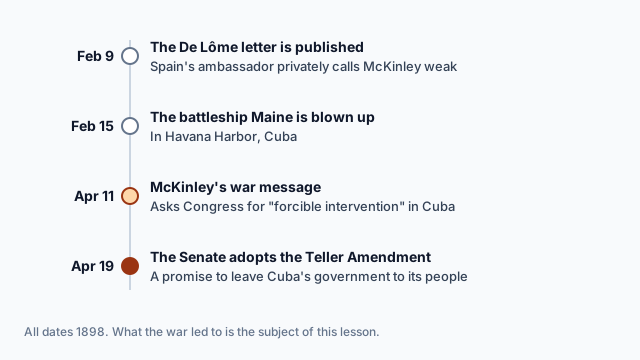
Background first. In February 1898 the New York Journal published a private letter from the Spanish ambassador, Enrique Dupuy de Lôme, calling McKinley "weak and a bidder for the admiration of the crowd." Cuban revolutionaries had intercepted it from the mail. On February 15 the battleship Maine was blown up in Havana Harbor, and on April 11 McKinley asked Congress for "forcible intervention" in Cuba.
The treaty that ended the war, signed December 10, 1898, set out its main results. Article I: "Spain relinquishes all claim of sovereignty over and title to Cuba." The United States would occupy the island. Article II: "Spain cedes to the United States the island of Porto Rico and other islands now under Spanish sovereignty in the West Indies, and the island of Guam in the Marianas or Ladrones." Porto Rico is the treaty's spelling of Puerto Rico. Article III ceded the Philippine Islands, and the United States agreed to pay Spain twenty million dollars. The treaty was ratified on February 6, 1899.
That July, during the war, Congress had also annexed Hawaii by joint resolution. The United States now held island territories in the Caribbean and the Pacific. Cuba was occupied, not annexed.
Sources: De Lôme Letter (National Archives); Treaty of Peace with Spain (Avalon Project); Annexing Hawaii (National Archives).
Quick check · Sort it
Each card is an island the United States came to hold or control in 1898. Tap a card, then say how it came under American power.
Ceded by Spain in the treaty
Not ceded by Spain
2b. Cuba: independence with conditions
In April 1898 Congress had promised, in the Teller Amendment, to "leave the government and control of the island to its people." Instead, U.S. troops occupied Cuba for several years after the war. Under Gen. Leonard Wood, the military government organized a school system, ordered the finances, and made significant progress in eliminating yellow fever.
In 1901 Congress set conditions for ending the occupation. They became known as the Platt Amendment, after Senator Orville Platt of Connecticut, and Cubans reluctantly wrote them into their constitution; a treaty approved May 22, 1903 repeated them. Cuba could make no treaty with a foreign power that would impair its independence. In Article III, "the government of Cuba consents that the United States may exercise the right to intervene for the preservation of Cuban independence." The amendment also let the United States lease or buy land for naval bases, the main one at Guantánamo Bay.
The National Archives says the amendment virtually made Cuba a U.S. protectorate: a country with its own government, over whose affairs another nation holds a right to step in.
Source: Platt Amendment (National Archives).
Quick check · Multiple choice
Why does the National Archives describe the Platt Amendment as making Cuba virtually a U.S. protectorate?
2c. Into the Pacific and Asia
The war also pulled the United States across the Pacific. Part of it was fought in the Philippine Islands, and that, the National Archives explains, made the case that Hawaii would be strategically valuable as a mid-Pacific fueling station and naval installation. A treaty to annex Hawaii had failed in the Senate earlier in 1898. Supporters then turned to a joint resolution of Congress, which needed only a simple majority in each house, and McKinley signed it on July 7, 1898.
With Hawaii, Guam and the Philippines, the United States held a chain of islands reaching to the edge of Asia, and its involvement in Asian affairs grew. In his second inaugural address, on March 4, 1901, McKinley said: "The part which the United States bore so honorably in the thrilling scenes in China, while new to American life, has been in harmony with its true spirit and best traditions." He calls the step new and, in the same breath, true to tradition, the way leaders of the period often described their moves abroad.
Sources: Annexing Hawaii (National Archives); McKinley's second inaugural (Avalon Project).
Quick check · Match
Match each place to what the war years brought there.
2d. The Philippines: a war after the war
The course framework describes what followed as the suppression of a nationalist movement in the Philippines: Filipinos who wanted a nation of their own fought American rule. The treaty had left their future to Washington: "The civil rights and political status of the native inhabitants of the territories hereby ceded to the United States shall be determined by the Congress."
Congress, McKinley said in 1901, "has, however, provided an army to enable the Executive to suppress insurrection, restore peace, give security to the inhabitants, and establish the authority of the United States throughout the archipelago." With that army the United States suppressed the nationalist movement. McKinley promised the islands self-government "as fast as they were ready for it," a promise that left Americans to decide when that would be.
Notice the words. An insurrection is a revolt against lawful authority, so calling the fighting an insurrection treats American rule as lawful and the fighters as rebels. Filipino nationalists saw a struggle for independence against a new foreign ruler. The same events read differently depending on who described them, and for what purpose.
Sources: Treaty of Peace with Spain (Avalon Project); McKinley's second inaugural (Avalon Project); the AP U.S. History course framework, Period 7.
Quick check · Fill the statement
Complete the notes on the Philippines after 1898.
McKinley described Filipinos fighting U.S. forces as taking part in an , while they saw themselves as part of a movement. The treaty left the islanders' civil rights and political status to be decided by .
Part 3 Watch it done Source McKinley's words on the Philippines
Watch each step, then do the last one yourself.
On March 4, 1901, at his second inauguration, President McKinley said of the Philippines: "We are not waging war against the inhabitants of the Philippine Islands. A portion of them are making war against the United States. By far the greater part of the inhabitants recognize American sovereignty and welcome it as a guaranty of order and of security for life, property, liberty, freedom of conscience, and the pursuit of happiness." Explain how the speech's purpose and audience shape these claims.
Predict first
Before the steps, what do you think this passage is?
Step 1 · Place it in time
The treaty with Spain had been ratified two years earlier, on February 6, 1899. Since then Congress had provided an army to suppress insurrection in the islands. McKinley spoke as he began his second term, with that policy still under way.
Why this step?
Why does it matter that he was beginning a second term?
An inaugural address speaks to the whole nation about the course the government will follow. A president defending a policy he means to keep has every reason to describe it in the best light.
Step 2 · Name the audience
An inaugural address speaks to the American people. McKinley gave this one at the start of his second term, while U.S. troops were still fighting in the islands. Ask what a speaker in that position needs his listeners to believe about the war.
Your step · Decide and justify
Finish it. How do the speech's purpose and audience shape McKinley's claims about the Filipinos?
Which evidence best supports your answer?
Part 4 Try it Cuba after the occupation
The Platt Amendment supplied the terms under which the United States intervened in Cuban affairs in 1906, 1912, 1917 and 1920. By 1934, rising Cuban nationalism and widespread criticism of the amendment brought its repeal, as part of Franklin D. Roosevelt's Good Neighbor policy toward Latin America. The United States kept its lease on Guantánamo Bay, where a naval base remains in operation today.
Source: Platt Amendment (National Archives).
Try it · Multiple choice
What does this later history best show about the effects of the war with Spain?
Try it · Spot the error
A student writes a paragraph on the effects of the war. Which line is the first to go wrong?
Part 5 Explain it Write it like a document-based answer
Nothing you type leaves this page. Check your answer against the model and each scoring point.
Free-response practice · Question 1 style
A short practice in the shape of the document-based question: three documents instead of seven, and a thesis with one body paragraph instead of a full essay.
Evaluate the extent to which the Spanish-American War changed the role of the United States in the world.
Document 1. Treaty of Peace Between the United States and Spain, December 10, 1898: "Spain cedes to the United States the island of Porto Rico and other islands now under Spanish sovereignty in the West Indies, and the island of Guam in the Marianas or Ladrones." And: "Spain cedes to the United States the archipelago known as the Philippine Islands."
Document 2. Platt Amendment, written into Cuba's constitution and into a treaty with the United States approved May 22, 1903, Article III: "the government of Cuba consents that the United States may exercise the right to intervene for the preservation of Cuban independence."
Document 3. President William McKinley, second inaugural address, March 4, 1901: "We are not waging war against the inhabitants of the Philippine Islands. A portion of them are making war against the United States."
Write a thesis, one sentence of historical context, and one paragraph that uses at least two documents and explains the purpose, audience, point of view or situation of one of them.
Model answer
Thesis: The war changed the country's role a great deal, making it a power that held islands in the Caribbean and the Pacific, policed Cuba and fought to rule the Philippines, though its leaders described these steps as protection and order rather than conquest.
Context: in the 1890s Americans had argued over expansion, with imperialists citing markets and rival European empires and anti-imperialists citing self-determination and the tradition of staying out of foreign politics.
In the treaty Spain ceded Puerto Rico, Guam and the Philippines (Document 1), so a war fought over Cuba ended with American territory in two oceans. Cuba was not annexed, but under the Platt Amendment it consented to a U.S. right to intervene (Document 2), making it a protectorate. In the Philippines the United States went to war again. McKinley said, "A portion of them are making war against the United States" (Document 3). He was defending his policy to Americans at the start of a second term, so he cast the fighting as a rebellion by a few, which shows how he wanted the war seen more than how Filipinos saw it.
Score your own answer. This is a self-check, not a grade. Tick each point your answer makes.
Part 6 Check yourself The treaty of 1898
The case questions use the treaty's articles. The others mix the ideas from the whole lesson.
Four passages from the Treaty of Peace Between the United States and Spain, signed December 10, 1898. Source: Treaty of Peace with Spain (Avalon Project).
| Article | Text |
|---|---|
| Article I | "Spain relinquishes all claim of sovereignty over and title to Cuba." |
| Article II | "Spain cedes to the United States the island of Porto Rico and other islands now under Spanish sovereignty in the West Indies, and the island of Guam in the Marianas or Ladrones." |
| Article III | "Spain cedes to the United States the archipelago known as the Philippine Islands" and "The United States will pay to Spain the sum of twenty million dollars ($20,000,000) within three months after the exchange of the ratifications of the present treaty." |
| Article IX | "The civil rights and political status of the native inhabitants of the territories hereby ceded to the United States shall be determined by the Congress." |
Case question 1 · Multiple choice
Which statement about Cuba does the treaty support?
Case question 2 · Multiple choice
How does Article IX help explain what happened in the Philippines after the treaty?
The rest stand on their own and do not use the case.
Check yourself · Put it in order
Put these events in the order they happened, earliest first.
Check yourself · Select all
Which two show the war increasing American involvement in Asia and the Pacific? Select two.
Select 2 answers, then check.
Part 7 Keep it Bring back earlier ideas
The war turned the debate of Topic 7.2 into decisions, and it was one step in the larger story of Topic 7.1.
Bring it back · Multiple choice
Which argument would an anti-imperialist most likely have made against keeping the Philippines?
Bring it back · Sort it
Each card is a development of Period 7. Tap a card, then the part of the period's story it belongs to.
The country's place in the world
The economy and society at home
In three lines
- In the 1898 treaty Spain gave up Cuba and ceded Puerto Rico, Guam and the Philippines, and Congress annexed Hawaii during the war.
- Cuba was occupied, then bound by the Platt Amendment to a U.S. right to intervene, while the Pacific islands drew the country into Asia.
- A Filipino nationalist movement fought American rule, and the United States suppressed it.
Exam strategy for this topic
- Section I Part A, Multiple Choice: 55 questions in 55 minutes.
- Section I Part B, Short Answer: 3 questions in 40 minutes.
- Section II, Document-Based Question and Long Essay: 2 questions in 100 minutes.
- This lesson's Explain it is shaped like free-response question 1, Document-based.
When a question asks for the effects of the war, sort them by place, the Caribbean, the Pacific, Asia and the Philippines, and say for each what the United States gained or did there.
Questions students ask
Did Cuba become part of the United States?
No. Spain gave up its claim, U.S. troops occupied the island for several years, and the Platt Amendment then gave the United States a right to intervene. The National Archives says it virtually made Cuba a U.S. protectorate.
Why was Hawaii annexed during the war?
The war was fought partly in the Philippines, which strengthened the argument that Hawaii would be valuable as a mid-Pacific fueling station and naval installation. Congress annexed it by joint resolution, signed on July 7, 1898.
What happened in the Philippines after the treaty?
A Filipino nationalist movement fought American rule. Congress provided an army to suppress what McKinley called an insurrection, and the United States suppressed the movement.
Why does the treaty say Porto Rico?
Every excerpt is copied exactly as the archive prints it. The 1898 treaty spells the island's name that way.
Where can I read these documents in full?
Each excerpt links to its full text at the National Archives or the Avalon Project at Yale Law School, the primary-source collections this lesson was checked against.
Course alignment, for teachers
AP U.S. History topic 7.3, Unit 7: Period 7: 1890–1945.
- Skill 2.B: Explain the point of view, purpose, historical situation, and/or audience of a source.
This lesson maps the one essential knowledge statement of the topic, and the one learning objective with none of its own, to the part that teaches each one: 2 are checked by a scored question. The map is in the lesson file.