Unit 9 · Topic 9.6 · about 30 minutes · 7 parts · 13 scored checks, 5 of them multiple choice
AP U.S. History 9.6: Challenges of the 21st Century
Unit 9: 4 to 6% of the multiple-choice section
What you'll be able to do
- Explain the causes and effects of the domestic and international challenges the United States has faced in the 21st century, and read the documents of those years for their point of view, purpose, historical situation and audience, including how these limit what each document can show.
Key vocabulary
| Term | What it means | The exam trap |
|---|---|---|
| War on terrorism | The military, intelligence and law enforcement efforts the United States launched against terrorist groups and the governments that supported them after the attacks of September 11, 2001. | It was not one war with one enemy country; it included conflicts abroad and security measures at home. |
| Authorization for Use of Military Force | The short title of S.J. Res. 23 (2001), which authorized the president to use force against those he determined planned, committed or aided the September 11 attacks, or harbored them. | It names no country, so it was not limited to one nation or group, but it is tied to the September 11 attacks and never mentions Iraq. |
| USA PATRIOT Act | The law Bush signed on October 26, 2001, which expanded surveillance, search and deportation powers against terrorism and drew a debate in Congress over civil liberties. | Most senators voted for it, but supporters as well as its one Senate opponent raised questions about its powers. |
| Civil liberties | Freedoms, such as speech and freedom from unreasonable searches, that the Constitution protects from government. | Civil liberties limit what government may do; civil rights guarantee equal treatment under the law. |
| Homeland security | Protecting the United States from attack inside its own borders, the job of a new Cabinet-level office Bush announced in September 2001 and established in October. | It is about security at home, not the military conflicts abroad. |
| Fossil fuels | Coal, oil and natural gas. | The debates were over dependence on these fuels and the effects of consumption, not over energy use in general. |
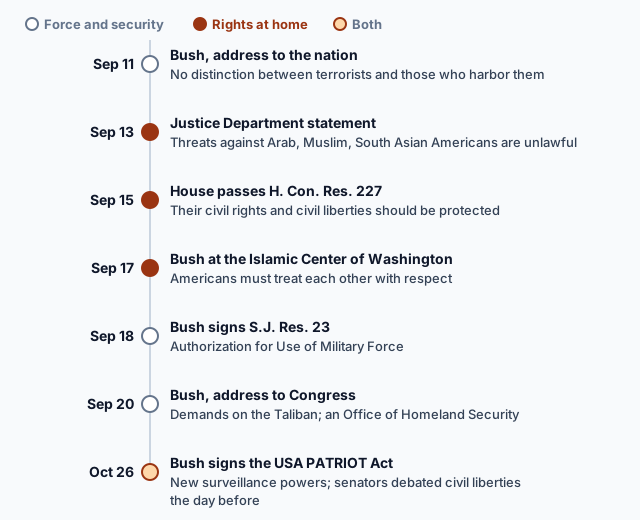 Tap to open the picture full size
Part 1 Think first What kind of war?
Commit to a guess first. Being wrong now makes the right idea stick better.
Predict first
On September 20, 2001, nine days after the attacks on the World Trade Center and the Pentagon, President George W. Bush spoke to a joint session of Congress about how the United States would respond. What kind of war do you think he told Americans to expect?
In short. After the attacks of September 11, 2001, the United States launched military efforts against terrorism and lengthy, controversial conflicts in Afghanistan and Iraq, and Americans debated how to protect both security and civil liberties and how far to depend on fossil fuels, while the country remained the world's leading superpower.
- Within days of the attacks, Congress authorized the president to use force against those he determined were behind them, and Bush warned of "a lengthy campaign."
- The war on terrorism sought to improve security at home but raised questions about civil liberties and human rights; senators who weighed the USA PATRIOT Act in October 2001 disagreed over where to strike the balance.
- Conflicts in the Middle East and concerns about climate change led to debates over fossil fuels and consumption, and despite economic and foreign policy challenges the United States continued as the world's leading superpower.
Part 2 Learn it Challenges after September 2001
2a. The attacks and the response
On September 11, 2001, terrorists attacked the World Trade Center and the Pentagon. That night President George W. Bush told the nation that "our very freedom came under attack in a series of deliberate and deadly terrorist acts." He set a rule for what came next: "We will make no distinction between the terrorists who committed these acts and those who harbor them."
Both houses of Congress passed S.J. Res. 23, the "Authorization for Use of Military Force," and Bush signed it on September 18. Its force was aimed at those behind the September 11 attacks, and those who harbored them.
On September 20 Bush told Congress the evidence pointed to "a collection of loosely affiliated terrorist organizations known as al Qaeda," which backed the Taliban regime that controlled most of Afghanistan. He demanded that the Taliban "Deliver to United States authorities all the leaders of al Qaeda who hide in your land." For defense at home he announced "a Cabinet-level position reporting directly to me," "the Office of Homeland Security," which an executive order established on October 8.
The course framework sums up what followed: military efforts against terrorism, and lengthy, controversial conflicts in Afghanistan and Iraq.
Sources: Address to the Nation, September 11, 2001 (Avalon Project); Bush on signing S.J. Res. 23 (Avalon Project); Address to Congress, September 20, 2001 (Avalon Project); Avalon Project, 21st Century index.
Quick check · Sort it
Each card is a phrase from a federal document of September 2001. Tap a card, then where the action it describes takes place.
Action abroad
Security at home
2b. Security and civil liberties
Civil liberties are freedoms, such as speech and freedom from unreasonable searches, that the Constitution protects from government. The course framework says the war on terrorism sought to improve security within the United States but also raised questions about the protection of civil liberties and human rights.
Signing the USA PATRIOT Act on October 26, 2001, Bush said it would "allow surveillance of all communications used by terrorists, including e-mails, the Internet, and cell phones." He said Congress agreed "because it upholds and respects the civil liberties guaranteed by our Constitution."
In the Senate debate the day before, Orrin Hatch said it would help "find, track, monitor, and prosecute terrorists operating here in the U.S. without in any way undermining civil liberties." Judiciary Committee chairman Patrick Leahy voted for it but said: "This bill has raised serious and legitimate concerns about the expansion of authorities for government surveillance and intelligence gathering within this country." Russ Feingold, the one senator to vote no, said "it does not strike the right balance between empowering law enforcement and protecting constitutional freedoms," and warned that the Justice Department was "making extraordinary use of its power to arrest and detain individuals." The bill passed 98 to 1.
Official pledges to protect Arab, Muslim and South Asian Americans (see Watch it done) show what officials promised, not how these questions were settled.
Sources: Bush at the signing of the Patriot Act (Avalon Project); Congressional Record, Senate, October 25, 2001 (Avalon Project).
Quick check · Multiple choice
On October 25, 2001, Senator Hatch said the USA PATRIOT Act would work "without in any way undermining civil liberties," and Senator Feingold said it "does not strike the right balance." What were the two senators disagreeing about?
2c. Energy, climate and consumption
Fossil fuels are coal, oil and natural gas. The course framework says conflicts in the Middle East and concerns about climate change led to debates over U.S. dependence on fossil fuels and the impact of economic consumption on the environment.
President Obama's inaugural address of January 20, 2009 states one side of those debates. He said that "each day brings further evidence that the ways we use energy strengthen our adversaries and threaten our planet." At home he promised to "harness the sun and the winds and the soil to fuel our cars and run our factories." Among his goals abroad he named rolling back "the specter of a warming planet." And he told nations "like ours that enjoy relative plenty" that "we can no longer afford indifference to suffering outside our borders; nor can we consume the world's resources without regard to effect." He said it right after pledging help to poor nations, so the effect he meant reaches people elsewhere, not only the planet.
Energy use that strengthens "our adversaries" is a security worry, the kind the framework ties to conflicts in the Middle East; Obama names no country. Energy use that threatens "our planet" is the climate worry.
This lesson quotes only Obama, a new president stating his own position, so it shows one side. The framework calls them debates: other Americans weighed fossil fuels and consumption differently.
Quick check · Match
Match each phrase from Obama's 2009 inaugural address to the concern it expresses.
2d. Still the leading power, and what a speech can show
The course framework says that despite economic and foreign policy challenges, the United States continued as the world's leading superpower in the 21st century. Two presidents described American power in their own words.
At his second inauguration, on January 20, 2005, Bush said: "America's influence is not unlimited, but fortunately for the oppressed, America's influence is considerable, and we will use it confidently in freedom's cause." He tied safety at home to liberty abroad: "The survival of liberty in our land increasingly depends on the success of liberty in other lands."
On January 20, 2009, Obama named the challenges: "Our nation is at war, against a far-reaching network of violence and hatred. Our economy is badly weakened." Then he said: "We remain the most prosperous, powerful nation on Earth."
To use a speech as evidence, ask what it was for. An inaugural address is given by a new president to the nation and to the peoples and governments watching abroad, at a ceremony that opens a term. Its purpose shapes what it stresses. It is strong evidence of what a president wanted people to believe and of the goals he set. It is weaker evidence of how the economy or a war was actually going.
Sources: Bush, Second Inaugural Address, 2005 (Avalon Project); Obama, Inaugural Address, 2009 (Avalon Project).
Quick check · Fill the statement
Complete a historian's notes on Obama's inaugural address of January 20, 2009.
Obama says "Our economy is badly weakened" and also "We remain the most prosperous, powerful nation on Earth." He spoke while the nation was at war and its economy was in trouble, which is the speech's . He wanted to give a worried nation confidence as his term began, which is its , and that limits how well the speech shows how the economy was really doing.
Part 3 Watch it done Source the remarks at the Islamic Center
Watch each step, then do the last one yourself.
On September 17, 2001, President Bush spoke at the Islamic Center of Washington, D.C. He said: "Women who cover their heads in this country must feel comfortable going outside their homes." And: "In our anger and emotion, our fellow Americans must treat each other with respect." Explain what this source can show about the treatment of Muslim Americans after the attacks, and what it cannot.
Predict first
Before the steps, what do you think this speech is best evidence of?
Step 1 · Place it in time
The speech came six days after the attacks. On September 13 the Justice Department's Civil Rights Division said threats against Arab, Muslim and South Asian Americans "are unlawful and will be treated as such." On September 15 the House passed a resolution noting that "vengeful threats and incidents of violence" against them "have already occurred."
Why this step?
Why start with the other documents of that week?
They tell you the problem the speech was answering. Bush says so himself: "I've been told that some fear to leave." That shows what the president had heard. It is not a count of incidents.
Step 2 · Name the speaker, the audience and the purpose
The president spoke at a mosque, standing with Muslim leaders he said felt the same way he did. He addressed the whole country: "it's important for my fellow Americans to understand that." He said "Islam is peace."
Your step · Decide and justify
Finish it. What is the speech at the Islamic Center best used to show?
Which evidence best supports your answer?
Part 4 Try it Lengthy, controversial conflicts
S.J. Res. 23, Section 2(a), reads: "That the President is authorized to use all necessary and appropriate force against those nations, organizations, or persons he determines planned, authorized, committed, or aided the terrorist attacks that occurred on September 11, 2001, or harbored such organizations or persons, in order to prevent any future acts of international terrorism against the United States by such nations, organizations or persons."
Senator Russ Feingold supported the resolution on September 14 and read it as narrow: "I am gratified that in the body of this resolution, it does not contain a broad grant of powers, but is appropriately limited to those entities involved in the attacks that occurred on September 11."
The resolution is about those behind the September 11 attacks; it does not mention Iraq. The course framework names Afghanistan and Iraq together as the lengthy, controversial conflicts that followed the attacks, but how the Iraq war began is outside this lesson's sources, so S.J. Res. 23 is not evidence about Iraq.
When Obama took office in January 2009, the country was still at war in both places. In his inaugural address he said: "We will begin to responsibly leave Iraq to its people, and forge a hard-earned peace in Afghanistan."
Sources: S.J. Res. 23 (Avalon Project); Feingold on war powers (Avalon Project); Obama, Inaugural Address, 2009 (Avalon Project).
Try it · Multiple choice
In Section 2(a) of S.J. Res. 23, quoted above, which words give the president, not Congress, the choice of whom to act against?
Try it · Spot the error
A student writes a sourcing paragraph on Obama's 2009 sentence about Iraq and Afghanistan. Which line is the first to go wrong?
Part 5 Explain it Write it like a document-based answer
Nothing you type leaves this page. Check your answer against the model and each scoring point.
Free-response practice · Question 1 style
A short practice in the shape of the document-based question: three documents instead of seven, and a thesis with one body paragraph instead of a full essay.
Evaluate the extent to which the war on terrorism raised questions about the protection of civil liberties in the United States in 2001.
Document 1. George W. Bush, Remarks at the Signing of the Patriot Act, October 26, 2001: "This new law that I sign today will allow surveillance of all communications used by terrorists, including e-mails, the Internet, and cell phones." Congress agreed to it, he said, "because it upholds and respects the civil liberties guaranteed by our Constitution."
Document 2. Senator Patrick Leahy, chairman of the Senate Judiciary Committee, Senate debate on the USA PATRIOT Act, October 25, 2001: "This bill has raised serious and legitimate concerns about the expansion of authorities for government surveillance and intelligence gathering within this country." And: "In negotiations with the Administration, I did my best to strike a reasonable balance between the need to address the threat of terrorism, which we all keenly feel at the present time, and the need to protect our constitutional freedoms."
Document 3. Senator Russ Feingold, Senate debate on the USA PATRIOT Act, October 25, 2001: "my focus on this bill, as Chair of the Constitution Subcommittee of the Judiciary Committee in the Senate, was on those provisions that implicate our constitutional freedoms." He concluded that "it does not strike the right balance between empowering law enforcement and protecting constitutional freedoms."
Write a thesis, one sentence of historical context, and one paragraph that uses at least two documents and explains the purpose, audience, point of view or situation of one of them.
Model answer
Thesis: The war on terrorism raised real questions about civil liberties in 2001, serious enough that even supporters of the USA PATRIOT Act named them, but leaders divided more over where to strike the balance than over whether to give law enforcement new powers.
Context: after the attacks on the World Trade Center and the Pentagon, the United States launched military efforts against terrorism abroad and sought to improve security at home.
Bush signed the law as one that would allow "surveillance of all communications used by terrorists" and said it respected constitutional liberties (Document 1). Leahy, who voted for the bill, still said it had raised "serious and legitimate concerns" about government surveillance, and described his work as striking "a reasonable balance" (Document 2). Feingold, the one senator who voted against it, said it "does not strike the right balance" (Document 3). His point of view matters: he spoke as chair of the Senate subcommittee on the Constitution and said his focus was on "those provisions that implicate our constitutional freedoms," so his objections show what a senator charged with that job saw as the risks, not what the law did in practice. All three spoke of balance and disagreed about where it lay, which shows the questions were real, though the Senate passed the bill 98 to 1.
Score your own answer. This is a self-check, not a grade. Tick each point your answer makes.
Part 6 Check yourself Two inaugurals on American power
The case questions use the two excerpts. The others mix the ideas from the whole lesson.
Both excerpts come from inaugural addresses, four years apart. Sources: Bush, Second Inaugural Address (Avalon Project); Obama, Inaugural Address (Avalon Project).
| Document | Excerpt |
|---|---|
| George W. Bush, Second Inaugural Address, January 20, 2005 | "America's influence is not unlimited, but fortunately for the oppressed, America's influence is considerable, and we will use it confidently in freedom's cause." |
| Barack Obama, Inaugural Address, January 20, 2009 | "Our nation is at war, against a far-reaching network of violence and hatred. Our economy is badly weakened." Later: "We remain the most prosperous, powerful nation on Earth." |
Case question 1 · Multiple choice
Taken together, the two excerpts best support which claim about how American presidents described the nation's place in the world?
Case question 2 · Multiple choice
Which best explains a limit on using the 2009 excerpt as evidence of how strong the American economy actually was?
The rest stand on their own and do not use the case.
Check yourself · Put it in order
Put these events of 2001 in order, earliest first, then read what the order shows: force abroad was authorized before the new powers at home.
Check yourself · Select all
Which two phrases from Obama's 2009 inaugural address are about the effects of how Americans use energy or resources? Select two.
Select 2 answers, then check.
Part 7 Keep it Bring back earlier ideas
This lesson stands on the debates over American power after the Cold War from Topic 9.3 and the oil crises and environmental movement of the 1970s from Topic 8.13.
Bring it back · Fill the statement
Read the situation, then complete the sentences.
On September 20, 2001, Bush told Congress the new war would not look like "the air war above Kosovo two years ago." That air war was one of the new U.S. military and peacekeeping that followed the end of the Cold War. Such actions were part of continued over the appropriate use of American power in the world.
Bring it back · Multiple choice
In 2009 Obama said "the ways we use energy strengthen our adversaries" and called for new sources of fuel. Which development of the 1970s is the closest earlier parallel?
In three lines
- After the 2001 attacks the United States launched military efforts against terrorism and lengthy, controversial conflicts in Afghanistan and Iraq.
- The war on terrorism sought security at home but raised questions about civil liberties and human rights, and energy and climate concerns led to debates over fossil fuels and consumption.
- Despite economic and foreign policy challenges, the United States continued as the world's leading superpower, and its leaders' speeches show their goals more than their results.
Exam strategy for this topic
- Section I Part A, Multiple Choice: 55 questions in 55 minutes.
- Section I Part B, Short Answer: 3 questions in 40 minutes.
- Section II, Document-Based Question and Long Essay: 2 questions in 100 minutes.
- This lesson's Explain it is shaped like free-response question 1, Document-based.
Period 9 sources are often speeches by presidents and senators. Say what the source shows about its speaker's goals and audience, then say what it cannot show, such as whether a policy worked, and attribute every view to its source.
Questions students ask
Does the course say whether the wars in Afghanistan and Iraq were right?
No. The course framework calls them lengthy, controversial conflicts. On the exam you earn credit for explaining their causes, effects and the debates over them with evidence, and for attributing each view to its source.
What did S.J. Res. 23 authorize?
It authorized the president to use "all necessary and appropriate force" against the nations, organizations or persons he determined had planned, committed or aided the September 11 attacks, or had harbored them. Its short title is the "Authorization for Use of Military Force." Bush signed it on September 18, 2001. It does not mention Iraq.
Why did the House and the Justice Department speak about Arab, Muslim and South Asian Americans in September 2001?
H. Con. Res. 227, which the House passed on September 15, says threats and incidents of violence against them had already occurred. It declared that "the civil rights and civil liberties of all American, including Arab-Americans, American Muslims, and Americans from South Asia, should be protected" (wording as printed). The Justice Department said such threats were unlawful.
Why does a quotation in this lesson say "of all American" with no s?
Every excerpt is copied exactly as the archive prints it, so you can check it against the source linked beside it.
Where can I read these documents in full?
Each excerpt links to its full text at the Avalon Project at Yale Law School, which keeps a collection of documents from September 2001 onward, including the Senate's debate on the USA PATRIOT Act, and the inaugural addresses of the presidents.
Course alignment, for teachers
AP U.S. History topic 9.6, Unit 9: Period 9: 1980–Present.
- Skill 2.C: Explain the significance of a source’s point of view, purpose, historical situation, and/or audience, including how these might limit the use(s) of a source.
This lesson maps all 4 essential knowledge statements of the topic, and the one learning objective with none of its own, to the part that teaches each one: 5 are checked by a scored question. The map is in the lesson file.