Unit 4 · Topic 4.13 · about 30 minutes · 7 parts · 10 scored checks, 4 of them multiple choice, plus 2 from earlier lessons
AP U.S. History 4.13: The Society of the South in the Early Republic
Unit 4: 10 to 17% of the multiple-choice section
What you'll be able to do
- Explain how geographic and environmental factors shaped the development of the South from 1800 to 1848.
Key vocabulary
| Term | What it means | The exam trap |
|---|---|---|
| Staple crop | A main crop grown in large amounts for sale, often to distant buyers. | In this period staple means a crop grown to sell, not a basic food a family eats. |
| Overcultivation | Farming the same land so hard, year after year, that the soil loses its fertility. | It describes what farming did to the soil, not a shortage of land to farm. |
| Cotton gin | A machine that separates cotton fiber from its seeds. | Such machines were centuries old by the 1790s; Whitney's patent was for an improved one. |
| Regional identity | The sense that a region's people share interests and a way of life that set them apart from other regions. | A regional identity describes how people saw their region; it does not by itself mean they wanted to leave the Union. |
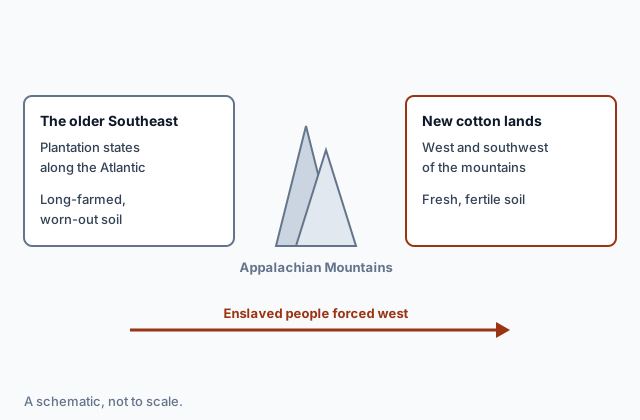 Tap to open the picture full size
Part 1 Think first Cotton wealth, few cities
Commit to a guess first. Being wrong now makes the right idea stick better.
Predict first
By the middle of the 1800s cotton was the South's great export, most of it shipped to mills in England and New England. Yet the South built far fewer cities and factories than the North, and in the 1850s most immigrants settled in the North. Why do you think cotton wealth built so few Southern cities?
In short. From 1800 to 1848, worn-out soil in the Southeast and fertile land to the west moved plantations, and slavery with them, west of the Appalachians, while cotton and other staple exports gave the South an economy and an identity of its own.
- Overcultivation wore out soil in the Southeast, and slavery moved to more fertile lands west of the Appalachians, where it kept growing.
- Southern business leaders kept relying on growing and exporting staple crops, above all cotton, and that reliance helped build a distinctive Southern regional identity.
- Most white Southerners owned no enslaved people, yet most Southern leaders argued that slavery was part of the Southern way of life.
Part 2 Learn it Land, cotton and a Southern identity
2a. Worn-out soil and fresh land to the west
Overcultivation means farming the same fields so hard, year after year, that the soil loses its fertility. A National Archives teaching page notes that when Eli Whitney went South in 1792, planters wanted a way to make cotton pay "at a time when tobacco was declining in profit due to over-supply and soil exhaustion." Douglass's memory of his Maryland birthplace fits that picture. He described "the worn-out, sandy, desert-like appearance of its soil."
Whitney's cotton gin, patented on March 14, 1794, was the first to clean short-staple cotton, and the National Archives says this "made cotton a profitable crop for the first time."
Slavery then moved to more fertile land west of the Appalachians. Some slaveholders moved their plantations and forced the people they enslaved to go with them. Others sold enslaved people to traders, a domestic slave trade that carried them to the new cotton lands. Even on one rich, fertile Maryland estate, Douglass wrote, "scarcely a month passed without the sale of one or more lots to the Georgia traders." Alabama's constitution of 1819 guaranteed that its legislature would have "no power to prevent emigrants to this State from bringing with them such persons as are deemed slaves by the laws of any one of the United States."
Sources: Patent for Cotton Gin (National Archives); National Archives teaching page; My Bondage and Freedom (Avalon Project); Constitution of Alabama, 1819 (Avalon Project).
Quick check · Sort it
Each card names something that helped move slavery west. Tap a card, then the kind of factor it is.
Conditions of the land
Inventions, choices and laws
2b. Staple crops and a regional identity
A staple crop is a main crop grown in large amounts for sale, often to buyers far away. After the gin, cotton became the South's leading staple. In the National Archives' summary, "the yield of raw cotton doubled each decade after 1800," and by mid-century America was growing "three-quarters of the world's supply of cotton," most of it shipped to England or New England to be made into cloth. Those are the Archives' round figures. The older staples did less well: tobacco fell in value, rice exports at best held steady, and sugar thrived only in Louisiana.
Southern business leaders kept putting their money where it had paid before. Cotton growing became so profitable for plantation owners that it "greatly increased their demand for both land and enslaved labor." Fewer cities and factories grew. The National Archives teaching page says that as large plantations spread into the Southwest, as the new cotton states were then called, "the price of enslaved labor and land inhibited the growth of cities and industries." By the 1850s most immigrants were settling in the North, where most of the nation's manufacturing was.
That reliance on staple exports helped build a distinctive regional identity. Plantations, cotton and slavery came to define the South and set it apart from a North of growing cities and factories.
Sources: Patent for Cotton Gin (National Archives); National Archives teaching page.
Quick check · Decide and justify
Did the South's reliance on staple exports cut it off from the rest of the nation's economy?
Which evidence best supports your answer?
2c. Few slaveholders, many defenders
Most white Southerners owned no enslaved people. Slaveholders were a minority. Even so, most Southern leaders argued that slavery was part of the Southern way of life, and they protected it in law. Alabama's 1819 constitution said the legislature "shall have no power to pass laws for the emancipation of slaves, without the consent of their owners, or without paying their owners, previous to such emancipation, a full equivalent in money for the slaves so emancipated." Freeing anyone would need the owner's consent or full payment.
Why did white Southerners who held no one in slavery go along? Douglass gave one answer, writing about white workers in Southern cities such as Baltimore. Slaveholders, he said, kept poor white workers on their side "by encouraging the enmity of the poor, laboring white man against the blacks." He added that the conflict was less plain in the country.
Read Douglass as a source, too. He wrote in 1855, recalling his years in Maryland long afterward, and he wrote as an opponent of slavery who wanted readers to see its harm to white Southerners as well as Black ones. That situation and purpose shape what he chose to describe.
Sources: Constitution of Alabama, 1819 (Avalon Project); My Bondage and Freedom (Avalon Project).
Quick check · Multiple choice
In the 1830s a Georgia farmer who owns no enslaved people votes for a governor who calls slavery essential to the South. Which statement best describes the pattern this shows?
Part 3 Watch it done Explain how geography shaped where slavery grew
Watch each step, then do the last one yourself.
Explain how geographic and environmental factors shaped where slavery grew in the South between 1800 and 1848.
Predict first
Before the steps, which do you think the explanation will lean on most?
Step 1 · Start with the conditions
Name what the land offered and what it lacked. Years of farming had worn out soil in the Southeast. Fertile land lay west of the Appalachians.
Why this step?
Why name the conditions before the people?
A process is a chain of links. The conditions explain why moving west looked attractive. They do not yet explain who moved, or how slavery went with them.
Step 2 · Add the human links
The cotton gin, patented in 1794, made short-staple cotton profitable. Slaveholders moved west and forced enslaved people to go with them, and traders sold others into the new cotton lands. Alabama's 1819 constitution guaranteed that its legislature could not stop settlers who brought enslaved people.
Your step · Decide and justify
Finish it. Which sentence best completes the explanation?
Which evidence best supports your answer?
Part 4 Try it A line drawn on the map
The Missouri Compromise of 1820 let Missouri enter the Union as a slave state, paired with Maine as a free state. In the act approved March 6, 1820, for the rest of the land "ceded by France to the United States, under the name of Louisiana," north of thirty-six degrees and thirty minutes north latitude, Congress declared that "slavery and involuntary servitude, otherwise than in the punishment of crimes, whereof the parties shall have been duly convicted, shall be, and is hereby, forever prohibited."
Try it · Multiple choice
What does the 1820 line suggest about how slavery spread west?
Try it · Spot the error
A student explains how the South developed from 1800 to 1848. Which line is the first to go wrong?
Part 5 Explain it Write it like a document-based answer
Nothing you type leaves this page. Check your answer against the model and each scoring point.
Free-response practice · Question 1 style
A short practice in the shape of the document-based question: three documents instead of seven, and a thesis with one body paragraph instead of a full essay.
Evaluate the extent to which geographic and environmental factors shaped where slavery grew in the South from 1800 to 1848.
Document 1. Frederick Douglass, My Bondage and Freedom, 1855, describing the district in Talbot county, Maryland, where he was born: "the worn-out, sandy, desert-like appearance of its soil, the general dilapidation of its farms and fences."
Document 2. Constitution of Alabama, 1819: the legislature shall have "no power to prevent emigrants to this State from bringing with them such persons as are deemed slaves by the laws of any one of the United States."
Document 3. Missouri Compromise, approved March 6, 1820, on the Louisiana lands north of thirty-six degrees and thirty minutes north latitude, outside Missouri: "slavery and involuntary servitude, otherwise than in the punishment of crimes, whereof the parties shall have been duly convicted, shall be, and is hereby, forever prohibited."
Write a thesis, one sentence of historical context, and one paragraph that uses at least two documents and explains the purpose, audience, point of view or situation of one of them.
Model answer
Thesis: Geography and the environment shaped where slavery grew to a large extent, since worn-out eastern soil and fertile western land drew plantations west, but laws and the choices of slaveholders and traders decided where slavery could legally go.
Context: after the cotton gin made short-staple cotton profitable in the 1790s, cotton became the South's leading staple, sold to mills in England and New England.
Douglass's worn-out, sandy Tuckahoe, with its run-down farms (Document 1), fits the exhausted land that other accounts say pushed planters west. He names no cause for it, though, and he wrote in 1855, years later, as an opponent of slavery who wanted to show how it degraded the South, so his picture supports the pattern rather than proving it. Alabama's 1819 constitution (Document 2) shows the other side of the move: the new state guaranteed that settlers heading for its fertile land could bring enslaved people. Geography made the West attractive, and law protected slavery's place there. The Missouri Compromise (Document 3) drew a line of latitude, not a line of soil, to decide where slavery was forbidden, which shows that politics limited how far geography's pull could carry slavery.
Score your own answer. This is a self-check, not a grade. Tick each point your answer makes.
Part 6 Check yourself Four Southern staples
The case questions use the table. The others mix the ideas from the whole lesson.
The table sums up the National Archives' description of the cotton gin's effects on Southern crops. Its figures are the Archives' round numbers. Source: Patent for Cotton Gin (National Archives).
| Crop | What happened to it |
|---|---|
| Cotton | Yield doubled each decade after 1800; by mid-century, three-quarters of the world's supply, most of it shipped to England or New England |
| Tobacco | Fell in value |
| Rice | Exports at best stayed steady |
| Sugar | Began to thrive, but only in Louisiana |
Case question 1 · Multiple choice
Which conclusion does the table best support?
Case question 2 · Multiple choice
Which best explains how the pattern in the table contributed to a distinctive Southern regional identity?
The rest stand on their own and do not use the case.
Check yourself · Fill the statement
Complete a historian's notes on two pieces of evidence.
Douglass saw enslaved people sold every month from a rich Maryland estate to the Georgia traders, an example of the that carried people from the older states to the new cotton lands. Alabama's 1819 constitution shows a new state choosing to slavery's growth.
Check yourself · Select all
Which two pieces of evidence show slavery moving into lands west of the Appalachians? Select two.
Select 2 answers, then check.
Part 7 Keep it Bring back earlier ideas
This lesson stands on enslaved people's resistance from Topic 4.12 and the causes of the Second Great Awakening from Topic 4.10.
From 4.12 African Americans in the Early Republic · Sort it
Enslaved people responded to slavery in more than one way. Tap a card, then the response it shows.
Protecting family and dignity within slavery
Revolt to overthrow slavery by force
From 4.10 The Second Great Awakening · Sort it
Each card is something a speaker might have said. Tap a card, then the speaker who would have said it.
A rationalist of the 1790s
A revival preacher of the 1830s
In three lines
- Overcultivation wore out the Southeast's soil, and slavery moved to fertile land west of the Appalachians, carried by migrating owners and the domestic slave trade.
- Southern leaders relied on staple exports, above all cotton, which built a distinctive Southern regional identity.
- Most white Southerners owned no enslaved people, but most Southern leaders defended slavery as part of the Southern way of life.
Exam strategy for this topic
- Section I Part A, Multiple Choice: 55 questions in 55 minutes.
- Section I Part B, Short Answer: 3 questions in 40 minutes.
- Section II, Document-Based Question and Long Essay: 2 questions in 100 minutes.
- This lesson's Explain it is shaped like free-response question 1, Document-based.
When a question asks how geography shaped a development, name the physical factor, then the human choice or law that turned it into a result.
Questions students ask
Did most white Southerners own enslaved people?
No. Most owned none, and slaveholders were a minority. Most Southern leaders still argued that slavery was part of the Southern way of life, and states such as Alabama protected it in their constitutions.
Did the cotton gin reduce the need for enslaved labor?
No. The National Archives notes that the gin did not reduce the number of enslaved people forced to grow and pick cotton, and that cotton became so profitable it raised planters' demand for both land and enslaved labor.
How did enslaved people end up in the new cotton lands?
By force, in two main ways. Some slaveholders moved west and made the people they enslaved go with them. Others sold enslaved people to traders, like the Georgia traders Douglass saw buying from a Maryland estate every month.
Why does this lesson quote Frederick Douglass?
Douglass was born into slavery in Talbot county, Maryland, and in My Bondage and Freedom (1855) he described the places he lived. He wrote years later, as an opponent of slavery, so read his descriptions for his purpose as well as for what they show.
Where can I read these documents in full?
Each excerpt links to its full text at the National Archives or the Avalon Project at Yale Law School. One National Archives page used here is a teaching page that summarizes historians, and the lesson says so where it uses it.
Course alignment, for teachers
AP U.S. History topic 4.13, Unit 4: Period 4: 1800–1848.
- Skill 1.B: Explain a historical concept, development, or process.
This lesson maps all 3 essential knowledge statements of the topic, and the one learning objective with none of its own, to the part that teaches each one: 4 are checked by a scored question. The map is in the lesson file.