Unit 5 · Topic 5.7 · about 30 minutes · 7 parts · 13 scored checks, 5 of them multiple choice
AP U.S. History 5.7: Election of 1860 and Secession
Unit 5: 10 to 17% of the multiple-choice section
What you'll be able to do
- Describe the effects of Lincoln's election: a free-soil victory won without any Southern electoral votes, followed by contested debates about secession in which most slave states voted to leave the Union, bringing on the Civil War.
Key vocabulary
| Term | What it means | The exam trap |
|---|---|---|
| Free-soil platform | The course framework's name for the Republican program of 1860: opposition to the spread of slavery into the territories. | A platform states what a party wants; read it for what it says about the territories and about the states separately. |
| Electoral vote | A vote cast by a state's electors for president, the votes that decide the election. | Winning a presidential election depends on electoral votes, which are counted state by state. |
| Secession | A state's withdrawal from the Union, declared by an ordinance passed by a state convention. | Secession is something the seceding states claimed as a right; whether it was lawful was exactly what was disputed. |
| Declaration of causes | A statement some seceding states published to explain their reasons for leaving the Union. | It was written to justify leaving, so read it for its purpose as well as its claims. |
| Sectional party | A party whose support comes almost entirely from one section of the country. | Sectional describes where a party's votes come from, not what its program says. |
 Tap to open the picture full size
Part 1 Think first How many Southern votes?
Commit to a guess first. Being wrong now makes the right idea stick better.
Predict first
Abraham Lincoln, the Republican candidate, won the presidential election of 1860. How many electoral votes do you think he won from the slave states of the South?
In short. Abraham Lincoln won the presidency in 1860 on the Republicans' free-soil platform without a single Southern electoral vote, and in the months that followed, after a series of contested debates, state by state, most slave states voted to secede from the Union, which brought on the Civil War.
- Lincoln's party opposed the spread of slavery into the territories, and he won with Northern votes alone, which Southern leaders read as a sectional party taking the government.
- Secession was debated and decided state by state: South Carolina had held back in 1852, Texas put its ordinance to the voters, and seven states had left before Lincoln took office.
- The declarations of causes put slavery at the center, and Lincoln answered in March 1861 that he would not touch slavery in the states but that secession was legally void.
Part 2 Learn it Lincoln's election and the secession of the South
2a. A free-soil victory without the South
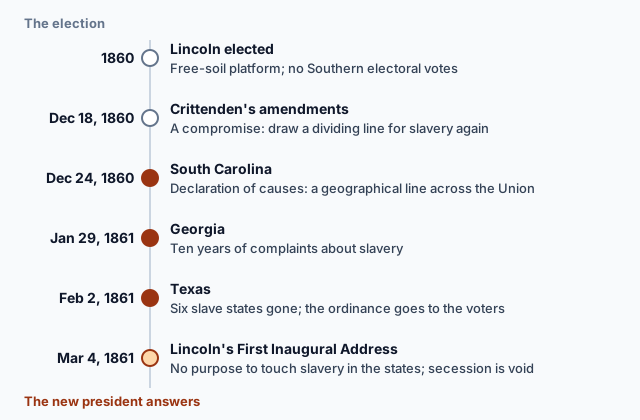
Opponents of the Kansas-Nebraska Act had helped found the Republican Party in the 1850s, and it "opposed the spread of slavery into the territories." In 1860 Abraham Lincoln ran on that free-soil platform and won the presidency without any Southern electoral votes. The Republicans had become a sectional party, and a sectional party had won.
Southern leaders read the result as a threat to slavery itself. South Carolina's declaration of causes, adopted December 24, 1860, charged that Lincoln had declared that "Government cannot endure permanently half slave, half free" and that "the public mind must rest in the belief that slavery is in the course of ultimate extinction." Those are South Carolina's versions of words from a Lincoln speech, not his own text. It warned that "On the 4th day of March next, this party will take possession of the Government," the day the new president took office. And it charged that the party "has announced that the South shall be excluded from the common territory, that the judicial tribunals shall be made sectional, and that a war must be waged against slavery until it shall cease throughout the United States." The first charge is the free-soil program seen from the South. The last turns a party against slavery's spread into one waging war on slavery everywhere, which Lincoln denied when he took office.
Sources: Kansas-Nebraska Act (National Archives); South Carolina's declaration of causes, 1860 (Avalon Project).
Quick check · Multiple choice
Which statement best describes Lincoln's victory in the election of 1860?
2b. What the declarations said
Several seceding states published a declaration of causes to explain why they were leaving. They put slavery at the center. Mississippi's begins: "Our position is thoroughly identified with the institution of slavery."
The declarations mixed two kinds of complaint. Some were about the election itself. Texas, on February 2, 1861, protested that "by the combined sectional vote of the seventeen non-slave-holding States, they have elected as president and vice-president of the whole confederacy two men" who threatened its slave-holding way of life. Others reached back years before 1860. South Carolina charged that Northern states "have enacted laws which either nullify the Acts of Congress or render useless any attempt to execute them," meaning the federal laws for returning people who escaped slavery, and Mississippi said Northern hostility to slavery "has nullified the Fugitive Slave Law in almost every free State in the Union."
That mix is the key to placing secession in context. The election was the trigger. The grievances it set off were about slavery, and they were older than Lincoln's campaign.
Sources: Mississippi's declaration (Avalon Project); Texas's declaration, 1861 (Avalon Project); South Carolina's declaration, 1860 (Avalon Project).
Quick check · Sort it
Each card is a complaint from a declaration of causes. Tap a card, then sort it by what it complains about.
The election of 1860 and what it decided
Older grievances against Northern states
2c. Secession, debated state by state
South Carolina's convention had claimed a right to leave back in 1852, but "in deference to the opinions and wishes of the other slaveholding States, she forbore at that time to exercise this right."
Compromise was tried. On December 18, 1860, Senator John J. Crittenden proposed constitutional amendments that would draw a line again, banning slavery north of it and providing south of it that "slavery of the African race is hereby recognized as existing, and shall not be interfered with by Congress." It did not stop the states that were leaving.
Georgia published its declaration of causes on January 29, 1861. In its declaration of February 2, 1861, the Texas convention, which had already passed an ordinance of secession, noted "the secession of six of the slave-holding States, and the certainty that others will speedily do likewise," and asked its voters to ratify it "at the ballot box." With Texas, seven states had left.
Other slave states waited. In April 1861 Confederate forces fired on Fort Sumter, after Jefferson Davis ordered "that the fort should at once be reduced." Davis then reported that Virginia "had withdrawn from the Union" and that others were "on the point of adopting similar measures." Most slave states voted to secede, and their secession brought on the Civil War, but the border slave states remained in the Union.
Sources: South Carolina, 1860; Crittenden's amendments, 1860; Texas, 1861; Davis, April 1861 (all Avalon Project); 13th Amendment (National Archives).
Quick check · Put it in order
Put these events in the order they happened, earliest first.
Part 3 Watch it done Put Lincoln's promise in context
Watch each step, then do the last one yourself.
On March 4, 1861, in his First Inaugural Address, Abraham Lincoln said: "I have no purpose, directly or indirectly, to interfere with the institution of slavery in the States where it exists." Explain how the broader context of early 1861 shapes this statement.
Predict first
Before the steps, whom do you think this sentence was mainly meant to reach?
Step 1 · Place it in time
On February 2, 1861, the Texas convention, which had passed its own ordinance of secession, counted six other slave states that had seceded, making Texas the seventh, and wrote of "the certainty that others will speedily do likewise." Other slave states had not yet left. Lincoln spoke a month later.
Why this step?
Why look at what had just happened before reading the sentence closely?
A statement answers its moment. Knowing what had just happened shows you what problem the speaker was trying to solve, which a careful reading of the words alone cannot tell you.
Step 2 · Find the audience in the speech
Lincoln names the worry he is answering: "Apprehension seems to exist among the people of the Southern States that by the accession of a Republican Administration their property and their peace and personal security are to be endangered." He says he is quoting his own earlier speeches, and he reads from his party's platform a resolution defending "the right of each State to order and control its own domestic institutions according to its own judgment exclusively."
Your step · Decide and justify
Finish it. In this context, what was Lincoln's promise mainly trying to do?
Which evidence best supports your answer?
Part 4 Try it Lincoln answers secession
In the same address Lincoln named what divided the country: "One section of our country believes slavery is right and ought to be extended, while the other believes it is wrong and ought not to be extended. This is the only substantial dispute."
Four more lines from the address, in the order he spoke them:
- "the Union of these States is perpetual"
- "resolves and ordinances to that effect are legally void"
- "In your hands, my dissatisfied fellow-countrymen, and not in mine, is the momentous issue of civil war."
- "We are not enemies, but friends."
Try it · Multiple choice
Lincoln said the "only substantial dispute" was whether slavery ought to be extended. How does that claim fit the history of the 1850s?
Try it · Select all
Which two passages from Lincoln's First Inaugural Address state his position that secession is not lawful? Select two.
Select 2 answers, then check.
Part 5 Explain it Write it like a document-based answer
Nothing you type leaves this page. Check your answer against the model and each scoring point.
Free-response practice · Question 1 style
A short practice in the shape of the document-based question: three documents instead of seven, and a thesis with one body paragraph instead of a full essay.
Evaluate the extent to which Lincoln's election in 1860 caused the secession of Southern states.
Document 1. South Carolina's declaration of causes, adopted December 24, 1860: "A geographical line has been drawn across the Union, and all the States north of that line have united in the election of a man to the high office of President of the United States, whose opinions and purposes are hostile to slavery."
Document 2. Georgia's declaration of causes, January 29, 1861: "For the last ten years we have had numerous and serious causes of complaint against our non-slave-holding confederate States with reference to the subject of African slavery."
Document 3. Abraham Lincoln, First Inaugural Address, March 4, 1861: "I have no purpose, directly or indirectly, to interfere with the institution of slavery in the States where it exists."
Write a thesis, one sentence of historical context, and one paragraph that uses at least two documents and explains the purpose, audience, point of view or situation of one of them.
Model answer
Thesis: Lincoln's election was the immediate cause of secession, because it showed that a free-soil party could win the presidency with Northern votes alone, but the deeper cause was a decade of conflict over slavery that the election brought to a head.
Context: in the 1850s the Kansas-Nebraska Act and the Dred Scott decision had deepened the fight over slavery in the territories, and the old national parties had given way to a Northern Republican Party.
South Carolina pointed straight at the election, complaining that the states "north of that line have united" to elect a president "hostile to slavery" (Document 1). Georgia, though, traced its grievances back "ten years" before 1861 (Document 2), so the election was the last of many complaints about slavery, not the first. Lincoln's promise that he had "no purpose" to interfere with slavery in the states (Document 3) was meant to calm Southern fears after seven states had already voted to leave. That it failed to bring them back suggests that Southern leaders feared what a sectional Republican government would do over time, above all to slavery's future in the territories.
Score your own answer. This is a self-check, not a grade. Tick each point your answer makes.
Part 6 Check yourself Two declarations, six weeks apart
The case questions use the two excerpts. The others mix the ideas from the whole lesson.
Both excerpts come from state conventions that voted to leave the Union. Sources: South Carolina's declaration (Avalon Project); Texas's declaration (Avalon Project).
| Document | Excerpt |
|---|---|
| South Carolina, adopted December 24, 1860 | "A geographical line has been drawn across the Union, and all the States north of that line have united in the election of a man to the high office of President of the United States, whose opinions and purposes are hostile to slavery." |
| Texas, adopted in convention February 2, 1861 | "By the secession of six of the slave-holding States, and the certainty that others will speedily do likewise." The convention would "confidently appeal to the intelligence and patriotism of the freemen of Texas to ratify the same at the ballot box." |
Case question 1 · Multiple choice
South Carolina's "geographical line" refers most directly to which fact about the election of 1860?
Case question 2 · Multiple choice
The Texas excerpt is best understood in which broader context?
Case question 3 · Fill the statement
Complete the notes on the two declarations in the table.
South Carolina complains that the new president was chosen by the states alone. When the Texas convention wrote, slave states had already seceded, and its own ordinance made Texas the .
The rest stand on their own and do not use the case.
Check yourself · Spot the error
A student places the secession crisis in context. Which line is the first to go wrong?
Check yourself · Match
Match each actor to its part in the debates over secession.
Part 7 Keep it Bring back earlier ideas
This lesson stands on the defense of slavery from Topic 5.5 and the breakup of the old parties from Topic 5.6.
Bring it back · Multiple choice
Which argument fits the way leading defenders of slavery made their case in the 1850s?
Bring it back · Fill the statement
Complete the sentences about the 1850s.
The Kansas-Nebraska Act let the settlers of a territory decide whether to allow slavery, an idea called . Opponents of the act helped found the Party, which grew strong as the old two-party system broke apart.
In three lines
- Lincoln won the presidency in 1860 on a free-soil platform without any Southern electoral votes.
- Secession was debated state by state, and the declarations of causes put slavery at the center.
- Most slave states voted to secede, Lincoln called secession legally void, and the Civil War followed.
Exam strategy for this topic
- Section I Part A, Multiple Choice: 55 questions in 55 minutes.
- Section I Part B, Short Answer: 3 questions in 40 minutes.
- Section II, Document-Based Question and Long Essay: 2 questions in 100 minutes.
- This lesson's Explain it is shaped like free-response question 1, Document-based.
To contextualize, name a development from before the source and say how it shapes the source, such as seven states already gone when Lincoln promised not to touch slavery in the states.
Questions students ask
Did Lincoln promise to end slavery?
No. He ran on a free-soil platform that opposed slavery's spread into the territories, and in his First Inaugural Address he said he had no purpose to interfere with slavery in the states where it existed.
Why did Southern states secede if Lincoln said he would not touch slavery in the states?
Their declarations show they feared a sectional party that opposed slavery's spread and could win the presidency without them. South Carolina warned that the party would take possession of the government in March, and Georgia listed ten years of complaints about slavery.
Did every slave state secede?
No. Seven states left before Lincoln took office, Virginia followed after the fighting at Fort Sumter in April 1861, and the border slave states remained in the Union. Most slave states voted to secede, but not all of them did.
What was the Crittenden Compromise?
A set of constitutional amendments Senator John J. Crittenden proposed on December 18, 1860, to draw a line again across the territories, banning slavery north of it and protecting it south of it. It did not stop the secessions.
Why are the declarations of causes useful to historians?
They are the seceding states' own explanations, written at the time. Because they were written to justify leaving, they show what Southern leaders wanted others to believe, as well as what they feared.
Course alignment, for teachers
AP U.S. History topic 5.7, Unit 5: Period 5: 1844–1877.
- Skill 4.B: Explain how a specific historical development or process is situated within a broader historical context.
This lesson maps the one essential knowledge statement of the topic, and the one learning objective with none of its own, to the part that teaches each one: 2 are checked by a scored question. The map is in the lesson file.