Unit 6 · Topic 6.12 · about 30 minutes · 7 parts · 12 scored checks, 4 of them multiple choice
AP U.S. History 6.12: Controversies over the Role of Government in the Gilded Age
Unit 6: 10 to 17% of the multiple-choice section
What you'll be able to do
- Explain continuities and changes in the role of the government in the U.S. economy, and place each new law or acquisition in the broader context of its time: what had happened just before it, and what larger pattern it belonged to.
Key vocabulary
| Term | What it means | The exam trap |
|---|---|---|
| Laissez-faire | The idea that the economy works best when government leaves business and markets alone. | Laissez-faire supporters did not say hard times were unimportant; they said government help would do more harm than good over time. |
| Paternalism | Cleveland's word, in 1893, for a government acting like a parent by handing out help and favors. | Cleveland aimed it at favors and subsidies; he still wanted federal power used against price-fixing combinations. |
| Regulation | Rules a government sets for how private businesses operate, such as the 1887 rule that railroad charges be reasonable and just. | Regulating an industry is not the same as owning or running it. |
| Trust | An arrangement in which stockholders of several companies hand their shares to one set of trustees, who run the companies together. | Outlawing trusts on paper, as the Sherman Act did, is not the same as breaking them up in practice. |
| Annexation | Adding a territory to a country, as Congress did with Hawaii by joint resolution in 1898. | Annexation is the final legal step; the context is the years of pressure that came before it. |
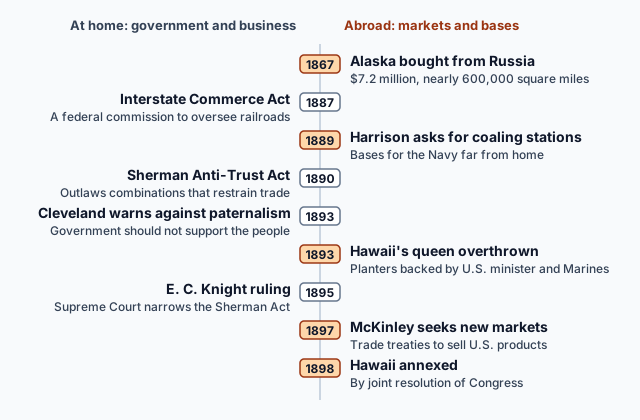 Tap to open the picture full size
Part 1 Think first More government or less?
Commit to a guess first. Being wrong now makes the right idea stick better.
Predict first
On March 4, 1893, Grover Cleveland began his second term as president. He warned against citizens expecting help from the government. In the same speech he said that business combinations formed to fix prices should be checked: "To the extent that they can be reached and restrained by Federal power the General Government should relieve our citizens from their interference and exactions." What do you think Cleveland wanted?
In short. In the Gilded Age many Americans argued that laissez-faire and competition built prosperity, yet Congress also passed its first laws to regulate railroads and trusts, and policymakers increasingly looked abroad for markets and naval bases in the Pacific.
- Supporters of laissez-faire held that competition promoted growth in the long run and opposed government intervention in hard times; Grover Cleveland said in 1893 that the government's "functions do not include the support of the people."
- The Interstate Commerce Act of 1887 and the Sherman Anti-Trust Act of 1890 were a change: a federal commission to oversee the railroads and a federal law against trusts, but weak enforcement and the courts limited both.
- From the purchase of Alaska in 1867 to the annexation of Hawaii in 1898, foreign policymakers increasingly looked outside U.S. borders for influence and control over markets and resources.
Part 2 Learn it Government and the economy, at home and abroad
2a. The case for leaving business alone
Laissez-faire is the idea that the economy works best when government leaves business and markets alone. In the Gilded Age some Americans argued that laissez-faire policies and competition promoted economic growth in the long run. They opposed government intervention even during economic downturns, when businesses failed and people lost work.
Grover Cleveland made the case in his second inaugural address, March 4, 1893:
Paternalism here means a government acting like a parent, handing out help and favors. Cleveland said of it: "It undermines the self-reliance of our people and substitutes in its place dependence upon governmental favoritism." The principle, he went on, called for "a refusal of bounties and subsidies," government payments to favored businesses.
Notice the reasoning. The argument is not that hard times do not matter. It is that government help weakens the people who receive it, and that competition, left alone, does more good over time.
Quick check · Sort it
Tap a card, then the side a supporter of laissez-faire in the 1890s would put it on.
Fits laissez-faire
Goes against laissez-faire
2b. New federal rules for business
After the Civil War, railroads were privately owned, and many gave rebates to large shippers, which hurt farmers who shipped too little to win better rates. In the 1870s, Granger-controlled state legislatures in the West and South acted against railroad monopolies, but state rules proved ineffective. On February 4, 1887, Congress passed the Interstate Commerce Act, largely in response to years of public demand. It said railroad charges "shall be reasonable and just; and every unjust and unreasonable charge for such service is prohibited and declared to be unlawful." It created the Interstate Commerce Commission to oversee the railroads, a body the National Archives calls unique in 1887. It also notes that in practice the law was not very effective.
On July 2, 1890, President Benjamin Harrison signed the Sherman Anti-Trust Act. Any combination "in restraint of trade or commerce among the several States, or with foreign nations, is hereby declared to be illegal." Five years later, in United States v. E. C. Knight Company (1895), the Supreme Court ruled that a company controlling about 98% of the country's sugar refining had not broken the law.
So the change was real: Congress claimed the right to regulate private business. The continuity was strong too: enforcement was weak and the courts narrowed the new laws.
Sources: Interstate Commerce Act (National Archives); Sherman Anti-Trust Act (National Archives).
Quick check · Multiple choice
Which statement best describes how the federal government's role in the economy changed between 1865 and 1895?
2c. Looking past the borders
Foreign policymakers increasingly looked outside U.S. borders to gain influence and control over markets and natural resources in the Pacific Rim, Asia and Latin America.
The pattern started early. On March 30, 1867, Secretary of State William H. Seward agreed to pay Russia $7.2 million for Alaska, nearly 600,000 square miles at less than 2 cents an acre. In 1889 President Harrison told the nation: "The necessities of our Navy require convenient coaling stations and dock and harbor privileges." In 1897 President McKinley asked Congress for more power to make trade treaties, aimed at "the opening up of new markets for the products of our country."
In Hawaii, U.S. sugar plantation owners came to dominate the islands' politics; the National Archives notes they feared a U.S. tariff on sugar would cut their profits. When Queen Lili'uokalani introduced a constitution to restore her power, a committee of U.S. businessmen and politicians with sugar interests, supported by the U.S. minister John Stevens and Marines from a U.S. warship, overthrew her in 1893.
Sources: Alaska purchase (National Archives); Harrison, 1889 and McKinley, 1897 (Avalon Project); Hawaii (National Archives).
Quick check · Match
Match each piece of evidence to the goal abroad it shows most clearly.
Part 3 Watch it done Place the annexation of Hawaii in context
Watch each step, then do the last one yourself.
On July 7, 1898, Congress annexed Hawaii by joint resolution. The resolution says the government of the Republic of Hawaii had consented "to cede absolutely and without reserve to the United States of America, all rights of sovereignty of whatsoever kind in and over the Hawaiian Islands and their dependencies." Explain how this annexation fits a broader historical context.
Predict first
Before the steps: did the push to annex Hawaii start in 1898, or earlier?
Step 1 · Look at what came just before
U.S. sugar planters had come to dominate Hawaii's politics. When the queen moved to restore her power with a new constitution, a committee of U.S. businessmen and politicians with sugar interests, supported by the U.S. minister John Stevens and Marines from a U.S. warship, overthrew Queen Lili'uokalani on January 17, 1893. President Harrison signed an annexation treaty with the new government, but Grover Cleveland replaced him and withdrew it. In 1898, war with Spain strengthened the argument that Hawaii would be valuable as a mid-Pacific fueling station and naval base.
Why this step?
Why not stop at the events in Hawaii itself?
Those events explain how annexation happened. Context asks a wider question: what larger pattern in U.S. history made it likely, and what else belongs to that pattern.
Step 2 · Widen the frame
Set Hawaii beside the other events in this lesson that reached past the borders: the Alaska purchase of 1867, Harrison's 1889 request for coaling stations, McKinley's 1897 request for treaty power to open markets. Then ask whether 1898 starts something or continues it.
Your step · Decide and justify
Finish it. Which broader context best explains the annexation of Hawaii in 1898?
Which evidence best supports your answer?
Part 4 Try it Weigh change against continuity
A good answer about the government's role does two things at once. It names what was new, such as the federal commission of 1887 or the trust law of 1890. It also names what held steady: a strong belief in laissez-faire, a Supreme Court that narrowed the new laws, and a federal government that still did far less than it would later. Context explains why each new law came when it did.
Try it · Multiple choice
A student claims that by 1895 the federal government had abandoned laissez-faire. Which evidence most weakens that claim?
Try it · Fill the statement
Place each development in its context. Complete the sentences.
The Interstate Commerce Act of 1887 came after that railroad operations be regulated. The annexation of Hawaii in 1898 came after years in which dominated the islands' politics.
Part 5 Explain it Write it like a document-based answer
Nothing you type leaves this page. Check your answer against the model and each scoring point.
Free-response practice · Question 1 style
A short practice in the shape of the document-based question: three documents instead of seven, and a thesis with one body paragraph instead of a full essay.
Evaluate the extent to which the role of the federal government in the U.S. economy changed from 1865 to 1898.
Document 1. Interstate Commerce Act, February 4, 1887: railroad charges "shall be reasonable and just; and every unjust and unreasonable charge for such service is prohibited and declared to be unlawful."
Document 2. Grover Cleveland, Second Inaugural Address, March 4, 1893: "The lessons of paternalism ought to be unlearned and the better lesson taught that while the people should patriotically and cheerfully support their Government its functions do not include the support of the people."
Document 3. William McKinley, First Inaugural Address, March 4, 1897, asking Congress for more power to make trade treaties, aimed at "the opening up of new markets for the products of our country."
Write a thesis, one sentence of historical context, and one paragraph that uses at least two documents and explains the purpose, audience, point of view or situation of one of them.
Model answer
Thesis: From 1865 to 1898 the federal government changed modestly at home, taking its first steps to regulate business while still holding to laissez-faire, and changed more clearly abroad, where it worked harder to open markets and gain bases.
Context: after the Civil War, railroads and large combinations grew with almost no federal rules, and farmers hurt by unequal railroad rates were among those who demanded that Congress act.
In 1887 Congress declared every "unjust and unreasonable charge" by railroads unlawful (Document 1), a new federal commission to oversee the railroads. Yet six years later President Cleveland told the nation that the government's "functions do not include the support of the people" (Document 2). Cleveland was speaking at his inauguration to the whole country, in a speech meant to set out his principles, so his words show that laissez-faire was still a respectable public creed, not a view held only by business. Abroad, McKinley sought "new markets for the products of our country" (Document 3), part of the same reach outward that produced Harrison's call for coaling stations and the annexation of Hawaii. Regulation at home began but stayed weak; the reach for markets abroad grew steadily.
Score your own answer. This is a self-check, not a grade. Tick each point your answer makes.
Part 6 Check yourself One president, two views of government
The case questions use Cleveland's words. The others mix ideas from the whole lesson.
All three excerpts come from Grover Cleveland's second inaugural address, March 4, 1893. Source: Avalon Project, Yale Law School.
| Subject | Excerpt |
|---|---|
| Paternalism | "The lessons of paternalism ought to be unlearned and the better lesson taught that while the people should patriotically and cheerfully support their Government its functions do not include the support of the people." |
| Its effect on citizens | "It undermines the self-reliance of our people and substitutes in its place dependence upon governmental favoritism." |
| Business combinations | Of "combinations of business interests formed for the purpose of limiting production and fixing prices": "To the extent that they can be reached and restrained by Federal power the General Government should relieve our citizens from their interference and exactions." |
Case question 1 · Multiple choice
What do the excerpts, taken together, show about Cleveland's view of the government's role in the economy?
Case question 2 · Select all
Which two phrases from the table express the laissez-faire side of Cleveland's thinking? Select two.
Select 2 answers, then check.
The rest stand on their own and do not use the case.
Check yourself · Put it in order
Put these steps outward in the order they happened, earliest first.
Check yourself · Spot the error
A student writes a paragraph placing the Interstate Commerce Act in context. Which line is the first to go wrong?
Part 7 Keep it Bring back earlier ideas
This lesson stands on the rise of trusts from Topic 6.6 and the reform movements of Topic 6.11.
Bring it back · Multiple choice
In the late 1800s, the stockholders of many separate companies in one industry hand their shares to a single board of trustees, which then runs all the companies together. What did arrangements like this most directly do?
Bring it back · Fill the statement
Read the situation, then complete the sentences.
In the Gilded Age, agrarians, utopians, socialists and advocates of the Social Gospel did not accept the economy as it was. Each group championed for the economy and U.S. society. Each was responding to the rise of .
In three lines
- Supporters of laissez-faire argued that competition built long-run growth and opposed government intervention, even in hard times.
- The Interstate Commerce Act and the Sherman Act set new federal rules for railroads and trusts, but weak enforcement and the courts limited them.
- From Alaska to Hawaii, policymakers increasingly looked abroad for markets, resources and naval bases.
Exam strategy for this topic
- Section I Part A, Multiple Choice: 55 questions in 55 minutes.
- Section I Part B, Short Answer: 3 questions in 40 minutes.
- Section II, Document-Based Question and Long Essay: 2 questions in 100 minutes.
- This lesson's Explain it is shaped like free-response question 1, Document-based.
When a question asks about continuity and change, name one thing that changed and one that stayed the same, and give a dated piece of evidence for each.
Questions students ask
If Cleveland believed in limited government, why did he want federal power used against combinations?
He drew a line between favors and fairness. Handing out subsidies, in his view, made people dependent; combinations that fixed prices, in his view, shut out fair competition. Restraining them protected the competition laissez-faire depended on.
Did the Interstate Commerce Act work?
Not very well at first. The National Archives judges that in practice the law was not very effective, though the Interstate Commerce Commission it created later became the model for many other regulatory agencies.
Why did the Supreme Court rule for the sugar company in 1895?
In United States v. E. C. Knight Company, the Court reasoned that control of manufacturing was not control of trade, so the Sherman Act did not reach it, even though the company controlled about 98% of sugar refining.
Why would a president in 1889 care about coaling stations?
Harrison tied the needs of the Navy to coaling stations and harbor privileges abroad. It was part of the wider reach for influence in the Pacific and beyond, which in 1898 also made Hawaii look valuable as a mid-Pacific fueling station and naval base.
Where can I read these documents in full?
Each excerpt links to its full text at the National Archives or the Avalon Project at Yale Law School, the primary-source collections this lesson was checked against.
Course alignment, for teachers
AP U.S. History topic 6.12, Unit 6: Period 6: 1865–1898.
- Skill 4.B: Explain how a specific historical development or process is situated within a broader historical context.
This lesson maps all 2 essential knowledge statements of the topic, and the one learning objective with none of its own, to the part that teaches each one: 3 are checked by a scored question. The map is in the lesson file.