Unit 4 · Topic 4.10 · about 30 minutes · 7 parts · 13 scored checks, 5 of them multiple choice
AP U.S. History 4.10: The Second Great Awakening
Unit 4: 10 to 17% of the multiple-choice section
What you'll be able to do
- Explain the causes of the Second Great Awakening, and connect it to other developments of the period such as the expansion of democracy and the market revolution.
Key vocabulary
| Term | What it means | The exam trap |
|---|---|---|
| Second Great Awakening | A wave of Protestant religious revivals in the United States in the early 1800s. | It is a Protestant movement of the early republic; do not mix it up with the colonial First Great Awakening. |
| Camp meeting | An outdoor religious gathering, often lasting days, where crowds heard preaching and sought conversion. | A camp meeting is a religious event, not a military camp or a political rally. |
| Predestination | The teaching that God has already chosen who will be saved. | Predestination is about salvation being settled in advance, not about fate in everyday events. |
| Revival | A season of religious meetings in which many people join churches at once. | A revival can happen in a town church as well as at a camp meeting. |
| Protestant | A Christian of one of the churches that broke from the Roman Catholic Church, such as Methodists, Baptists and Presbyterians. | The Second Great Awakening was a Protestant movement, but Protestants did not all welcome it. |
 Tap to open the picture full size
Part 1 Think first A conversion at a camp meeting
Commit to a guess first. Being wrong now makes the right idea stick better.
Predict first
In August 1833, at a week-long Methodist camp meeting near St. Michael's, Thomas Auld, the man who held Frederick Douglass in slavery, professed religion. Douglass, who had found faith himself, hoped the conversion would lead Auld to free the people he enslaved, or at least to treat them better. What do you think happened?
In short. The Second Great Awakening was a wave of Protestant revivals in the early 1800s, caused by the rise of democratic and individualistic beliefs, a reaction against rationalism, the changes the market revolution brought, and greater social and geographical mobility.
- Revival preachers told each listener to repent and choose salvation, a message that matched a time when more ordinary men could vote.
- Against a religion of reason, revivals offered a religion of the heart, with conversion felt in public at camp meetings.
- Revivals grew fastest on the frontier and in places the market revolution was changing quickly, and they followed Americans as they moved.
Part 2 Learn it Four causes of a religious awakening
2a. Democratic and individualistic beliefs
The Second Great Awakening was a wave of Protestant revivals in the early 1800s, often held at camp meetings, outdoor gatherings that could last days. The first cause was the rise of democratic and individualistic beliefs in American society.
Outside the churches, Americans were coming to trust ordinary people's judgment: states were dropping property tests for voting. Many older churches taught predestination, that God had already chosen who would be saved, a poor fit for people used to choosing for themselves. Revival preachers spoke to the new mood. In sermons printed in 1834, Charles G. Finney told listeners they had the power to choose for themselves. Douglass, enslaved in Baltimore when he was no more than thirteen, recalled: "My religious nature was awakened by the preaching of a white Methodist minister, named Hanson. He thought that all men, great and small, bond and free, were sinners in the sight of God; that they were, by nature, rebels against His government; and that they must repent of their sins, and be reconciled to God, through Christ."
A National Archives history notes: "The emphasis on individual responsibility for salvation matched the growing influence of individual voting power." The democratic mood made a message of individual choice persuasive.
Sources: My Bondage and Freedom, 1855 (Avalon Project); The Two-Party System (National Archives). Finney's sermons are described from the AP U.S. History course framework.
Quick check · Multiple choice
Douglass recalled a preacher who held that "all men, great and small, bond and free," were sinners who must repent. Which cause of the Second Great Awakening does that message reflect most directly?
2b. A response to rationalism
A second cause was a reaction against rationalism, the Enlightenment habit of judging religion by reason. In the late 1700s many educated Americans held a religion of reason. Some, called deists, pictured God as a creator who set the world running under natural laws and then left it alone, and they doubted miracles.
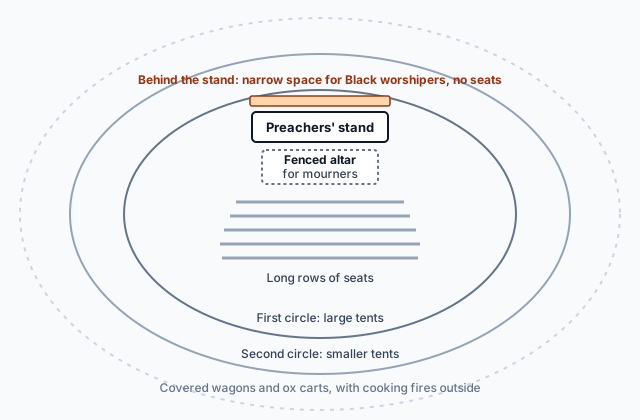
Revivalists answered with the heart. Conversion was something a person felt, often in front of a crowd. At the 1833 camp meeting, mourners, people grieving over their sins, were invited to "a rude altar fenced in, fronting the preachers' stand." Douglass watched Thomas Auld there and saw that "his face was extremely red, and his hair disheveled, and though I heard him groan, and saw a stray tear halting on his cheek." Yet Douglass wrote, "I could not wholly confide in the genuineness of his conversion." The felt, public conversion was the revival's method; whether a given one was real was another matter.
Reason was not thrown away, but feeling now came first.
Sources: My Bondage and Freedom (Avalon Project).
Quick check · Sort it
Each card describes religion in the late 1700s or early 1800s. Tap a card, then the side it belongs to.
Enlightenment rationalism
The revivalists' answer
2c. The market revolution's changes
A third cause lay in the economy. The market revolution changed how Americans lived. More families produced goods for distant markets instead of for their own use, factories and towns grew, and while some prospered, a large population of laboring poor grew too. Old communities came apart, and new ones formed fast.
Revivals were strongest where that change was fastest. The National Archives' history describes "the growth of evangelical religion that took place primarily in frontier regions and in areas of the older states undergoing rapid development and change." Central and western New York, which the Erie Canal had opened to eastern markets in the 1820s, saw so much religious fervor that it became known as the burned-over district. Finney's own memoirs give the first known use of that name for the region.
For people whose lives had been unsettled, a revival offered a fresh start the person chose, and a congregation of new neighbors with shared rules for living.
Sources: The Two-Party System (National Archives). The burned-over district and Finney's memoirs are described from the AP U.S. History course framework.
Quick check · Fill the statement
Complete the explanation.
Revivals spread fastest where the was changing how people lived. Central and western New York, opened to eastern markets by a canal, saw so many revivals that it was called the district.
2d. A nation on the move
The last cause was mobility, both geographical and social. Many Americans moved west of the Appalachians, far from the churches they had grown up in. Preachers followed them. Peter Cartwright, a backwoods Methodist preacher, described the camp meetings that spread evangelical Protestantism in the West, and Harry Hosier, an African American Methodist preacher, often traveled with Bishop Francis Asbury.
Moving also meant choosing. People who changed towns or work were freer to change churches, and the newer, revival-minded churches gained. Black Protestants built churches of their own: Richard Allen founded the African Methodist Episcopal Church, whose first congregation, Mother Bethel, began in 1794.
New transportation helped. Of the 1833 camp meeting, Douglass wrote that "people gathered from all parts of the county, and two steamboat loads came from Baltimore." Yet the old order of slavery and race came too: "a narrow space was marked out for the use of the colored people."
Sources: My Bondage and Freedom (Avalon Project). Cartwright, Hosier and Allen are described from the AP U.S. History course framework.
Quick check · Match
Match each piece of evidence to what it shows about the causes of the Awakening.
Part 3 Watch it done Connect wider voting to the revivals
Watch each step, then do the last one yourself.
In the same decades that revivals swept the country, states replaced property tests for voting with voting by all adult white men. Explain how the expansion of democracy relates to the Second Great Awakening.
Predict first
Before the steps, what kind of connection do you expect between voting and religion here?
Step 1 · Name both developments
In politics, voting moved from a system based on owning property to one based on voting by all adult white men. In religion, revival preachers told every listener that he or she could repent and choose salvation, instead of waiting on a choice God had already made.
Why this step?
Why name both developments before linking them?
A connection needs two things to connect. Stating each one plainly keeps you from describing one development and only hinting at the other.
Step 2 · Find what they share
Look for what the two have in common. In each case, ask who makes the decision, and who used to make it.
Your step · Decide and justify
Finish it. Which statement best explains the connection between wider voting and the revivals?
Which evidence best supports your answer?
Part 4 Try it Sojourner Truth's churches
Sojourner Truth, born enslaved in Ulster County, New York, told her story to Olive Gilbert, who wrote it down; the narrative appeared in 1850. It calls her Isabella in these years. After she obtained her son's freedom through the courts, she stayed about a year in Kingston, where "she became a member of the Methodist Church there." When she moved to New York City she transferred to a Methodist church there, and later "joined Zion's Church in Church street, composed entirely of colored people."
Years later, near Hartford, Connecticut, she attended two camp meetings of believers in the Second Advent, who expected Christ's return at any moment. When people there asked whether she shared that belief, "She told them it had not been revealed to her; perhaps, if she could read, she might see it differently." Once she "had gained a good standing with them," she began trying to calm their fears, and when she found the preachers "doing their utmost to agitate and excite the people, who were already too much excited," "she arose and addressed the preachers."
Try it · Multiple choice
At a Second Advent camp meeting, Truth, a formerly enslaved woman who could not read, rose and addressed the preachers. Which feature of revival religion does that moment best illustrate?
Now a different connection. A student links the market revolution to the revivals in one paragraph.
Try it · Spot the error
A student writes a paragraph connecting the market revolution to the Second Great Awakening. Which line is the first to go wrong?
Part 5 Explain it Write it like a document-based answer
Nothing you type leaves this page. Check your answer against the model and each scoring point.
Free-response practice · Question 1 style
A short practice in the shape of the document-based question: three documents instead of seven, and a thesis with one body paragraph instead of a full essay.
Evaluate the relative importance of the causes of the Second Great Awakening.
Document 1. Frederick Douglass, My Bondage and Freedom, 1855, recalling his boyhood in Baltimore: "My religious nature was awakened by the preaching of a white Methodist minister, named Hanson. He thought that all men, great and small, bond and free, were sinners in the sight of God; that they were, by nature, rebels against His government; and that they must repent of their sins, and be reconciled to God, through Christ."
Document 2. The same book, on a Methodist camp meeting of August 1833: "people gathered from all parts of the county, and two steamboat loads came from Baltimore."
Document 3. The Narrative of Sojourner Truth, written by Olive Gilbert from Truth's account, 1850, on Truth after she moved to New York City: she "joined Zion's Church in Church street, composed entirely of colored people."
Write a thesis, one sentence of historical context, and one paragraph that uses at least two documents and explains the purpose, audience, point of view or situation of one of them.
Model answer
Thesis: The rise of democratic and individualistic beliefs in American society was the most important cause of the Second Great Awakening, because it made a message of individual choice persuasive to people used to choosing their own leaders, while the market revolution and greater mobility mattered as the conditions that carried that message to people whose lives were changing.
Context: in the early 1800s states were dropping property tests for voting, so ordinary white men were growing used to deciding public questions for themselves, the habit revival preachers appealed to.
Douglass's preacher held that "all men, great and small, bond and free," must repent (Document 1), a message that put salvation in each person's hands and treated every hearer as equal before God, which suited a public that already trusted ordinary judgment. Douglass wrote this in 1855 as an abolitionist and a man who had escaped slavery, so he had reason to stress a message that included the enslaved; his point of view makes the equality in it stand out. The steamboats that brought crowds from Baltimore (Document 2) and Truth's move from Kingston to New York City and into a Black congregation (Document 3) show mobility at work, but they show how people reached the revival and chose a church, not why its message drew them. Rationalism, which none of these documents shows, gave the revivals something to answer, but it explains their style more than their reach. Mobility spread the Awakening; democratic belief gave it its pull.
Score your own answer. This is a self-check, not a grade. Tick each point your answer makes.
Part 6 Check yourself Where the revivals burned
The case questions use the two accounts. The others mix the ideas from the whole lesson.
One account is a history of the period; the other is a memoir by a man who was there. Sources: The Two-Party System (National Archives); My Bondage and Freedom (Avalon Project).
| Account | Excerpt |
|---|---|
| National Archives, The Two-Party System, a history of politics from 1824 to 1840 | The Second Great Awakening refers to "the growth of evangelical religion that took place primarily in frontier regions and in areas of the older states undergoing rapid development and change." |
| Frederick Douglass, My Bondage and Freedom (1855), on a Methodist camp meeting of August 1833 | "people gathered from all parts of the county, and two steamboat loads came from Baltimore" |
Case question 1 · Multiple choice
The first account says evangelical religion grew mainly in frontier regions and fast-changing parts of older states. Which development best explains that pattern?
Case question 2 · Multiple choice
How is Douglass's account in the second row best used in an essay on the causes of the Second Great Awakening?
The rest stand on their own and do not use the case.
Check yourself · Select all
Which two developments outside the churches best show the democratic and individualistic beliefs that made revival preaching persuasive? Select two.
Select 2 answers, then check.
Check yourself · Sort it
Each card is something a speaker might have said. Tap a card, then the speaker who would have said it.
A rationalist of the 1790s
A revival preacher of the 1830s
Part 7 Keep it Bring back earlier ideas
This lesson stands on the Romantic ideas of Topic 4.9 and on the migrations of the market revolution from Topic 4.6.
Bring it back · Fill the statement
Read the situation, then complete the sentences.
In the 1830s a reformer argues that better schools and better surroundings would make better citizens. The argument reflects the Romantic belief in , one of the influences that reached American thought from .
Bring it back · Multiple choice
During the market revolution, where did large numbers of international migrants and of westward-moving Americans settle?
In three lines
- Democratic and individualistic beliefs told each person to choose salvation, as more ordinary men gained the vote.
- Revivals answered rationalism with a religion of the heart, felt in public at camp meetings.
- The market revolution's upheaval and Americans' movement west and between churches gave the revivals their crowds.
Exam strategy for this topic
- Section I Part A, Multiple Choice: 55 questions in 55 minutes.
- Section I Part B, Short Answer: 3 questions in 40 minutes.
- Section II, Document-Based Question and Long Essay: 2 questions in 100 minutes.
- This lesson's Explain it is shaped like free-response question 1, Document-based.
When a question asks for causes, name the cause and tie a specific piece of evidence to it, then say how two causes worked together. A list of four causes with no evidence explains nothing.
Questions students ask
How was the Second Great Awakening different from the first one?
The First Great Awakening came in the colonial era. The Second came in the early republic, and its preachers stressed each person's choice to be saved, in a nation where more men could vote and many were moving west.
Were the revivals only for white Americans?
No. Richard Allen founded the African Methodist Episcopal Church, Jarena Lee wrote of her call to preach, and Sojourner Truth addressed the preachers at a camp meeting. But racial lines held: at the 1833 camp meeting Douglass saw, "a narrow space was marked out for the use of the colored people."
Why is it called the burned-over district?
Central and western New York saw so many revivals in the early 1800s that it was described as burned over by religious fervor. The course framework notes that Charles Finney's memoirs give the first known use of the term for the region.
Did the Second Great Awakening lead to reform?
Yes, and that is the next topic. Converts who believed each person could change often set out to change society, through temperance, antislavery and other causes.
Where can I read these sources?
Douglass's My Bondage and Freedom and The Narrative of Sojourner Truth are at the Avalon Project at Yale Law School, and The Two-Party System is a National Archives publication, each linked beside its excerpt. Finney, Lee, Cartwright and Allen are described from the course framework, not quoted.
Course alignment, for teachers
AP U.S. History topic 4.10, Unit 4: Period 4: 1800–1848.
- Skill 5.B: Explain how a historical development or process relates to another historical development or process.
This lesson maps the one essential knowledge statement of the topic, and the one learning objective with none of its own, to the part that teaches each one: 2 are checked by a scored question. The map is in the lesson file.