Unit 8 · Topic 8.14 · about 30 minutes · 7 parts · 13 scored checks, 4 of them multiple choice
AP U.S. History 8.14: Society in Transition
Unit 8: 10 to 17% of the multiple-choice section
What you'll be able to do
- Explain the causes and effects of continuing policy debates about the role of the federal government over time, from the conservative challenge of the 1960s to the decline of public trust and the clashes between conservatives and liberals in the 1970s.
- Explain the effects of the growth of religious movements over the course of the 20th century, including the rapid growth of evangelical Christian churches and the political and social activism of religious conservatives.
Key vocabulary
| Term | What it means | The exam trap |
|---|---|---|
| Liberalism | In this period, the belief that the federal government should act to solve social and economic problems. | Liberal here describes a view of what government should do; check what a source wants government to do before you label it. |
| Conservatism | In this period, the push to limit the federal government, defend traditional values and take a firmer stand abroad. | Conservatives wanted a smaller government at home but often a more assertive foreign policy; do not say they wanted less government everywhere. |
| Watergate | The scandal over a break-in and its cover-up by the Nixon White House, which led to President Nixon's resignation on August 9, 1974. | The scandal is mostly about the cover-up, which the tapes revealed, not only the break-in. |
| Stagflation | Rising prices combined with a stalled economy, a problem of the 1970s. | Stagflation is both at once, high inflation and weak growth, not one or the other. |
| Evangelical | A Protestant tradition that stresses personal conversion and the authority of the Bible. | Evangelical names a religious tradition; it became linked with political activism in this period, but the word itself is not a party label. |
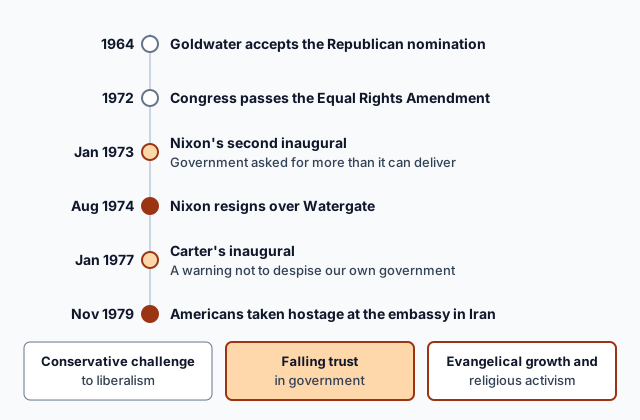 Tap to open the picture full size
Part 1 Think first Two presidents, one warning
Commit to a guess first. Being wrong now makes the right idea stick better.
Predict first
On January 20, 1973, Richard Nixon told the nation: "In trusting too much in government, we have asked of it more than it can deliver." Four years later to the day, a new president, Jimmy Carter, said Americans had learned "that even our great Nation has its recognized limits, and that we can neither answer all questions nor solve all problems." What do you think best explains why both presidents said something like this?
In short. From the 1960s conservatives challenged liberal laws and court decisions and what they saw as moral decline; in the 1970s economic trouble, the Watergate scandal and crises abroad drained public trust in government, conservatives and liberals clashed over rights, race and the family, and fast-growing evangelical churches turned religious conservatives toward politics.
- Conservatives in the 1960s challenged liberal laws such as Johnson's Great Society and liberal court decisions, sought to limit the federal government, and by 1973 Nixon was telling Americans they had asked of government "more than it can deliver."
- Watergate, which ended with Nixon's resignation on August 9, 1974, along with economic trouble and crises such as the Iran hostage crisis, lowered confidence in government's ability to solve problems.
- Evangelical Christian churches and organizations grew rapidly, and religious conservatives became more active in politics and in fights over women's rights and the family.
Part 2 Learn it A society in transition
2a. The conservative challenge
Liberalism, in this period, meant using the federal government actively to solve social and economic problems. Its largest program was President Lyndon Johnson's Great Society, a set of programs as sweeping as the New Deal, with reforms to end poverty and racial discrimination and big spending on education and Medicare. A series of Supreme Court decisions also expanded civil rights and individual liberties.
In the 1960s conservatives challenged those liberal laws and court decisions, and what they saw as moral and cultural decline. They wanted to limit the federal government and take a more assertive stand abroad. The course framework names voices such as Buckley's National Review, the Sharon Statement of Young Americans for Freedom (1960), and Barry Goldwater's speech accepting the Republican nomination on July 16, 1964. Nixon took office in 1969 facing Vietnam War protests in Congress and in the streets, and in a speech of November 3, 1969, he called his supporters a silent majority.
Nixon did not dismantle the Great Society. He signed the Clean Air Act of 1970 and created the Environmental Protection Agency, and conservatives in his own party opposed any expansion of welfare. In 1973 he still made the conservative case: "We have lived too long with the consequences of attempting to gather all power and responsibility in Washington."
Sources: Nixon on the Home Front (Prologue, 2012); Nixon's Second Inaugural Address (Avalon Project). The Supreme Court decisions and the named conservative voices are from the AP U.S. History course framework.
Quick check · Sort it
Each card is a conservative complaint of the 1960s and early 1970s. Tap a card, then what it objects to.
Too large a federal government
Moral and cultural decline
2b. Trust falls in the 1970s
In the 1970s public confidence in government's ability to solve social and economic problems declined. Three kinds of events wore it down, some reaching back to the 1960s.
Economic challenges. Nixon inherited an economy strained by heavy spending on both the Vietnam War and the Great Society. Unemployment was low but prices were rising, and his wage and price controls did not stop them. Prices kept climbing while the economy stalled, a mix called stagflation. The course framework points to a 1973 photograph of a New York gas station during the oil embargo.
Political scandal. In Watergate, the House Judiciary Committee approved three articles of impeachment against Nixon in the summer of 1974. After the Supreme Court forced him to surrender tape recordings that revealed his knowledge of the cover-up, "even his staunchest supporters in the House admitted that they would have to vote in favor of impeachment." Nixon resigned on August 9, 1974, and President Ford later pardoned him.
Foreign policy crises. The Vietnam War had divided the country. Later, on November 4, 1979, the course framework notes, the U.S. embassy in Iran was seized; 52 Americans were held for 444 days.
Carter opened his 1977 inaugural by thanking Ford: "I want to thank my predecessor for all he has done to heal our land."
Sources: Watergate and the Constitution (National Archives); Nixon on the Home Front (Prologue, 2012); Carter's Inaugural Address (Avalon Project).
Quick check · Put it in order
Put these events in the order they happened, earliest first.
2c. Clashes over rights and the family
The 1970s saw growing clashes between conservatives and liberals over social and cultural issues, the power of the federal government, race, and movements for greater individual rights.
Race and the courts. In Swann v. Charlotte-Mecklenburg Board of Education, the Supreme Court unanimously approved busing as a legal means to desegregate schools. In the early 1970s, tensions over court-ordered desegregation grew in northern cities such as Boston and Detroit. Nixon opposed busing to achieve desegregation but enforced the court orders.
Women's rights. Congress passed the Equal Rights Amendment, which sought equal legal rights for women, in 1972. By the deadline 35 state legislatures had approved it, but 38 were needed. In 1978 Congress and President Carter extended the deadline to June 30, 1982, and the amendment still fell short.
The course framework points to people on each side: Phyllis Schlafly, one of the most prominent women fighting the amendment, debating Betty Friedan, one of its most prominent supporters, on Good Morning America in January 1976; the 1977 International Women's Year conference in Houston, in a history of the battle over women's rights and family values; and the singer Anita Bryant, whose career it calls representative of the rise of the New Christian Right.
Sources: Nixon on the Home Front (Prologue, 2012); Equal Rights Amendment (National Archives). The people in the last paragraph are from the AP U.S. History course framework.
Quick check · Match
Match each development of the 1970s to what it shows.
2d. Evangelicals and religious activism
Evangelical Christians stress personal conversion, being born again, and the authority of the Bible. In these decades evangelical churches and organizations grew rapidly and substantially, and that growth came with greater political and social activism by religious conservatives.
The course framework gives a line of examples. In a 1958 speech in Charlotte, the evangelist Billy Graham named political and social problems and proposed individual, religious solutions. In 1970 the psychologist James Dobson, who later founded Focus on the Family, published Dare to Discipline, parenting advice he tied to political ideas about the American family. The Christian Broadcasting Network and its program The 700 Club carried the message on television. Paul Weyrich, a founder of the Heritage Foundation, worked to build conservative politics in the 1970s.
What drew religious conservatives into politics? Particular fights as well as a mood. The course framework places Anita Bryant and the New Christian Right among the decade's clashes over women's rights, the Equal Rights Amendment and family values, and Dobson's book tied the family to politics directly. Many religious conservatives also saw the protests and counterculture of the 1960s as moral decline.
How does this connect to the rest of the lesson? Religious activism joined the conservative challenge to liberal laws and the clashes of the 1970s.
These examples are from the AP U.S. History course framework.
Quick check · Fill the statement
Complete the sentences.
From the 1950s to the 1970s, Christian churches and organizations grew rapidly. Their growth was accompanied by greater political and social by religious conservatives.
Part 3 Watch it done Put Carter's warning in context
Watch each step, then do the last one yourself.
In his inaugural address of January 20, 1977, Jimmy Carter said: "Let our recent mistakes bring a resurgent commitment to the basic principles of our Nation, for we know that if we despise our own government we have no future." Explain the broader context that helps account for this warning.
Predict first
Before the steps, what do you think Carter meant by recent mistakes?
Step 1 · Read the speech for clues
Carter's first sentence thanks his predecessor "for all he has done to heal our land." A land needs healing only if something has hurt it. Near the end he hopes it will be said "that we had enabled our people to be proud of their own Government once again," which suggests they were not proud of it then.
Why this step?
Why look for clues inside the speech first?
A speaker's own words point to what he thought his audience was worried about. They tell you which part of the wider history to look in.
Step 2 · Find the events
Less than three years earlier, tape recordings had revealed President Nixon's knowledge of the Watergate cover-up, and he had resigned on August 9, 1974, rather than face impeachment. President Ford then pardoned him. Rising prices and the oil embargo had also shaken Americans.
Your step · Decide and justify
Finish it. Which broader context best explains Carter's warning not to despise government?
Which evidence best supports your answer?
Part 4 Try it Religion, politics and the 1970s
By the late 1970s religious conservatives were active in politics. Their activism grew out of the rapid growth of evangelical churches and organizations, and it found its causes in the decade's clashes: the fight over the Equal Rights Amendment, which Congress passed in 1972 and which fell short of ratification, and the wider battle over women's rights and family values that the course framework traces through the 1977 Houston conference.
Source: Equal Rights Amendment (National Archives). The Houston conference is from the AP U.S. History course framework.
Try it · Multiple choice
In January 1973 Nixon complained: "Our children have been taught to be ashamed of their country, ashamed of their parents, ashamed of America's record at home and of its role in the world." This complaint is best understood in the context of which development?
Try it · Spot the error
A student writes a contextualization paragraph on religious conservatives in the 1970s. Which line is the first to go wrong?
Part 5 Explain it Write it like a document-based answer
Nothing you type leaves this page. Check your answer against the model and each scoring point.
Free-response practice · Question 1 style
A short practice in the shape of the document-based question: three documents instead of seven, and a thesis with one body paragraph instead of a full essay.
Evaluate the extent to which Americans' confidence in the federal government changed between 1973 and 1977.
Document 1. Richard Nixon, second inaugural address, January 20, 1973: "In trusting too much in government, we have asked of it more than it can deliver." And: "We have lived too long with the consequences of attempting to gather all power and responsibility in Washington."
Document 2. The National Archives on Watergate: the House Judiciary Committee approved three articles of impeachment against Nixon in the summer of 1974, and after the Supreme Court forced him to surrender tapes revealing his knowledge of the cover-up, "even his staunchest supporters in the House admitted that they would have to vote in favor of impeachment." Nixon resigned on August 9, 1974.
Document 3. Jimmy Carter, inaugural address, January 20, 1977: "Let our recent mistakes bring a resurgent commitment to the basic principles of our Nation, for we know that if we despise our own government we have no future."
Write a thesis, one sentence of historical context, and one paragraph that uses at least two documents and explains the purpose, audience, point of view or situation of one of them.
Model answer
Thesis: Between 1973 and 1977 Americans' confidence in the federal government fell sharply, as a conservative argument that government had promised too much met the shock of Watergate, so that by 1977 a new president had to plead with Americans not to despise their own government.
Context: in the 1960s conservatives had challenged Great Society programs and liberal court decisions, the Vietnam War had divided the country, and heavy spending on the war and the Great Society had left Nixon an economy with rising prices.
In 1973 Nixon told the nation it had asked of government "more than it can deliver" (Document 1). A president newly reelected was speaking to a national audience, and his purpose was to win support for shifting power away from Washington, so his words show doubts about what government could do, not yet distrust of its honesty. The Watergate tapes changed that: once they revealed Nixon's knowledge of the cover-up, even his strongest House supporters said they would vote to impeach, and he resigned (Document 2). By 1977 Carter warned that "if we despise our own government we have no future" (Document 3), a sign that doubt about government's ability had become doubt about government itself.
Score your own answer. This is a self-check, not a grade. Tick each point your answer makes.
Part 6 Check yourself Two inaugurals, four years apart
The case questions use the two excerpts. The others mix the ideas from the whole lesson.
Both excerpts come from inaugural addresses given on January 20, four years apart. Sources: Nixon, 1973 (Avalon Project); Carter, 1977 (Avalon Project).
| Speech | Excerpt |
|---|---|
| Richard Nixon, second inaugural, January 20, 1973 | "In trusting too much in government, we have asked of it more than it can deliver." |
| Jimmy Carter, inaugural, January 20, 1977 | "that even our great Nation has its recognized limits, and that we can neither answer all questions nor solve all problems" |
Case question 1 · Multiple choice
What do the two excerpts have in common?
Case question 2 · Multiple choice
Nixon's excerpt fits best into which longer-running development?
The rest stand on their own and do not use the case.
Check yourself · Select all
Which two developments show the growth of evangelical Christianity and the activism that came with it? Select two.
Select 2 answers, then check.
Check yourself · Fill the statement
Complete the sentences.
In Swann v. Charlotte-Mecklenburg Board of Education, the Supreme Court unanimously approved as a legal means to desegregate schools. In the early 1970s, tensions over court-ordered desegregation grew in northern cities such as .
Part 7 Keep it Bring back earlier ideas
This lesson stands on the environmental movement of Topic 8.13 and the youth culture of Topic 8.12.
Bring it back · Multiple choice
An oil spill fouls a stretch of coastline, and citizens' groups press Congress to act. Which response fits the pattern of the years from 1968 to 1980?
Bring it back · Match
Match each description to the change in American culture it shows.
In three lines
- From the 1960s conservatives challenged liberal laws and court decisions and perceived moral decline, seeking to limit the federal government.
- Economic trouble, Watergate and crises abroad lowered public trust in government's ability to solve problems in the 1970s.
- Clashes over rights and the family grew, and fast-growing evangelical churches brought religious conservatives into politics.
Exam strategy for this topic
- Section I Part A, Multiple Choice: 55 questions in 55 minutes.
- Section I Part B, Short Answer: 3 questions in 40 minutes.
- Section II, Document-Based Question and Long Essay: 2 questions in 100 minutes.
- This lesson's Explain it is shaped like free-response question 1, Document-based.
For a question on the 1970s, give at least two of the causes of falling trust (economic trouble, scandal, crises abroad) and connect each to a specific example.
Questions students ask
What was Watergate?
A scandal over a break-in and its cover-up by the Nixon White House. The House Judiciary Committee approved three articles of impeachment in the summer of 1974, the Supreme Court forced Nixon to surrender tapes that revealed his knowledge of the cover-up, and he resigned on August 9, 1974.
Was the loss of trust only about Nixon?
No. Watergate mattered most, but economic trouble and crises abroad wore down trust too. Nixon in 1973 and Carter in 1977 both told Americans to expect less of government, and Carter warned that "if we despise our own government we have no future."
Why did the Equal Rights Amendment fail?
Congress passed it in 1972, but only 35 of the 38 needed state legislatures ratified it, even after the deadline was extended to 1982. Opponents such as Phyllis Schlafly campaigned against it as the clash over women's rights and the family grew.
How did religion connect to politics in the 1970s?
Evangelical churches and organizations grew rapidly, and religious conservatives became more active in politics and social causes, often in the fights over the family and women's rights.
Where can I read these speeches?
Nixon's and Carter's inaugural addresses are in full at the Avalon Project at Yale Law School, linked beside each excerpt, and the Watergate material is at the National Archives.
Course alignment, for teachers
AP U.S. History topic 8.14, Unit 8: Period 8: 1945–1980.
- Skill 4.B: Explain how a specific historical development or process is situated within a broader historical context.
This lesson maps all 4 essential knowledge statements of the topic, and the 2 learning objectives with none of their own, to the part that teaches each one: 6 are checked by a scored question. The map is in the lesson file.