Unit 6 · Topic 6.5 · about 30 minutes · 7 parts · 13 scored checks, 5 of them multiple choice
AP U.S. History 6.5: Technological Innovation
Unit 6: 10 to 17% of the multiple-choice section
What you'll be able to do
- Explain the effects of technological advances in the development of the United States over time, and practice explaining how one historical development relates to another: railroads and the iron they used, invention and manufacturing, growth and regulation.
Key vocabulary
| Term | What it means | The exam trap |
|---|---|---|
| Technological innovation | A new or improved device or method that changes how goods are made or moved, such as Edison's improved lamp. | An innovation can improve something that already exists; it does not have to be the first of its kind. |
| Patent | A government grant giving an inventor the exclusive right to an invention. | A patent shows a claim to an invention, not how widely it was used or sold. |
| Natural resources | Materials taken from the land, such as timber, stone and minerals, that businesses turn into goods. | Greater access to resources is not the same as a new technology, though railroads delivered both. |
| Transcontinental railroad | A railroad crossing the continent; the first was finished on May 10, 1869, with federal aid from the 1862 act. | Federal aid in land and loans built it, so it is evidence of government policy as well as of technology. |
| Making a connection | Explaining how one historical development relates to another, through cause, comparison or continuity. | Two events in order are not a connection until you explain the link between them. |
 Tap to open the picture full size
Part 1 Think first Who gains when a railroad is built?
Commit to a guess first. Being wrong now makes the right idea stick better.
Predict first
In 1862 Congress offered land and loans to build a railroad and telegraph line to the Pacific. The law also required "the rails and all the other iron used in the construction and equipment of said road to be American manufacture of the best quality." Besides the railroad company, who do you think gained most directly from that rule?
In short. In the decades after the Civil War, businesses raised the production of goods dramatically by putting technological innovations to work and by reaching more natural resources, and railroads, built with federal aid, did both at once.
- Edison's 1880 lamp patent covered "an Improvement in Electric Lamps and in the method of manufacturing the same," invention organized as a business, with financial backing and a team.
- The Pacific Railway Act of 1862 gave builders land, loans and the right to take timber and stone from public lands, and required the railroad's iron to be of American manufacture.
- One development drove the next: railroads created demand for iron and widened markets, growth led businesses to combine, and Congress answered with the first federal regulation of an industry in 1887.
Part 2 Learn it Technology, resources and production
2a. Invention as organized work
On January 27, 1880, Thomas Edison received a patent for an electric lamp. His application, from Menlo Park, New Jersey, asked for a patent on "an Improvement in Electric Lamps and in the method of manufacturing the same."
Read that phrase closely. Edison's patent was an improvement on electric lamps, not the invention of them. His design changes and materials, such as a carbon filament, made a lamp that was reliable, safe, and practical. And the patent claims a way to manufacture the lamp, not only the lamp itself.
How Edison worked matters as much as what he made. He lined up financial backing and assembled a team of scientists and technicians, and his New Jersey laboratories were themselves inventions. Out of them came 1,093 patented inventions and innovations. By 1882 crews were laying tubes for electric wires in the streets of New York City.
This is what the period's innovation looked like: money, teams and laboratories aimed at products a business could make and sell.
Source: Thomas Edison's Patent Application (National Archives). The AP U.S. History course framework points to an 1882 Harper's Weekly image of the New York street work.
Quick check · Multiple choice
Edison's 1880 patent was for "an Improvement in Electric Lamps and in the method of manufacturing the same." What does this wording best show?
2b. Railroads and greater access to natural resources
Businesses in this period raised the production of goods dramatically by using technological innovations and by reaching more natural resources. Railroads did both.
The Pacific Railway Act, passed on July 1, 1862, was written "To aid in the construction of a railroad and telegraph line from the Missouri River to the Pacific Ocean, and to secure to the Government the use of the same for postal, military, and other purposes." It gave federal subsidies in land and loans, and the right "to take from the public lands adjacent to the line of said road, earth, stone, timber, and other materials for the construction thereof."
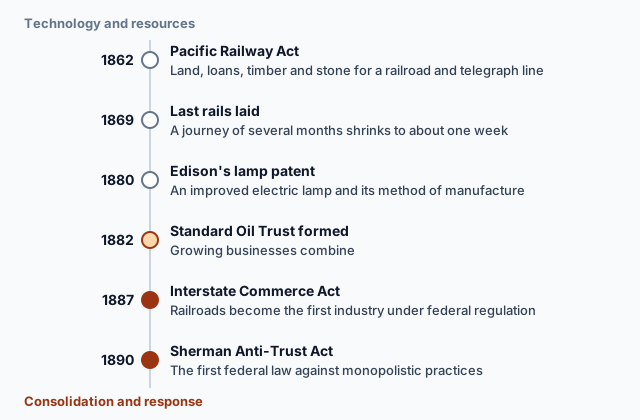
The last rails were laid on May 10, 1869, and a journey of several months shrank to about one week. Congress eventually authorized four transcontinental railroads and granted 174 million acres of public lands for rights-of-way.
Faster travel and a telegraph line across the continent opened new markets. Railroads, mineral discoveries and government policies created new communities and centers of commercial activity in the West.
Quick check · Sort it
Each card names something businesses used to raise production. Tap a card, then say which kind it is.
Technological innovation
Greater access to natural resources
2c. One development drives another
Making a connection means explaining how one development led to, resembled or continued another, not just listing two facts side by side. Three links run through this period.
- Demand. The 1862 act required "the rails and all the other iron used in the construction and equipment of said road to be American manufacture of the best quality." Building one industry created orders for another.
- Scale. Where only one railroad served an area, it held a natural monopoly. Railroads gave rebates to large shippers, which hurt farmers who shipped too little to win better rates. The same network that widened markets favored the biggest producers.
- Response. As production grew, businesses combined: the Standard Oil Trust was formed on January 2, 1882. Congress answered growth with law. The Interstate Commerce Act of 1887 made railroads the first industry subject to federal regulation, and the Sherman Anti-Trust Act of 1890 was the first federal act that outlawed monopolistic business practices.
Sources: Pacific Railway Act; Interstate Commerce Act; Sherman Anti-Trust Act (National Archives).
Quick check · Match
Match each development to the connection it shows.
Part 3 Watch it done Connect two railroad laws
Watch each step, then do the last one yourself.
Explain how the Pacific Railway Act of 1862 relates to the Interstate Commerce Act of 1887.
Predict first
Before the steps, how do you think the two laws are related?
Step 1 · Say what each law did
The 1862 act gave federal land and loans to build a railroad and telegraph line to the Pacific. The 1887 act, approved February 4, set rules for railroad rates: "every unjust and unreasonable charge for such service is prohibited and declared to be unlawful."
Why this step?
Why describe each development before linking them?
A connection is only as good as the facts on each end. If you misstate what one law did, the link you draw from it will be wrong too.
Step 2 · Find what happened in between
Railroads spread with public help, and Congress passed the 1887 act largely in response to decades of public demand that railroad operations be regulated. What did railroads do in those decades that people wanted stopped?
Your step · Decide and justify
Finish it. How does the 1862 act relate to the 1887 act?
Which evidence best supports your answer?
Part 4 Try it Old technology, new scale
In the Market Revolution earlier in the century, textile machinery, steam engines, interchangeable parts, the telegraph and agricultural inventions made production more efficient, and roads, canals and railroads widened markets. Those railroads linked the North and Midwest more closely than they linked the South.
After 1862 a telegraph line ran with the railroad to the Pacific, four transcontinental railroads were authorized, and electric wires were laid under city streets to light buildings. On farms, improvements in mechanization raised production and contributed to declines in food prices.
Source: Pacific Railway Act (National Archives). The Market Revolution is Topic 4.5 of the course framework.
Try it · Multiple choice
Which statement best compares the role of technology in the Market Revolution with its role after the Civil War?
Try it · Spot the error
A student writes a chain of connections about the Pacific Railway Act. Which line is the first to go wrong?
Try it · Fill the statement
Complete the sentences.
Edison's 1880 patent covered a better lamp and a method of it. The 1862 act's grant of timber and stone from public lands gave railroad builders greater access to .
Part 5 Explain it Write it like a document-based answer
Nothing you type leaves this page. Check your answer against the model and each scoring point.
Free-response practice · Question 1 style
A short practice in the shape of the document-based question: three documents instead of seven, and a thesis with one body paragraph instead of a full essay.
Evaluate the extent to which technological advances increased the production of goods in the United States between 1862 and 1890.
Document 1. Pacific Railway Act, July 1, 1862: an act "To aid in the construction of a railroad and telegraph line from the Missouri River to the Pacific Ocean, and to secure to the Government the use of the same for postal, military, and other purposes." It grants the right "to take from the public lands adjacent to the line of said road, earth, stone, timber, and other materials for the construction thereof."
Document 2. Thomas Edison, patent application to the Commissioner of Patents, patent granted January 27, 1880: "Your Petitioner Thomas A. Edison of Menlo Park in the State of New Jersey prays that Letters Patent may be granted to him for the invention of an Improvement in Electric Lamps and in the method of manufacturing the same"
Document 3. Interstate Commerce Act, approved February 4, 1887, on railroad charges: "every unjust and unreasonable charge for such service is prohibited and declared to be unlawful."
Write a thesis, one sentence of historical context, and one paragraph that uses at least two documents and explains the purpose, audience, point of view or situation of one of them.
Model answer
Thesis: Between 1862 and 1890 technological advances drove a large increase in the production of goods, but only together with greater access to natural resources and federal aid, and the railroads that made that growth possible gained a power over rates that Congress moved to regulate.
Context: the Market Revolution earlier in the century had already used steam engines, textile machinery and the telegraph to make production more efficient, so this period built on older technology at a national scale.
The Pacific Railway Act paired a technology, the railroad and telegraph line, with resources, the builders' right to take "earth, stone, timber, and other materials" from public lands (Document 1). Edison's application asks for a patent on an improved lamp and "the method of manufacturing the same" (Document 2). It is a legal petition, written to secure Edison's exclusive right to the invention, so it shows that he meant to produce the lamp, not how many were made or sold. The same railroads gained power over rates, giving rebates to large shippers that hurt farmers, and by 1887 Congress declared every "unjust and unreasonable charge" by railroads unlawful (Document 3). These documents show the means of growth more than its amount: technology raised production, but resources, public aid and later regulation shaped how far and for whom.
Score your own answer. This is a self-check, not a grade. Tick each point your answer makes.
Part 6 Check yourself What the 1862 act gave, and what it held back
The case questions use the three excerpts. The others mix the ideas from the whole lesson.
All three excerpts come from the Pacific Railway Act of July 1, 1862. Source: Pacific Railway Act (National Archives).
| Subject | Excerpt |
|---|---|
| Building materials | "to take from the public lands adjacent to the line of said road, earth, stone, timber, and other materials for the construction thereof" |
| Land grants | "all mineral lands shall be excepted from the operation of this act; but where the same shall contain timber, the timber thereon is hereby granted to said company" |
| Iron | "the rails and all the other iron used in the construction and equipment of said road to be American manufacture of the best quality" |
Case question 1 · Multiple choice
What do the first two excerpts together show about the railroad builders' access to natural resources?
Case question 2 · Multiple choice
The third excerpt best connects railroad building to which other development?
The rest stand on their own and do not use the case.
Check yourself · Put it in order
Put these events in the order they happened, earliest first.
Check yourself · Select all
Which two statements about Edison's 1880 lamp patent are accurate? Select two.
Select 2 answers, then check.
Part 7 Keep it Bring back earlier ideas
This lesson stands on the New South economy from Topic 6.4 and the federal aid for railroads from Topic 6.2.
Bring it back · Multiple choice
Which statement best describes the Southern economy between 1877 and 1898?
Bring it back · Fill the statement
Complete the sentences.
After the Civil War, the federal government gave to companies building railroads and telegraph lines. These systems helped open new in North America.
In three lines
- Businesses raised the production of goods dramatically by using technological innovations and greater access to natural resources.
- Invention became organized work: Edison's 1880 patent improved an existing lamp and claimed a method of manufacturing it.
- Railroads built with federal aid opened resources and markets, created demand for American iron, and led to the first federal regulation of an industry.
Exam strategy for this topic
- Section I Part A, Multiple Choice: 55 questions in 55 minutes.
- Section I Part B, Short Answer: 3 questions in 40 minutes.
- Section II, Document-Based Question and Long Essay: 2 questions in 100 minutes.
- This lesson's Explain it is shaped like free-response question 1, Document-based.
When a question asks you to connect two developments, name the relationship (cause, comparison or continuity) and the specific link, such as the railroad's demand for American iron, not just the order of events.
Questions students ask
Did Edison invent the light bulb?
Not the first one. The National Archives notes that his patent was an improvement on electric lamps, not the invention of them. His design changes and materials, such as a carbon filament, made a lamp that was reliable, safe and practical.
Why is a railroad law in a lesson about technology?
Railroads were the period's great technology for moving goods, and the 1862 act also gave builders land, loans and materials from public lands. It shows technology and greater access to natural resources working together.
How is this different from the Market Revolution?
The Market Revolution already used steam engines, textile machinery, interchangeable parts and the telegraph to make production more efficient. After the Civil War the same kind of change reached across the continent, with transcontinental railroads and a telegraph line to the Pacific.
What did the government do about the growth of big business?
In 1887 the Interstate Commerce Act made railroads the first industry subject to federal regulation, and in 1890 the Sherman Anti-Trust Act became the first federal act that outlawed monopolistic business practices. Topic 6.6 follows the businesses those laws were aimed at.
Where can I read these documents in full?
Each excerpt links to its full text at the National Archives, the primary-source collection this lesson was checked against.
Course alignment, for teachers
AP U.S. History topic 6.5, Unit 6: Period 6: 1865–1898.
- Skill 5.B: Explain how a historical development or process relates to another historical development or process.
This lesson maps the one essential knowledge statement of the topic, and the one learning objective with none of its own, to the part that teaches each one: 2 are checked by a scored question. The map is in the lesson file.