Unit 2 · Topic 2.4 · about 30 minutes · 7 parts · 13 scored checks, 5 of them multiple choice
AP U.S. History 2.4: Transatlantic Trade
Unit 2: 6 to 8% of the multiple-choice section
What you'll be able to do
- Explain causes and effects of transatlantic trade over time, and identify the patterns that connect the trade documents of the colonial era.
Key vocabulary
| Term | What it means | The exam trap |
|---|---|---|
| Atlantic economy | The trade network that linked Europe, Africa and the Americas, exchanging goods and enslaved people across the ocean. | The network carried people as well as goods, so a description of cargo alone leaves part of it out. |
| Commodity | A good produced or acquired for sale, such as tobacco, sugar or furs. | A commodity is defined by being traded, so the same crop can be food in one place and a commodity in another. |
| Mercantilism | The economic idea that a nation grows strong by exporting more than it imports and by using colonies to supply goods it would otherwise buy from rivals. | Mercantilism names a goal for a whole empire's trade, not any single law or tax. |
| Acts of Navigation | English laws on the trade and shipping of the colonies, which Pennsylvania's 1681 charter required colonists to obey. | A law requiring something is not proof that colonists obeyed it; look for evidence of enforcement. |
| Demographic shift | A large change in the size or makeup of a population. | A demographic shift is a change in numbers and makeup, not a movement of people from place to place. |
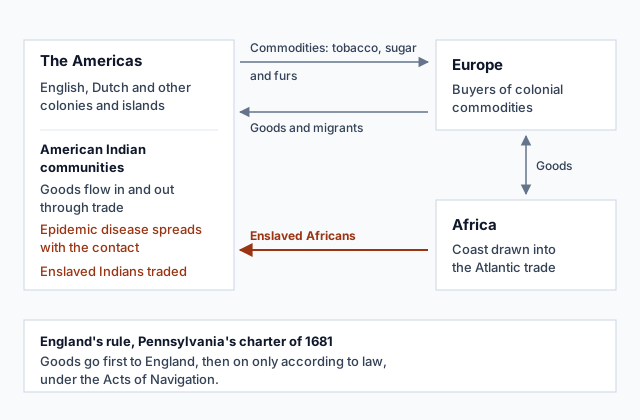 Tap to open the picture full size
Part 1 Think first A shipload of furs
Commit to a guess first. Being wrong now makes the right idea stick better.
Predict first
On November 5, 1626, a letter written in Amsterdam reported that a ship had just arrived from New Netherland, the Dutch colony in North America: "The cargo of the aforesaid ship is: 7246 beaver skins, 17886 otter skins." Who do you think supplied most of those furs, and what changed for them because of trades like this one?
In short. Transatlantic trade built an Atlantic economy in which goods and enslaved people moved among Europe, Africa and the Americas, reshaped American Indian communities, and drew England, later Great Britain, into trying, unevenly, to run its colonies for mercantilist gain.
- European colonial economies focused on acquiring, producing and exporting commodities valued in Europe, and on gaining new sources of labor, including enslaved Africans and American Indians.
- Continuing trade with Europeans increased the flow of goods in and out of American Indian communities, bringing cultural and economic change and epidemic diseases that caused radical demographic shifts.
- England, and Great Britain after it, increasingly tried to fit its North American colonies into a coherent, hierarchical imperial structure for mercantilist aims, but conflicts with colonists and American Indians made its enforcement erratic.
Part 2 Learn it Trade across the Atlantic
2a. An Atlantic economy
In the 1600s and 1700s an Atlantic economy grew up in which goods, and also enslaved Africans and American Indians, were exchanged between Europe, Africa and the Americas through extensive trade networks. European colonial economies focused on two things: acquiring, producing and exporting commodities, goods that were valued in Europe, and gaining new sources of labor.
The networks crossed empires. When the Dutch chartered their West India Company in 1621, they declared that "the navigation, trade, and commerce, in the parts of the West-Indies, and Africa, and other places hereafter described, should not henceforth be carried on any otherwise than by the common united strength of the merchants and inhabitants of these countries." One company's trade would join Africa to the Americas.
People were traded too. In 1688 a group of settlers at Germantown, Pennsylvania, wrote: "These are the reasons why we are against the traffic of men-body." They had heard that most enslaved Africans were "brought hither against their will and consent, and that many of them are stolen."
Sources: Charter of the Dutch West India Company (Avalon Project); Germantown protest, 1688 (Avalon Project).
Quick check · Sort it
Colonial economies sought two things from the Atlantic world. Tap a card, then the one it shows.
Commodities valued in Europe
New sources of labor
2b. Trade reaches into American Indian communities
The furs on the Dutch ship of 1626 came out of North America through trade with American Indians. Continuing trade with Europeans increased the flow of goods in and out of American Indian communities. Furs and other products went out; European goods came in.
Native traders were not passive in that exchange. They judged what they were offered. Pennsylvania's Concessions of 1681 admit that "it is usual with the planters to over-reach the poor natives of the country, in trade, by goods not being good of the kind, or debased with mixtures, with which they are sensibly aggrieved." So whatever was sold to the Indians "in consideration of their furs" had to be tested in the public market, "that the natives may not be abused, nor provoked."
The flow stimulated cultural and economic changes in how Native people worked, what they used and whom they dealt with. The same contact spread epidemic diseases, illnesses that run through a population quickly, which caused radical demographic shifts: sudden, large changes in the size and makeup of Native populations.
Source: Concessions to the Province of Pennsylvania, 1681 (Avalon Project).
Quick check · Match
Match each development in the fur trade to the effect on American Indian communities that it fits best.
2c. Mercantilism and England's rules for trade
Mercantilism was the economic idea that a nation grows strong by exporting more than it imports and by using colonies to supply goods it would otherwise buy from rivals. To pursue mercantilist aims, England increasingly tried to fit its North American colonies into a coherent, hierarchical imperial structure.
Compare two charters. Maryland's, of 1632, gave colonists license to land the colony's goods "into any the Ports whatsoever of Us, our Heirs and Successors, of England or Ireland, or otherwise to dispose of the same there," and to ship them on "to any other Countries they shall think proper, whether belonging to Us, or any foreign Power which shall be in Amity with Us."
Pennsylvania's, of 1681, requires that goods go to ports "in our Kingdome of England, and not into any other Countrey whatsoever," with no mention of Ireland, and lets colonists ship them on "to export the same into any other Countreys, either of our Dominions or fforeigne, according to Lawe." So the route narrowed, from a license to use English or Irish ports to a rule of England only. The machinery of control grew too: colonists must "doe observe the Acts of Navigation, and other Lawes in that behalfe made" and admit the Crown's customs officers, and Penn must keep an agent in London to answer for offenses against the trade laws.
Sources: Charter of Maryland (Avalon Project); Charter of Pennsylvania (Avalon Project).
Quick check · Multiple choice
Pennsylvania's 1681 charter makes the colony admit the Crown's customs officers and "observe the Acts of Navigation." Which aim do these rules most directly serve?
2d. An empire enforced by fits and starts
England's control did not tighten in a straight line. Massachusetts Bay had held a charter since March 4, 1629. Under Charles II, an English court ordered that charter canceled.
The Dominion of New England, set up in 1686, was enlarged in 1688. James II's commission to its governor, Sir Edmund Andros, added "the neighboring Colonies of Road Island and Connecticutt, our Province of New York and East and West Jersey" (spelling as printed), giving as the reason "for the better protection and security of our subjects in those parts." Andros was to make the laws "by and with the advise and consent of our said Councill," a council the king could fill. The commission names no elected assembly.
Three years later, a new Massachusetts charter of 1691 kept a governor "to be from time to time appointed and Commissionated by Vs Our Heires and Successors," but its towns again elected representatives to an assembly.
These documents do not say why policy swung. The course framework's explanation is that conflicts with colonists and American Indians led to erratic enforcement of imperial policies. Try it shows two such conflicts in later documents.
Sources: Andros commission, 1688 (Avalon Project); Massachusetts charter, 1691 (Avalon Project).
Quick check · Put it in order
Put these steps in Massachusetts's government in the order they happened, earliest first.
Part 3 Watch it done Connect a report on sugar to a rule for trade
Watch each step, then do the last one yourself.
In 1668 the English writer Josiah Child observed that "the Sugar-Bakers of Holland can afford to give a greater prize for Barbados Sugars in London" (spelling as printed; sugar-bakers were sugar refiners, and prize means price). Pennsylvania's charter of 1681 sends that colony's goods to ports "in our Kingdome of England, and not into any other Countrey whatsoever," and only then lets them be shipped "into any other Countreys, either of our Dominions or fforeigne, according to Lawe." Identify the pattern that connects the two.
Predict first
Before the steps, where do you think Dutch refiners bought sugar grown on an English island?
Step 1 · Say what each source shows
Child's sentence puts Dutch buyers paying for Barbados sugar "in London." The sugar grew in an English colony in the West Indies. Pennsylvania's charter, thirteen years later, requires that the colony's goods go first to England, and lets them go on to other countries only after that.
Why this step?
Why state what each source shows before looking for a pattern?
A pattern is a connection between developments. You can only connect two things accurately once you know what each one actually says, and not what you expect it to say.
Step 2 · Look for what they share
Ask the same question of both sources: what route did colonial goods take to reach buyers elsewhere in Europe? The answer to that question is the pattern. Name it yourself below.
Your step · Decide and justify
Finish it. Which pattern connects the two sources?
Which evidence best supports your answer?
Part 4 Try it Conflict and imperial rule in the 1700s
Two later documents show how the colonies were governed in the 1700s.
In 1725 the king, now ruling Great Britain, issued an explanatory charter for Massachusetts. It says the 1691 charter made no provision for choosing a speaker of the representatives, "nor any particular Reservacon made of the Right of Vs Our Heires and Successors to approve or disapprove of such Speaker by the Governor" (spelling as printed). In plain words, the royal governor had no clear right to approve or reject the speaker. As a result "divers Doubts and Controversies have Arisen within Our said Province to the Interrupcon of the Publick Business thereof and the obstruccon of Our Service." The new charter settled the dispute in the Crown's favor: the elected speaker goes to the governor, who has "full power and Authority to approve or disapprove of the Person so Elected and presented."
In 1754 the Albany Plan of Union proposed a general government for the colonies, to be set up by an act of Parliament. It would "hold or direct all Indian treaties, in which the general interest of the Colonies may be concerned; and make peace or declare war with Indian nations," and "make such laws as they judge necessary for regulating all Indian trade." It was a proposal; this document does not show it taking effect.
Sources: Explanatory Charter of Massachusetts Bay, 1725 (Avalon Project); Albany Plan of Union, 1754 (Avalon Project).
Try it · Multiple choice
Which connection between the 1725 charter and the 1754 Albany Plan does the evidence best support?
Try it · Spot the error
A student writes a paragraph on patterns in Atlantic trade. Which line is the first to go wrong?
Part 5 Explain it Write it like a document-based answer
Nothing you type leaves this page. Check your answer against the model and each scoring point.
Free-response practice · Question 1 style
A short practice in the shape of the document-based question: three documents instead of seven, and a thesis with one body paragraph instead of a full essay.
Evaluate the extent to which England's control over its North American colonies increased from 1632 to 1691.
Document 1. Charter of Maryland, granted by the king, 1632: the colony's goods go "into any the Ports whatsoever of Us, our Heirs and Successors, of England or Ireland," and may then be exported "to any other Countries they shall think proper, whether belonging to Us, or any foreign Power which shall be in Amity with Us."
Document 2. Charter for the Province of Pennsylvania, granted by Charles II, 1681: the colony's goods go to ports "in our Kingdome of England, and not into any other Countrey whatsoever," and may then be exported "into any other Countreys, either of our Dominions or fforeigne, according to Lawe"; the colonists must "doe observe the Acts of Navigation, and other Lawes in that behalfe made."
Document 3. Charter of Massachusetts Bay, 1691: a governor "to be from time to time appointed and Commissionated by Vs Our Heires and Successors"; each town "impowered to Elect and Depute Two Persons and noe more to serve for and represent them respectively in the said Great and Generall Court or Assembly."
Write a thesis, one sentence of historical context, and one paragraph that uses at least two documents and explains the purpose, audience, point of view or situation of one of them.
Model answer
Thesis: From 1632 to 1691 England's control over colonial trade tightened in both route and enforcement, as Maryland's license to land goods in England or Ireland gave way to Pennsylvania's rule of England only, backed by the Acts of Navigation, while its control over colonial government rose and fell, ending in a compromise that kept an elected assembly.
Context: an Atlantic economy had grown up in which colonies produced commodities valued in Europe, and England, pursuing mercantilist aims, wanted those goods and their profits to pass through its own hands.
Maryland's charter licensed colonists to land the colony's goods in England or Ireland and ship them on to any friendly foreign power (Document 1). Pennsylvania's required that goods go to England "and not into any other Countrey whatsoever," allowed them abroad only afterward and "according to Lawe," and made colonists "doe observe the Acts of Navigation" (Document 2), so by 1681 both the route and the rules behind it had tightened. Document 2 is a royal charter, written by the Crown to set the terms of a grant; its purpose was to state what the king required, so it shows England's intentions, not how well colonists obeyed. Government followed a different path. The 1691 Massachusetts charter gave the Crown the power to appoint the governor, a gain in control, yet it restored towns' right to elect representatives to an assembly (Document 3). Control over trade grew more steadily than control over self-government, where conflicts with colonists and American Indians made enforcement erratic.
Score your own answer. This is a self-check, not a grade. Tick each point your answer makes.
Part 6 Check yourself One king's dominion, and the charter that followed
The case questions use the two excerpts. The others mix the ideas from the whole lesson.
Both excerpts set out who would make the laws in Massachusetts and its neighbors, three years apart. Sources: Andros commission, 1688 (Avalon Project); Massachusetts charter, 1691 (Avalon Project).
| Document | Excerpt |
|---|---|
| Commission of Sir Edmund Andros as governor of the Dominion of New England, April 7, 1688 | Andros, with a council the king could appoint, may make laws "by and with the advise and consent of our said Councill" |
| Charter of Massachusetts Bay, October 7, 1691 | A governor "to be from time to time appointed and Commissionated by Vs Our Heires and Successors"; each town "impowered to Elect and Depute Two Persons and noe more to serve for and represent them respectively in the said Great and Generall Court or Assembly" |
Case question 1 · Multiple choice
Under the 1688 excerpt, who makes the laws?
Case question 2 · Multiple choice
Massachusetts Bay had held its own charter since 1629, until an English court ordered it canceled under Charles II. Read against that, what pattern in imperial policy do the two excerpts show?
The rest stand on their own and do not use the case.
Check yourself · Fill the statement
Complete the explanation of England's trade policy.
Under , England wanted its colonies to supply goods it would otherwise buy from rivals. So Pennsylvania's charter sent the colony's goods first to and required colonists to obey the Acts of Navigation.
Check yourself · Select all
Which two were effects of continuing trade with Europeans on American Indian communities? Select two.
Select 2 answers, then check.
Part 7 Keep it Bring back earlier ideas
This lesson stands on the regions of British colonies from Topic 2.3 and the European colonizers from Topic 2.2.
Bring it back · Multiple choice
A Virginia planter in the 1600s wants to plant much more tobacco. What did a Chesapeake planter need most, and how was that need met at first?
Bring it back · Sort it
Tap a card, then the colonizers it describes.
English colonization
French and Dutch colonization
In three lines
- An Atlantic economy exchanged goods and enslaved Africans and American Indians among Europe, Africa and the Americas, as colonies sought commodities valued in Europe and new sources of labor.
- Continuing trade with Europeans moved goods in and out of American Indian communities, changing their cultures and economies and spreading diseases that caused radical demographic shifts.
- England, and then Great Britain, tried to fit its colonies into a coherent imperial structure for mercantilist aims, but conflicts with colonists and American Indians made its enforcement erratic.
Exam strategy for this topic
- Section I Part A, Multiple Choice: 55 questions in 55 minutes.
- Section I Part B, Short Answer: 3 questions in 40 minutes.
- Section II, Document-Based Question and Long Essay: 2 questions in 100 minutes.
- This lesson's Explain it is shaped like free-response question 1, Document-based.
When a question asks for a pattern or connection, name what two developments share in one sentence, then give one specific detail from each that shows it.
Questions students ask
Was the Atlantic trade really a triangle?
Goods and people moved among Europe, Africa and the Americas through extensive networks, in many directions. This lesson describes those networks without drawing a fixed route, since the sources here do not show one.
What were the Acts of Navigation?
They were English laws on the trade and shipping of the colonies. Pennsylvania's charter of 1681 required colonists to obey them and to admit the Crown's customs officers, and it sent the colony's goods first to England, to be shipped on only according to law.
Why did trade cause so many deaths among American Indians?
Continuing contact through trade spread epidemic diseases into Native communities, and those diseases caused radical demographic shifts, sudden and large population losses.
Why are so many words in these quotations spelled oddly?
Every excerpt is copied exactly as the archive prints it, from documents written before English spelling was settled, so you can check it against the source linked beside it.
Why does the lesson say England for the 1600s and Britain later?
The documents of the 1600s speak of the kingdom of England; by the 1720s they speak of Great Britain, as the 1725 Massachusetts charter and the 1754 Albany Plan do. The course framework calls the empire British throughout.
Where can I read these documents in full?
Each excerpt links to its full text at the Avalon Project at Yale Law School, the primary-source collection this lesson was checked against.
Course alignment, for teachers
AP U.S. History topic 2.4, Unit 2: Period 2: 1607–1754.
- Skill 5.A: Identify patterns among or connections between historical developments and processes.
This lesson maps all 3 essential knowledge statements of the topic, and the one learning objective with none of its own, to the part that teaches each one: 4 are checked by a scored question. The map is in the lesson file.