Unit 3 · Topic 3.4 · about 30 minutes · 7 parts · 13 scored checks, 5 of them multiple choice
AP U.S. History 3.4: Philosophical Foundations of the American Revolution
Unit 3: 10 to 17% of the multiple-choice section
What you'll be able to do
- Explain how and why colonial attitudes about government and the individual changed in the years leading up to the American Revolution, and read the documents of those years for their point of view, purpose, historical situation and audience.
Key vocabulary
| Term | What it means | The exam trap |
|---|---|---|
| Natural rights | Rights people hold because they are human, such as life and liberty, rather than because a government granted them. | A document can name rights without saying they are natural; read what it says the rights come from. |
| Hereditary privilege | Power or reward that passes down by birth rather than being earned. | Hereditary describes how an office is handed on, not how powerful the office is. |
| Republican government | Government in which power comes from the people and is held by officials they choose, with no hereditary ruler. | In this period the word names a form of government, not a political party. |
| Consent of the governed | The idea, in the Declaration of Independence, that a government's just powers come from the people it governs. | Consent is about where authority comes from, not a promise that everyone agrees to every law. |
| Sourcing | Reading a source for its point of view, purpose, historical situation and audience. | Sourcing explains why a document says what it says; it does not prove the document false. |
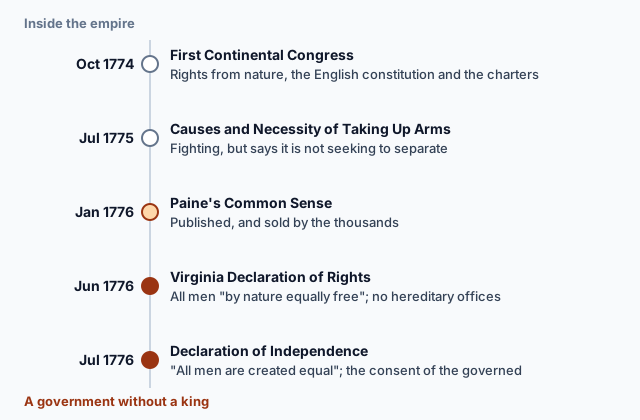 Tap to open the picture full size
Part 1 Think first What changed in twelve months?
Commit to a guess first. Being wrong now makes the right idea stick better.
Predict first
In July 1775, Congress, meeting in Philadelphia, wrote of "Hostilities, thus commenced by the British troops." The same declaration, of July 6, also said: "We have not raised armies with ambitious designs of separating from Great-Britain, and establishing independent states." On July 4, 1776, the Continental Congress declared independence. What do you think did most to change its mind in those twelve months?
In short. Colonial leaders argued from natural rights before the war began, but between 1775 and 1776, as British actions convinced many Americans that Britain was treating the colonies as a foreign entity, those rights became the case for independence and for a republican government, stated in Thomas Paine's Common Sense and the Declaration of Independence.
- In 1774 Congress rested the colonists' rights on the laws of nature together with the English constitution and the colonial charters; in 1776 the Declaration claimed independence itself under "the Laws of Nature and of Nature's God."
- Enlightenment ideas led many American thinkers to value individual talent over hereditary privilege, and religion strengthened Americans' view of themselves as a people blessed with liberty.
- The Declaration's claims that "all men are created equal" and that just powers come from "the consent of the governed" shaped how later Americans understood the nation's ideals.
Part 2 Learn it New ideas about government and the individual
2a. From British rights to the case for independence
In October 1774 the First Continental Congress said the colonists held their rights "by the immutable laws of nature, the principles of the English constitution, and the several charters or compacts." Natural rights, rights people hold because they are human, sat beside rights the colonists held as British subjects. Congress was asking Britain to respect both.
Then came the British actions of 1775 and 1776: the king's proclamation of rebellion, the Prohibitory Act, the hiring of German soldiers. Many Americans concluded that Britain treated them as foreigners, and rights that rested on being British seemed to count for less.
Rights from nature did not depend on Britain. In July 1776 the Declaration of Independence claimed for the colonies "the separate and equal station to which the Laws of Nature and of Nature's God entitle them," and said people are "endowed by their Creator with certain unalienable Rights." Natural rights now justified leaving the empire. The British footing did not vanish: the Declaration still charges the king "For taking away our Charters, abolishing our most valuable Laws."
Sources: Declaration and Resolves, 1774 (Avalon Project); The Declaration of Independence: A History (National Archives); Declaration of Independence (National Archives).
Quick check · Sort it
Each card is a phrase from a document of 1774 to 1776. Tap a card, then the kind of right it claims.
Rights held as British subjects
Rights held as human beings
2b. Talent over hereditary privilege
Hereditary privilege is power or reward that passes down by birth. The political thought of the Enlightenment led many American thinkers to put individual talent ahead of birth. Virginia's convention put the idea in writing. It adopted the Virginia Declaration of Rights, drafted by George Mason, on June 12, 1776. Section IV reads:
Emoluments are payments or rewards for holding office. Read the sentence in two halves. Rewards and privileges are owed only for "public services," for what a person does. Services cannot be handed down ("not being descendible"), so no office, from local magistrate to judge, should pass by birth.
The ideal had limits in practice. The same document gives the vote only to men with "sufficient evidence of permanent common interest with, and attachment to, the community," a test of a man's stake in the community rather than of his birth.
Quick check · Multiple choice
Section IV of the Virginia Declaration of Rights (June 12, 1776) says privileges are owed only "in consideration of public services" and that the offices of "magistrate, legislator, or judge" should not "be hereditary." Which idea does it most directly express?
2c. A people blessed with liberty
Religion strengthened many Americans' view of themselves as a people blessed with liberty, and the colonists' documents put faith and reason side by side.
In July 1775 Congress wrote that "a reverance for our Creator, principles of humanity, and the dictates of common sense, must convince all those who reflect upon the subject, that government was instituted to promote the welfare of mankind" (spelling as printed). The same declaration read the colonies' history as God's plan: "his Providence would not permit us to be called into this severe controversy, until we were grown up to our present strength." God, in that telling, had prepared the colonies for this fight.
The Declaration of Independence does the same. Rights are "endowed by their Creator." Congress declares independence while "appealing to the Supreme Judge of the world for the rectitude of our intentions," asking God to judge that its aims are right, and closes "with a firm reliance on the protection of divine Providence." And when a government shows "a long train of abuses and usurpations," the Declaration calls throwing it off both "their right" and "their duty."
Sources: Causes and Necessity of Taking Up Arms, 1775 (Avalon Project); Declaration of Independence (National Archives).
Quick check · Match
Match each phrase from the documents of 1775 and 1776 to the work it does in the colonists' argument.
2d. Republican government, and the Declaration as a source
Republican government puts power in the people and in officials they choose, with no hereditary ruler. The Virginia Declaration of Rights says "all power is vested in, and consequently derived from, the people." Thomas Paine's Common Sense and the Declaration of Independence both expressed the colonists' belief that a republic resting on the people's natural rights was the best form of government. Common Sense came out in January 1776 and sold by the thousands. The Declaration said governments draw their "just powers from the consent of the governed."
A founding document is still a source, made by people for a reason. Ask who wrote it and from what position (point of view), whom it was for (audience), what it was meant to do (purpose), and what was happening around it (historical situation).
The Declaration's first sentence names its audience: "a decent respect to the opinions of mankind requires that they should declare the causes which impel them to the separation." Its purpose was to justify the break, so it reads as a case against the king. Its signers pledged "our Lives, our Fortunes and our sacred Honor" to independence, and wrote as men who had staked everything on it.
Sources: The Declaration of Independence: A History (National Archives); Declaration of Independence (National Archives).
Quick check · Fill the statement
Complete a historian's notes on the 1775 Declaration of the Causes and Necessity of Taking Up Arms.
Congress says it does not mean "to dissolve that union which has so long and so happily subsisted between us." It was written while British troops and colonial forces were already fighting, which is its . It speaks to "our friends and fellow-subjects in any part of the empire," which is its .
Part 3 Watch it done Source the Virginia Declaration of Rights
Watch each step, then do the last one yourself.
Section II of the Virginia Declaration of Rights, adopted by Virginia's convention of delegates on June 12, 1776, reads: "That all power is vested in, and consequently derived from, the people; that magistrates are their trustees and servants, and at all times amenable to them." Explain how the document's historical situation shapes this claim.
Predict first
Before the steps, what kind of document do you think Section II belongs to?
Step 1 · Place it in time
On May 15, 1776, the Virginia Convention instructed its delegates in Congress to propose that the colonies be declared free and independent. The Virginia Declaration of Rights came four weeks later. The Declaration of Independence followed on July 4.
Why this step?
Why start with the date instead of the words?
Words do not explain themselves. Knowing what had happened just before a document was written tells you what problem its authors were trying to solve.
Step 2 · Name the authors and the audience
Virginia's convention of delegates adopted it unanimously; George Mason drafted it. It speaks to Virginians about their own government, and it says "all power" comes from "the people."
Your step · Decide and justify
Finish it. How does the historical situation shape Section II's claim that magistrates are the people's "trustees and servants"?
Which evidence best supports your answer?
Part 4 Try it Ideas that outlived 1776
In 1776 the ideals were stated for "all men" and practiced for far fewer. Virginia limited the vote, and the Declaration itself calls Native Americans "merciless Indian Savages." Yet the words kept their hold on how Americans understood the nation. On November 19, 1863, during the Civil War, Abraham Lincoln spoke where part of the Gettysburg battlefield was being dedicated as "a final resting-place for those who here gave their lives that that nation might live." He began: "Fourscore and seven years ago our fathers brought forth on this continent a new nation, conceived in liberty and dedicated to the proposition that all men are created equal." Fourscore and seven years is 87, which counts back to 1776. He called for "a new birth of freedom" and resolved "that government of the people, by the people, for the people shall not perish from the earth."
Source: Gettysburg Address (Avalon Project). The AP U.S. History course framework names Lincoln as the speaker, in its Period 5 topics.
Try it · Multiple choice
What does Lincoln's use of the Declaration in 1863 show about continuity and change in the nation's founding ideals?
Try it · Spot the error
A student writes a sourcing paragraph on the Gettysburg Address. Which line is the first to go wrong?
Part 5 Explain it Write it like a document-based answer
Nothing you type leaves this page. Check your answer against the model and each scoring point.
Free-response practice · Question 1 style
A short practice in the shape of the document-based question: three documents instead of seven, and a thesis with one body paragraph instead of a full essay.
Evaluate the extent to which colonial ideas about the basis of government changed between 1774 and 1776.
Document 1. Declaration and Resolves of the First Continental Congress, October 14, 1774: the colonists hold their rights "by the immutable laws of nature, the principles of the English constitution, and the several charters or compacts."
Document 2. Declaration of the Causes and Necessity of Taking Up Arms, issued by Congress at Philadelphia, July 6, 1775: "We have not raised armies with ambitious designs of separating from Great-Britain, and establishing independent states." And: "Lest this declaration should disquiet the minds of our friends and fellow-subjects in any part of the empire, we assure them that we mean not to dissolve that union which has so long and so happily subsisted between us, and which we sincerely wish to see restored."
Document 3. Virginia Declaration of Rights, June 12, 1776: "That all power is vested in, and consequently derived from, the people; that magistrates are their trustees and servants, and at all times amenable to them."
Write a thesis, one sentence of historical context, and one paragraph that uses at least two documents and explains the purpose, audience, point of view or situation of one of them.
Model answer
Thesis: Between 1774 and 1776 colonial ideas changed greatly in where they placed political authority, from rights claimed partly as British subjects to power held by the people alone, though the appeal to natural rights was there from the start.
Context: after the Seven Years' War, Britain's efforts to collect taxes without direct colonial representation and to assert imperial authority pushed colonial leaders to argue about the source of their rights, and by 1775 the colonies were fighting British troops.
In 1774 Congress rested the colonists' rights on "the immutable laws of nature" but also on "the English constitution" and the colonial "charters" (Document 1), the claims of loyal British subjects. As late as July 1775 Congress denied any wish to separate (Document 2). That document was written to reassure "our friends and fellow-subjects in any part of the empire," so its denial shows what Congress wanted readers across the empire to believe and may understate how far some colonists had already moved. By June 1776 Virginia declared that "all power" comes from "the people" and that officials are their "servants" (Document 3), a government with no place for the crown. Natural rights continued; what they were used to build changed.
Score your own answer. This is a self-check, not a grade. Tick each point your answer makes.
Part 6 Check yourself One Congress, two declarations
The case questions use the two excerpts. The others mix the ideas from the whole lesson.
Both excerpts come from the colonies' Congress at Philadelphia, a year apart. Sources: 1775 declaration (Avalon Project); Declaration of Independence (National Archives).
| Document | Excerpt |
|---|---|
| Declaration of the Causes and Necessity of Taking Up Arms, July 6, 1775 | "Lest this declaration should disquiet the minds of our friends and fellow-subjects in any part of the empire, we assure them that we mean not to dissolve that union which has so long and so happily subsisted between us, and which we sincerely wish to see restored." |
| Declaration of Independence, July 4, 1776 | "That these United Colonies are, and of Right ought to be Free and Independent States; that they are Absolved from all Allegiance to the British Crown" |
Case question 1 · Multiple choice
The 1775 excerpt is addressed most directly to which audience?
Case question 2 · Multiple choice
Which best explains the change between the two excerpts?
The rest stand on their own and do not use the case.
Check yourself · Put it in order
Put these events in the order they happened, earliest first.
Check yourself · Select all
Which two phrases from the Declaration of Independence call on God to stand behind the signers' cause, rather than saying where rights come from? Select two.
Select 2 answers, then check.
Part 7 Keep it Bring back earlier ideas
This lesson stands on colonial resistance to British taxes from Topic 3.3 and the forces of Period 3 from Topic 3.1.
Bring it back · Multiple choice
After the Seven Years' War, a colonial leader objects to a new British tax. Which argument fits the grounds colonial leaders gave for resisting British policies?
Bring it back · Fill the statement
Read the situation, then complete the sentences.
Suppose Parliament passes a law letting royal officials overrule a colony's elected assembly, and colonists answer that only their own assembly may make their laws. The law is an attempt to the colonies. The answer shows the colonists' resolve to pursue .
In three lines
- Natural rights were in colonial arguments from 1774; British actions in 1775 and 1776 turned them into the case for independence.
- Enlightenment ideas put individual talent over hereditary privilege, and religion strengthened Americans' sense of being a people blessed with liberty.
- Common Sense and the Declaration of Independence stated the case for republican government based on natural rights, ideas Americans kept returning to.
Exam strategy for this topic
- Section I Part A, Multiple Choice: 55 questions in 55 minutes.
- Section I Part B, Short Answer: 3 questions in 40 minutes.
- Section II, Document-Based Question and Long Essay: 2 questions in 100 minutes.
- This lesson's Explain it is shaped like free-response question 1, Document-based.
When a question asks about a document's purpose or audience, quote the words that show it, then say how that purpose or audience limits what the document can prove.
Questions students ask
Did the colonists stop seeing themselves as British all at once?
No. In 1774 Congress rested the colonists' rights partly on the English constitution and the charters, and in July 1775 it said it was not trying to separate. Even the Declaration of Independence still charges the king "For taking away our Charters, abolishing our most valuable Laws."
What did Common Sense have to do with independence?
Thomas Paine's Common Sense, with the Declaration of Independence, expressed the colonists' belief in republican government based on natural rights. The National Archives notes it was published in January 1776 and sold by the thousands, and that by the middle of May eight colonies had decided to support independence.
Who wrote the Declaration of Independence?
Congress named a Committee of Five to draft it: John Adams, Roger Sherman, Benjamin Franklin, Robert R. Livingston and Thomas Jefferson. The National Archives notes that after Congress made its changes, the basic document remained Jefferson's.
Why does a quotation in this lesson spell reverence as "reverance"?
Every excerpt is copied exactly as the archive prints it, so you can check it against the source linked beside it.
Where can I read these documents in full?
Each excerpt links to its full text at the National Archives or the Avalon Project at Yale Law School, the primary-source collections this lesson was checked against.
Course alignment, for teachers
AP U.S. History topic 3.4, Unit 3: Period 3: 1754–1800.
- Skill 2.B: Explain the point of view, purpose, historical situation, and/or audience of a source.
This lesson maps all 2 essential knowledge statements of the topic, and the one learning objective with none of its own, to the part that teaches each one: 3 are checked by a scored question. The map is in the lesson file.