Unit 6 · Topic 6.11 · about 30 minutes · 7 parts · 15 scored checks, 6 of them multiple choice
AP U.S. History 6.11: Reform in the Gilded Age
Unit 6: 10 to 17% of the multiple-choice section
What you'll be able to do
- Explain how different reform movements responded to the rise of industrial capitalism in the Gilded Age, and read reformers' petitions and presidents' speeches for their point of view, purpose, historical situation and audience, including how these limit what each source can show.
Key vocabulary
| Term | What it means | The exam trap |
|---|---|---|
| Agrarian | Having to do with farming and farmers; agrarian reformers spoke for farmers' interests, as the Grangers did against railroad monopolies. | Agrarian reformers wanted change in how the economy treated farmers, not a return to a world with no industry. |
| Utopian | A reformer who imagined a whole new, better society to show what was wrong with the present one. | A utopian vision is a model to argue from; do not describe it as a law or a program that took effect. |
| Socialism | The idea that the public, rather than private owners, should own and run major industries. | Do not use socialist as a label for every critic of big business; agrarians and Social Gospel advocates made different arguments. |
| Social Gospel | A movement that applied Christian teaching to the social questions of industrial life. | Do not confuse it with the Gospel of Wealth, which was about what the rich owed; the Social Gospel questioned how the industrial economy treated people. |
| Voluntary organization | A group people join by choice to pursue a shared goal, such as a suffrage association or a temperance union. | These were private groups people chose to join, not government agencies. |
| Sourcing | Reading a source for its point of view, purpose, historical situation and audience, and saying how they limit what it can show. | A source with a strong purpose is still useful; say what it is good evidence of instead of only calling it biased. |
 Tap to open the picture full size
Part 1 Think first A vote cast on purpose
Commit to a guess first. Being wrong now makes the right idea stick better.
Predict first
In the 1872 election, Susan B. Anthony registered and voted in Rochester, New York, where the law did not let women vote. Why do you think she did it?
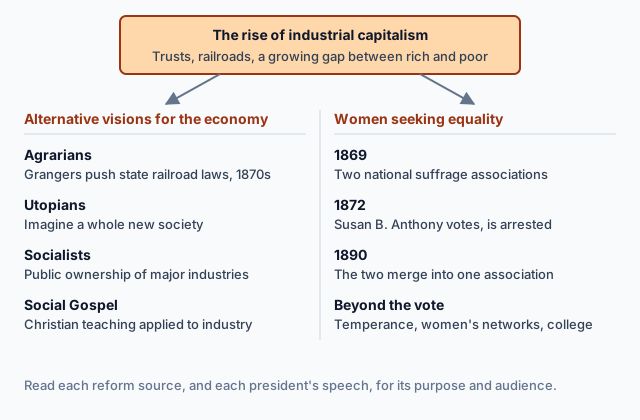
In short. As industrial capitalism concentrated wealth and power, agrarians, utopians, socialists and advocates of the Social Gospel championed other visions for the economy and society, while many women sought equality with men through voluntary organizations, college and reform.
- Farmers in the Granger movement pushed state laws against railroad monopolies in the 1870s, and decades of public demand helped bring the Interstate Commerce Act of 1887.
- Women formed national suffrage organizations in 1869, petitioned Congress, and in 1872 Susan B. Anthony voted in a planned test of the law.
- A reform document, or a president's speech about reform, has its own purpose and audience, and those limit what it can show.
Part 2 Learn it Reformers answer industrial capitalism
2a. Other visions for the economy
Industrial capitalism brought trusts that concentrated wealth (Topic 6.6) and a growing gap between rich and poor. A number of artists and critics, including agrarians, utopians, socialists and advocates of the Social Gospel, championed alternative visions for the economy and U.S. society.
Agrarians spoke for farmers. Railroads gave rebates to large shippers, which especially hurt farmers who could not ship enough to win better rates. The Granger movement began in the 1860s by offering benefits to isolated rural communities, and in the 1870s Granger-controlled state legislatures in the West and South took early action against railroad monopolies. Decades of public demand helped bring the Interstate Commerce Act, approved February 4, 1887, which made the railroads the first industry under federal regulation.
Utopians imagined whole new societies to show what was wrong with their own. Socialists argued that the public, not private owners, should own and run major industries; the course framework names Reverdy Ransom, a minister in the AME Church, who argued for socialism in 1896 while noting the discrimination African Americans faced in organized labor. Advocates of the Social Gospel applied Christian teaching to the social questions of industrial life; the framework names Washington Gladden, an early leader, and his 1887 book Applied Christianity: Moral Aspects of Social Questions.
Source: Interstate Commerce Act, with the National Archives' introduction.
Quick check · Match
Match each group of critics to the alternative vision it championed.
2b. Women organize for equality
Many women sought greater equality with men, often by joining voluntary organizations, going to college and promoting social and political reform.
The vote divided them at first. In May 1869 Elizabeth Cady Stanton and Susan B. Anthony formed the National Woman Suffrage Association (NWSA), which opposed the 15th Amendment because it did not protect women's votes. The American Woman Suffrage Association (AWSA), founded the same year by Lucy Stone, Julia Ward Howe and Thomas Wentworth Higginson, supported the amendment and worked for the vote at the state and local levels. In 1871 the NWSA petitioned Congress to extend suffrage to women. In 1878 Frederick Douglass's son, daughter and son-in-law signed a petition asking Congress "to prohibit the several States from Disfranchising United States Citizens on account of Sex." In 1890 the two groups merged into the National American Woman Suffrage Association (NAWSA), the largest suffrage organization in the country.
The vote was one cause among many. The course framework names Frances Willard, president of the Woman's Christian Temperance Union, who in an 1893 address predicted a future in which women would share political equality with men. It also names Mary Church Terrell, whose 1893 introduction of Ida B. Wells shows African American women's national networks focused on fighting lynching. For college, it lists an 1875 letter to the class of 1871 at Mount Holyoke Seminary, a school for women, on what was expected of its graduates.
Source: Woman Suffrage and the 19th Amendment (National Archives).
Quick check · Multiple choice
In 1869 the woman suffrage movement formed two separate national organizations. What divided them?
2c. Reading a president on reform
At his second inauguration, on March 4, 1893, Grover Cleveland warned against "a popular disposition to expect from the operation of the Government especial and direct individual advantages." Read on and his targets are clear: "maintaining protection for protection's sake" (high tariffs), "bounties and subsidies" to businesses, and "wild and reckless pension expenditure." He called these paternalism and said government's "functions do not include the support of the people."
Yet the same speech asked for reform of other kinds. He praised civil-service reform as deserving "the hearty support and encouragement of all who desire to see our public service well performed." And of big business he said: "These aggregations and combinations frequently constitute conspiracies against the interests of the people." He added: "To the extent that they can be reached and restrained by Federal power the General Government should relieve our citizens from their interference and exactions."
Source it. His point of view was that of a president opposed to tariff protection and government favors. His audience was the whole nation. His purpose was to set out his program. The historical situation: the Interstate Commerce Act of 1887 and the Sherman Anti-Trust Act of 1890 were already law. So a president wary of government favors still backed action against combinations: that complaint had spread far. The limit: it shows a president's priorities, not what farmers or other reformers themselves demanded.
Sources: Second Inaugural Address of Grover Cleveland (Avalon Project); Sherman Anti-Trust Act (National Archives).
Quick check · Fill the statement
Complete a historian's notes on Cleveland's 1893 inaugural address.
Cleveland came to office opposed to tariff protection and other government favors, which shapes his . He spoke to set out the program of his new term, which is his .
Part 3 Watch it done Source Anthony's petition to Congress
Watch each step, then do the last one yourself.
On January 12, 1874, Susan B. Anthony petitioned Congress, requesting "that the fine imposed upon your petitioner be remitted, as an expression of the sense of this high tribunal that her conviction was unjust." Explain how the petition's purpose limits what it can show.
Predict first
Before the steps, what do you think Anthony most wanted from Congress?
Step 1 · Place it in time
In 1872 Anthony registered and voted in Rochester, New York, as a test of the law. As planned, she was arrested. New York convicted her and fined her $100, which she insisted she would never pay. The petition came after that conviction.
Why this step?
Why start with what happened before the petition?
Because the petition answers a conviction she set out to provoke. Knowing that tells you it is a move in a campaign, not a private plea about money.
Step 2 · Name the audience and the purpose
She writes to Congress, which she calls "this high tribunal." Read again what she asks it to do, and in what words.
Your step · Decide and justify
Finish it. How does the petition's purpose limit its use as evidence?
Which evidence best supports your answer?
Part 4 Try it A farmers' complaint in a president's speech
On March 4, 1897, President William McKinley took office after years of hard times: "The depression of the past four years has fallen with especial severity upon the great body of toilers of the country, and upon none more than the holders of small farms."
Later he reminded listeners that his party had declared "opposition to all combinations of capital organized in trusts, or otherwise, to control arbitrarily the condition of trade among our citizens," and had supported "such legislation as will prevent the execution of all schemes to oppress the people by undue charges on their supplies, or by unjust rates for the transportation of their products to the market."
Unjust shipping rates were the farmers' old complaint against the railroads, the one the Grangers had taken to state legislatures in the 1870s. By 1897 a president repeated it on the day he took office.
Source: First Inaugural Address of William McKinley (Avalon Project).
Try it · Sort it
Each card is a fact about McKinley's 1897 address. Tap a card, then what it tells you about the source.
Historical situation
Audience
Purpose
Try it · Multiple choice
What is the best reason to be careful using McKinley's 1897 address as evidence of what agrarian reformers wanted?
Now back to Cleveland in 1893. He said government's "functions do not include the support of the people." Of business combinations he said: "To the extent that they can be reached and restrained by Federal power the General Government should relieve our citizens from their interference and exactions."
Source: Second Inaugural Address of Grover Cleveland (Avalon Project).
Try it · Spot the error
A student writes a sourcing paragraph on Cleveland's 1893 address. Which line is the first to go wrong?
Part 5 Explain it Write it like a document-based answer
Nothing you type leaves this page. Check your answer against the model and each scoring point.
Free-response practice · Question 1 style
A short practice in the shape of the document-based question: three documents instead of seven, and a thesis with one body paragraph instead of a full essay.
Evaluate the extent to which reform movements won support for their ideas between 1869 and 1898.
Document 1. Susan B. Anthony, petition to Congress, January 12, 1874, after her conviction for voting in 1872: she asks "that the fine imposed upon your petitioner be remitted, as an expression of the sense of this high tribunal that her conviction was unjust."
Document 2. Second Inaugural Address of Grover Cleveland, March 4, 1893: opposing tariff protection, subsidies and pension spending, he says government's "functions do not include the support of the people." He also says: "These aggregations and combinations frequently constitute conspiracies against the interests of the people," and "To the extent that they can be reached and restrained by Federal power the General Government should relieve our citizens from their interference and exactions."
Document 3. First Inaugural Address of William McKinley, March 4, 1897: his party has supported "such legislation as will prevent the execution of all schemes to oppress the people by undue charges on their supplies, or by unjust rates for the transportation of their products to the market."
Write a thesis, one sentence of historical context, and one paragraph that uses at least two documents and explains the purpose, audience, point of view or situation of one of them.
Model answer
Thesis: Between 1869 and 1898 reformers won real but limited support: their complaints against business combinations and unjust railroad rates reached presidents and federal law, but a national amendment for woman suffrage, among their larger demands, was turned away.
Context: as railroads and trusts concentrated economic power, farmers in the Granger movement pressed state legislatures in the 1870s to act against railroad monopolies, and decades of public demand brought the Interstate Commerce Act of 1887.
Anthony was convicted for voting, and her 1874 petition asks Congress to declare "that her conviction was unjust" (Document 1). The petition was written to win a public judgment for her cause, so it shows her argument, not acceptance of it, and a woman suffrage amendment went on being ignored or voted down in Congress for decades. Economic reformers did better. Cleveland rejected any government "support of the people," yet even he called business combinations "conspiracies against the interests of the people" and asked for federal power to restrain them (Document 2). Because he opposed government favors such as tariff protection and subsidies, his call to restrain combinations is strong evidence that the complaint against monopoly had spread well beyond farmers' groups. By 1897 McKinley pledged laws against "unjust rates for the transportation of their products to the market" (Document 3), the farmers' own grievance. Support grew for curbing monopoly, not for every reform.
Score your own answer. This is a self-check, not a grade. Tick each point your answer makes.
Part 6 Check yourself Asking government to act
The case questions use the excerpts in the table. The others mix the ideas from the whole lesson.
Three statements about what the national government should do, from 1878 to 1897. Sources: 1878 petition, quoted by the National Archives; Cleveland, 1893 (Avalon Project); McKinley, 1897 (Avalon Project).
| Source | Excerpt |
|---|---|
| Petition to Congress signed by Frederick Douglass's son, daughter and son-in-law, 1878 | "to prohibit the several States from Disfranchising United States Citizens on account of Sex" |
| Grover Cleveland, second inaugural address, March 4, 1893 | "its functions do not include the support of the people" |
| William McKinley, first inaugural address, March 4, 1897 | "such legislation as will prevent the execution of all schemes to oppress the people by undue charges on their supplies, or by unjust rates for the transportation of their products to the market" |
Case question 1 · Multiple choice
What does the 1878 petition show about the strategy of its signers?
Case question 2 · Multiple choice
Which statement about the 1893 and 1897 excerpts is best supported?
Case question 3 · Select all
Which two excerpts in the table call for action by the national government? Select two.
Select 2 answers, then check.
The rest stand on their own and do not use the case.
Check yourself · Put it in order
Put these events in the order they happened, earliest first.
Check yourself · Fill the statement
Complete the sentences about the farmers' movement.
The Granger movement began in the 1860s, offering benefits to isolated communities. In the 1870s, Granger-controlled state legislatures took early action against .
Check yourself · Sort it
Tap a card, then the kind of reform it belongs to.
An alternative vision for the economy
Women seeking equality with men
Part 7 Keep it Bring back earlier ideas
This lesson stands on the growth of the middle class from Topic 6.10 and the responses to immigration, including Social Darwinism, from Topic 6.9.
Bring it back · Multiple choice
In the 1880s and 1890s, many young men and women took jobs keeping records and handling letters in the offices of large corporations. What did this kind of work most directly foster?
Bring it back · Multiple choice
A social commentator in the 1880s argues that great fortunes are the natural result of competition, and that trying to change who ends up on top would be both wrong and useless. This argument is an example of which set of ideas?
In three lines
- Agrarians, utopians, socialists and Social Gospel advocates championed alternative visions for an industrial economy.
- Many women sought equality through voluntary organizations such as the suffrage associations, through college, and through reform.
- Every reform source, and every president's speech about reform, has a purpose and audience that limit what it can show.
Exam strategy for this topic
- Section I Part A, Multiple Choice: 55 questions in 55 minutes.
- Section I Part B, Short Answer: 3 questions in 40 minutes.
- Section II, Document-Based Question and Long Essay: 2 questions in 100 minutes.
- This lesson's Explain it is shaped like free-response question 1, Document-based.
For the sourcing point, name the author's purpose or point of view and then finish the sentence with so: what that means the document can, or cannot, show.
Questions students ask
Why doesn't this lesson quote Gladden, Ransom or a utopian novel?
The lesson checks every quotation against public-domain texts at the National Archives and the Avalon Project, and those collections do not hold these writings. The course framework names them, so the lesson describes them in its own words.
Did women win the vote in this period?
Not nationally. The National Archives notes that a woman suffrage amendment was introduced in every session of Congress for 42 years but ignored or voted down, until it passed in 1919.
Why did suffragists split in 1869?
Over the 15th Amendment. The NWSA, led by Stanton and Anthony, opposed it because it barred denial of the vote by race but not by sex; the AWSA supported it and worked for the vote state by state. The two merged in 1890.
How can a president's speech be evidence about reform?
Read it for its point of view. Cleveland opposed government favors such as tariff protection, subsidies and pension spending, yet he said federal power should restrain business combinations, which shows how far that complaint had spread by 1893.
Where can I read these documents in full?
Each excerpt links to its full text, or to the page that quotes it, at the National Archives or the Avalon Project at Yale Law School, the primary-source collections this lesson was checked against.
Course alignment, for teachers
AP U.S. History topic 6.11, Unit 6: Period 6: 1865–1898.
- Skill 2.C: Explain the significance of a source’s point of view, purpose, historical situation, and/or audience, including how these might limit the use(s) of a source.
This lesson maps all 2 essential knowledge statements of the topic, and the one learning objective with none of its own, to the part that teaches each one: 3 are checked by a scored question. The map is in the lesson file.