Unit 8 · Topic 8.9 · about 30 minutes · 7 parts · 13 scored checks, 5 of them multiple choice
AP U.S. History 8.9: The Great Society
Unit 8: 10 to 17% of the multiple-choice section
What you'll be able to do
- Explain the causes and effects of the debates over the role of the federal government that the Great Society's laws and programs set off.
- Explain what continued and what changed in immigration to the United States after the immigration law of 1965.
Key vocabulary
| Term | What it means | The exam trap |
|---|---|---|
| Affluence | Widespread wealth, as in the United States after World War II. | An affluent country can still have many poor people; affluence describes the whole, not everyone in it. |
| Liberalism | In the 1960s, anti-communism abroad joined with confidence that government power could reach social goals at home. | It is not the same as opposing the Cold War; these liberals were firm anti-communists. |
| Great Society | Lyndon Johnson's program of federal laws and programs against racial discrimination, poverty and other social problems. | It names a set of laws and programs, not one law; name the law you mean. |
| War on poverty | The antipoverty part of the Great Society, run largely through the Office of Economic Opportunity. | It is a set of federal programs, not a military war; do not mix it up with Vietnam. |
| National origin quotas | Limits on immigration set by a person's country of birth, fully lifted in 1965. | Ending them did not end limits; the 1965 act set new overall caps for each hemisphere. |
 Tap to open the picture full size
Part 1 Think first Rich country, poor elders?
Commit to a guess first. Being wrong now makes the right idea stick better.
Predict first
The years after World War II were prosperous for many Americans. In 1950, about how many older Americans do you think had health insurance?
In short. In the mid-1960s liberals, confident that federal power could defeat communism abroad and solve problems at home, passed Lyndon Johnson's Great Society: laws against racial discrimination and poverty, health insurance for the old and the poor, and a 1965 immigration law that ended national origin quotas.
- Postwar America was rich, but advocates showed that poverty persisted inside the boom, among older Americans and others, and called it a national problem.
- The Civil Rights Act, the Economic Opportunity Act, Medicare and Medicaid and the Voting Rights Act used federal law to attack discrimination and poverty, and each one set off arguments about how far the federal government should reach.
- The 1965 immigration law ended national origin quotas that ranked nationalities and had helped keep out almost all Asian immigrants; limits remained, but people now came from around the world, still for opportunity.
Part 2 Learn it The Great Society
2a. Poverty inside the boom
After 1945 most Americans were better off than their parents had been. Yet advocates kept pointing to people the boom had missed. The course framework suggests one of them as an optional source: Michael Harrington, whose 1962 study of poverty in America sold over a million copies and is credited with shaping policy in the 1960s.
Older Americans were one group the boom missed. In 1950 two-thirds of them had incomes under $1,000 a year and only one in eight had health insurance. Between 1950 and 1963 their number grew from about 12 million to 17.5 million, while hospital costs climbed far faster than prices in general.
Affluence means widespread wealth. The argument advocates made was that poverty in an affluent country was a national problem with a national answer. President Lyndon Johnson put it in his inaugural address of January 20, 1965: "In a land of great wealth, families must not live in hopeless poverty."
Sources: Medicare and Medicaid Act (National Archives); Johnson's inaugural address, 1965 (Avalon Project).
Quick check · Sort it
Each card is a piece of evidence from the 1950s and 1960s. Tap a card, then what it is evidence of.
Postwar affluence
Poverty that persisted, and the alarm about it
2b. Liberalism at its height
Liberalism in these years joined two beliefs: firm anti-communism abroad, and confidence that government power could reach social goals at home. By the mid-1960s it was at the height of its political influence.
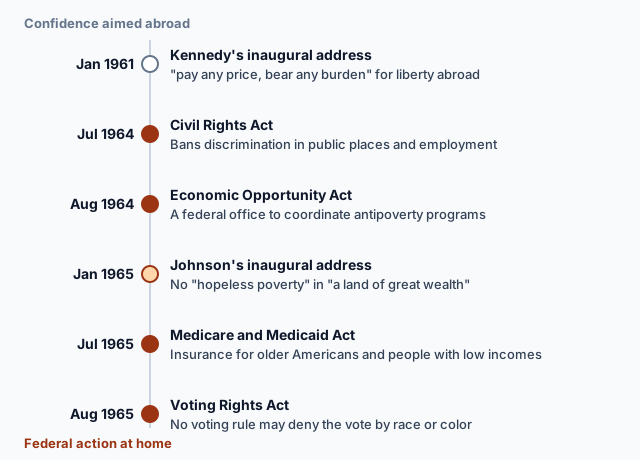
John F. Kennedy's inaugural address of January 20, 1961 was mostly about the world. He promised to "pay any price, bear any burden, meet any hardship, support any friend, oppose any foe" for liberty, and the National Archives notes that he called on the nation to combat "tyranny, poverty, disease, and war itself."
Events then gave liberals the votes. After Kennedy was assassinated in November 1963, Lyndon Johnson pressed Congress to pass the civil rights bill Kennedy had proposed. In November 1964 Johnson won the presidency in a landslide over the conservative Republican Barry Goldwater, and the large Democratic majorities elected with him passed Medicare, the Voting Rights Act and the immigration law in 1965.
Johnson called his program the Great Society. In his 1965 inaugural he named poverty and injustice the enemy ("this injustice to our people, this waste of our resources, was our real enemy") and promised to win: "But change has given us new weapons."
Sources: Kennedy's inaugural address (National Archives); Civil Rights Act (National Archives); Johnson's inaugural address (Avalon Project).
Quick check · Multiple choice
Kennedy in 1961 promised to "pay any price, bear any burden, meet any hardship, support any friend, oppose any foe" for liberty. Johnson in 1965 said of poverty and injustice, "But change has given us new weapons." What belief do the two speeches share?
2c. Laws against discrimination and poverty
The Great Society used federal laws and programs to end racial discrimination, to eliminate poverty and to take on other social problems. Four laws carried much of it.
- Civil Rights Act, July 2, 1964: banned discrimination in public places and in employment and provided for integrating schools. Title II says "All persons shall be entitled to the full and equal enjoyment of the goods, services, facilities, and privileges, advantages, and accommodations of any place of public accommodation." The National Archives calls it the most sweeping civil rights law since Reconstruction.
- Economic Opportunity Act, August 20, 1964: created the Office of Economic Opportunity to coordinate antipoverty programs, among them the Job Corps and VISTA (Volunteers in Service to America).
- Medicare and Medicaid, July 30, 1965: health insurance for older Americans (Medicare) and for people with limited income (Medicaid). Nearly 20 million people enrolled in the first three years.
- Voting Rights Act, August 6, 1965: suspended literacy tests and other rules in the states and counties where they had been used to keep African Americans from voting.
Sources: Civil Rights Act; Office of Economic Opportunity records; Medicare and Medicaid Act; Voting Rights Act (all National Archives).
Quick check · Match
Match each law to what it did.
2d. A new immigration law
From 1875 to 1965, the National Archives notes, American laws kept out almost all immigrants from Asian countries, and national origin quotas, which favored some nationalities over others, were not fully lifted until the Immigration and Nationality Act of 1965. The act did not end limits on immigration. It set overall caps for each hemisphere, the first ever for the Western Hemisphere, and within them family ties and job skills, not nationality, decided who came first.
Continuity and change is the habit of asking what stayed the same as well as what changed. What stayed the same: immigrants, as the course framework puts it, sought the political, social and economic opportunities of the United States, as earlier immigrants had. What changed: after 1965 they came from around the world, and the course framework ties the new law to rising immigration from Asia and Latin America, which it takes up in Period 9. Other laws followed. The Cuban Adjustment Act of 1966, one of the framework's optional sources, made it easier for Cuban immigrants to become permanent residents.
Source: Immigration from Asia and the Pacific (National Archives). The hemispheric caps are stated from the history of the act; the 1966 law and the later pattern are from the AP U.S. History course framework.
Quick check · Fill the statement
Complete the continuity and change notes on immigration after 1965.
Before 1965, laws going back to 1875 shut out almost all immigrants from . The 1965 law lifted national origin quotas, so the of immigrants changed, while their main reason for coming, , stayed much the same.
Part 3 Watch it done Connect the protests and the Voting Rights Act
Watch each step, then do the last one yourself.
The Voting Rights Act, signed August 6, 1965, says: "No voting qualification or prerequisite to voting, or standard, practice, or procedure shall be imposed or applied by any State or political subdivision to deny or abridge the right of any citizen of the United States to vote on account of race or color." Explain how the civil rights protests of 1964 and 1965 relate to the act.
Predict first
Before the steps, which came first, do you think?
Step 1 · Name the problem the law answered
African Americans in the South faced poll taxes, literacy tests and other rules meant to keep them from voting, and they risked violence when they tried to register. The Fifteenth Amendment had banned denying the vote by race 95 years earlier.
Why this step?
Why start with the problem and not with the law?
A law is an answer. To connect it to anything else, you first need to know what question it answered and who was asking it.
Step 2 · Put the events in order
In 1964 civil rights leaders organized many peaceful demonstrations for voting rights, and they were met with violence. In June 1964 three voting-rights workers were murdered in Mississippi. On March 7, 1965, white state troopers attacked peaceful marchers in Selma, Alabama. The National Archives says this violence gained national attention and persuaded Johnson and Congress to act. The act passed in August 1965, five months after Selma.
Your step · Decide and justify
Finish it. How do the protests relate to the Voting Rights Act?
Which evidence best supports your answer?
Part 4 Try it Arguing over the reach of government
Every Great Society law raised the same question: how far should the federal government reach? Health insurance had been argued over for twenty years. President Harry Truman asked Congress for a national health insurance plan, opponents warned of "socialized medicine," and Truman backed away from covering everyone. The debate grew hot again in 1960, when it became clear that private insurers could not give the fast-growing older population coverage it could afford. Johnson signed Medicare in 1965 beside Truman at the Truman Library in Independence, Missouri, to honor that earlier effort.
The war on poverty had its own fights. The Economic Opportunity Act called for the "maximum feasible participation of the poor" in its community action programs, and that led to open conflicts with city governments. At first the local agencies did not have to work with city or county governments, and mayors had no veto over their projects. Local anger led to a 1967 amendment that tied the agencies to state or local government.
The Great Society had opponents from the start. In 1965 the American Medical Association fought Medicare, and conservatives such as Goldwater argued that the federal government was reaching too far, an argument Topic 8.14 takes up.
Sources: Medicare and Medicaid Act (National Archives); Office of Economic Opportunity records (National Archives).
Try it · Multiple choice
The health insurance debate began under Truman but did not grow hot until 1960. What best explains the change?
Try it · Spot the error
A student writes about the debate over community action. Which line is the first to go wrong?
Part 5 Explain it Write it like a document-based answer
Nothing you type leaves this page. Check your answer against the model and each scoring point.
Free-response practice · Question 1 style
A short practice in the shape of the document-based question: three documents instead of seven, and a thesis with one body paragraph instead of a full essay.
Evaluate the extent to which the Great Society expanded the role of the federal government in American life.
Document 1. Lyndon B. Johnson, inaugural address, January 20, 1965: "In a land of great wealth, families must not live in hopeless poverty."
Document 2. Civil Rights Act of 1964, Title II: "All persons shall be entitled to the full and equal enjoyment of the goods, services, facilities, and privileges, advantages, and accommodations of any place of public accommodation."
Document 3. National Archives history of the Office of Economic Opportunity, describing the local community action agencies (CAAs) that the 1964 antipoverty law funded: "Local governments were often antagonized because the mayors had no veto of CAA projects"
Write a thesis, one sentence of historical context, and one paragraph that uses at least two documents and explains the purpose, audience, point of view or situation of one of them.
Model answer
Thesis: The Great Society greatly expanded the federal government's role, reaching into restaurants, hotels and city neighborhoods that states and local governments had controlled, and extending federal help with health care and poverty well beyond what the New Deal had begun, though that reach met resistance from southern senators and from local governments.
Context: in the early 1960s postwar affluence sat beside persistent poverty, and civil rights protests met with violence drew national attention to discrimination in the South.
Johnson's inaugural (Document 1) treats poverty amid "a land of great wealth" as a national failure. As a newly elected president speaking to the whole nation, he was setting out goals, so the speech shows what the administration wanted more than what it achieved. The laws turned those goals into federal rules. The Civil Rights Act (Document 2) gave "All persons" equal use of places of public accommodation, overriding segregation laws that states had written. The reach had limits, though. The antipoverty programs went around city halls, and Document 3 shows that mayors, who had no veto over community action projects, resented it; their anger led Congress in 1967 to tie the agencies to state or local government.
Score your own answer. This is a self-check, not a grade. Tick each point your answer makes.
Part 6 Check yourself The laws of 1964 and 1965
The case questions use the table. The others mix the ideas from the whole lesson.
Dates and descriptions are from the National Archives. Sources: Civil Rights Act; Office of Economic Opportunity records; Medicare and Medicaid Act; Voting Rights Act; Immigration from Asia and the Pacific.
| Law | Signed | What it did |
|---|---|---|
| Civil Rights Act | July 2, 1964 | Banned discrimination in public places and employment; provided for integrating schools |
| Economic Opportunity Act | August 20, 1964 | Created the Office of Economic Opportunity to coordinate antipoverty programs |
| Medicare and Medicaid Act | July 30, 1965 | Health insurance for older Americans and for people with limited income |
| Voting Rights Act | August 6, 1965 | Suspended literacy tests and other voting rules where they were used to deny the vote by race |
| Immigration and Nationality Act | 1965 | Fully lifted national origin quotas on immigration |
Case question 1 · Multiple choice
What pattern does the table show in how the Great Society pursued its goals?
Case question 2 · Multiple choice
The last row of the table relates most directly to which later development?
The rest stand on their own and do not use the case.
Check yourself · Put it in order
Put these events in the order they happened, earliest first.
Check yourself · Select all
Which two were aimed most directly at poverty? Select two.
Select 2 answers, then check.
Part 7 Keep it Bring back earlier ideas
This lesson stands on the early civil rights victories of Topic 8.6 and the debates over the Vietnam War in Topic 8.8.
Bring it back · Multiple choice
Before the Great Society, which measures did the federal government use to promote greater racial equality?
Bring it back · Fill the statement
Read the situation, then complete the sentences.
Suppose a senator complains that the president is sending more troops to Vietnam without asking Congress for a declaration of war. The senator is raising a question about the power of the branch in policy.
In three lines
- Advocates showed that poverty persisted in an affluent country, and liberals, confident in government at home and anti-communist abroad, made it a national cause.
- The Great Society used federal laws and programs against discrimination and poverty, and each one set off debate over how far federal power should reach.
- The 1965 immigration law ended national origin quotas: immigrants still came for opportunity, but now from around the world.
Exam strategy for this topic
- Section I Part A, Multiple Choice: 55 questions in 55 minutes.
- Section I Part B, Short Answer: 3 questions in 40 minutes.
- Section II, Document-Based Question and Long Essay: 2 questions in 100 minutes.
- This lesson's Explain it is shaped like free-response question 1, Document-based.
When a question asks how one development relates to another, name the relation (cause, effect, or continuity), and give the event that shows it, such as Selma before the Voting Rights Act.
Questions students ask
Was the Great Society the same as the New Deal?
Both used federal power on social problems, and Johnson signed Medicare beside Truman to honor an earlier Democratic effort. The Great Society also took on racial discrimination directly, through the civil rights and voting laws, which the New Deal had not.
What is the difference between Medicare and Medicaid?
Medicare is health insurance for older Americans. Medicaid is health insurance for people with limited income, paid for by the states and the federal government together.
Did Kennedy start the Great Society?
No. Johnson led it after Kennedy's assassination in November 1963, though Kennedy had proposed the civil rights bill that became the Civil Rights Act of 1964.
Did the 1965 immigration law end limits on immigration?
No. It ended the national origin quotas that ranked some nationalities above others, but it kept overall limits, including the first cap on immigration from the Western Hemisphere. Within those limits, family ties and job skills decided who came first.
Where can I read these documents in full?
Each excerpt links to its full text at the National Archives or the Avalon Project at Yale Law School, the primary-source collections this lesson was checked against.
Course alignment, for teachers
AP U.S. History topic 8.9, Unit 8: Period 8: 1945–1980.
- Skill 5.B: Explain how a historical development or process relates to another historical development or process.
This lesson maps all 4 essential knowledge statements of the topic, and the 2 learning objectives with none of their own, to the part that teaches each one: 6 are checked by a scored question. The map is in the lesson file.