Unit 8 · Topic 8.3 · about 30 minutes · 7 parts · 13 scored checks, 4 of them multiple choice
AP U.S. History 8.3: The Red Scare
Unit 8: 10 to 17% of the multiple-choice section
What you'll be able to do
- Explain the causes and effects of the Red Scare after World War II, and read its documents for their point of view, purpose, historical situation and audience.
Key vocabulary
| Term | What it means | The exam trap |
|---|---|---|
| Red Scare | A wave of fear that Communists had worked their way into American government and institutions; the second one followed World War II. | There were two Red Scares; the first followed World War I, so check which one a question means. |
| Security risk | In the security programs of the 1950s, a person judged too likely to reveal secrets, on grounds that could include character and associations as well as loyalty. | A security risk was not necessarily accused of disloyalty; the Oppenheimer majority said disloyalty was only one basis. |
| Censure | A formal condemnation of a member by the rest of a legislature. | Censure is a condemnation, not expulsion; it does not by itself remove a member. |
| Bipartisan | Supported by both major political parties. | Bipartisan support for containment abroad did not mean agreement about methods at home. |
 Tap to open the picture full size
Part 1 Think first A list of 205 names
Commit to a guess first. Being wrong now makes the right idea stick better.
Predict first
On February 9, 1950, Joseph McCarthy, a Republican senator from Wisconsin, claimed he had a list of 205 State Department employees who were Communists. He offered little proof. What do you think happened to McCarthy over the next four years?
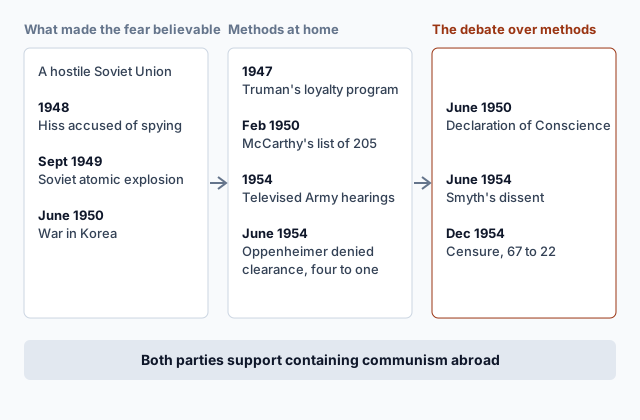
In short. Cold War events abroad and spy cases at home spread fear of Communist influence inside the United States, and Americans fought bitterly over the methods used to expose suspected Communists even as both parties supported containing communism abroad.
- A hostile Soviet Union, its atomic explosion of 1949, the Communist victory in China, war in Korea and spy cases such as Alger Hiss's made fears of Communist influence spread easily.
- The methods began with Truman's loyalty program of 1947 and HUAC, and grew with Senator Joseph McCarthy's charges and security reviews such as Oppenheimer's; critics attacked them, including members of McCarthy's own party.
- Both parties supported containment abroad, while the fight over methods at home had a party edge yet split the Republicans: all 22 votes against McCarthy's censure in 1954 came from his own party.
Part 2 Learn it Fear at home, and the fight over methods
2a. Why fear spread
The Red Scare after World War II was a wave of fear that Communists, often called Reds, had worked their way into American government and institutions. It was the country's second; the first followed World War I.
Events abroad made the fear believable. The National Archives sums up the early Cold War: a hostile Soviet Union, the Communist victory in China (which many Americans called the loss of China) and war in Korea. On September 23, 1949, President Truman announced: "We have evidence that within recent weeks an atomic explosion occurred in the U. S. S. R." On June 25, 1950, war broke out in Korea.
Spy cases at home made it more believable still. In 1948 Alger Hiss, a former high-ranking State Department official, was accused of passing secret information to a member of the Communist Party, and he was later convicted of perjury. President Eisenhower allowed the executions of Julius and Ethel Rosenberg for spying.
"In this politically charged atmosphere, fears of Communist influence over American institutions spread easily." The methods for exposing suspected Communists began before McCarthy. Truman's Executive Order 9835 of March 21, 1947, set up a loyalty program requiring the investigation of all existing and prospective federal employees, and the House Un-American Activities Committee (HUAC) investigated groups it called Communist fronts.
Sources: Truman's statement (Avalon Project); Censure of McCarthy (National Archives); Hiss grand jury records (National Archives); Eisenhower and McCarthy (Prologue); Prelude to McCarthyism (Prologue).
Quick check · Sort it
Tap each development, then say what part it played in the Red Scare.
An event that made the fear believable
A method used to expose suspected Communists
2b. McCarthy's rise and fall
McCarthy's claim of February 1950 offered little proof, but it gave him great notoriety. Not every Republican went along. In June 1950 Senator Margaret Chase Smith of Maine and six fellow Republicans issued a Declaration of Conscience, saying that McCarthy's tactics had left the Senate "debased to the level of a forum for hate and character assassination."
McCarthy kept strong support in the opinion polls, and his attacks helped defeat some Democratic opponents. After Republicans took control of the White House and Congress in 1953, he chaired the Senate Committee on Government Operations and its Subcommittee on Investigations, and went on accusing government agencies, though he was now attacking a Republican administration.
In 1954 his investigation of security threats in the Army was televised. The public could watch his bullying of witnesses, and it turned public opinion against him. Republican Senators Ralph Flanders of Vermont, Arthur Watkins of Utah and Smith led the effort to discipline him. On December 2, 1954, the Senate voted to censure him, a formal condemnation by his colleagues.
Quick check · Fill the statement
Complete the account of McCarthy's fall.
In 1954 McCarthy's investigation of the Army was , and his bullying of witnesses turned public opinion against him. Senators from his own party led the effort that ended in his censure that December.
2c. Methods on trial: the Oppenheimer case
Security reviews raised the question McCarthy's charges did: what counts as evidence that a person is a danger? In 1954 a security board heard the case of J. Robert Oppenheimer, and on June 29 the Commission voted four to one to deny him access to restricted data.
The majority put his character first. In 1943, it said, "he told Colonel Pash a fabrication of lies" about an attempt by a Soviet agent to get information on the atom bomb. Pash was a Military Intelligence officer guarding the project, and Oppenheimer admitted under oath in 1954 that the story was false. "He has falsified in matters wherein he was charged with grave responsibilities in the national interest." The majority added that "Dr. Oppenheimer's early Communist associations are not in themselves a controlling reason for our decision"; what counted was his continuing contact with Communists, including meetings in December 1953 with Haakon Chevalier, the go-between in the 1943 approach.
Commissioner Smyth dissented. He found Oppenheimer "completely loyal and I do not believe he is a security risk." Oppenheimer had been watched for years, "his movements watched, his conversations noted, his mail and telephone calls checked," and "there is no indication in the entire record that Dr. Oppenheimer has ever divulged any secret information."
The two sides disagreed about the method: whether lies to security officers and continuing associations could disqualify a man whose record showed no secret revealed.
Source: AEC decision (Avalon Project).
Quick check · Match
Match each passage from the Commission's decision of June 29, 1954, to the argument it makes.
2d. Agreed abroad, divided at home
On containing communism abroad, the two parties largely agreed. Truman, a Democrat, asked for aid to Greece and Turkey in 1947, and the National Archives notes: "The sanction of aid to Greece and Turkey by a Republican Congress indicated the beginning of a long and enduring bipartisan Cold War foreign policy." Congress's approval of the Marshall Plan carried the same bipartisanship forward. Bipartisan means supported by both major parties.
At home the fight over methods had a strong party edge. McCarthy, a Republican, attacked a Democratic administration, and his attacks helped defeat some Democratic opponents. But the fight also cut across party lines. McCarthy kept attacking government agencies after his own party took the White House in 1953. Seven Republicans signed the Declaration of Conscience in 1950, Republicans led the effort to censure him, and when the Senate voted 67 to 22 on December 2, 1954, all 22 votes against censure came from Republicans. His own party was divided over him.
Sources: Truman Doctrine (National Archives); Marshall Plan (National Archives); Censure of McCarthy (National Archives); Eisenhower and McCarthy (Prologue).
Quick check · Multiple choice
Which statement best describes the politics of the Red Scare after World War II?
Part 3 Watch it done Source the Senate's censure of McCarthy
Watch each step, then do the last one yourself.
On December 2, 1954, the Senate resolved that McCarthy had "repeatedly abused the subcommittee and its members who were trying to carry out assigned duties, thereby obstructing the constitutional processes of the Senate," and that his conduct "is contrary to senatorial traditions and is hereby condemned." Explain what the resolution's situation and purpose show about what the Senate was condemning.
Predict first
Before the steps, what do you think the Senate was condemning?
Step 1 · Place it in time
The resolution came months after McCarthy's televised Army investigation, when his bullying of witnesses had turned public opinion against him. Republicans had controlled Congress since 1953.
Why this step?
Why read exactly what a resolution charges, not just that it was passed?
A vote tells you the senators agreed on something. The charges tell you what they agreed on, and that can be narrower than the headline.
Step 2 · Name the authors and the charges
Republican Senators Flanders, Watkins and Smith led the effort, so the authors included McCarthy's own party colleagues. Read the charges: the first says he failed to cooperate with a Senate subcommittee and abused it and its members; the second condemns his attacks on the committee that studied the censure charges.
Your step · Decide and justify
Finish it. What does the resolution show the Senate was condemning?
Which evidence best supports your answer?
Part 4 Try it Read the Declaration of Conscience
In June 1950, four months after McCarthy's claim about a list of 205 names, Senator Margaret Chase Smith of Maine and six fellow Republicans issued a Declaration of Conscience. The National Archives sums it up: because of McCarthy's tactics, they said, the Senate had been "debased to the level of a forum for hate and character assassination."
Try it · Multiple choice
Why is the authors' point of view significant in reading the Declaration of Conscience?
Try it · Spot the error
A student writes a sourcing paragraph on the Declaration of Conscience. Which line is the first to go wrong?
Part 5 Explain it Write it like a document-based answer
Nothing you type leaves this page. Check your answer against the model and each scoring point.
Free-response practice · Question 1 style
A short practice in the shape of the document-based question: three documents instead of seven, and a thesis with one body paragraph instead of a full essay.
Evaluate the extent to which Americans agreed about how to fight communism between 1947 and 1954.
Document 1. President Harry Truman, message to a joint session of Congress, March 12, 1947: "I believe that it must be the policy of the United States to support free peoples who are resisting attempted subjugation by armed minorities or by outside pressures."
Document 2. Majority opinion of the Atomic Energy Commission, denying J. Robert Oppenheimer access to restricted data, June 29, 1954: "He has falsified in matters wherein he was charged with grave responsibilities in the national interest." And: "Substantial defects of character and imprudent and dangerous associations, particularly with known subversives who place the interests of foreign powers above those of the United States, are also reasons for disqualification."
Document 3. Commissioner Smyth, dissenting from the same decision, June 29, 1954: Oppenheimer is "completely loyal and I do not believe he is a security risk," and "there is no indication in the entire record that Dr. Oppenheimer has ever divulged any secret information."
Write a thesis, one sentence of historical context, and one paragraph that uses at least two documents and explains the purpose, audience, point of view or situation of one of them.
Model answer
Thesis: Between 1947 and 1954 Americans largely agreed on containing communism abroad, but they disagreed sharply about the methods used to expose suspected Communists at home.
Context: the Soviet atomic explosion announced in 1949, the Communist victory in China, war in Korea and spy cases such as Alger Hiss's made fears of Communist influence spread easily.
Truman's 1947 pledge to "support free peoples" (Document 1) was approved by a Republican Congress, which the National Archives calls the beginning of a bipartisan Cold War foreign policy. At home there was no such agreement. In 1954 the Atomic Energy Commission's majority held that defects of character, above all Oppenheimer's admitted lies to a Military Intelligence officer in 1943, together with "dangerous associations," could disqualify a man even without proof of disloyalty (Document 2). Smyth, the one commissioner who voted the other way, answered that the record showed no secret ever divulged (Document 3). As a commissioner dissenting from his own agency's decision, Smyth shows that the methods were contested even inside the government that used them. The goal was shared; the means were not.
Score your own answer. This is a self-check, not a grade. Tick each point your answer makes.
Part 6 Check yourself One decision, two answers
The case questions use the two excerpts. The others mix the ideas from the whole lesson.
Both excerpts come from the Atomic Energy Commission's decision of June 29, 1954, on J. Robert Oppenheimer. Source: Atomic Energy Commission decision and opinions (Avalon Project).
| Opinion | Excerpt |
|---|---|
| Majority of the Commission (four votes) | "Substantial defects of character and imprudent and dangerous associations, particularly with known subversives who place the interests of foreign powers above those of the United States, are also reasons for disqualification." |
| Commissioner Smyth, dissenting (one vote) | "there is no indication in the entire record that Dr. Oppenheimer has ever divulged any secret information" |
Case question 1 · Multiple choice
On what do the two excerpts disagree most directly?
Case question 2 · Select all
Which two statements do the excerpts support? Select two.
Select 2 answers, then check.
The rest stand on their own and do not use the case.
Check yourself · Put it in order
Put these events in the order they happened, earliest first.
Check yourself · Fill the statement
Complete the sentences about the politics of the Red Scare.
A Republican Congress approved a Democratic president's aid to Greece and Turkey, the start of a Cold War foreign policy. Americans still argued fiercely over the used to expose suspected Communists at home.
Part 7 Keep it Bring back earlier ideas
This lesson stands on Cold War policy from Topic 8.2 and on the first Red Scare, after World War I, from Topic 7.6.
Bring it back · Multiple choice
Which development best shows the Cold War swinging toward coexistence between the United States and the Soviet Union?
Bring it back · Fill the statement
Complete the sentences about the first Red Scare.
During World War I, official restrictions on grew, as anxiety about radicalism led to a Red Scare and to attacks on labor activism and culture.
In three lines
- Events abroad, from the Soviet atomic explosion of 1949 to war in Korea, and spy cases at home made fears of Communist influence spread easily.
- Methods from Truman's loyalty program to McCarthy's charges and the Oppenheimer hearing were contested, and McCarthy's own party split over his censure in 1954.
- Americans debated the methods of exposing suspected Communists at home even as both parties supported containing communism abroad.
Exam strategy for this topic
- Section I Part A, Multiple Choice: 55 questions in 55 minutes.
- Section I Part B, Short Answer: 3 questions in 40 minutes.
- Section II, Document-Based Question and Long Essay: 2 questions in 100 minutes.
- This lesson's Explain it is shaped like free-response question 1, Document-based.
When a question asks for the causes of the Red Scare, start with the events that made the fear believable, abroad and in spy cases at home, then explain the methods (Truman's loyalty program, HUAC, McCarthy, security hearings) and the debate over them; never let McCarthy stand in for the whole story.
Questions students ask
Why is it called the Red Scare?
Red was a common name for Communists. The Red Scare after World War II was the second such wave of fear; the first came during and after World War I.
Did McCarthy ever prove his claims?
The National Archives notes that he offered little proof for his February 1950 claim of a list of 205 Communists in the State Department, yet the claims gave him great notoriety and he kept strong support in the polls until 1954.
What happened to McCarthy after the censure?
A censure is a formal condemnation, not an expulsion; the resolution condemned his conduct and did not remove him. His standing had already fallen after his televised investigation of the Army in 1954 turned public opinion against him.
Who was J. Robert Oppenheimer?
A physicist whom the government had trusted with high positions since 1942. In 1954 the Atomic Energy Commission voted four to one to deny him access to restricted data, and Commissioner Smyth dissented.
Where can I read these documents in full?
Each excerpt links to its full text at the National Archives or the Avalon Project at Yale Law School, the primary-source collections this lesson was checked against.
Course alignment, for teachers
AP U.S. History topic 8.3, Unit 8: Period 8: 1945–1980.
- Skill 2.B: Explain the point of view, purpose, historical situation, and/or audience of a source.
This lesson maps the one essential knowledge statement of the topic, and the one learning objective with none of its own, to the part that teaches each one: 2 are checked by a scored question. The map is in the lesson file.