Unit 4 · Topic 4.4 · about 30 minutes · 7 parts · 11 scored checks, 4 of them multiple choice, plus 2 from earlier lessons
AP U.S. History 4.4: America on the World Stage
Unit 4: 10 to 17% of the multiple-choice section
What you'll be able to do
- Explain how and why American foreign policy developed and expanded over time, and read its documents for their point of view, purpose, historical situation and audience.
Key vocabulary
| Term | What it means | The exam trap |
|---|---|---|
| Treaty of Ghent | The treaty, signed December 24, 1814, that ended the War of 1812. | Ending a war is not the same as one side winning it. |
| Monroe Doctrine | The statement of American policy toward Europe and the Western Hemisphere in Monroe's 1823 message to Congress. | It was a statement of policy, not a treaty or a law. |
| Sphere of influence | A region where one power claims a special right to shape events, short of ruling it. | Claiming influence over a region is not the same as governing it. |
| Indian removal | The federal policy of moving American Indian nations from east of the Mississippi to land in the west. | Read who agreed to a removal treaty and who did not. |
 Tap to open the picture full size
Part 1 Think first A warning from a young country
Commit to a guess first. Being wrong now makes the right idea stick better.
Predict first
In August 1814 British troops burned the Capitol and the President's house in Washington. Nine years later, on December 2, 1823, President James Monroe told Congress that "the American continents, by the free and independent condition which they have assumed and maintain, are henceforth not to be considered as subjects for future colonization by any European powers." Why do you think the United States made that claim?
In short. From the War of 1812 to the 1830s, the United States, still struggling to make its own place among the world's powers, used war, treaties, the Monroe Doctrine and the removal of American Indians to claim land across North America, protect its trade and keep European powers from new colonies in the Western Hemisphere.
- The War of 1812 grew out of British seizures of American sailors and limits on American trade; the Treaty of Ghent ended it in December 1814 with each side returning what it had taken, and the United States gained influence as a foreign power.
- Treaties with Britain in 1818 and Spain in 1819 set a northern border along the 49th parallel and gave the United States Florida, after an American army had entered it, and a boundary line running to the Pacific.
- The Monroe Doctrine of 1823 warned Europe against new colonies in the Americas, and the removal of American Indian nations in the 1830s, which Jackson defended as securing the southwestern frontier, opened their land to settlement.
Part 2 Learn it Claiming a place in the world
2a. Trade, sailors and the War of 1812
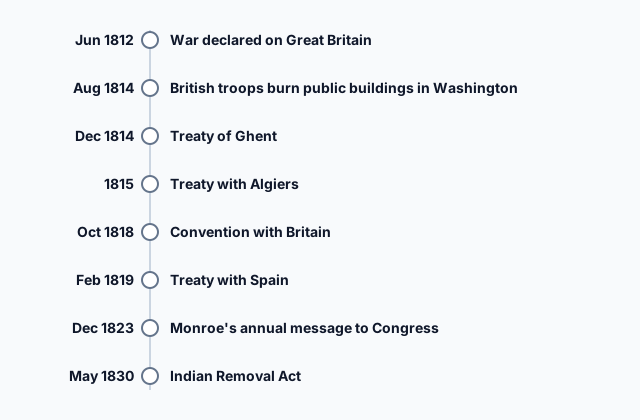
In the early 1800s Britain, at war in Europe, blockaded neutral countries such as the United States and took American sailors from their ships, forcing them into the British navy. Taking sailors this way was called impressment. On June 18, 1812, Congress declared "That war be and the same is hereby declared to exist" with Great Britain. The war went badly in places: in August 1814 British troops burned the Capitol and the President's house. The Treaty of Ghent, signed December 24, 1814, ended the war, and each side returned the territory it had taken. The National Archives' judgment: "America, in turn, gained influence as a foreign power."
Trade at sea came next. Algiers, one of the Barbary states of North Africa, had demanded payments called tribute and had captured American ships and sailors. In 1815, with an American squadron off its coast, Algiers signed a treaty promising that "no tribute either as biennial presents, or under any other form or name whatever, shall ever be required by the Dey and Regency of Algiers from the United States of America on any pretext whatever," and gave American commerce the terms of the most favored nations.
Sources: Treaty of Ghent (National Archives); Declaration of war (Avalon Project); Treaty with Algiers (Avalon Project).
Quick check · Fill the statement
Complete the sentences about American trade at sea.
Before 1812 Britain seized American sailors and forced them into its navy, a practice called . In 1815, with an American squadron off its coast, Algiers promised that no would ever again be required from the United States.
2b. Lines across the continent
After the war the United States used diplomacy, backed at times by force, to claim land across North America.
In the Convention of 1818 with Britain, signed at London on October 20, the northern border was set along the 49th parallel from the Lake of the Woods to the Rocky Mountains, which the treaty calls the Stony Mountains. The country "Westward of the Stony Mountains," later called Oregon, would "be free and open, for the term of ten Years from the date of the Signature of the present Convention, to the Vessels, Citizens, and Subjects of the Two Powers," with neither side giving up its claim. An 1815 agreement regulating commerce between the two countries was renewed for ten years.
In 1818 Andrew Jackson led troops into Spanish Florida. On February 22, 1819, Secretary of State John Quincy Adams signed a treaty with Spain: "His Catholic Majesty cedes to the United States, in full property and sovereignty, all the territories which belong to him, situated to the eastward of the Mississippi, known by the name of East and West Florida." (His Catholic Majesty is Spain's king.) The United States promised satisfaction for injuries from "the late operations of the American Army in Florida." The treaty also drew a boundary that climbed to latitude 42 north and ran along it "to the South Sea," the Pacific.
Sources: Convention of 1818 (Avalon Project); Treaty with Spain, 1819 (Avalon Project); The Two-Party System (National Archives).
Quick check · Multiple choice
What did the Convention of 1818 with Britain and the 1819 treaty with Spain have in common?
2c. The Monroe Doctrine
Monroe's annual message of December 2, 1823 answered two different problems.
The first was the northwest coast of the continent. Russia had proposed talks with the United States, and with Britain, over each nation's rights there. "In the discussions to which this interest has given rise," Monroe asserted that "the American continents, by the free and independent condition which they have assumed and maintain, are henceforth not to be considered as subjects for future colonization by any European powers."
The second was Spain. Several of its American colonies had declared independence, and the United States had recognized them. The allied powers, a group of European powers whose governments, Monroe said, differed from America's, had "interposed by force in the internal concerns of Spain." Monroe warned that "The political system of the allied powers is essentially different in this respect from that of America," and that any attempt "to extend their system to any portion of this hemisphere" was "dangerous to our peace and safety." He also promised: "With the existing colonies or dependencies of any European power we have not interfered and shall not interfere." And: "In the wars of the European powers in matters relating to themselves we have never taken any part, nor does it comport with our policy to do so." (Comport with means fit.)
These passages, later called the Monroe Doctrine, were a statement of policy, not a treaty.
Source: Monroe Doctrine (Avalon Project).
Quick check · Match
Match each phrase from Monroe's 1823 message to the policy it states.
2d. Removal as a means of control
Control of the continent was also pursued at home, against American Indian nations. The Indian Removal Act of May 28, 1830 authorized the president to negotiate removal treaties with the tribes living east of the Mississippi River. In his annual message of December 6, 1830, Andrew Jackson told Congress that removal would "incalculably strengthen the southwestern frontier and render the adjacent States strong enough to repel future invasions without remote aid." He presented removal as strengthening the frontier against future invasions and as opening land to white settlement.
The Treaty of New Echota, ratified in 1836, called for the removal of the Cherokees. Many Cherokees opposed it, and when they refused to leave, Major General Winfield Scott was ordered to remove them, with 3,000 troops. During the fall and winter of 1838 to 1839 the Cherokees were forcibly moved to the Indian Territory, and about 4,000 of 16,000 died on the way. Removal opened some 25 million acres of eastern land to white settlement.
Source: Jackson's message on Indian removal (National Archives).
Quick check · Sort it
Each card is a step the United States took to extend its control. Tap a card, then the means it used. Use diplomacy backed by force for a treaty signed while American forces were present or had just been used against the other side. Put a step under removal whenever its aim was to move American Indian nations, whatever tools carried it out.
Diplomacy
Military action
Diplomacy backed by force
Removal of American Indians
Part 3 Watch it done Source the Monroe Doctrine
Watch each step, then do the last one yourself.
In his message of December 2, 1823, Monroe told Congress that "we should consider any attempt on their part to extend their system to any portion of this hemisphere as dangerous to our peace and safety." Explain how the historical situation shaped this warning.
Predict first
Before the steps, who do you think the warning was really aimed at?
Step 1 · Place it in time
Spain's former colonies had declared independence, and the United States had recognized them. In the same message Monroe noted that Europe's allied powers had already acted by force inside Spain.
Why this step?
Why look at what had just happened in Spain?
A warning answers a threat. If the allies had used force inside Spain, the obvious next question was whether they would use it in Spain's former colonies too.
Step 2 · Name the author and the audience
Monroe wrote it as president, in his annual message to Congress. But a statement about what Europe may not do is meant to be heard in Europe's capitals as much as in Washington.
Your step · Decide and justify
Finish it. How does the historical situation shape Monroe's warning?
Which evidence best supports your answer?
Part 4 Try it A Secretary of State becomes president
John Quincy Adams had served as Monroe's Secretary of State and signed the 1819 treaty with Spain. On March 4, 1825, in his inaugural address, he listed what the eight years of Monroe's presidency had achieved: "the Floridas have been peaceably acquired, and our boundary has been extended to the Pacific Ocean; the independence of the southern nations of this hemisphere has been recognized, and recommended by example and by counsel to the potentates of Europe."
Try it · Multiple choice
Which fact about the source matters most when you judge Adams's claim that the Floridas were peaceably acquired?
Try it · Spot the error
A student writes a sourcing paragraph on the passage from Adams's inaugural address. Which line is the first to go wrong?
Part 5 Explain it Write it like a document-based answer
Nothing you type leaves this page. Check your answer against the model and each scoring point.
Free-response practice · Question 1 style
A short practice in the shape of the document-based question: three documents instead of seven, and a thesis with one body paragraph instead of a full essay.
Evaluate the extent to which the United States relied on diplomacy rather than force to extend its control in North America and the Western Hemisphere between 1815 and 1839.
Document 1. Treaty between the United States and Spain, signed February 22, 1819: "His Catholic Majesty cedes to the United States, in full property and sovereignty, all the territories which belong to him, situated to the eastward of the Mississippi, known by the name of East and West Florida."
Document 2. President James Monroe, message to Congress, December 2, 1823: "we should consider any attempt on their part to extend their system to any portion of this hemisphere as dangerous to our peace and safety."
Document 3. President Andrew Jackson, message to Congress, December 6, 1830, on removing American Indian nations from east of the Mississippi: removal would "incalculably strengthen the southwestern frontier and render the adjacent States strong enough to repel future invasions without remote aid."
Write a thesis, one sentence of historical context, and one paragraph that uses at least two documents and explains the purpose, audience, point of view or situation of one of them.
Model answer
Thesis: Between 1815 and 1839 the United States relied largely on diplomacy with the powers of Europe, though force often stood behind it, and it used force outright against American Indian nations, so the choice of means depended on how strong the other side was.
Context: the War of 1812 had shown that the young country could not protect its sailors or its capital, and it emerged wanting secure borders and safe trade.
With Spain and the European powers the tools were treaties and statements of policy, backed by force when it was at hand. Spain ceded Florida by treaty in 1819 (Document 1), but only after Jackson's troops had entered Spanish Florida the year before, and in 1823 Monroe warned the allied monarchies that extending their system to the hemisphere would be "dangerous to our peace and safety" (Document 2), a warning with no army named behind it. Within the continent the means changed. Jackson's 1830 message (Document 3) presents removal as defense against "future invasions," but Jackson was the president carrying out the policy and wrote to justify it to Congress, so his message describes the goal and not the cost; when the Cherokees refused to leave, federal troops moved them by force, and about 4,000 of 16,000 died.
Score your own answer. This is a self-check, not a grade. Tick each point your answer makes.
Part 6 Check yourself Keeping claims open, keeping Europe out
The case questions use the two excerpts. The others mix the ideas from the whole lesson.
The first excerpt is from the Convention of 1818 with Britain, the second from Monroe's message of 1823. Sources: Convention of 1818 (Avalon Project); Monroe Doctrine (Avalon Project).
| Document | Excerpt |
|---|---|
| Convention of 1818, Article III, on the country west of the Rocky Mountains | It shall "be free and open, for the term of ten Years from the date of the Signature of the present Convention, to the Vessels, Citizens, and Subjects of the Two Powers," and "this Agreement is not to be construed to the Prejudice of any Claim, which either of the Two High Contracting Parties may have to any part of the said Country." |
| Monroe's message to Congress, December 2, 1823 | "the American continents, by the free and independent condition which they have assumed and maintain, are henceforth not to be considered as subjects for future colonization by any European powers" |
Case question 1 · Multiple choice
Read together, the two excerpts show the United States doing what?
Case question 2 · Multiple choice
Which development best explains why Monroe made the claim in the second excerpt in 1823?
The rest stand on their own and do not use the case.
Check yourself · Put it in order
Put these events in the order they happened, earliest first.
Check yourself · Select all
Which two show the United States working to promote its foreign trade? Select two.
Select 2 answers, then check.
Part 7 Keep it Bring back earlier ideas
This lesson stands on the Louisiana Purchase from Topic 4.2 and the Missouri Compromise from Topic 4.3.
From 4.2 The Rise of Political Parties and the Era of Jefferson · Multiple choice
After the Louisiana Purchase, which approach did the federal government take to extend its influence over the new land?
From 4.3 Politics and Regional Interests · Match
Match each part of the Missouri debate to what it did or would have done.
In three lines
- Struggling for an independent place among the powers, the United States fought Britain in 1812 and protected its trade at sea, as in the 1815 treaty with Algiers.
- Treaties with Britain in 1818 and Spain in 1819 extended American claims across the continent, and the Monroe Doctrine warned Europe against new colonies.
- Removal of American Indian nations, enforced by troops, was another means of controlling the continent.
Exam strategy for this topic
- Section I Part A, Multiple Choice: 55 questions in 55 minutes.
- Section I Part B, Short Answer: 3 questions in 40 minutes.
- Section II, Document-Based Question and Long Essay: 2 questions in 100 minutes.
- This lesson's Explain it is shaped like free-response question 1, Document-based.
When a question asks why a foreign policy was made, name the threat or opportunity of that moment, then quote the words in the document that answer it.
Questions students ask
Who won the War of 1812?
The Treaty of Ghent ended the war in December 1814, and each side returned the territory it had taken. The National Archives sums up the result for the United States: it gained influence as a foreign power.
Did the Monroe Doctrine have an army behind it?
No. Monroe's message named none; it stated a policy. The National Archives notes that the doctrine was conceived for the concerns of the moment, and it was first invoked with diplomatic and military pressure in 1865.
What did the United States gain from Spain in 1819?
Spain ceded East and West Florida, and the two countries drew a boundary west of the Mississippi that ran to the Pacific. John Quincy Adams signed it as Secretary of State in 1819, the year after Andrew Jackson had led troops into Spanish Florida.
Why is Indian removal in a lesson on foreign policy?
The government sought control over the continent by several means, and removal was one. Jackson defended it to Congress as making the southwestern frontier strong enough to repel future invasions.
Where can I read these documents in full?
Each excerpt links to its full text at the National Archives or the Avalon Project at Yale Law School, the primary-source collections this lesson was checked against.
Course alignment, for teachers
AP U.S. History topic 4.4, Unit 4: Period 4: 1800–1848.
- Skill 2.B: Explain the point of view, purpose, historical situation, and/or audience of a source.
This lesson maps all 2 essential knowledge statements of the topic, and the one learning objective with none of its own, to the part that teaches each one: 3 are checked by a scored question. The map is in the lesson file.