Unit 5 · Topic 5.2 · about 30 minutes · 7 parts · 13 scored checks, 5 of them multiple choice
AP U.S. History 5.2: Manifest Destiny
Unit 5: 10 to 17% of the multiple-choice section
What you'll be able to do
- Explain the causes and effects of westward expansion from 1844 to 1877: why settlers went west, how advocates argued for annexing land, what conflict it provoked, how new laws boosted migration, and why the United States sought ties with Asia.
Key vocabulary
| Term | What it means | The exam trap |
|---|---|---|
| Manifest Destiny | The belief that the United States was plainly meant to expand across North America to the Pacific Ocean. | It names an argument made by advocates of annexing land; it does not describe what every settler believed. |
| Annexation | Adding a territory to a country and bringing it under that country's government. | Annexation can happen by treaty, by vote or after war; the word alone does not tell you how. |
| Homestead | A farm a settler claimed from public land by living on it and working it. | A homestead claim was a promise of land after years of work, not land handed over on the first day. |
| Public land | Land owned by the federal government, which Congress could sell, grant to companies or give to settlers. | Public land in the West was often land American Indians still lived on and claimed. |
| Transcontinental railroad | A railroad line linking the eastern rail network to the Pacific coast, finished in 1869. | Its two halves were built by different companies from opposite ends, so it had more than one starting point. |
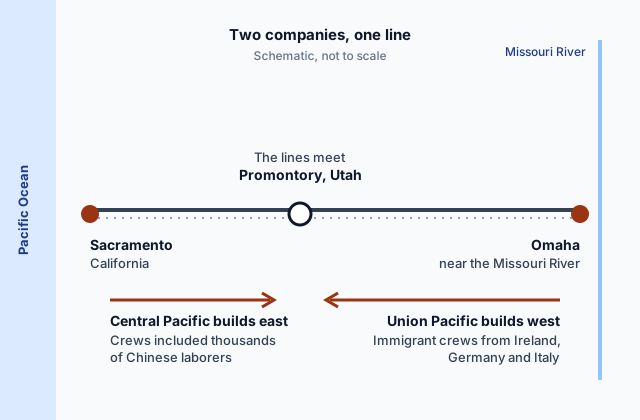 Tap to open the picture full size
Part 1 Think first From ocean to ocean?
Commit to a guess first. Being wrong now makes the right idea stick better.
Predict first
On March 4, 1845, President James K. Polk began his inaugural address by admitting his nerves, asking "what ought not to be the apprehensions of one so much younger and less endowed now that our domain extends from ocean to ocean." That day Great Britain also claimed Oregon, no treaty had drawn a border there, and California belonged to Mexico. What do you think his words about the nation's domain were mainly doing?
In short. From 1844 to 1877, Americans moved west for land, minerals, opportunity and religious freedom, while advocates of Manifest Destiny argued that the nation's superior institutions should spread to the Pacific, a push that brought competition and violent conflict and that Congress sped up with new laws in 1862.
- Settlers went west for natural and mineral resources, for economic opportunity, and in some cases for religious refuge.
- Advocates of annexing western lands argued that Manifest Destiny and the superiority of American institutions compelled expansion to the Pacific; expansion frequently provoked competition with other nations and violent conflict with American Indians.
- The Homestead Act and the Pacific Railway Act of 1862 boosted migration during and after the Civil War, and interest in trade drew the United States toward Asia, as in the 1854 Treaty of Kanagawa with Japan.
Part 2 Learn it Westward expansion, 1844 to 1877
2a. Why people went west
Between the 1840s and the 1870s, Americans moved west in large numbers. Most of them had concrete reasons.
Natural and mineral resources. Farmland, forests and minerals drew settlers and companies. Gold pulled miners again and again. The National Archives describes one rush. An 1868 treaty had recognized the Black Hills as part of the Great Sioux Reservation, set aside for the Sioux alone. Yet after an Army expedition with miners entered the Black Hills in 1874, "Once gold was found in the Black Hills, miners were soon moving onto the Sioux hunting grounds and demanding protection from the U.S. Army."
Economic opportunity. For a family with little money, a farm of its own in the West was a chance to get ahead. Congress built that hope into law in 1862: a homestead claim had to be made "for the purpose of actual settlement and cultivation."
Religious refuge. Some settlers went west hoping for a place where they could practice their faith freely.
Gold on Sioux land is also a case of the conflict in the next section. One person could have more than one reason. A historian still asks which reason pulled hardest in a given case.
Sources: Fort Laramie Treaty (National Archives); Homestead Act (National Archives).
Quick check · Sort it
Each card describes people this lesson's sources show going west or taking up western land. Tap a card, then what mainly drew them.
What the land held: gold, timber or grass
The chance to own a farm and get ahead
2b. Manifest Destiny, and what it provoked
Manifest Destiny was the belief that the United States was plainly meant to spread across the continent to the Pacific. Advocates of annexing western lands joined it to a second claim: American institutions were superior, so spreading them did good. Polk said in 1845: "The jurisdiction of our laws and the benefits of our republican institutions should be extended over them in the distant regions which they have selected for their homes."
Polk also claimed that enlarging the Union spread peace. Instead, expansion frequently provoked competition and violent conflict.
- Great Britain also claimed Oregon. Polk answered that "already are our people preparing to perfect that title by occupying it with their wives and children": settlers would make the claim good. A treaty of June 15, 1846 settled it by diplomacy, at the forty-ninth parallel.
- Mexico had not given up Texas. Annexing it led to war, the subject of Topic 5.3.
- American Indians already lived on the land. Polk counted it a success that "The title of numerous Indian tribes to vast tracts of country has been extinguished." Railroads later brought "conflict with American Indians, whose ancestral lands were transected by the railroads," and the National Archives notes: "From the 1860s through the 1870s, warfare and skirmishes broke out frequently on the American frontier."
Sources: Polk's inaugural address (Avalon Project); Treaty with Great Britain, 1846 (Avalon Project); Pacific Railway Act (National Archives); Fort Laramie Treaty (National Archives).
Quick check · Multiple choice
In 1845 Polk said that "the benefits of our republican institutions should be extended over them in the distant regions which they have selected for their homes." Which belief behind Manifest Destiny does this most directly express?
2c. Two laws of 1862
The Civil War did not stop westward migration. Congress gave it a push with two laws in 1862.
The Homestead Act, passed May 20, 1862, was titled "An Act to secure Homesteads to actual Settlers on the Public Domain." The National Archives sums it up: adult heads of families could claim 160 acres of surveyed public land for a small filing fee and five years of living on it.
The Pacific Railway Act, passed July 1, 1862, was "An Act To aid in the construction of a railroad and telegraph line from the Missouri River to the Pacific Ocean." It gave the builders federal land and loans. Two companies built toward each other, the Union Pacific from Omaha and the Central Pacific from Sacramento, and the last rails were laid on May 10, 1869.
Both laws used the federal government's great asset in the West, its public land, to draw people and business there. Both kept working after the war. Union soldiers, for example, could count their time in service toward a homestead claim.
Sources: Homestead Act (National Archives); Pacific Railway Act (National Archives).
Quick check · Fill the statement
Complete the notes on the two laws of 1862.
The Homestead Act offered settlers if they lived on and farmed it for five years. The Pacific Railway Act gave the companies building a line to the Pacific .
2d. Looking across the Pacific
U.S. interest in expanding trade led to efforts to build ties with Asia. This lesson shows the economic and diplomatic side of those efforts through one treaty.
The Treaty of Kanagawa with Japan was signed March 31, 1854. The American who signed it is named as "Matthew Calbraith Perry, special ambassador of the United States to Japan." Japan opened two ports, Simoda and Hakodadi (spelling as printed), to American ships "where they can be supplied with wood, water, provisions and coal, and other articles their necessities may require." Ships crossing the Pacific needed exactly those things.
The treaty opens by "desiring to establish firm, lasting and sincere friendship between the two nations." It allows for "consuls or agents to reside in Simoda." And it promises that if Japan grants more to any other nation, "these same privileges and advantages shall be granted likewise to the United States and to the citizens thereof."
Trade itself stayed narrow. American ships "shall be permitted to exchange gold and silver coin and articles of goods for other articles of goods under such regulations as shall be temporarily established by the Japanese government for that purpose." The treaty gave Americans a foothold in Japan, with wider commerce still to come.
Quick check · Match
Match each phrase from the Treaty of Kanagawa (1854) to what it shows about American aims in Asia.
Part 3 Watch it done Explain how a railroad law moved people west
Watch each step, then do the last one yourself.
The Pacific Railway Act became law on July 1, 1862. Explain how it boosted westward migration.
Predict first
Before the steps, what do you think the act mainly gave the railroad companies?
Step 1 · Read what the law gave
Section 3 grants the company "every alternate section of public land, designated by odd numbers, to the amount of five alternate sections per mile on each side of said railroad." The National Archives adds that the act provided federal loans too, and that private companies had been unwilling to build such a line without federal help.
Why this step?
Why start with what the law gave the companies, not with the settlers?
A cause works through a chain. Here the law changed what companies could afford to build, and the finished railroad then changed what settlers could do. Skip the first link and the explanation has a gap.
Step 2 · Follow the line to its result
The Union Pacific built west from Omaha with more than 8,000 Irish, German and Italian immigrants. The Central Pacific built east from Sacramento with more than 10,000 Chinese laborers. The last spike was driven at Promontory, Utah, on May 10, 1869. The National Archives notes that the finished line shortened a journey of several months to about one week.
Your step · Decide and justify
Finish it. Which explanation best links the Pacific Railway Act to westward migration?
Which evidence best supports your answer?
Part 4 Try it Read the Homestead Act
The Homestead Act set out who could claim land. A claimant had to be a head of a family or at least twenty-one, and a citizen "or who shall have filed his declaration of intention to become such" under the naturalization laws. He or she must also have "never borne arms against the United States Government or given aid and comfort to its enemies." The claim had to be made "for the purpose of actual settlement and cultivation."
The results were mixed. The National Archives notes that few laborers and farmers could afford to build a farm or buy the tools, seed and livestock they needed. Most of the land went to speculators, cattle owners, miners, loggers and railroads. Of some 500 million acres the General Land Office gave out between 1862 and 1904, about 80 million went to homesteaders.
Source: Homestead Act (National Archives).
Try it · Multiple choice
Why would Congress, in May 1862, limit homestead claims to people who had "never borne arms against the United States Government or given aid and comfort to its enemies"?
Try it · Spot the error
A student writes a paragraph on the effects of the Homestead Act. Which line is the first to go wrong?
Part 5 Explain it Write it like a document-based answer
Nothing you type leaves this page. Check your answer against the model and each scoring point.
Free-response practice · Question 1 style
A short practice in the shape of the document-based question: three documents instead of seven, and a thesis with one body paragraph instead of a full essay.
Evaluate the extent to which economic interests, rather than belief in Manifest Destiny, drove United States expansion from 1844 to 1877.
Document 1. James K. Polk, inaugural address, March 4, 1845: "The jurisdiction of our laws and the benefits of our republican institutions should be extended over them in the distant regions which they have selected for their homes." And of the Union: "To enlarge its limits is to extend the dominions of peace over additional territories and increasing millions."
Document 2. Treaty of Kanagawa between the United States and Japan, March 31, 1854: Japan opens two ports to American ships "where they can be supplied with wood, water, provisions and coal, and other articles their necessities may require."
Document 3. Pacific Railway Act, July 1, 1862, "An Act To aid in the construction of a railroad and telegraph line from the Missouri River to the Pacific Ocean." It grants the builders "every alternate section of public land, designated by odd numbers, to the amount of five alternate sections per mile on each side of said railroad."
Write a thesis, one sentence of historical context, and one paragraph that uses at least two documents and explains the purpose, audience, point of view or situation of one of them.
Model answer
Thesis: Economic interests drove much of United States expansion from 1844 to 1877, from trade with Asia to railroads built on public land, but leaders presented that expansion through Manifest Destiny's claim that American institutions should spread, so the two worked together more than they competed.
Context: by the 1840s many Americans were already moving west for land, minerals and economic opportunity, and some for religious refuge.
Polk's inaugural address speaks of extending "the benefits of our republican institutions" (Document 1). It was given to the whole nation and, through it, to foreign powers, at a moment when he meant to complete the annexation of Texas and press the claim to Oregon, so his purpose was to make expansion sound like a gift of peace rather than a grab for land. Nine years later the Treaty of Kanagawa (Document 2) asked Japan for ports where American ships could take on coal and supplies, a commercial foothold even though trade there stayed narrow. The Pacific Railway Act (Document 3) paid for a line to the Pacific with public land. The ideology gave expansion its language, but trade and land gave it its engines.
Score your own answer. This is a self-check, not a grade. Tick each point your answer makes.
Part 6 Check yourself Two federal statements about Indian land
The case questions use the two excerpts. The others mix the ideas from the whole lesson.
One excerpt is from a president's speech, the other from a law passed seventeen years later. Sources: Polk's inaugural address (Avalon Project); Pacific Railway Act (National Archives).
| Document | Excerpt |
|---|---|
| James K. Polk, inaugural address, March 4, 1845 | "The title of numerous Indian tribes to vast tracts of country has been extinguished" |
| Pacific Railway Act, Section 2, July 1, 1862 | "The United States shall extinguish as rapidly as may be the Indian titles to all lands falling under the operation of this act" |
Case question 1 · Multiple choice
Which conclusion about westward expansion do both excerpts support?
Case question 2 · Multiple choice
Why did the Pacific Railway Act commit the United States to extinguish Indian titles to the lands it covered?
The rest stand on their own and do not use the case.
Check yourself · Put it in order
Put these events in the order they happened, earliest first.
Check yourself · Select all
Which two developments show the United States building ties with Asia in this period? Select two.
Select 2 answers, then check.
Part 7 Keep it Bring back earlier ideas
This lesson sits inside the big picture of Period 5 from Topic 5.1.
Bring it back · Multiple choice
A historian lists three developments of the 1840s and 1850s: the United States annexes large western territories, signs a treaty opening ports in Japan, and receives many migrants from other countries. Which broader context best ties the three together?
Bring it back · Put it in order
Put these developments of Period 5 in the order they happened, earliest first.
In three lines
- Settlers went west for resources, opportunity and religious refuge; advocates of Manifest Destiny argued that the nation's superior institutions should spread to the Pacific.
- Expansion frequently provoked competition and conflict: with Great Britain over Oregon, with Mexico over Texas, and with American Indians, whose land titles the government ended and whose lands railroads and miners crossed.
- The Homestead Act and the Pacific Railway Act of 1862 boosted migration during and after the Civil War, and the 1854 Treaty of Kanagawa opened a diplomatic and economic foothold in Japan.
Exam strategy for this topic
- Section I Part A, Multiple Choice: 55 questions in 55 minutes.
- Section I Part B, Short Answer: 3 questions in 40 minutes.
- Section II, Document-Based Question and Long Essay: 2 questions in 100 minutes.
- This lesson's Explain it is shaped like free-response question 1, Document-based.
When a question asks for a cause of westward expansion, name who acted and why: a settler looking for land, an advocate arguing from Manifest Destiny, or Congress passing a law. Then say what effect that cause had.
Questions students ask
Did Polk use the phrase Manifest Destiny in his inaugural address?
No. The phrase does not appear in his 1845 address, but his claims that the nation's laws and republican institutions should be extended over distant regions are the ideas advocates of Manifest Destiny argued.
Was Oregon won in a war?
No. Great Britain and the United States both claimed it, and a treaty of June 15, 1846 set the border along the forty-ninth parallel. The land Mexico gave up came through a war, the subject of Topic 5.3.
Did the Homestead Act give free land to poor families?
It offered 160 acres for a small fee and five years on the land, but the National Archives notes that few laborers or farmers could afford to start a farm, and most land went to speculators, cattle owners, miners, loggers and railroads.
Who built the transcontinental railroad?
Two companies. The Union Pacific built west from Omaha with more than 8,000 Irish, German and Italian immigrants, and the Central Pacific built east from Sacramento with more than 10,000 Chinese laborers. The lines met at Promontory, Utah, in May 1869.
Why are the Japanese port names spelled Simoda and Hakodadi?
Every excerpt is copied exactly as the archive prints it. Those are the spellings in the treaty's printed English text, so you can check them against the source linked beside it.
Course alignment, for teachers
AP U.S. History topic 5.2, Unit 5: Period 5: 1844–1877.
- Skill 1.B: Explain a historical concept, development, or process.
This lesson maps all 4 essential knowledge statements of the topic, and the one learning objective with none of its own, to the part that teaches each one: 5 are checked by a scored question. The map is in the lesson file.