Unit 9 · Topic 9.2 · about 30 minutes · 7 parts · 13 scored checks, 5 of them multiple choice
AP U.S. History 9.2: Reagan and Conservatism
Unit 9: 4 to 6% of the multiple-choice section
What you'll be able to do
- Explain the causes and effects of continuing policy debates about the role of the federal government over time.
Key vocabulary
| Term | What it means | The exam trap |
|---|---|---|
| Deregulation | Removing or loosening government rules on how businesses and industries operate. | Deregulation was under way before 1981; Reagan's victory let conservatives continue it. |
| Social safety net | The set of government programs meant to help people who fall into need, such as the poor, the old and the sick. | The debate was over the net's scope, how far it should reach, not whether to have one at all. |
| Counterproductive | Working against its own goal. Conservatives used it of liberal programs meant to fight poverty and spur growth. | It names the conservative argument about these programs, not a settled verdict on them. |
| Free-trade agreement | An agreement between nations to lower or remove taxes and limits on goods traded between them. | The framework lists free trade as a continuing debate, so name who argued each side. |
 Tap to open the picture full size
Part 1 Think first Problem, solution, or neither?
Commit to a guess first. Being wrong now makes the right idea stick better.
Predict first
On January 20, 1981, in his first inaugural address, Ronald Reagan said: "In this present crisis, government is not the solution to our problem; government is the problem." Sixteen years later, on January 20, 1997, President William J. Clinton gave his second inaugural address. What do you think Clinton said about whether government was the problem?
In short. Ronald Reagan's victory in 1980 let conservatives cut taxes and continue deregulation in the name of a smaller federal government, but many programs stayed popular, and later presidents kept debating what government should do about taxes, the safety net, trade, the financial system and the nation's social values.
- Reagan said in 1981 that "government is not the solution to our problem; government is the problem," and conservatives enacted significant tax cuts and continued deregulating many industries.
- Conservatives argued that liberal programs were counterproductive against poverty and for economic growth, but efforts to shrink government met inertia and liberal opposition, as many programs remained popular with voters.
- Debates continued over free trade, the safety net and financial reform, and over immigration, diversity, gender roles and family structures.
Part 2 Learn it The conservative turn and the debates it started
2a. A milestone in 1980
Ronald Reagan won the presidential election of 1980. The AP U.S. History course framework calls that victory an important milestone: it allowed conservatives to enact significant tax cuts and to continue the deregulation of many industries, removing government rules on how businesses operate. The framework's word continue means deregulation was already under way before Reagan took office.
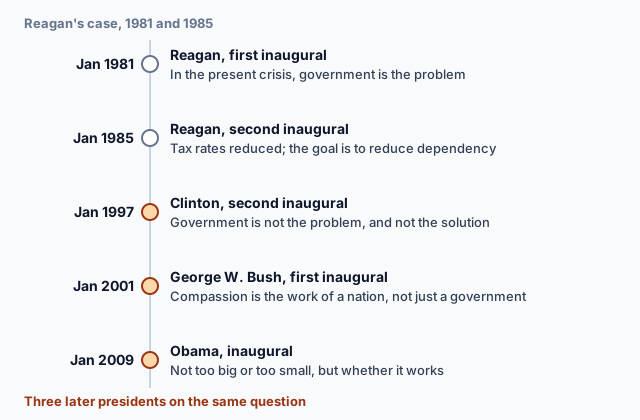
Reagan's first inaugural address, on January 20, 1981, made the case. He described "the longest and one of the worst sustained inflations in our national history" and "a tax system which penalizes successful achievement." Then came his most quoted line: "In this present crisis, government is not the solution to our problem; government is the problem." He promised "to curb the size and influence of the Federal establishment" and "to lighten our punitive tax burden," and said he would propose "removing the roadblocks that have slowed our economy and reduced productivity."
The same speech set a limit: "it is not my intention to do away with government." In his words, "Government can and must provide opportunity, not smother it."
In his second inaugural, on January 21, 1985, Reagan reported: "Tax rates have been reduced, inflation cut dramatically, and more people are employed than ever before in our history." That is a president describing his own record, so read it as a source with a purpose.
Sources: Reagan, First Inaugural, 1981 (Avalon Project); Reagan, Second Inaugural, 1985 (Avalon Project).
Quick check · Multiple choice
In 1981 Reagan promised "to lighten our punitive tax burden" and to propose "removing the roadblocks that have slowed our economy and reduced productivity." Which pair of policies did his 1980 victory allow conservatives to enact?
2b. Poverty, growth and programs that stayed
Liberal programs such as Lyndon Johnson's Great Society of the 1960s used federal legislation to try to end racial discrimination and eliminate poverty. Conservatives argued that liberal programs were counterproductive in fighting poverty and stimulating economic growth: they worked against their own goals. Reagan's 1985 address put it this way: "there is a place for the Federal Government in matters of social compassion. But our fundamental goals must be to reduce dependency and upgrade the dignity of those who are infirm or disadvantaged."
That was one side. The course framework records the other: some conservative efforts to reduce the size and scope of government met with inertia and liberal opposition, as many programs remained popular with voters. Inertia here means the pull of established programs to keep going.
Two later inaugurals show presidents promising to keep and reform large programs rather than end them. In 1997 Clinton pictured "A nation where our grandparents have secure retirement and health care, and their grandchildren know we have made the reforms necessary to sustain those benefits for their time." In 2001 George W. Bush promised: "we will reform Social Security and Medicare, sparing our children from struggles we have the power to prevent."
Sources: Reagan, Second Inaugural, 1985 (Avalon Project); Clinton, Second Inaugural, 1997 (Avalon Project); G. W. Bush, First Inaugural, 2001 (Avalon Project).
Quick check · Fill the statement
Complete a student's notes on the conservative argument and what happened to it.
Conservatives argued that liberal programs worked against their own goals of fighting poverty and stimulating growth, which makes the programs . In 1985 Reagan said the federal government's fundamental goals must be to reduce and upgrade the dignity of those who are infirm or disadvantaged. Some efforts to shrink government met inertia and liberal opposition, as many programs remained .
2c. Debates that continued
Three policy debates continued: over free-trade agreements, over the scope of the government social safety net (programs meant to help people who fall into need), and over calls to reform the U.S. financial system.
On the safety net, Clinton in 1997 said that "record numbers of our fellow citizens have moved from welfare to work," a president describing his own record. George W. Bush in 2001 said: "Government has great responsibilities for public safety and public health, for civil rights and common schools. Yet compassion is the work of a nation, not just a government."
On trade, Clinton spoke of new ties with former adversaries: "Growing connections of commerce and culture give us a chance to lift the fortunes and spirits of people the world over." He named no trade agreement.
On the financial system, Obama in 2009, speaking in what he called a crisis, said of the market: "Its power to generate wealth and expand freedom is unmatched, but this crisis has reminded us that without a watchful eye, the market can spin out of control and that a nation cannot prosper long when it favors only the prosperous."
On trade and finance these sources show one side only; none argues against free-trade agreements or new oversight of the market.
Sources: Clinton, Second Inaugural, 1997 (Avalon Project); G. W. Bush, First Inaugural, 2001 (Avalon Project); Obama, Inaugural, 2009 (Avalon Project).
Quick check · Sort it
Each card is a passage from an inaugural address. Tap a card, then the policy debate it speaks to.
The social safety net
Free trade
The financial system
2d. Social values and cultural debates
Conservative beliefs about the need for traditional social values, along with a reduced role for government, advanced in U.S. politics after 1980. In 1985 Reagan hoped Americans would remember his years in office as a time "when our values of faith, family, work, and neighborhood were restated for a modern age."
Intense political and cultural debates also continued over immigration policy, diversity, gender roles and family structures.
- Immigration. Clinton in 1997 warned that "each new wave of immigrants gives new targets to old prejudices." At an October 17, 2001 Senate hearing on immigration controls after the September 11 attacks, Senator Orrin Hatch stressed enforcement: "If a nonimmigrant illegally remains in the United States, he or she must be promptly removed if relief from removal is not merited." Senator Patrick Leahy said: "Immigrants play a vital role in refreshing our democracy and strengthening our economy."
- Diversity. Clinton: "Our rich texture of racial, religious and political diversity will be a Godsend in the 21st century."
- Gender roles. Clinton listed "extending the circle of citizenship, opportunity and dignity to women" among the century's achievements.
Inaugurals state shared ideals, so the presidents quoted here take the welcoming side, and no source here takes up family structures directly. When you write about these debates, find a source for each side.
Sources: Reagan, Second Inaugural, 1985 (Avalon Project); Clinton, Second Inaugural, 1997 (Avalon Project); Hatch, Senate hearing, 2001 (Avalon Project); Leahy, Senate hearing, 2001 (Avalon Project).
Quick check · Match
Match each passage to the issue it speaks to.
Part 3 Watch it done Compare Reagan in 1981 with Clinton in 1997
Watch each step, then do the last one yourself.
Reagan, January 20, 1981: "In this present crisis, government is not the solution to our problem; government is the problem." Clinton, January 20, 1997: "Today we can declare: Government is not the problem, and government is not the solution." Compare the main ideas of the two addresses about the role of the federal government.
Step 1 · State each main idea in your own words
Reagan: in the crisis of 1981 the growth of government was itself the cause of the nation's troubles, so government should be cut back and its tax burden lightened. Clinton: government should be "a government that is smaller, lives within its means, and does more with less," yet "strong enough to give us the tools to solve our problems for ourselves."
Why this step?
Why put each idea in your own words before you compare?
If you cannot state each main idea plainly, matching words can fool you. Reagan's and Clinton's lines share problem and solution but say opposite things. A real similarity has to hold in the argument, not just the wording.
Step 2 · Look for what carried over
Reagan in 1981 wanted "to get government back within its means." Clinton wanted a government that "lives within its means." Here the shared phrase carries a shared argument: both want a government that spends no more than it can afford.
Your step · Decide and justify
Finish it. Which sentence best compares the two main ideas?
Which evidence best supports your answer?
Part 4 Try it Compare Reagan in 1985 with Obama in 2009
Reagan began his second term on January 21, 1985. He claimed "25 straight months of economic growth" and said his administration had begun to "reduce the increase in the cost and size of government and its interference in people's lives."
Barack Obama took the oath on January 20, 2009, in what he called a crisis: "Our economy is badly weakened, a consequence of greed and irresponsibility on the part of some, but also our collective failure to make hard choices and prepare the nation for a new age." He said "the stale political arguments that have consumed us for so long no longer apply," and: "The question we ask today is not whether our government is too big or too small, but whether it works." And: "Where the answer is yes, we intend to move forward. Where the answer is no, programs will end."
Sources: Reagan, Second Inaugural, 1985 (Avalon Project); Obama, Inaugural, 2009 (Avalon Project).
Try it · Multiple choice
Which statement best compares the two addresses on the role of the federal government?
Try it · Spot the error
A student writes a paragraph comparing the two addresses. Which line is the first to go wrong?
Part 5 Explain it Write it like a document-based answer
Nothing you type leaves this page. Check your answer against the model and each scoring point.
Free-response practice · Question 1 style
A short practice in the shape of the document-based question: four documents instead of seven, and a thesis with one body paragraph instead of a full essay.
Evaluate the extent to which ideas about the role of the federal government changed from 1981 to 2009.
Document 1. Ronald Reagan, First Inaugural Address, January 20, 1981: "In this present crisis, government is not the solution to our problem; government is the problem."
Document 2. William J. Clinton, Second Inaugural Address, January 20, 1997: "Today we can declare: Government is not the problem, and government is not the solution." And: "a government that is smaller, lives within its means, and does more with less. Yet where it can stand up for our values and interests in the world, and where it can give Americans the power to make a real difference in their everyday lives, government should do more, not less." Later in the address: "The American people returned to office a President of one party and a Congress of another."
Document 3. George W. Bush, First Inaugural Address, January 20, 2001: "Government has great responsibilities for public safety and public health, for civil rights and common schools. Yet compassion is the work of a nation, not just a government."
Document 4. Barack Obama, Inaugural Address, January 20, 2009: "The question we ask today is not whether our government is too big or too small, but whether it works." And: "Its power to generate wealth and expand freedom is unmatched, but this crisis has reminded us that without a watchful eye, the market can spin out of control and that a nation cannot prosper long when it favors only the prosperous."
Write a thesis, one sentence of historical context, and one paragraph that uses at least two documents and explains the purpose, audience, point of view or situation of one of them.
Model answer
Thesis: From 1981 to 2009 presidents kept arguing about the size and scope of the federal government; what changed was the emphasis, from Reagan's claim that government was the problem to later presidents' stress on where government should act and whether it works, while each still limited what government should do.
Context: in the 1960s Lyndon Johnson's Great Society had used federal legislation and programs to try to end racial discrimination and eliminate poverty, and after 1980 conservatives argued that such liberal programs were counterproductive.
Reagan in 1981 named government itself as "the problem" in a time of crisis (Document 1), though the same speech said he did not mean to do away with government. Clinton in 1997 used the same words the other way: government "is not the problem" and "not the solution," it should be "smaller," yet it "should do more, not less" where it could give Americans power (Document 2). Clinton spoke after an election in which, as he said, voters had returned a President of one party and a Congress of another, so his middle position may reflect an audience and a government divided between the parties. Bush in 2001 also gave government "great responsibilities" while saying compassion is "not just a government" task (Document 3). By 2009 Obama set size aside and asked "whether it works" (Document 4). The question of what government should do continued; the answers shifted with each president's moment.
Score your own answer. This is a self-check, not a grade. Tick each point your answer makes.
Part 6 Check yourself Two inaugurals on what government should do
The case questions use the two excerpts. The others mix the ideas from the whole lesson.
Both excerpts come from inaugural addresses four years apart. Sources: Clinton, Second Inaugural, 1997 (Avalon Project); G. W. Bush, First Inaugural, 2001 (Avalon Project).
| Address | Excerpt |
|---|---|
| William J. Clinton, Second Inaugural Address, January 20, 1997 | "a government that is smaller, lives within its means, and does more with less. Yet where it can stand up for our values and interests in the world, and where it can give Americans the power to make a real difference in their everyday lives, government should do more, not less." |
| George W. Bush, First Inaugural Address, January 20, 2001 | "Government has great responsibilities for public safety and public health, for civil rights and common schools. Yet compassion is the work of a nation, not just a government." |
Case question 1 · Multiple choice
On which point do the two excerpts most clearly agree?
Case question 2 · Multiple choice
Which best describes the main difference in emphasis between the two excerpts?
The rest stand on their own and do not use the case.
Check yourself · Put it in order
Put these statements in the order they were made, earliest first.
Check yourself · Select all
Which two passages speak to the debates over immigration and diversity? Select two.
Select 2 answers, then check.
Part 7 Keep it Bring back earlier ideas
This lesson stands on the overview of Period 9 from Topic 9.1 and the liberal programs of the Great Society from Topic 8.9.
Bring it back · Multiple choice
Which statement best describes the conservative movement of the period after 1980?
Bring it back · Fill the statement
Complete the sentences about the liberalism that conservatives after 1980 argued against.
By the mid-1960s liberalism rested on a firm belief in the of government power to achieve social goals at home. Lyndon Johnson's Great Society used federal legislation and programs to try to end racial discrimination and eliminate .
In three lines
- Reagan's 1980 victory let conservatives enact significant tax cuts and continue deregulation, in the name of a smaller federal government.
- Conservatives called liberal programs counterproductive, but many programs stayed popular and met efforts to cut them with inertia and opposition.
- Debates continued over trade, the safety net and financial reform, and over immigration, diversity, gender roles and family structures.
Exam strategy for this topic
- Section I Part A, Multiple Choice: 55 questions in 55 minutes.
- Section I Part B, Short Answer: 3 questions in 40 minutes.
- Section II, Document-Based Question and Long Essay: 2 questions in 100 minutes.
- This lesson's Explain it is shaped like free-response question 1, Document-based.
When a question asks you to compare two sources, state each main idea in a sentence of your own, then name one similarity and one difference, each tied to a phrase from the source.
Questions students ask
Did Reagan want to get rid of the federal government?
No. In the same 1981 speech that called government the problem, he said "it is not my intention to do away with government," and in 1985 he said "there is a place for the Federal Government in matters of social compassion. But our fundamental goals must be to reduce dependency and upgrade the dignity of those who are infirm or disadvantaged." His aim was a smaller government with a narrower scope.
Did the debate over the role of government end in the 1990s?
Clinton claimed in 1997 that "we have resolved for our time a great debate over the role of government," but the course framework says policy debates continued over trade, the safety net and the financial system, and Obama was still framing the question in 2009.
Why does this lesson not say which side of these debates was right?
The course asks you to explain the causes and effects of these debates. Strong answers name who argued each side and what they said, using their own words, and leave the verdict out.
Why are most of the sources inaugural addresses?
Each new president uses the inaugural to tell the nation what government should do, so reading them side by side shows the debate across administrations. They are also public, dated and easy to check, which suits practice in comparing sources.
Where can I read these speeches in full?
Each excerpt links to its full text at the Avalon Project at Yale Law School, the primary-source collection this lesson was checked against.
Course alignment, for teachers
AP U.S. History topic 9.2, Unit 9: Period 9: 1980–Present.
- Skill 3.C: Compare the arguments or main ideas of two sources.
This lesson maps all 5 essential knowledge statements of the topic, and the one learning objective with none of its own, to the part that teaches each one: 6 are checked by a scored question. The map is in the lesson file.