Unit 5 · Topic 5.1 · about 30 minutes · 7 parts · 13 scored checks, 5 of them multiple choice
AP U.S. History 5.1: Contextualizing Period 5
Unit 5: 10 to 17% of the multiple-choice section
What you'll be able to do
- Explain the context in which sectional conflict emerged from 1844 to 1877: how expansion, debates over rights and slavery, the Civil War and Reconstruction fit together, and how to place a single document or event inside that larger story.
Key vocabulary
| Term | What it means | The exam trap |
|---|---|---|
| Contextualization | Explaining how a specific development fits inside a broader process of its time. | Context is not any earlier event; it must be tied to the development you are explaining. |
| Sectionalism | Loyalty to one's own region, North or South, over the nation as a whole. | Sections are regions with shared interests, not single states. |
| Free soil | The position that slavery should be kept out of the western territories. | Free soil is about where slavery may spread, which is not the same as abolishing it. |
| Secession | A state's formal withdrawal from the Union. | Secession was the act of a state government; it is not another name for the war. |
| Reconstruction | The period after the Civil War when the federal government set the terms for restoring the Southern states and defined the rights of the formerly enslaved. | Reconstruction was a political process, not only the physical rebuilding of the South. |
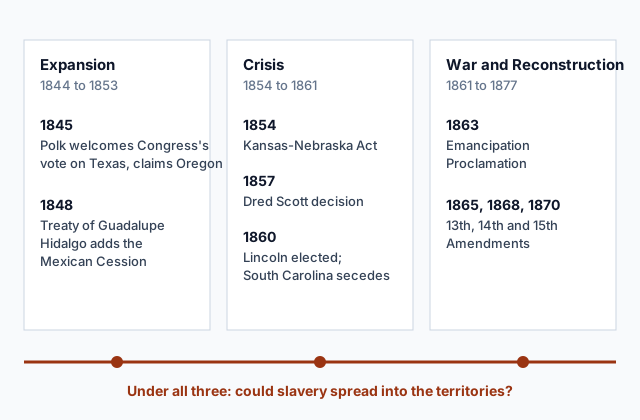 Tap to open the picture full size
Part 1 Think first Polk's promise
Commit to a guess first. Being wrong now makes the right idea stick better.
Predict first
In his inaugural address of March 4, 1845, President James K. Polk said of the country's growth: "It is confidently believed that our system may be safely extended to the utmost bounds of our territorial limits, and that as it shall be extended the bonds of our Union, so far from being weakened, will become stronger." Fifteen years later the Union broke apart. What do you think did most to prove him wrong?
In short. From 1844 to 1877 the United States grew across the continent and reached toward Asia, but each new territory reopened the question of whether slavery could spread there; that question came to dominate politics, split the Union in 1860 and 1861, and was settled by a Union victory and Reconstruction that left questions of federal power and citizenship open.
- Popular enthusiasm for expansion, backed by economic and security interests, brought Texas, Oregon and the Mexican Cession into the country, and Americans argued over the rights of the people living in it.
- Northern and Southern responses to slavery diverged, debates over slavery dominated the 1850s, and after the bitter election of 1860 most slave states seceded.
- The North's resources, Lincoln's leadership and emancipation won the war; Reconstruction ended slavery and redefined citizenship, but the fights over federal power and equal rights went on.
Part 2 Learn it The big picture of 1844 to 1877
2a. A growing country, tied to the world
In his inaugural address of 1845, Polk welcomed the vote of Congress to annex Texas, saying "by an act of the late Congress of the United States the assent of this Government has been given to the reunion," and said it only remained for the two countries "to agree upon the terms to consummate an object so important to both." He also vowed to uphold "the right of the United States to that portion of our territory which lies beyond the Rocky Mountains," the Oregon Country. His reasons were partly economic, since Texas offered "the vast resources of her fertile soil and genial climate," and partly about security, since annexation protected "the safety of New Orleans and of our whole southwestern frontier."
Popular enthusiasm for expansion, bolstered by those economic and security interests, brought new territory quickly. After the Mexican-American War, the Treaty of Guadalupe Hidalgo of February 2, 1848 added large lands in the West, and settlers moved west in large numbers.
The country also reached outward. In the Treaty of Kanagawa of March 31, 1854, signed by Matthew Calbraith Perry, Japan opened two ports to American ships, "where they can be supplied with wood, water, provisions and coal." At home, the United States became the destination for many migrants from other countries, mainly from Ireland and Germany in these years.
Sources: Polk's inaugural address, 1845 (Avalon Project); Treaty of Kanagawa (Avalon Project); Avalon Project index of 19th century documents.
Quick check · Match
Match each development to the larger trend of the period it belongs to.
2b. Who has the rights of a citizen?
In the 1840s and 1850s Americans kept arguing about which inhabitants held the rights of citizens.
The Treaty of Guadalupe Hidalgo said that Mexicans who stayed in the ceded lands would be "admitted at the proper time (to be judged of by the Congress of the United States) to the enjoyment of all the rights of citizens of the United States." Its timing was left to Congress.
For African Americans the Supreme Court gave a harsher answer. On March 6, 1857, in Dred Scott v. Sandford, Chief Justice Roger B. Taney put the question this way: "Can a negro whose ancestors were imported into this country, and sold as slaves, become a member of the political community formed and brought into existence by the Constitution of the United States"? The Court answered: "We think they are not." Since the question covered all descendants of enslaved people, free Black Americans were shut out too. It also said Congress could not ban slavery from a federal territory. By then, the National Archives notes, "slavery became the single most explosive issue in American politics."
In December 1860 South Carolina complained that Northern states were "elevating to citizenship, persons who, by the supreme law of the land, are incapable of becoming citizens." The Court had said exactly that of free Black Americans in 1857.
Sources: Treaty of Guadalupe Hidalgo (Avalon Project); Dred Scott v. Sandford (National Archives); South Carolina's declaration, 1860 (Avalon Project).
Quick check · Multiple choice
Taken together, the Treaty of Guadalupe Hidalgo (1848), which left Mexicans' citizenship to Congress, the Dred Scott decision (1857) and South Carolina's complaint of 1860 are best used as evidence of which development?
2c. Slavery takes over national politics
Every new territory raised one question: could slavery spread there? The Kansas-Nebraska Act of May 30, 1854 repealed the Missouri Compromise line that had barred slavery from these lands. It declared "the eighth section of the act preparatory to the admission of Missouri into the Union" void, and set out "to leave the people thereof perfectly free to form and regulate their domestic institutions in their own way."
Responses split by section. Northern abolitionists, Black and white, were a loud minority calling slavery morally wrong. Many other Northerners opposed its spread, not on principle, but because they believed it would undermine free labor. Southern defenders called slavery a positive good, rested it on racial doctrines, and said the Constitution protected it, the "right of property in slaves." Slavery and anti-Catholic nativism aimed at Irish and German immigrants broke up the old parties, and a sectional Republican Party rose in the North.
In the bitter election of 1860, Lincoln won on the Republicans' free-soil platform without a single Southern electoral vote. South Carolina declared on December 24: "A geographical line has been drawn across the Union, and all the States north of that line have united in the election of a man to the high office of President of the United States, whose opinions and purposes are hostile to slavery." After contested debates, most slave states voted to secede.
Sources: Kansas-Nebraska Act (Avalon Project); Kansas-Nebraska Act (National Archives); South Carolina's declaration (Avalon Project).
Quick check · Sort it
Each card is a position Americans took on slavery in the 1850s. Tap a card, then the section where it was mainly heard.
Mainly heard in the North
Mainly heard in the South
2d. War, emancipation and an unfinished settlement
The North's greater manpower and industrial resources, the leadership of Lincoln and others, and the decision to emancipate enslaved people led to Union victory. Lincoln issued the Emancipation Proclamation on January 1, 1863 "as a fit and necessary war measure for suppressing said rebellion," and it said freed people would be "received into the armed service of the United States."
In March 1865 Lincoln said of slavery: "These slaves constituted a peculiar and powerful interest. All knew that this interest was somehow the cause of the war." Congress had passed the 13th Amendment that January, and it was ratified on December 6, 1865: "Neither slavery nor involuntary servitude, except as a punishment for crime whereof the party shall have been duly convicted, shall exist within the United States."
Reconstruction then changed how the states and the nation related. The 14th Amendment, ratified in 1868, begins: "All persons born or naturalized in the United States, and subject to the jurisdiction thereof, are citizens of the United States and of the State wherein they reside." And: "No State shall make or enforce any law which shall abridge the privileges or immunities of citizens of the United States." The 15th, ratified in 1870, bars denying the vote "on account of race, color, or previous condition of servitude." It says nothing about sex, and women's rights advocates split over it.
Sources: Emancipation Proclamation (Avalon Project); Lincoln's second inaugural (Avalon Project); 13th, 14th and 15th Amendments (National Archives).
Quick check · Fill the statement
Complete the summary of what the war and Reconstruction settled and what they left open.
The Union victory settled whether a state could and whether could continue. It left open , and what citizenship would mean for African Americans, women and other minorities.
Part 3 Watch it done Place the Kansas-Nebraska Act in context
Watch each step, then do the last one yourself.
Explain how the Kansas-Nebraska Act of May 30, 1854 is situated within the broader context of expansion from 1844 to 1861.
Predict first
Before the steps, what kind of context do you think fits this act best?
Step 1 · Say exactly what the act did
It organized Kansas and Nebraska as territories and set out "to leave the people thereof perfectly free to form and regulate their domestic institutions in their own way." Settlers, not Congress, would decide on slavery.
Why this step?
Why pin down the act before naming any context?
Context has to fit the thing you are explaining. If you are vague about what the act did, you cannot show which larger process it belongs to.
Step 2 · Read what the act says about the past
The act declares "the eighth section of the act preparatory to the admission of Missouri into the Union" void. That section, from 1820, is the Missouri Compromise line that had barred slavery from these lands. The act also points to the laws of 1850, "commonly called the Compromise Measures."
Your step · Decide and justify
Finish it. Which sentence best situates the Kansas-Nebraska Act in its broader context?
Which evidence best supports your answer?
Part 4 Try it Two more documents to place
Contextualizing works the same way on any document: say exactly what it is, then name the larger process it belongs to and show the link. Try it on two documents you have met only briefly: the Treaty of Kanagawa of 1854, and South Carolina's declaration of December 24, 1860.
Sources: Treaty of Kanagawa (Avalon Project); South Carolina's declaration (Avalon Project).
Try it · Multiple choice
In 1854 Matthew Perry signed a treaty with Japan that opened the ports of Simoda and Hakodadi to American ships. Which broader context best situates the treaty?
Try it · Spot the error
A student writes a context paragraph for South Carolina's declaration of December 24, 1860. Which line is the first to go wrong?
Part 5 Explain it Write it like a document-based answer
Nothing you type leaves this page. Check your answer against the model and each scoring point.
Free-response practice · Question 1 style
A short practice in the shape of the document-based question: three documents instead of seven, and a thesis with one body paragraph instead of a full essay.
Evaluate the extent to which westward expansion intensified sectional conflict between 1844 and 1861.
Document 1. Inaugural address of President James K. Polk, March 4, 1845: "It is confidently believed that our system may be safely extended to the utmost bounds of our territorial limits, and that as it shall be extended the bonds of our Union, so far from being weakened, will become stronger." And, on Texas: "Whatever is good or evil in the local institutions of Texas will remain her own whether annexed to the United States or not."
Document 2. Kansas-Nebraska Act, May 30, 1854: its purpose is "to leave the people thereof perfectly free to form and regulate their domestic institutions in their own way."
Document 3. First inaugural address of President Abraham Lincoln, March 4, 1861: "One section of our country believes slavery is right and ought to be extended, while the other believes it is wrong and ought not to be extended. This is the only substantial dispute."
Write a thesis, one sentence of historical context, and one paragraph that uses at least two documents and explains the purpose, audience, point of view or situation of one of them.
Model answer
Thesis: Westward expansion intensified sectional conflict to a great extent, because each new territory turned the question of slavery's spread into a national fight, though the deeper division over slavery itself existed before 1844.
Context: in the early 1800s the Missouri Compromise had only temporarily calmed the conflict between opponents and defenders of slavery, so the question was unresolved when Polk took office.
In 1845 Polk promised that expansion would make "the bonds of our Union" stronger and said the "local institutions of Texas", his phrase for slavery, which he does not name, would remain Texas's own (Document 1). Speaking to the whole nation and to foreign powers while the annexation of Texas awaited its final terms, he had reason to keep slavery out of the national argument, so his promise shows what he hoped rather than what happened. The Kansas-Nebraska Act left slavery to the settlers of each territory (Document 2), which reopened lands closed to slavery since 1820 and set the sections competing for the West. By 1861 Lincoln named the spread of slavery as "the only substantial dispute" (Document 3). Expansion did not create the division over slavery, but it kept forcing the nation to decide where slavery could go.
Score your own answer. This is a self-check, not a grade. Tick each point your answer makes.
Part 6 Check yourself The secession winter
The case questions use the two excerpts. The others mix the ideas from the whole lesson.
Two statements from the months between Lincoln's election and his first day in office. Sources: South Carolina's declaration (Avalon Project); Lincoln's first inaugural (Avalon Project).
| Document | Excerpt |
|---|---|
| Declaration of the Immediate Causes of the Secession of South Carolina, December 24, 1860 | "A geographical line has been drawn across the Union, and all the States north of that line have united in the election of a man to the high office of President of the United States, whose opinions and purposes are hostile to slavery." |
| First inaugural address of Abraham Lincoln, March 4, 1861 | "I have no purpose, directly or indirectly, to interfere with the institution of slavery in the States where it exists." |
Case question 1 · Multiple choice
Which development best explains why South Carolina wrote of a geographical line drawn across the Union?
Case question 2 · Multiple choice
Lincoln's statement of March 4, 1861 is best understood as an attempt to do what?
The rest stand on their own and do not use the case.
Check yourself · Put it in order
Put these events in the order they happened, earliest first.
Check yourself · Select all
Which two factors helped bring about the Union's victory in the Civil War? Select two.
Select 2 answers, then check.
Part 7 Keep it Bring back earlier ideas
This lesson stands on Period 4: the compromises over slavery in the West from Topic 4.3 and the reform movements of Topic 4.11.
Bring it back · Multiple choice
Which statement best describes the effect of congressional compromises such as the Missouri Compromise on tensions between opponents and defenders of slavery?
Bring it back · Fill the statement
Read the situation, then complete the sentences.
A reformer in the 1840s argues that women deserve the same chances in education and public life as men. She is part of the movement that stated its ideals at the . Years later the movement argues over whom its demands should cover, and one side wants them to .
In three lines
- Expansion from 1844, backed by economic and security interests, added Texas, Oregon and the Mexican Cession and tied the country to the wider world.
- Each new territory reopened the slavery question, which came to dominate the 1850s and led to the election of 1860 and secession.
- The Union's victory and Reconstruction ended slavery and secession, but left federal power and citizenship rights in dispute.
Exam strategy for this topic
- Section I Part A, Multiple Choice: 55 questions in 55 minutes.
- Section I Part B, Short Answer: 3 questions in 40 minutes.
- Section II, Document-Based Question and Long Essay: 2 questions in 100 minutes.
- This lesson's Explain it is shaped like free-response question 1, Document-based.
For the context point, write one or two sentences about a broader process that was under way before or during the document, and end with a clause that says how that process shaped the document itself.
Questions students ask
Why does Period 5 start in 1844 and end in 1877?
The course framework sets those dates. In this lesson's documents the period opens with Polk welcoming Texas in 1845, and it closes with the end of Reconstruction, which the framework dates from 1865 to 1877.
Was the Civil War about slavery or about states' rights?
Read the documents. South Carolina's 1860 declaration defends states' rights in order to protect slavery, and Lincoln in 1861 called the spread of slavery "the only substantial dispute." The states' rights argument was the means; slavery was the end it served.
Did the Emancipation Proclamation end slavery?
Not everywhere. It applied to the areas in rebellion and was issued as a war measure. The 13th Amendment, ratified on December 6, 1865, ended slavery throughout the United States.
What does contextualization mean on a document-based question?
It means describing a broader historical development relevant to the prompt, outside the documents, and showing how it connects to the topic. A sentence of background with no link to the argument does not do it.
Where can I read these documents in full?
Each excerpt links to its full text at the National Archives or the Avalon Project at Yale Law School, the collections this lesson was checked against.
Course alignment, for teachers
AP U.S. History topic 5.1, Unit 5: Period 5: 1844–1877.
- Skill 4.B: Explain how a specific historical development or process is situated within a broader historical context.
This lesson maps all 9 essential knowledge statements of the topic, and the one learning objective with none of its own, to the part that teaches each one: 10 are checked by a scored question. The map is in the lesson file.