Unit 8 · Topic 8.1 · about 30 minutes · 7 parts · 13 scored checks, 4 of them multiple choice
AP U.S. History 8.1: Contextualizing Period 8
Unit 8: 10 to 17% of the multiple-choice section
What you'll be able to do
- Explain the context for societal change from 1945 to 1980: Cold War leadership abroad and the debates it caused at home, the civil rights movement and liberal efforts to expand government and the responses they drew, and the economic and demographic changes that brought both optimism and division.
Key vocabulary
| Term | What it means | The exam trap |
|---|---|---|
| Cold War | The long rivalry between the United States and the Soviet Union after World War II, fought through alliances, aid, an arms race and wars in other countries. | Cold does not mean there was no fighting; Americans fought and died in Korea and Vietnam. |
| Liberalism | In this period, anti-communism abroad joined with a firm belief that federal power could achieve social goals at home. | Postwar liberals were anti-communist, so do not set liberalism against the Cold War. |
| Civil liberties | Freedoms the government must not take away, such as free speech and fair treatment under the law. | Civil liberties limit what government may do to people; civil rights are about equal treatment. |
| Contextualization | Explaining how a specific development fits a broader process of its time. | A date or a decade is not context; name the larger process and connect it. |
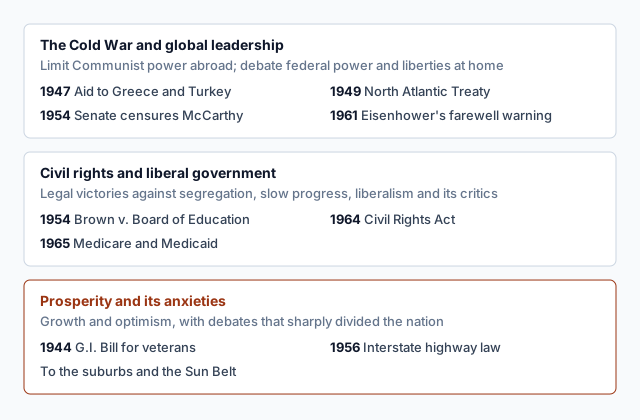 Tap to open the picture full size
Part 1 Think first Boom or bust after the war?
Commit to a guess first. Being wrong now makes the right idea stick better.
Predict first
In 1944, with World War II still being fought, the Department of Labor estimated that 15 million men and women then serving in the armed forces would be unemployed after the war. Many Americans remembered the Great Depression and feared it would return. What do you think the years after 1945 brought instead?
In short. After 1945 the United States took up global leadership in a cold war with the Soviet Union, civil rights activists and liberal leaders used federal power to attack segregation and social problems, and rapid economic and demographic change brought optimism along with sharp divisions, and those three forces set the context for change from 1945 to 1980.
- To limit Communist power, the United States built alliances, gave aid and armed itself, and those Cold War policies set off debates at home over federal power and civil liberties.
- Civil rights activists and political leaders won legal victories against segregation, though progress was slow, and their movement inspired others; liberalism peaked in the mid-1960s and then drew attack from the left and from a resurgent conservative movement.
- Postwar growth fed optimism, while new ways of living and Cold War fears changed American culture and set off moral and political debates that sharply divided the nation.
Part 2 Learn it Three forces behind change, 1945 to 1980
2a. A world power in an unstable world
Victory in 1945 left the United States the strongest power in a shaken world. By 1947 it was in a cold war with the Soviet Union: a long rivalry fought through alliances, aid, an arms race and wars in other countries, such as Korea.
On March 12, 1947, President Harry Truman asked a joint session of Congress for aid to Greece and Turkey and said that "it must be the policy of the United States to support free peoples who are resisting attempted subjugation by armed minorities or by outside pressures." American leaders set out to limit the growth of Communist military power and influence, build a free-market world economy and build an international security system. In April 1949 the United States signed the North Atlantic Treaty, which says "an armed attack against one or more of them in Europe or North America shall be considered an attack against them all."
Leadership abroad changed life at home. The military services and the defense industry expanded a great deal in the 1950s, and Cold War policies set off public debates over the power of the federal government and over how to pursue the nation's goals while protecting civil liberties. In 1954 the Senate censured Senator Joseph McCarthy, whose charges against suspected Communists in government had made him notorious on little proof.
Sources: Truman Doctrine (National Archives); North Atlantic Treaty (Avalon Project); Censure of Senator McCarthy (National Archives); Eisenhower's Farewell Address (National Archives).
Quick check · Sort it
Each card is a development of the Cold War years. Tap a card, then the side of the Cold War it shows best.
Leadership abroad
Debate at home
2b. Civil rights and the reach of government
The second force came from Americans demanding the equality promised during Reconstruction. On May 17, 1954, the Supreme Court ruled unanimously in Brown v. Board of Education that "Separate educational facilities are inherently unequal." The ruling met considerable resistance. On July 2, 1964, President Lyndon Johnson signed the Civil Rights Act, which outlawed discrimination in public places and in employment. The National Archives calls it the most sweeping civil rights legislation since Reconstruction, and Southern Democrats in the Senate had tried to talk it to death in a filibuster. Activists and leaders won real victories, but progress toward racial equality was slow.
The African American civil rights movement inspired others. Feminist, Latino, American Indian, Asian American and LGBTQ+ activists pressed their own claims to equality, and an environmental movement fought pollution.
Liberalism in these years meant anti-communism abroad and a firm belief that federal power could achieve social goals at home. It reached its high point in the mid-1960s. Medicare and Medicaid, signed in July 1965, made the federal government a health insurer for older and low-income Americans; opponents had long warned against "socialized medicine." Liberalism then came under attack from the left, from critics who said it did too little to change the racial and economic order, and from a resurgent conservative movement that wanted a smaller federal government.
Sources: Brown v. Board of Education (National Archives); Civil Rights Act (National Archives); Medicare and Medicaid Act (National Archives).
Quick check · Match
Match each development to what it shows about civil rights and the reach of government.
2c. Prosperity and its anxieties
The third force was economic and demographic. The feared postwar depression did not come. The G.I. Bill paid for schooling for about eight million veterans, and by 1955 it had backed 4.3 million home loans. Rapid economic and social change fed a sense of optimism. A growing private sector, federal spending, the baby boom and new technology spurred growth. As higher education spread, much of the middle class moved to the suburbs, and many Americans moved to the South and West, the region called the Sun Belt. In June 1956 Congress authorized the interstate highway system, the biggest public works project in the nation's history.
The gains were not shared equally. Black veterans were often unable to get mortgage loans in Black neighborhoods, and prejudice and discrimination kept most of them from buying homes in white suburbs.
New ways of living, and anxiety about the Cold War, changed American culture and set off moral and political debates that sharply divided the nation. Mass culture grew more alike from place to place, and artists, intellectuals and rebellious youth challenged its conformity. In the 1960s a counterculture rejected many of its parents' values. Evangelical Christian churches grew fast, and religious conservatives became more active in politics.
Sources: Servicemen's Readjustment Act (National Archives); Interstate Highways Act (National Archives).
Quick check · Fill the statement
Complete the summary of the postwar years.
In 1944 the Department of Labor expected mass unemployment after the war. Instead, veterans went to college and bought homes in large numbers, and rapid economic and social change fostered a sense of . At the same time, new ways of living, together with fear of the Cold War, set off moral and political debates that the nation.
2d. Contextualizing a development
Contextualization means explaining how a specific development fits a broader process of its time. A date is not context, and neither is an idea on its own. Name what was happening, then show how it shaped the development you are explaining.
Take Medicare and Medicaid in 1965. A weak context says only This happened in the 1960s. Another weak one names only a belief: liberals trusted federal power. Liberals held that belief in the 1940s too, when President Truman asked Congress for national health insurance and later backed off. A strong context names what had changed. Between 1950 and 1963 the population aged 65 and older grew from about 12 million to 17.5 million, hospital costs rose about 6.7 percent a year, and by 1960 it was clear that private insurers could not give older Americans affordable coverage. Those pressures, met by liberals at the height of their influence, explain why the law came in 1965.
Many developments of Period 8 sit inside two of the forces in this lesson. The censure of McCarthy belongs to the Cold War and to the argument over civil liberties at home. Pick the force that does the most to explain your development, and name the events that carried it.
Quick check · Multiple choice
A student is explaining the Senate's censure of Senator Joseph McCarthy in December 1954. Which sentence best places the censure in its broader historical context?
Part 3 Watch it done Place Eisenhower's warning in context
Watch each step, then do the last one yourself.
On January 17, 1961, President Dwight Eisenhower gave his farewell address on national television from the Oval Office. He warned: "In the councils of government, we must guard against the acquisition of unwarranted influence, whether sought or unsought, by the military-industrial complex." Explain the broader historical context of his warning.
Predict first
Before the steps, what do you think a president who had been a general was worried about?
Step 1 · Name the development
The development is the warning itself: a president who had been a military leader and hero of World War II telling the whole country to watch the defense establishment. He also said: "We must never let the weight of this combination endanger our liberties or democratic processes."
Why this step?
Why look for a broader process instead of just giving the date?
A date tells you when. Context tells you what larger change was under way, and that is what makes a development make sense.
Step 2 · Find the broader process
The Cold War arms race had gone on through his two terms. The military services and the defense industry had expanded a great deal in the 1950s. Eisenhower thought the growth was needed to counter the Soviet Union, and he had still slowed the push for more defense spending.
Your step · Decide and justify
Finish it. Which broader context best explains Eisenhower's warning?
Which evidence best supports your answer?
Part 4 Try it Put the Civil Rights Act in context
In a nationally televised address on June 6, 1963, President John F. Kennedy urged the nation to act toward equal treatment of every American regardless of race, and soon proposed a civil rights bill. Kennedy was assassinated in November 1963, but his proposal became the Civil Rights Act, signed by President Lyndon Johnson on July 2, 1964. It prohibited discrimination in public places, provided for the integration of schools and other public facilities, and made employment discrimination illegal. Southern Democratic senators tried to talk the bill to death in a filibuster. The National Archives credits three men with beating it: Senator Hubert Humphrey of Minnesota, who led on the floor; President Johnson, who gave the bill considerable support; and Senate Minority Leader Everett Dirksen of Illinois, who convinced enough Republicans to vote for it. It passed the Senate 73 to 27.
Source: Civil Rights Act (National Archives).
Try it · Multiple choice
Which broader context best explains the passage of the Civil Rights Act in 1964?
Try it · Spot the error
A student writes a contextualization paragraph for the Civil Rights Act of 1964. Which line is the first to go wrong?
Part 5 Explain it Write it like a document-based answer
Nothing you type leaves this page. Check your answer against the model and each scoring point.
Free-response practice · Question 1 style
A short practice in the shape of the document-based question: three documents instead of seven, and a thesis with one body paragraph instead of a full essay.
Evaluate the extent to which the role of the federal government in American life grew between 1945 and 1965.
Document 1. President Harry Truman, message to a joint session of Congress, March 12, 1947: "I believe that it must be the policy of the United States to support free peoples who are resisting attempted subjugation by armed minorities or by outside pressures."
Document 2. Supreme Court, Brown v. Board of Education, unanimous opinion, May 17, 1954: "Separate educational facilities are inherently unequal."
Document 3. President Dwight Eisenhower, farewell address on national television, January 17, 1961: "In the councils of government, we must guard against the acquisition of unwarranted influence, whether sought or unsought, by the military-industrial complex." And: "We must never let the weight of this combination endanger our liberties or democratic processes."
Write a thesis, one sentence of historical context, and one paragraph that uses at least two documents and explains the purpose, audience, point of view or situation of one of them.
Model answer
Thesis: Between 1945 and 1965 the federal government's role grew a great deal, abroad as a Cold War leader and at home against segregation, though the growth drew warnings that it could threaten Americans' liberties.
Context: the New Deal of the 1930s had already made the federal government responsible for relief and reform, and World War II left the United States the most powerful nation on Earth.
In 1947 Truman told Congress the nation must "support free peoples" who resisted outside pressures (Document 1), a policy later administrations used to justify action in Korea and Vietnam. The federal courts also reached into the states, ruling that separate schools were "inherently unequal" (Document 2), a ruling that met considerable resistance. Yet the growth worried even a president who had led it. Leaving office, Eisenhower warned of the "unwarranted influence" of the military-industrial complex and its danger to "our liberties" (Document 3). He spoke to the whole nation as a former general, and his standing as a military leader helped give the warning credibility, though as a farewell it names a danger rather than measuring how great it was. At home the growth went further still with Medicare and Medicaid in 1965. The federal role grew a great deal, and so did the argument over how far it should reach.
Score your own answer. This is a self-check, not a grade. Tick each point your answer makes.
Part 6 Check yourself Six moments, three forces
The case questions use the table. The others mix the ideas from the whole lesson.
Six developments from 1947 to 1965, as the National Archives' milestone documents record them. Sources: Truman Doctrine; Brown v. Board of Education; Censure of McCarthy; Interstate Highways Act; Civil Rights Act; Medicare and Medicaid Act.
| Year | Development |
|---|---|
| 1947 | Truman asks Congress for $400 million in aid to Greece and Turkey |
| 1954 | The Supreme Court rules segregated public schools unconstitutional in Brown v. Board of Education |
| 1954 | The Senate censures Senator Joseph McCarthy |
| 1956 | Congress authorizes the interstate highway system |
| 1964 | The Civil Rights Act outlaws discrimination in public places and in employment |
| 1965 | Medicare and Medicaid make the federal government a health insurer for older and low-income Americans |
Case question 1 · Multiple choice
A historian wants to show that liberal faith in federal power to reach social goals was at its height in the mid-1960s. Which pair of rows is the best evidence?
Case question 2 · Select all
Which two rows show the Cold War shaping events most directly? Select two.
Select 2 answers, then check.
The rest stand on their own and do not use the case.
Check yourself · Put it in order
Put these developments in the order they happened, earliest first.
Check yourself · Fill the statement
Complete the sentences about the movements of the period.
The African American civil rights movement inspired other groups. Feminist, Latino, American Indian and Asian American activists demanded , and a growing movement set out to fight pollution and protect natural resources.
Part 7 Keep it Bring back earlier ideas
This lesson starts where Period 7 ended: the New Deal from Topic 7.10 and the nation's power after World War II from Topic 7.14.
Bring it back · Multiple choice
Which best explains why the United States emerged from World War II as the most powerful nation on Earth?
Bring it back · Fill the statement
Complete the sentences about the New Deal.
Franklin Roosevelt's New Deal used government power to provide to the poor, stimulate recovery and reform the economy. It did not end the Depression, but it left behind reforms and agencies that lasted long after the 1930s.
In three lines
- The United States answered an unstable postwar world with Cold War leadership: alliances, aid and arms to limit Communist power, and debates at home over federal power and civil liberties.
- Civil rights activists and liberal leaders used federal power against segregation and social problems, won real but slow progress, inspired other movements, and drew attacks from the left and from conservatives.
- Postwar prosperity fed optimism, while new ways of living and Cold War fears changed American culture and sharply divided the nation.
Exam strategy for this topic
- Section I Part A, Multiple Choice: 55 questions in 55 minutes.
- Section I Part B, Short Answer: 3 questions in 40 minutes.
- Section II, Document-Based Question and Long Essay: 2 questions in 100 minutes.
- This lesson's Explain it is shaped like free-response question 1, Document-based.
When you write context, name a broader process from outside the documents and the events that carried it, such as the Cold War arms buildup of the 1950s or Kennedy's civil rights proposal of 1963, and say in the same sentence how it shaped the development you are explaining.
Questions students ask
Why does this lesson split the period into three forces?
The AP U.S. History course framework organizes Period 8 around three key concepts: Cold War leadership and its effects at home, civil rights and liberal government with the responses they drew, and postwar economic and demographic change. Every later topic in the unit fits under at least one of them.
Was the Cold War ever a real war?
Americans fought in Korea and later in Vietnam to contain communism, and the two powers ran an arms race. The rivalry moved between periods of direct and indirect military confrontation and periods of coexistence, called détente. Topic 8.2 follows those swings.
Did the Civil Rights Act end segregation?
It outlawed segregation in public places and discrimination in employment, and the National Archives calls it the most sweeping civil rights legislation since Reconstruction. But resistance slowed desegregation, and progress toward racial equality was slow.
What was the military-industrial complex?
Eisenhower's name in 1961 for the combination of a large, permanent military establishment and a large arms industry, which had grown during the Cold War. He warned that it must never endanger Americans' liberties or democratic processes.
Where can I read these documents in full?
Each excerpt links to its full text at the National Archives or the Avalon Project at Yale Law School, the primary-source collections this lesson was checked against.
Course alignment, for teachers
AP U.S. History topic 8.1, Unit 8: Period 8: 1945–1980.
- Skill 4.B: Explain how a specific historical development or process is situated within a broader historical context.
This lesson maps all 10 essential knowledge statements of the topic, and the one learning objective with none of its own, to the part that teaches each one: 11 are checked by a scored question. The map is in the lesson file.