Unit 3 · Topic 3.1 · about 30 minutes · 7 parts · 13 scored checks, 5 of them multiple choice
AP U.S. History 3.1: Contextualizing Period 3
Unit 3: 10 to 17% of the multiple-choice section
What you'll be able to do
- Explain the context in which America gained independence and developed a sense of national identity, and describe the larger developments that a document or event from 1754 to 1800 belongs to.
Key vocabulary
| Term | What it means | The exam trap |
|---|---|---|
| Contextualization | Describing a development outside a document, before or around it, that helps explain why the document says what it says. | Context has to connect to the source; a true fact from the same decade that explains nothing about it does not count. |
| Seven Years' War | The war of the 1750s and 1760s in which Britain fought France and the American Indian nations allied with France, and which decided who would control much of North America; in the colonies it is also called the French and Indian War. | The two names describe one war, so do not treat them as two conflicts. |
| Self-government | People making their own laws and taxes through officials and assemblies they choose. | Self-government in the 1760s did not yet mean independence; read whether a source wants to leave the empire or to rule itself inside it. |
| Imperial authority | The power a ruling country claims over its colonies, such as the power to tax them, make their laws or set their boundaries. | Authority is a claim to power; a law that claims authority is not proof the colonists accepted it. |
| Sovereignty | Final authority to govern, held by a state or a nation. | Ask who holds sovereignty in a document, a state or the union, since the answer changed across the period. |
 Tap to open the picture full size
Part 1 Think first How does a victory become a break?
Commit to a guess first. Being wrong now makes the right idea stick better.
Predict first
In February 1763 Britain signed a peace treaty that took Canada from France. Thirteen years later, Britain's own colonists in North America declared independence. Which do you think best explains how a British victory turned into a break with the colonies?
In short. Period 3 runs from 1754 to 1800: British attempts to assert tighter control over the colonies after the Seven Years' War, met by the colonial resolve to pursue self-government, produced the independence movement and the Revolutionary War, and the new nation then built governments from revolutionary ideals while it competed with American Indian nations and European powers for a continent.
- Britain defeated France and its American Indian allies in the Seven Years' War and won Canada in 1763, then tried to tax and govern the colonies more closely.
- Colonists insisted that only their own assemblies could tax them, and that conflict became a movement for independence.
- After 1776, new constitutions and declarations of rights limited both central power and popular influence, while a national identity grew alongside regional differences and conflicts over land, borders and trade.
Part 2 Learn it The big picture of Period 3
2a. A tighter empire meets colonial self-government
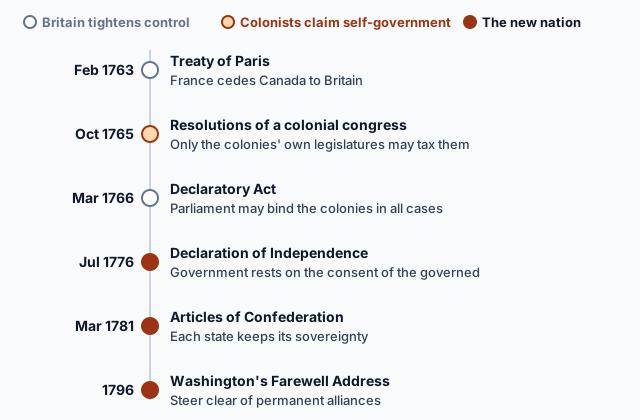
Britain, France and American Indian nations competed for trade and power in North America. That competition ended in the Seven Years' War, also called the French and Indian War, in which Britain defeated France and the American Indians allied with France. In the treaty of February 10, 1763, France gave up Canada, and the line between British and French lands became "a line drawn along the middle of the River Mississippi."
Then Britain tried to hold its colonies more tightly. In March 1765 Parliament passed the Stamp Act, a tax on paper and documents. In October 1765 a colonial congress replied: "That the only representatives of the people of these colonies, are persons chosen therein by themselves, and that no taxes ever have been, or can be constitutionally imposed on them, but by their respective legislatures."
Parliament repealed the Stamp Act on March 18, 1766. The same day it passed the Declaratory Act, claiming "full power and authority to make laws and statutes of sufficient force and validity to bind the colonies and people of America, subjects of the crown of Great Britain, in all cases whatsoever."
That is the frame for the whole unit. British attempts to assert tighter control over the colonies, met by the colonial resolve to pursue self-government, produced the independence movement and the Revolutionary War.
Sources: Treaty of Paris, 1763; Resolutions of October 19, 1765; Declaratory Act, 1766; Avalon Project, 18th century index.
Quick check · Sort it
Each card is a passage from a document of 1763 to 1774. Tap a card, then the force of the period it shows.
Britain asserting tighter control
Colonists claiming self-government
2b. Revolutionary ideals build new governments
The ideals behind the Revolution grew out of new beliefs about politics, religion and society that had been developing through the 18th century. The Declaration of Independence said governments draw their "just powers from the consent of the governed."
Those democratic and republican ideals inspired new experiments in government. After declaring independence, American leaders wrote new state constitutions and declarations of rights. They spelled out what governments could do, protected individual liberties, and limited two dangers.
The first was centralized power, the kind they had just fought. The Articles of Confederation, agreed to by Congress in 1777 and in force from March 1, 1781, called the union "a firm league of friendship with each other" and said: "Each state retains its sovereignty, freedom, and independence, and every power, jurisdiction, and right, which is not by this Confederation expressly delegated to the United States, in Congress assembled."
The second was excessive popular influence, too much power in the hands of every voter. The Virginia Declaration of Rights of June 12, 1776, said "That all power is vested in, and consequently derived from, the people," yet it declared that the right to vote belonged to men with "sufficient evidence of permanent common interest with, and attachment to, the community." Many new states kept property qualifications for voting in tests like this one.
Sources: Declaration of Independence (National Archives); Articles of Confederation; Virginia Declaration of Rights.
Quick check · Multiple choice
The Articles of Confederation say each state keeps every power not expressly given to the United States in Congress. Which goal of the new American governments does this most directly show?
2c. One nation, many regions
After independence, new forms of national culture and new national political institutions grew up, first under the Articles and then under the Constitution. Regional differences did not go away. Americans kept disagreeing over economic, political, social and foreign policy questions, often along regional lines.
George Washington's Farewell Address of 1796 shows both sides. He urged a shared identity: "The name of American, which belongs to you in your national capacity, must always exalt the just pride of patriotism more than any appellation derived from local discriminations." An appellation is a name; local discriminations here means distinctions between places. In the same address he worried about parties formed by "geographical discriminations, Northern and Southern, Atlantic and Western."
A president who needed to warn against regional parties was describing a country where they were a real risk. Read the address as evidence of both the national identity he hoped for and the regional splits he feared.
Source: Washington's Farewell Address, 1796 (Avalon Project).
Quick check · Fill the statement
Complete a student's notes on Washington's Farewell Address of 1796.
Washington wants the name of American to count for more than any local name, which shows a growing . He also warns of parties split Northern against Southern and Atlantic against Western, which shows continuing .
2d. A continent still contested
Independence did not settle who would control North America. Migration within the continent and competition over resources, boundaries and trade made conflicts sharper.
As settlers pushed west, different groups competed for land and resources, changed alliances, and blended cultures. The Northwest Ordinance of July 13, 1787, promised American Indians that "their lands and property shall never be taken from them without their consent." Settlers moving onto those same lands tested that promise.
European powers stayed, too. Britain and Spain still held territory along the new nation's borders, and wars in Europe threatened American shipping. The United States had to safeguard its borders, keep its right to trade as a neutral nation, and promote its economic interests. Washington's Farewell Address gave one answer: "It is our true policy to steer clear of permanent alliances with any portion of the foreign world."
Sources: Northwest Ordinance, 1787; Washington's Farewell Address, 1796.
Quick check · Match
Match each situation of the 1780s and 1790s to the kind of conflict or challenge it shows.
Part 3 Watch it done Put the Declaratory Act in context
Watch each step, then do the last one yourself.
On March 18, 1766, Parliament passed the Declaratory Act. It said the colonies were "subordinate unto, and dependent upon the imperial crown and parliament of Great Britain." Describe the context that best explains why Parliament passed it.
Predict first
Before the steps, what do you think Parliament was reacting to?
Step 1 · Look at what came just before
Parliament passed the Stamp Act on March 22, 1765. In October 1765 a colonial congress replied that taxes could be laid on the colonies only by their own legislatures. The Avalon Project lists An Act Repealing the Stamp Act under the same date as the Declaratory Act: March 18, 1766.
Why this step?
Why look at what happened just before the document instead of starting with its words?
A document answers a situation. Knowing the events right before it tells you what problem its authors were trying to solve, and the words make more sense once you know that.
Step 2 · Read the act's own reason
The act opens by complaining that colonial houses of representatives had claimed for themselves "the sole and exclusive right of imposing duties and taxes upon his majesty's subjects in the said colonies and plantations."
Your step · Decide and justify
Finish it. Which statement best describes the context of the Declaratory Act?
Which evidence best supports your answer?
Part 4 Try it Context for a new government
Context works for documents of the new nation too. The Articles of Confederation took effect on March 1, 1781, five years after independence was declared. Article II reads: "Each state retains its sovereignty, freedom, and independence, and every power, jurisdiction, and right, which is not by this Confederation expressly delegated to the United States, in Congress assembled."
Try it · Multiple choice
Which context best explains why the Articles of Confederation left most power with the states?
Context also works backward. A student writing about the coming of the Revolution starts with the rivalry and the war that ended in 1763.
Try it · Spot the error
A student writes the context paragraph for an essay on the coming of the Revolution. Which line is the first to go wrong?
Part 5 Explain it Write it like a document-based answer
Nothing you type leaves this page. Check your answer against the model and each scoring point.
Free-response practice · Question 1 style
A short practice in the shape of the document-based question: three documents instead of seven, and a thesis with one body paragraph instead of a full essay.
Evaluate the extent to which American ideas about where political authority should rest changed between 1765 and 1781.
Document 1. Resolutions of a colonial congress, October 19, 1765: "That His Majesty's liege subjects in these colonies, are entitled to all the inherent rights and liberties of his natural born subjects within the kingdom of Great-Britain." And: "That the only representatives of the people of these colonies, are persons chosen therein by themselves, and that no taxes ever have been, or can be constitutionally imposed on them, but by their respective legislatures."
Document 2. Declaration of Independence, July 4, 1776: governments are "deriving their just powers from the consent of the governed."
Document 3. Articles of Confederation, in force March 1, 1781: "Each state retains its sovereignty, freedom, and independence, and every power, jurisdiction, and right, which is not by this Confederation expressly delegated to the United States, in Congress assembled."
Write a thesis, one sentence of historical context, and one paragraph that uses at least two documents and explains the purpose, audience, point of view or situation of one of them.
Model answer
Thesis: Between 1765 and 1781 Americans moved from claiming their rights inside the empire, under the crown, to placing all authority in the people and their states, though the belief that people should be governed only by representatives they chose ran through the whole period.
Context: after defeating France in the Seven Years' War, Britain tried to raise revenue from the colonies and govern them more tightly, and in 1766 Parliament declared it could bind them "in all cases whatsoever."
In 1765 the colonial congress still spoke as loyal subjects, claiming the "inherent rights and liberties" of Britons (Document 1). Its point of view was that of colonists who wanted to stay in the empire on their own terms, so it limited its claim to taxes: only "their respective legislatures" could tax them. By 1776 Congress rested government on "the consent of the governed" (Document 2) and no longer placed the crown above the colonies, though its grievances still included taxes laid without consent. The Articles then kept that authority close to home, leaving each state "its sovereignty, freedom, and independence" (Document 3). The constant was government by people's own representatives; what changed was whether a British crown and Parliament had any place above them.
Score your own answer. This is a self-check, not a grade. Tick each point your answer makes.
Part 6 Check yourself Two acts of Parliament
The case questions use the two excerpts. The others mix the ideas from the whole lesson.
Both excerpts are acts of Parliament, eight years apart. Sources: Declaratory Act (Avalon Project); Massachusetts Government Act (Avalon Project).
| Document | Excerpt |
|---|---|
| Declaratory Act, March 18, 1766 | Parliament has "full power and authority to make laws and statutes of sufficient force and validity to bind the colonies and people of America, subjects of the crown of Great Britain, in all cases whatsoever" |
| Massachusetts Government Act, May 20, 1774 | "the said method of annually electing the counsellors or assistants of the said province should no longer be suffered to continue" (spelling as printed); the king would appoint the council instead |
Case question 1 · Multiple choice
Both excerpts are best understood in the context of which development?
Case question 2 · Multiple choice
The colonial congress of 1765 said the only representatives of the colonists were "persons chosen therein by themselves." A colonist who held that view would most likely object to the 1774 act on which grounds?
The rest stand on their own and do not use the case.
Check yourself · Put it in order
Put these events in the order they happened, earliest first.
Check yourself · Select all
Which two passages rest political authority on the people rather than on the crown? Select two.
Select 2 answers, then check.
Part 7 Keep it Bring back earlier ideas
This lesson stands on the colonial world of Period 2: colonies that governed themselves and empires that competed for North America.
Bring it back · Multiple choice
Before 1754, why did the British colonies develop self-governing institutions that were unusually democratic for the era?
Bring it back · Fill the statement
Complete the sentences comparing French and English colonization before 1754.
Compared with the English, French colonizers in North America were relatively in number. They relied on trade alliances and intermarriage with American Indians, above all to acquire for export to Europe.
In three lines
- Britain defeated France in the Seven Years' War, then tried to tax and govern the colonies more tightly, and colonists answered that they would govern themselves.
- That collision produced the independence movement and the Revolutionary War, and its ideals produced new governments that limited both central power and popular influence.
- The new nation built a national identity alongside regional differences, and competed with American Indian nations and European powers for land, borders and trade.
Exam strategy for this topic
- Section I Part A, Multiple Choice: 55 questions in 55 minutes.
- Section I Part B, Short Answer: 3 questions in 40 minutes.
- Section II, Document-Based Question and Long Essay: 2 questions in 100 minutes.
- This lesson's Explain it is shaped like free-response question 1, Document-based.
For the context point, name one specific development outside the documents, give it a date, and say in the same sentence how it helps explain the topic of the prompt.
Questions students ask
What years does Period 3 cover?
From 1754 to 1800. It starts with the Seven Years' War and ends with the new nation's first decade under the Constitution.
Is the French and Indian War the same as the Seven Years' War?
Yes. The course uses both names for one war, in which Britain defeated France and the American Indian nations allied with France.
Why did Britain change how it treated the colonies after 1763?
The victory was expensive and the empire was much larger, so Britain tried to raise revenue from the colonies and to control them more closely. Colonists answered that only their own assemblies could tax them.
Why do some quotations in this lesson look misspelled?
Every excerpt is copied exactly as the archive prints it, so words like "guaranties" and "Britannick" keep their 18th century spelling, and each is marked as printed.
Where can I read these documents in full?
Each excerpt links to its full text at the Avalon Project at Yale Law School or the National Archives, the primary-source collections this lesson was checked against.
Course alignment, for teachers
AP U.S. History topic 3.1, Unit 3: Period 3: 1754–1800.
- Skill 4.A: Identify and describe a historical context for a specific historical development or process.
This lesson maps all 10 essential knowledge statements of the topic, and the one learning objective with none of its own, to the part that teaches each one: 11 are checked by a scored question. The map is in the lesson file.