Unit 5 · Topic 5.6 · about 30 minutes · 7 parts · 13 scored checks, 5 of them multiple choice
AP U.S. History 5.6: Failure of Compromise
Unit 5: 10 to 17% of the multiple-choice section
What you'll be able to do
- Explain the political causes of the Civil War: how the Kansas-Nebraska Act and the Dred Scott decision failed to settle slavery in the territories, and how slavery and nativism ended the Second Party System and fostered sectional parties, above all the Republican Party in the North.
Key vocabulary
| Term | What it means | The exam trap |
|---|---|---|
| Popular sovereignty | The idea that the settlers of a territory, not Congress, should decide whether slavery would be legal there. | Popular sovereignty names who decides, not what they decide; it is not a position for or against slavery. |
| Missouri Compromise line | The line of 1820 north of which slavery was outlawed in the lands of the Louisiana Purchase. | The line applied to Louisiana Purchase land only, so check which acquisition a territory came from. |
| Second Party System | The contest between the Democrats and the Whigs, two parties that competed for voters in every section, from the 1830s into the 1850s. | It names a system of two national parties, not either party on its own. |
| Nativism | Hostility to immigrants, which in the 1850s took a strongly anti-Catholic form. | Nativism is about immigrants, not about slavery, though both pulled voters away from the same parties. |
| Sectional party | A party whose support comes almost entirely from one section of the country. | Sectional describes where a party's votes come from, not how large the party is. |
| Free soil | The goal of keeping western land open to free labor and closed to slavery. | Free soil opposed slavery's spread; it is not the same as abolition, which opposed slavery everywhere. |
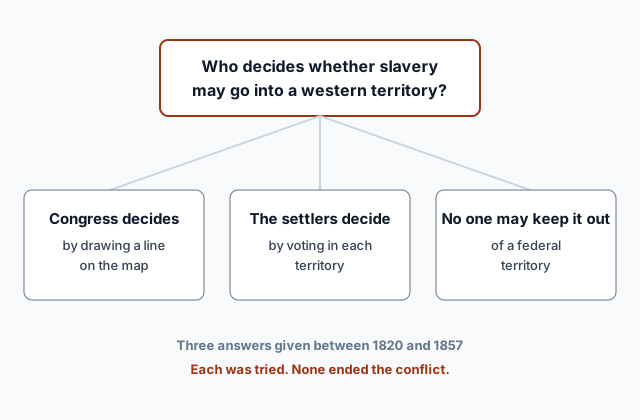 Tap to open the picture full size
Part 1 Think first Let the settlers decide?
Commit to a guess first. Being wrong now makes the right idea stick better.
Predict first
In 1854 Congress passed a law for two new territories west of Missouri, Kansas and Nebraska. Instead of Congress deciding whether slavery would be allowed there, the settlers would decide. What do you think happened in Kansas next?
In short. In the 1850s Congress and the Supreme Court each tried to settle whether slavery could spread into the western territories, and each attempt, the Kansas-Nebraska Act of 1854 and the Dred Scott decision of 1857, made the conflict worse while slavery and anti-immigrant nativism broke up the old national parties.
- The Kansas-Nebraska Act let settlers decide on slavery by popular sovereignty and declared the Missouri Compromise's ban north of its line void, which led to violence in Kansas and outrage in the North.
- The Dred Scott decision held that Black Americans descended from enslaved people could not be citizens and that Congress could not ban slavery from a territory, so it fed the conflict instead of ending it.
- Slavery and nativism weakened loyalty to the Democrats and Whigs, the Second Party System ended, and sectional parties rose, most of all the Republican Party in the North.
Part 2 Learn it Attempts to settle slavery in the territories, and why they failed
2a. The Kansas-Nebraska Act reopens the West
The Compromise of 1850 dealt with the land won from Mexico. It left open the rest of the West. In January 1854, Senator Stephen Douglas of Illinois introduced a bill that divided the land just west of Missouri into two territories, Kansas and Nebraska. Douglas argued for popular sovereignty: the settlers of a territory, not Congress, would decide whether slavery would be legal there. The act, passed on May 30, 1854, said that it was "the true intent and meaning of this act not to legislate slavery into any Territory or State, nor to exclude it therefrom."
That collided with an older deal. Under the Missouri Compromise of 1820, slavery was outlawed in Louisiana Purchase land north of the 36°30' line, and both new territories lay north of it. The new act said the 1820 ban "is hereby declared inoperative and void." Antislavery Northerners were outraged that land closed to slavery for more than thirty years was open again.
In Kansas, popular sovereignty turned an election into a race. Proslavery and antislavery settlers rushed in, the fighting earned the name "Bleeding Kansas," and the National Archives judges that the act "aggravated the split between North and South on the issue of slavery until reconciliation seemed virtually impossible."
Source: Kansas-Nebraska Act, with transcript (National Archives).
Quick check · Multiple choice
How did the Kansas-Nebraska Act of 1854 relate to the Missouri Compromise of 1820?
2b. The Supreme Court tries: Dred Scott
Dred Scott, an enslaved man, had lived with his enslaver at Fort Snelling, then in the free Territory of Wisconsin. In 1846 he and his wife, Harriet, sued for their freedom, claiming that they had become free by living in a territory where slavery was prohibited. On March 6, 1857, Chief Justice Roger B. Taney read the Supreme Court's majority opinion.
The Court ruled two things. First, a Black American whose ancestors had been brought to the country and sold as slaves, free or enslaved, could not be a citizen, so Scott could not sue in a federal court. Taney wrote that at the founding Black people had been regarded as "so far inferior, that they had no rights which the white man was bound to respect," and he relied on that reading of the founding to hold that they could not be citizens. Second, Congress had no authority to ban slavery from a federal territory. The Missouri Compromise ban, the opinion said, "is not warranted by the Constitution, and is therefore void."
A ruling meant to end the argument raised the stakes instead. If Congress could not keep slavery out of a territory, the central goal of the new Republican Party, which opponents of the Kansas-Nebraska Act had helped found, was unconstitutional by the Court's reading. The National Archives judges that the decision moved the nation a step closer to the Civil War.
Source: Dred Scott v. Sandford, with transcript (National Archives).
Quick check · Fill the statement
Complete the notes on Dred Scott v. Sandford (1857).
The Court ruled that a Black American descended from enslaved people could not be a , so Scott could not sue in a federal court. It also ruled that Congress had no power to ban slavery from a . Rather than calming the conflict, the decision made the plan to keep slavery out of the West look .
2c. The old parties break apart
By the 1830s two parties, the Democrats and the Whigs, had formed, and they competed for votes in both the North and the South. That contest is called the Second Party System. A party with members in both sections could be split from inside by a fight over slavery.
In the 1850s two issues wore down voters' loyalty to both parties. One was slavery in the territories, which the Kansas-Nebraska Act had reopened. The other was nativism, hostility to immigrants. Large numbers of newcomers, mainly from Ireland and Germany, kept arriving, and a strongly anti-Catholic nativist movement set out to limit their political power and cultural influence. Voters drawn to either cause had less reason to stay with the party they had always backed.
The Second Party System ended, and the strain showed even among the Democrats. A Democratic convention's platform of June 18, 1860, admitted that "difference of opinion exists in the Democratic party as to the nature and extent of the powers of a Territorial Legislature, and as to the powers and duties of Congress" over slavery in the territories. The most it could promise was that "the Democratic party will abide by the decision of the Supreme Court."
Quick check · Sort it
Each card describes a pull on voters in the 1850s. Tap a card, then the issue behind it.
Slavery in the territories
Anti-immigrant nativism
2d. A sectional party in the North
A sectional party draws its strength from one part of the country. The breakup of the old system fostered such parties, and the most important was new. Opponents of the Kansas-Nebraska Act helped found the Republican Party, which "opposed the spread of slavery into the territories." Its goal was free soil: western land kept open to free labor and closed to slavery.
Southern leaders saw a party that did not need them. In January 1861 Georgia's secession convention described it this way: "The party of Lincoln, called the Republican party, under its present name and organization, is of recent origin. It is admitted to be an anti-slavery party." And: "The prohibition of slavery in the Territories is the cardinal principle of this organization." Of the party's first run for president, Georgia wrote: "They raised their standard in 1856 and were barely defeated."
Read Georgia's words as a hostile source, written to justify leaving the Union. "Barely defeated" is Georgia's claim, chosen to make the threat look large, so do not take it as a vote count. What the passage does show is how Southern leaders saw a party that drew its strength from the North alone: as a danger to slavery.
Sources: Kansas-Nebraska Act (National Archives); Georgia's declaration of causes, 1861 (Avalon Project).
Quick check · Select all
Which two developments weakened loyalty to the Democrats and Whigs and helped end the Second Party System? Select two.
Select 2 answers, then check.
Part 3 Watch it done Connect the Kansas-Nebraska Act to the Republican Party
Watch each step, then do the last one yourself.
Explain how the Kansas-Nebraska Act of 1854 relates to the rise of the Republican Party.
Predict first
Before the steps, how do you think the two are connected?
Step 1 · State each development on its own
The Kansas-Nebraska Act, passed on May 30, 1854, let settlers in Kansas and Nebraska decide on slavery and declared the Missouri Compromise ban north of its line void. The Republican Party opposed the spread of slavery into the territories.
Why this step?
Why state each development before linking them?
A connection is a claim about two things at once. If you have not pinned down what each one was, you cannot tell whether one led to the other, answered it, or only happened nearby.
Step 2 · Look at the order and the people
Check the dates: the act passed in May 1854, and the new party first ran for president in 1856. Then ask who founded the party and what they were angry about.
Your step · Decide and justify
Finish it. Which connection best describes the two developments?
Which evidence best supports your answer?
Part 4 Try it Did the Court settle it?
Four years after Dred Scott, both sides were still arguing about what the Court's word was worth. In January 1861 Georgia's convention, defending slavery in the territories, offered "the judgment of the Supreme Court of the United States, the highest judicial tribunal of our country, in our favor." On March 4, 1861, in his First Inaugural Address, President Abraham Lincoln agreed that "such decisions must be binding in any case upon the parties to a suit as to the object of that suit." Then he added a warning: "if the policy of the Government upon vital questions affecting the whole people is to be irrevocably fixed by decisions of the Supreme Court, the instant they are made in ordinary litigation between parties in personal actions the people will have ceased to be their own rulers." He did not name the case, but read his words with Dred Scott in mind.
Sources: Georgia's declaration of causes, 1861 (Avalon Project); Lincoln's First Inaugural Address (Avalon Project).
Try it · Multiple choice
Read together, what do the two statements of 1861 show about the Dred Scott decision?
Try it · Spot the error
A student explains why the attempts of the 1850s failed to reduce conflict over slavery. Which line is the first to go wrong?
Part 5 Explain it Write it like a document-based answer
Nothing you type leaves this page. Check your answer against the model and each scoring point.
Free-response practice · Question 1 style
A short practice in the shape of the document-based question: three documents instead of seven, and a thesis with one body paragraph instead of a full essay.
Evaluate the extent to which the attempts of the 1850s to settle slavery in the territories reduced sectional conflict.
Document 1. Kansas-Nebraska Act, passed by Congress May 30, 1854: it was "the true intent and meaning of this act not to legislate slavery into any Territory or State, nor to exclude it therefrom."
Document 2. Dred Scott v. Sandford, majority opinion read by Chief Justice Roger B. Taney, March 6, 1857: the act of Congress banning slavery north of the Missouri Compromise line "is not warranted by the Constitution, and is therefore void."
Document 3. Georgia's declaration of the causes of secession, January 29, 1861: "The prohibition of slavery in the Territories is the cardinal principle of this organization." And: "They raised their standard in 1856 and were barely defeated."
Write a thesis, one sentence of historical context, and one paragraph that uses at least two documents and explains the purpose, audience, point of view or situation of one of them.
Model answer
Thesis: The attempts of the 1850s did little to reduce sectional conflict; by taking the decision on slavery away from Congress, first through popular sovereignty and then through the Court, each one reopened the West to slavery and drove Northern voters toward a sectional party.
Context: the Mexican Cession had already set off heated arguments over slavery in the new territories, and the Compromise of 1850 had not settled the rest of the West.
The Kansas-Nebraska Act promised Congress would neither bring slavery into a territory "nor to exclude it therefrom" (Document 1), but because Kansas lay north of the Missouri line, that promise opened land closed to slavery since 1820, and settlers fought over it. In 1857 the Court went further and declared the Missouri ban "void" (Document 2), so the free-soil answer many Northerners wanted was ruled out of the Constitution. By 1861 Georgia called stopping slavery in the territories the "cardinal principle" of the Republican Party, which it said had been "barely defeated" in 1856 (Document 3). Georgia wrote to justify secession, so it makes the Republican threat look as large as it can, but its alarm shows that the decade's attempts had produced a Northern party built on free soil instead of a settlement.
Score your own answer. This is a self-check, not a grade. Tick each point your answer makes.
Part 6 Check yourself Two parties, one dividing line
The case questions use the two excerpts. The others mix the ideas from the whole lesson.
The first excerpt is from the Democratic platform of June 18, 1860. The second is from Georgia's secession convention seven months later. Sources: Democratic Party Platform, 1860 (Avalon Project); Georgia's declaration of causes, 1861 (Avalon Project).
| Document | Excerpt |
|---|---|
| Democratic Party Platform, June 18, 1860 | "difference of opinion exists in the Democratic party as to the nature and extent of the powers of a Territorial Legislature" |
| Georgia's declaration of the causes of secession, January 29, 1861 | "The party of Lincoln, called the Republican party, under its present name and organization, is of recent origin. It is admitted to be an anti-slavery party." |
Case question 1 · Multiple choice
The 1860 Democratic excerpt is best understood as evidence of which development?
Case question 2 · Multiple choice
Georgia's description of the Republican Party best supports which claim?
The rest stand on their own and do not use the case.
Check yourself · Put it in order
Put these events in the order they happened, earliest first.
Check yourself · Match
Match each term to what it meant for slavery in the territories.
Part 7 Keep it Bring back earlier ideas
This lesson stands on the fight over the Mexican Cession from Topic 5.4 and the free-soil argument from Topic 5.5.
Bring it back · Multiple choice
The Mexican Cession of 1848 added vast western lands to the United States. Which issue made it the source of heated controversy in Congress?
Bring it back · Fill the statement
Read the situation, then complete the sentences.
A Northern carpenter in the 1850s says he has no quarrel with slavery in the South. What he fears is that slaveholders will bring enslaved workers west, and men like him will have to compete with people who are never paid. His worry is for the market that Northern workers depend on, and it is the core of the movement.
In three lines
- The Kansas-Nebraska Act let settlers decide on slavery and voided the Missouri Compromise ban, and Bleeding Kansas followed.
- The Dred Scott decision denied Black Americans citizenship and said Congress could not ban slavery from a territory, so the conflict deepened.
- Slavery and nativism ended the Second Party System and fostered sectional parties, above all the Republican Party in the North.
Exam strategy for this topic
- Section I Part A, Multiple Choice: 55 questions in 55 minutes.
- Section I Part B, Short Answer: 3 questions in 40 minutes.
- Section II, Document-Based Question and Long Essay: 2 questions in 100 minutes.
- This lesson's Explain it is shaped like free-response question 1, Document-based.
When a question asks how two developments relate, name both, then say which way the link runs (a cause, an effect, a reaction) and give the evidence that ties them, such as the act's opponents founding the Republican Party.
Questions students ask
Why did popular sovereignty lead to violence in Kansas?
It made slavery a question for the first territorial election. Proslavery and antislavery settlers rushed in, each side hoping to win that vote, and the conflict turned violent.
What exactly did the Supreme Court decide in Dred Scott?
Two things. A Black American descended from people brought to the country as slaves could not be a citizen and so could not sue in a federal court, and Congress had no authority to ban slavery from a federal territory, so the Missouri Compromise ban was void.
Was the Republican Party an abolitionist party?
Its program was free soil: it opposed the spread of slavery into the territories. Abolitionists wanted slavery ended everywhere. Southern leaders still called the Republicans an anti-slavery party, as Georgia's 1861 declaration does.
What did nativism have to do with the Civil War?
Nativism did not cause the war directly. Along with slavery, it weakened voters' loyalty to the Democrats and Whigs, which helped end the Second Party System and opened the way for sectional parties.
Why does the lesson quote Georgia's secession declaration on the Republican Party?
It shows how Southern leaders saw the party. Georgia wrote to justify leaving the Union, so read it as a hostile view, useful for what it reveals about Southern fears.
Course alignment, for teachers
AP U.S. History topic 5.6, Unit 5: Period 5: 1844–1877.
- Skill 5.B: Explain how a historical development or process relates to another historical development or process.
This lesson maps all 2 essential knowledge statements of the topic, and the one learning objective with none of its own, to the part that teaches each one: 3 are checked by a scored question. The map is in the lesson file.