Unit 2 · Topic 2.2 · about 30 minutes · 7 parts · 11 scored checks, 4 of them multiple choice
AP U.S. History 2.2: European Colonization
Unit 2: 6 to 8% of the multiple-choice section
What you'll be able to do
- Explain how and why various European colonies developed and expanded from 1607 to 1754, tracing each development to its causes.
Key vocabulary
| Term | What it means | The exam trap |
|---|---|---|
| Subjugation | Bringing a people under another's control, usually by force, and keeping them there. | Subjugation and conversion are different aims, even when one colony pursued both at once. |
| Trade alliance | An agreement between two peoples to trade with each other and to stand by each other. | An alliance between unequal partners is still an alliance, not the same thing as rule by one side. |
| Intermarriage | Marriage between members of different groups, here European colonists and American Indians. | Do not assume intermarriage was equally common in every empire; the course ties it to particular empires. |
| Social mobility | The chance to rise to a better position in society, for example by coming to own land. | Social mobility means moving up in society, not moving from one place to another. |
 Tap to open the picture full size
Part 1 Think first Who needed the neighbors more?
Commit to a guess first. Being wrong now makes the right idea stick better.
Predict first
In 1606 England's charter for Virginia granted its colonists "all the Lands, Woods, Soil, Grounds, Havens, Ports, Rivers, Mines, Minerals" along their stretch of coast and said they "shall and may inhabit and remain there." In 1626 a ship from the Dutch colony of New Netherland reached Amsterdam carrying "7246 beaver skins, 17886 otter skins." Which colony do you think depended more on staying on good terms with nearby American Indians?
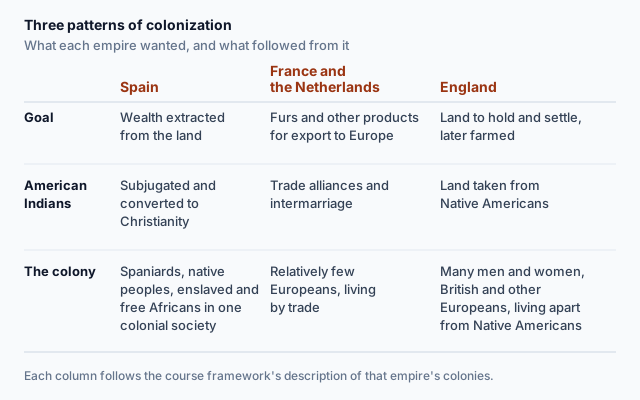
In short. European colonies in North America developed differently because each empire wanted different things: Spain wealth drawn from native labor, France and the Netherlands furs gained through trade alliances, and England land for a large number of farming settlers.
- Spanish efforts to extract wealth led to institutions that subjugated native peoples, converted them to Christianity and drew them, with enslaved and free Africans, into Spanish colonial society.
- French and Dutch colonies had relatively few Europeans and relied on trade alliances and intermarriage with American Indians to get furs and other goods for Europe.
- English colonization drew comparatively many men and women seeking a better life; they farmed land taken from Native Americans and lived apart from them.
Part 2 Learn it Three patterns of colonization
2a. Spain: wealth, conversion and one colonial society
Spain came first. Its conquests of the 1500s had built a large empire before Period 2 began, and its colonies in North America kept the same aim: to extract wealth from the land.
That aim shaped Spain's institutions. Wealth from mines and plantations took labor, so the Spanish built institutions based on subjugating native populations, bringing them under Spanish control and putting them to work, as the encomienda system did (Topic 1.5 covers it). They set out to convert native peoples to Christianity. And they incorporated native peoples, along with enslaved and free Africans, into Spanish colonial society.
So the Spanish pattern is not separation. Spaniards, native peoples and Africans lived inside one colonial society, bound together by Spanish rule, with native peoples subjugated within it. Keep that picture in mind for the English pattern in 2c.
Quick check · Multiple choice
Which best explains why Spanish colonies drew native peoples into colonial society instead of living apart from them?
2b. France and the Netherlands: furs and alliances
French and Dutch colonial efforts involved relatively few Europeans. They relied on trade alliances and on intermarriage with American Indians to build economic and diplomatic relationships, and to acquire furs and other products for export to Europe.
In 1603, just before Period 2, King Henry IV of France sent the Sieur de Monts "to people and inhabit the lands, shores, and countries of Acadia" and "there to establish our authority." He paid for it with a monopoly: "to support its expenses," de Monts and his partners alone could "trade in pelts and other merchandises during ten years." The settlement would live by trade with native peoples. In 1621 the Dutch West India Company could "make contracts, engagements and alliances with the princes and natives of the countries comprehended therein." In 1626 a ship from New Netherland reached Amsterdam with "7246 beaver skins, 17886 otter skins."
The reasoning runs as a chain. The goal was furs and other goods to sell in Europe. With few colonists of their own, French and Dutch traders depended on American Indian partners to supply them, and alliances, sometimes joined by marriage, kept the trade going.
Sources: Charter of Acadia, 1603 (Avalon Project); Charter of the Dutch West India Company, 1621 (Avalon Project); Notification of the Purchase of Manhattan, 1626 (Avalon Project).
Quick check · Fill the statement
Read the situation, then complete the sentences.
A French trader in the 1600s lives on a river far from any French town. He marries into a native family, and each spring his wife's relatives bring him furs, which he loads onto a ship that will cross the Atlantic. His marriage is an example of . The furs are a product for .
2c. England: many settlers, farms and taken land
English colonization attracted a comparatively large number of British migrants, both men and women, and other European migrants as well. They came seeking social mobility, economic prosperity, religious freedom and better living conditions.
The 1606 Virginia charter shows the claim to land from the start. It granted the colonists "all the Lands, Woods, Soil, Grounds, Havens, Ports, Rivers, Mines, Minerals" for fifty miles each way along the coast and a hundred miles inland, and said they "shall and may inhabit and remain there." It still hoped for mines, as Topic 2.1 showed, so it claims land to hold and settle rather than setting out a plan for farms. It also hoped the colony might bring "the Infidels and Savages, living in those parts, to human Civility, and to a settled and quiet Government," in the king's words.
As the English colonies grew, their colonists focused on agriculture. They settled on land taken from Native Americans and lived separately from them, not inside one shared colonial society. The French and Dutch depended on native partners for trade; the English mainly needed the land itself.
Quick check · Spot the error
A student explains why English colonies developed differently from French ones. Which line is the first to go wrong?
Part 3 Watch it done Explain a Dutch colony from its own report
Watch each step, then do the last one yourself.
In November 1626 a Dutch official in Amsterdam, P. Schagen, passed on to his government what the crew of a ship from New Netherland reported. The colonists "have purchased the island Manhattes from the Indians for the value of 60 guilders," the cargo began with "7246 beaver skins, 17886 otter skins," and "our people are in good heart and live in peace there." Explain why New Netherland developed as a colony of trade.
Predict first
Before the steps, which part of the report do you think best shows what the colony was for?
Step 1 · Name the development
New Netherland was sending home a cargo made up mostly of animal skins. The report also says the colony bought Manhattan from the Indians, but it is the Dutch account, passed on secondhand, and what the island's native people understood the exchange to mean is not in it.
Why this step?
Why start from what the colony was doing rather than from a list of facts about the Dutch?
Explaining a development means giving its causes. You cannot pick the right cause until you are clear about what needs explaining.
Step 2 · Find the cause in the empire's goal
Ask what the Dutch wanted from North America, and how many of their own people they sent. Then ask what kind of relationship with American Indians that goal, and those numbers, would require.
Your step · Decide and justify
Finish it. Why did New Netherland develop as a colony of trade?
Which detail from the report best supports your answer?
Part 4 Try it Whose pattern is it?
Each card below is a short note an imagined colonist might write. None is a real document. Use what you know about each empire's goals to place it.
Try it · Sort it
Tap a card, then the empire whose pattern of colonization it fits best.
Spanish
French or Dutch
English
Part 5 Explain it Write it like a document-based answer
Nothing you type leaves this page. Check your answer against the model and each scoring point.
Free-response practice · Question 1 style
A short practice in the shape of the document-based question: three documents instead of seven, and a thesis with one body paragraph instead of a full essay.
Evaluate the extent to which European colonizers' goals shaped their dealings with American Indians in the early 1600s.
Document 1. Charter of Acadia, granted by King Henry IV of France to the Sieur de Monts, December 18, 1603: he is sent "to people and inhabit the lands, shores, and countries of Acadia" so that French subjects may come "to dwell there, and to trade with the savage inhabitants of the said places," and, "to support its expenses," he and his partners alone may "trade in pelts and other merchandises during ten years."
Document 2. Notification of the Purchase of Manhattan, written in Amsterdam by a Dutch official from a ship's report, November 5, 1626: "They have purchased the island Manhattes from the Indians for the value of 60 guilders." The ship's cargo: "7246 beaver skins, 17886 otter skins" and other goods.
Document 3. The First Charter of Virginia, granted by King James of England, April 10, 1606: the colonists receive "all the Lands, Woods, Soil, Grounds, Havens, Ports, Rivers, Mines, Minerals" of their grant, and the king hopes the colony may bring "the Infidels and Savages, living in those parts, to human Civility, and to a settled and quiet Government."
Write a thesis, one sentence of historical context, and one paragraph that uses at least two documents and explains the purpose, audience, point of view or situation of one of them.
Model answer
Thesis: In the early 1600s colonizers' goals largely shaped their dealings with American Indians. France and the Netherlands, whose colonies were to live on the fur trade, planned for and carried on trade with native peoples, while England handed its colonists the land itself. The limit is that France also planned to settle, so the empires differed in what their settlements would live on, not in whether they settled at all.
Context: by 1600 Spain had built a large American empire on conquest and native labor, and other European powers were looking for their own sources of wealth in North America.
France's 1603 charter sent de Monts "to people and inhabit" Acadia so that French subjects could "dwell there, and to trade with the savage inhabitants," and it paid for the venture with a monopoly to "trade in pelts" (Document 1). A settlement that lived on furs needed native partners. The Dutch report of 1626 shows a trade colony at work: its cargo began with "7246 beaver skins" and it records a purchase of Manhattan "from the Indians" (Document 2). That report is the Dutch account, written in Amsterdam from what a ship's crew said, so it shows how the Dutch saw the exchange, not what the island's native people understood they had agreed to. England's charter instead hands the colonists "all the Lands, Woods, Soil" (Document 3) and treats native peoples as "Infidels and Savages" to be brought "to human Civility," a plan built around land rather than partnership.
Score your own answer. This is a self-check, not a grade. Tick each point your answer makes.
Part 6 Check yourself Two royal grants, three years apart
The case questions use the two excerpts. The others mix the ideas from the whole lesson.
The first excerpt is from the French king's grant for Acadia; the second is from the English king's grant for Virginia. Sources: Charter of Acadia, 1603 (Avalon Project); First Charter of Virginia, 1606 (Avalon Project).
| Document | Excerpt |
|---|---|
| Charter of Acadia, France, December 18, 1603 | the Sieur de Monts is sent "to people and inhabit the lands, shores, and countries of Acadia," and, "to support its expenses," he and his partners alone may "trade in pelts and other merchandises during ten years" |
| The First Charter of Virginia, England, April 10, 1606 | the colonists shall have "all the Lands, Woods, Soil, Grounds, Havens, Ports, Rivers, Mines, Minerals" of their grant, and they "shall and may inhabit and remain there" |
Case question 1 · Multiple choice
In the 1603 excerpt, what does the monopoly on pelts show about how France meant to carry out its colony in Acadia?
Case question 2 · Multiple choice
Which difference between the two grants best fits the way English colonization developed?
The rest stand on their own and do not use the case.
Check yourself · Match
Match each development to the cause that best explains it.
Check yourself · Select all
Which two statements describe French and Dutch colonization in North America? Select two.
Select 2 answers, then check.
Part 7 Keep it Bring back earlier ideas
This lesson stands on the big picture of Topic 2.1 and the Spanish labor system of Topic 1.5.
Bring it back · Multiple choice
Two British colonies founded in the 1600s develop very differently. One grows crops for export in a warm climate; the other is settled by a religious community on rocky soil. Which explanation best fits the period?
Bring it back · Fill the statement
Read the situation, then complete the sentences.
A Spanish colonist in the 1500s is granted the labor of the people living on the lands around his estate. They must work his fields and dig in his silver mine. This arrangement is the system, and it put labor to work for the colonial economy.
In three lines
- Spain's search for wealth led to institutions that subjugated and converted native peoples and drew them, with Africans, into one colonial society.
- France and the Netherlands, with few colonists, relied on trade alliances and intermarriage with American Indians to get furs for Europe.
- England sent many men and women who farmed land taken from Native Americans and lived apart from them.
Exam strategy for this topic
- Section I Part A, Multiple Choice: 55 questions in 55 minutes.
- Section I Part B, Short Answer: 3 questions in 40 minutes.
- Section II, Document-Based Question and Long Essay: 2 questions in 100 minutes.
- This lesson's Explain it is shaped like free-response question 1, Document-based.
When a question asks you to explain how or why a colony developed as it did, start from the empire's goal and the number of colonists it sent, then trace how those shaped its relations with American Indians.
Questions students ask
Were French and Dutch colonists friendlier to American Indians than the English were?
The course does not explain the difference by character. French and Dutch colonies had relatively few Europeans and needed native partners for the fur trade, while English colonists came in larger numbers to farm land taken from Native Americans.
Why does the lesson quote no Spanish document?
No Spanish colonial text from this period could be checked against the archives this site quotes, so the Spanish part of the lesson follows the course framework's own description.
Why does the Charter of Acadia come from 1603, before Period 2 begins?
It is the founding grant for a French colony that carried on into the period, so it shows the goal the French brought with them.
Did the Dutch really buy Manhattan?
The report this lesson quotes says so, but it is a Dutch official's account, written in Amsterdam from what a ship's crew said. It does not record what the island's native people understood the exchange to mean.
Why do the old charters call native peoples savages?
The words are the kings' own, printed as the archive gives them. They show how the colonizers saw the people whose land and trade they wanted, which is evidence about the colonizers' point of view.
Where can I read these documents in full?
Each excerpt links to its full text at the Avalon Project at Yale Law School, the primary-source collection this lesson was checked against.
Course alignment, for teachers
AP U.S. History topic 2.2, Unit 2: Period 2: 1607–1754.
- Skill 1.B: Explain a historical concept, development, or process.
This lesson maps all 3 essential knowledge statements of the topic, and the one learning objective with none of its own, to the part that teaches each one: 4 are checked by a scored question. The map is in the lesson file.