Unit 6 · Topic 6.13 · about 30 minutes · 7 parts · 12 scored checks, 4 of them multiple choice
AP U.S. History 6.13: Politics in the Gilded Age
Unit 6: 10 to 17% of the multiple-choice section
What you'll be able to do
- Explain the similarities and differences between the political parties during the Gilded Age, and judge how a piece of evidence supports, modifies or refutes a claim about them.
Key vocabulary
| Term | What it means | The exam trap |
|---|---|---|
| Protective tariff | A tax on imported goods set high to shield American industries from foreign competition. | Every tariff raises revenue; a protective one is meant mainly to shelter home industry. |
| Spoils system | The practice of rewarding political friends and supporters with government jobs. | The Pendleton Act did not end it at once; its rules at first covered only a tenth of federal workers. |
| Civil service | The government's nonmilitary workers, whose hiring the Pendleton Act began to base on competitive examinations. | Civil service reform changed how workers were hired, not which party won elections. |
| Political machine | A party organization that ran a city's politics, winning loyalty in part by giving immigrants and the poor social services. | Machines were not only corrupt; their services are why many city voters stood by them. |
| People's (Populist) Party | A party created by agrarian activists amid economic instability, calling for a stronger government role in regulating the economy. | It was a challenge to both major parties, not a wing of either one. |
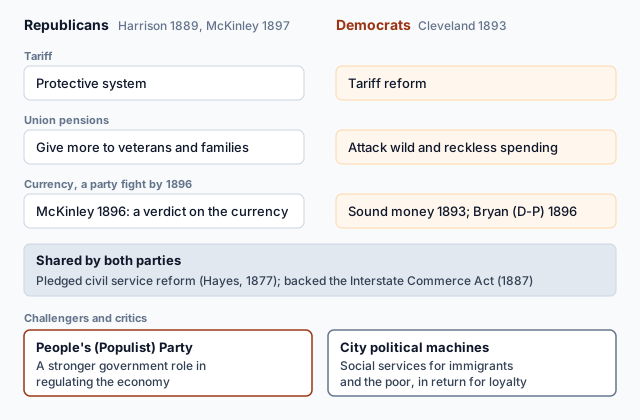 Tap to open the picture full size
Part 1 Think first How different were the parties?
Commit to a guess first. Being wrong now makes the right idea stick better.
Predict first
In 1877 President Rutherford B. Hayes called for reform of the civil service, the way the government hired its workers. He said that on this question "both political parties are virtually pledged to give it their unreserved support." How do you think the two major parties of the Gilded Age compared?
In short. Gilded Age Republicans and Democrats traded the presidency while fighting over tariffs, currency and the memory of the Civil War; reformers charged that greed had corrupted government, farmers formed the People's Party, and city machines won votes by helping immigrants and the poor.
- Republican Benjamin Harrison praised "our protective system" and generous Union pensions; Democrat Grover Cleveland led a party pledged to tariff reform and attacked "wild and reckless pension expenditure."
- Economic instability led agrarian activists to create the People's (Populist) Party, which called for a stronger government role in regulating the economy.
- Reformers argued that greed and self-interest had corrupted every level of government; the Pendleton Act of 1883 began to replace the spoils system, while urban political machines thrived by providing social services.
Part 2 Learn it Parties, challengers and machines
2a. Tariffs and the memory of the war
The presidency changed hands between the Republicans and Democrats. The National Archives lists Benjamin Harrison, a Republican [R], as the winner over Democrat Grover Cleveland [D] in 1888, and Cleveland as the winner over Harrison in 1892.
The parties contended over the tariff, a tax on imported goods. A protective tariff is set high to shield American industries from foreign competition. Harrison told the nation in 1889: "I look hopefully to the continuance of our protective system." Cleveland, back in office in 1893, said voters had "condemned the injustice of maintaining protection for protection's sake" and had chosen "a political party pledged in the most positive terms to the accomplishment of tariff reform."
Both parties also appealed to lingering divisions from the Civil War. Harrison urged: "Our pension laws should give more adequate and discriminating relief to the Union soldiers and sailors and to their widows and orphans." Harrison also tied the South's new factories to the end of slavery: "Mill fires were lighted at the funeral pile of slavery." Cleveland attacked "wild and reckless pension expenditure," and in 1885 had asked Americans to "abandon all sectional prejudice and distrust," a sign of how deep the war's divisions still ran.
Sources: 1888 and 1892 results (National Archives); Harrison, 1889 and Cleveland, 1893 (Avalon Project).
Quick check · Sort it
Tap a card, then the president who said it.
Harrison, Republican, 1889
Cleveland, Democrat, 1893
2b. Money, hard times and a new party
The parties also contended over currency, what the nation's money should rest on. In 1877 Hayes said that "the feeling of uncertainty inseparable from an irredeemable paper currency, with its fluctuation of values, is one of the greatest obstacles to a return to prosperous times." Irredeemable paper money could not be exchanged for coin. In 1893 Cleveland, a Democrat, called for "a sound and stable currency" and spoke of "differences of opinion" over it.
Hard times fell hardest on farmers. Railroad rates had long hurt small shippers, and in 1897 McKinley said: "The depression of the past four years has fallen with especial severity upon the great body of toilers of the country, and upon none more than the holders of small farms." Economic instability inspired agrarian activists to create the People's (Populist) Party, which called for a stronger governmental role in regulating the American economic system.
By 1896 money was a party fight. The National Archives lists William J. Bryan, beaten by Republican William McKinley, under a joint label, D-P: Democrats and Populists behind one candidate. McKinley called the result a verdict for "the integrity of its currency" and promised that silver would be kept at par with gold.
Sources: Hayes, 1877, Cleveland, 1893 and McKinley, 1897 (Avalon Project); 1896 results (National Archives).
Quick check · Multiple choice
How did the People's Party differ most from the major-party leaders of the 1890s?
2c. Spoils, reformers and machines
Reformers argued that economic greed and self-interest had corrupted all levels of government. One target was the spoils system, in which officials rewarded political friends and supporters with government jobs. In 1877 Hayes called for a return to the practices of the nation's founders, who, he said, held that "appointments to office were not to be made nor expected merely as rewards for partisan services."
After President James A. Garfield was assassinated by a disgruntled job seeker, Congress passed the Pendleton Act in January 1883. It called for "open, competitive examinations for testing the fitness of applicants for the public service." At first its hiring rules covered only 10 percent of the government's 132,000 employees. A decade later Cleveland praised civil service reform for working to "remove from political action the demoralizing madness for spoils."
In the cities, access to power was unequally distributed. Political machines, party organizations that ran city politics, thrived there, in part by providing immigrants and the poor with social services that won their loyalty and votes.
Sources: Hayes, 1877 (Avalon Project); Pendleton Act (National Archives).
Quick check · Fill the statement
Complete the sentences.
The Pendleton Act of 1883 required for some federal jobs, a blow to the . In the cities, political machines thrived in part by giving social services.
Part 3 Watch it done Test a president's claim against the election record
Watch each step, then do the last one yourself.
In his second inaugural address, March 4, 1893, Grover Cleveland spoke of "The verdict of our voters which condemned the injustice of maintaining protection for protection's sake." How does the result of the 1896 election affect his claim that voters had turned against the protective tariff?
Predict first
Before the steps: do you expect the later evidence to support, modify or refute Cleveland's claim?
Step 1 · State the claim exactly
Cleveland claims that the 1892 vote was a verdict against protection kept for its own sake. The claim is about what voters wanted in 1892, and it implies the question was settled.
Why this step?
Why pin the claim down before looking at evidence?
Evidence can only support, modify or refute a claim you have stated precisely. A loose claim lets any evidence seem to fit.
Step 2 · Line up the evidence by date
1888: Republican Harrison beat Cleveland, 233 electoral votes to 168. 1892: Cleveland beat Harrison, 277 to 145. 1896: Republican William McKinley won, 271 to 176. In March 1897 McKinley said the country "is committed by its latest popular utterance to the system of tariff taxation." That is McKinley's own reading of his win; he also called the result a verdict on the currency, so 1896 was not a vote on the tariff alone.
Your step · Decide and justify
Finish it. How does the 1896 evidence affect Cleveland's claim?
Which evidence best supports your answer?
Part 4 Try it Where the parties agreed
Differences make headlines, but a strong answer also tests them against likenesses. In 1877 Hayes noted that both great parties, in declaring their principles before the election, gave a prominent place to civil service reform, and said that "both political parties are virtually pledged to give it their unreserved support." A decade later, the Interstate Commerce Act became law with the support of both major parties.
Try it · Multiple choice
A student argues that the two major parties of the Gilded Age disagreed on every major issue. How does Hayes's 1877 statement that both parties were pledged to civil service reform affect that argument?
Try it · Spot the error
A student writes a paragraph comparing the parties. Which line is the first to go wrong?
Part 5 Explain it Write it like a document-based answer
Nothing you type leaves this page. Check your answer against the model and each scoring point.
Free-response practice · Question 1 style
A short practice in the shape of the document-based question: three documents instead of seven, and a thesis with one body paragraph instead of a full essay.
Evaluate the extent to which the major political parties differed in the Gilded Age.
Document 1. Rutherford B. Hayes, Inaugural Address, March 5, 1877, on reform of the civil service: "both political parties are virtually pledged to give it their unreserved support."
Document 2. Benjamin Harrison, Republican, Inaugural Address, March 4, 1889: "I look hopefully to the continuance of our protective system." And: "Our pension laws should give more adequate and discriminating relief to the Union soldiers and sailors and to their widows and orphans."
Document 3. Grover Cleveland, Democrat, Second Inaugural Address, March 4, 1893, on his party's victory: "The verdict of our voters which condemned the injustice of maintaining protection for protection's sake." He also attacked "wild and reckless pension expenditure."
Write a thesis, one sentence of historical context, and one paragraph that uses at least two documents and explains the purpose, audience, point of view or situation of one of them.
Model answer
Thesis: The Gilded Age parties differed sharply on the tariff, on Civil War pensions and, by 1896, on the currency, but they shared more than their campaigns admitted, including a pledge to civil service reform.
Context: after Garfield's assassination by a disgruntled job seeker and amid hard times for farmers, reformers charged that greed had corrupted government and agrarian activists created the People's Party to demand a stronger government role in the economy.
Harrison, a Republican, looked forward to "the continuance of our protective system" and asked for more for Union veterans (Document 2), while Cleveland, a Democrat, said voters had condemned "protection for protection's sake" and attacked "wild and reckless pension expenditure" (Document 3). Both men spoke at their inaugurations, to the whole nation and to the voters who had just elected them, so each presented his party's program as the people's verdict; their claims show what each party stood for more than what all voters wanted. Yet Hayes said in 1877 that both parties were pledged to civil service reform (Document 1). The parties split on the tariff and pensions, but on reform of the civil service they stood closer than their campaigns suggested.
Score your own answer. This is a self-check, not a grade. Tick each point your answer makes.
Part 6 Check yourself Three presidents on money
The case questions use the three excerpts. The others mix ideas from the whole lesson.
Each excerpt is from an inaugural address. Sources: Hayes, 1877, Cleveland, 1893 and McKinley, 1897 (Avalon Project); party labels from the National Archives election results for 1892 and 1896.
| President and year | Excerpt |
|---|---|
| Rutherford B. Hayes, 1877 | "the feeling of uncertainty inseparable from an irredeemable paper currency, with its fluctuation of values, is one of the greatest obstacles to a return to prosperous times." |
| Grover Cleveland, Democrat, 1893 | "Manifestly nothing is more vital to our supremacy as a nation and to the beneficent purposes of our Government than a sound and stable currency." And: "in our efforts to adjust differences of opinion we should be free from intolerance or passion, and our judgments should be unmoved by alluring phrases and unvexed by selfish interests" |
| William McKinley, Republican, 1897 | Silver money: "the value of the silver already coined and of that which may hereafter be coined, must be kept constantly at par with gold by every resource at our command." On the 1896 election: "The credit of the Government, the integrity of its currency, and the inviolability of its obligations must be preserved. This was the commanding verdict of the people." He hoped that "our finances cease to be the subject of mere partisan contention." |
Case question 1 · Multiple choice
What idea do all three excerpts share?
Case question 2 · Select all
Which two claims about Gilded Age politics do the excerpts support? Select two.
Select 2 answers, then check.
The rest stand on their own and do not use the case.
Check yourself · Match
Match each term to its description.
Check yourself · Put it in order
Put these events in the order they happened, earliest first.
Part 7 Keep it Bring back earlier ideas
This lesson stands on the arguments about government's role from Topic 6.12 and the reform efforts of Topic 6.11.
Bring it back · Multiple choice
A Gilded Age president refuses federal aid to farmers hurt by a drought, saying that such help weakens self-reliance and that competition serves the country best in the long run. Which view does this reflect?
Bring it back · Select all
In the Gilded Age, many women sought greater equality with men. Which two were common ways they did so? Select two.
Select 2 answers, then check.
In three lines
- Republicans and Democrats traded the presidency and fought over the tariff, Civil War pensions and, by 1896, the currency, yet shared pledges such as civil service reform.
- Economic instability led agrarian activists to form the People's (Populist) Party, which called for a stronger government role in the economy.
- Reformers attacked corruption and the spoils system, while city machines thrived by giving immigrants and the poor social services.
Exam strategy for this topic
- Section I Part A, Multiple Choice: 55 questions in 55 minutes.
- Section I Part B, Short Answer: 3 questions in 40 minutes.
- Section II, Document-Based Question and Long Essay: 2 questions in 100 minutes.
- This lesson's Explain it is shaped like free-response question 1, Document-based.
When asked how evidence affects an argument, say whether it supports, modifies or refutes it, and point to the exact part of the argument the evidence touches.
Questions students ask
If the parties agreed on some things, why did voters care which one won?
They split on real issues: the tariff, pensions for Union veterans and, by 1896, money. Each also drew on loyalties left from the Civil War. In 1885 Cleveland asked Americans to "abandon all sectional prejudice and distrust," a sign of how strong those loyalties still were.
What did the People's Party want?
Agrarian activists created it amid economic instability, and it called for a stronger governmental role in regulating the economy. In 1896 the National Archives lists the losing candidate, William J. Bryan, under the joint label D-P, Democrats and Populists together.
Why did Garfield's assassination matter for civil service reform?
He was killed by a disgruntled job seeker, which made the dangers of the spoils system plain. Congress passed the Pendleton Act in January 1883.
Did political machines only harm their cities?
Reformers saw them as corrupt, but machines thrived in part because they gave immigrants and the poor social services, in cities where access to power was unequally distributed.
Where can I read these documents in full?
Each excerpt links to its full text at the National Archives or the Avalon Project at Yale Law School, the primary-source collections this lesson was checked against.
Course alignment, for teachers
AP U.S. History topic 6.13, Unit 6: Period 6: 1865–1898.
- Skill 3.D: Explain how claims or evidence support, modify, or refute a source’s argument.
This lesson maps all 3 essential knowledge statements of the topic, and the one learning objective with none of its own, to the part that teaches each one: 4 are checked by a scored question. The map is in the lesson file.