Unit 4 · Topic 4.12 · about 30 minutes · 7 parts · 13 scored checks, 5 of them multiple choice
AP U.S. History 4.12: African Americans in the Early Republic
Unit 4: 10 to 17% of the multiple-choice section
What you'll be able to do
- Explain the continuities and changes in the experience of African Americans from 1800 to 1848, and explain how evidence from the sources supports, modifies or refutes an argument about that experience.
Key vocabulary
| Term | What it means | The exam trap |
|---|---|---|
| Insurrection | An armed rising against a government or an authority; here, a revolt by enslaved people against slavery. | A plot discovered before it began can still be counted among the attempts at insurrection; check whether a source means a plan or a fight. |
| Free African American | An African American who was not enslaved, whether born free or freed by law, by an owner or by escape. | Free did not mean equal; many states limited the rights of free African Americans. |
| African Church | A name used at the time, and by Du Bois, for the churches African Americans founded in Northern cities. | These were churches founded by African Americans in America, not churches in Africa. |
| Abolitionist | A person who worked to end slavery. | Abolitionists did not all agree on how to end slavery or how fast. |
| Domestic slave trade | The buying and selling of enslaved people within the United States. | It could carry a person hundreds of miles from home, across state lines. |
 Tap to open the picture full size
Part 1 Think first Did any revolt succeed?
Commit to a guess first. Being wrong now makes the right idea stick better.
Predict first
Frederick Douglass was an enslaved boy in Baltimore when news came of Nat Turner's revolt in Virginia. Years later he remembered that afterward "the alarm and terror had not subsided." Between 1800 and 1848, how often do you think a revolt by enslaved people in the South ended slavery, even in one place?
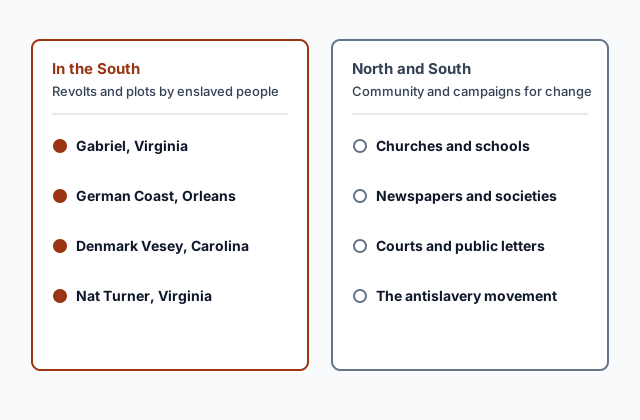
In short. From 1800 to 1848, antislavery efforts in the South were largely limited to rebellions by enslaved people, and every one failed; meanwhile enslaved and free African Americans built communities, protected their families and dignity, and joined political efforts to change their status.
- Gabriel's plot in 1800, the German Coast uprising in 1811, Vesey's plot in 1822 and Nat Turner's revolt in 1831 all failed.
- Enslaved people protected family and dignity in daily life, by working small plots for their families, by learning to read and teaching others, and by weighing escape against the family they would leave behind.
- Free African Americans built churches, schools, newspapers and societies, and used courts, public letters and the antislavery movement to press for change.
Part 2 Learn it Resistance, family and community
2a. Revolts in the South
In the South, antislavery efforts were largely limited to rebellions by enslaved people, and none succeeded. Du Bois, writing in 1903, counted three great attempts, by Gabriel in 1800, Vesey in 1822 and Nat Turner in 1831. The course framework adds the German Coast uprising of 1811, in the Territory of Orleans. Gabriel, an enslaved blacksmith, plotted to capture Richmond, Virginia's capital, and end slavery; he and twenty-five of his followers were executed.
Failed revolts left fear behind. Douglass recalled that after Turner's revolt "the alarm and terror had not subsided." In St. Michael's, a Maryland town, he later helped run a Sabbath school "at the house of a free colored man in St. Michael's, named James Mitchell," "simply teaching a few colored children how to read the gospel of the Son of God." A mob drove them off and ordered them never to meet again. Douglass wrote: "One of this pious crew told me, that as for my part, I wanted to be another Nat Turner."
The white community there, he said, "frowned upon everything like imparting instruction either to slaves or to free colored persons." To the mob, a school for Black children looked like the start of another rising.
Sources: The Souls of Black Folk, 1903 (Avalon Project); My Bondage and My Freedom, 1855 (Avalon Project). The German Coast uprising is among the AP U.S. History course framework's examples for this topic; Gabriel's plot and the executions are from its Period 3 examples.
Quick check · Multiple choice
Which statement best describes antislavery efforts in the South from 1800 to 1848?
2b. Protecting family and dignity under slavery
The law gave enslaved families no protection. Sojourner Truth's narrative, published in 1850, notes that enslaved people were not husbands and wives in law, so a husband, wife or child could be sold away. Enslaved people still found ways to protect their families and their dignity.
Some worked for their families on the little time that was their own. Truth's parents, enslaved in New York, were given a small plot of land. On evenings and Sundays they raised tobacco, corn or flax and traded it for extra food and clothing for their children.
Some chose family over freedom. Douglass, who escaped from Baltimore on September 3, 1838, wrote that thousands more would have escaped but for "the strong cords of affection that bind them to their families, relatives and friends." Staying could itself be a decision to protect people one loved.
And some protected their minds. Douglass learned to read as a boy, and as a young man he taught others, in the Sabbath school at St. Michael's that the mob broke up. Reading was a kind of dignity no owner had granted.
Sources: The Narrative of Sojourner Truth, 1850 (Avalon Project); My Bondage and My Freedom, 1855 (Avalon Project).
Quick check · Sort it
Enslaved people responded to slavery in more than one way. Tap a card, then the response it shows.
Protecting family and dignity within slavery
Revolt to overthrow slavery by force
2c. Free communities
Free African Americans, in the North and in Southern cities such as Baltimore, built institutions of their own. Du Bois wrote that in Philadelphia and New York, discrimination drove Black worshipers out of white churches, and they formed "a peculiar socio-religious institution among the Negroes known as the African Church." Sojourner Truth's narrative says that in New York City she had "joined the African Church in Church street." In Boston, the free Black community built the African Meeting House in 1806, a church, a school and a meeting place for abolitionists.
They started newspapers too. John Russwurm and Samuel Cornish founded Freedom's Journal in New York City in 1827, the first newspaper owned and run by African Americans.
In Baltimore, free young Black men organized the "East Baltimore Mental Improvement Society," a debating club the enslaved Douglass was allowed to join. "Many of the young calkers could read, write and cipher." A calker sealed the seams of wooden ships. A society meant to improve the mind was a claim to equal worth.
Sources: The Souls of Black Folk (Avalon Project); Narrative of Sojourner Truth (Avalon Project); My Bondage and My Freedom (Avalon Project). The African Meeting House and Freedom's Journal are from the AP U.S. History course framework's examples.
Quick check · Fill the statement
Complete the notes on free African American communities.
The African Meeting House in Boston served as a church, a school and a meeting place, an example of a built by free African Americans. Freedom's Journal, founded in 1827, was the first owned and run by African Americans.
2d. Using the law and politics
African Americans also joined political efforts to change their status. In 1813, James Forten, a free Black businessman in Philadelphia, published letters against a bill in Pennsylvania's senate that proposed to ban people of color from the state.
Sojourner Truth went to court. New York was ending slavery gradually, and "The law expressly prohibited the sale of any slave out of the State." Her owner sold her son Peter, a boy of five, to a man who passed him on to a planter in Alabama, against that law. When she learned of it, "she immediately started on foot and alone, to find the man who had thus dared, in the face of all law, human and divine, to sell her child out of the State." She found lawyers and pressed her case; she wanted no money, for "it was her son, and her son alone she wanted, and her son she must have." As Truth understood it, the judge ordered the "boy be delivered into the hands of the mother."
Douglass, after his escape, joined the abolitionists and spent years speaking for the movement.
Sources: Narrative of Sojourner Truth (Avalon Project). Forten's letters are from the AP U.S. History course framework's examples.
Quick check · Match
Match each person to the way they worked to change African Americans' status or protect their families.
Part 3 Watch it done Test Du Bois's argument against Douglass
Watch each step, then do the last one yourself.
In The Souls of Black Folk (1903), in an essay on Booker T. Washington and other Black leaders, the scholar W. E. B. Du Bois wrote of the early 1800s: "The slaves in the South, aroused undoubtedly by vague rumors of the Haytian revolt, made three fierce attempts at insurrection" (spelling as printed). Then: "In the Free States, on the other hand, a new and curious attempt at self-development was made." Explain how Douglass's account of the Sabbath school at St. Michael's, Maryland, bears on Du Bois's argument.
Predict first
Before the steps, does the Sabbath school fit Du Bois's picture of the South?
Step 1 · Break the argument into claims
Du Bois sorts African Americans' responses by region. In the South: attempts at insurrection. In the Free States: self-development, such as the African Church.
Why this step?
Why split an argument into separate claims before testing it?
A piece of evidence rarely bears on a whole argument at once. It can support one claim and complicate another. Evidence supports a claim when it fits it, modifies it when part of the claim survives, and refutes it when the claim cannot stand as written.
Step 2 · Place the evidence
The school met "at the house of a free colored man in St. Michael's, named James Mitchell," in Maryland, a slave state. Its work was "simply teaching a few colored children how to read the gospel of the Son of God." A mob broke it up, and one of them told Douglass he "wanted to be another Nat Turner."
Your step · Decide and justify
Finish it. How does Douglass's account of the Sabbath school bear on Du Bois's argument?
Which evidence best supports your answer?
Part 4 Try it What the 1807 law changed, and what it did not
An act of Congress approved on March 2, 1807, made it unlawful, from January 1, 1808, "to import or bring into the United States or the territories thereof from any foreign kingdom, place, or country" any person to be held as a slave. A student argues that this law ended the trade in enslaved people in the United States.
Sojourner Truth's narrative tells what happened to her son in the 1820s, shortly before she left her owner, nearly twenty years after the law took effect. Her owner sold Peter, a boy of five, within New York; the boy was then passed on to a planter who took him to Alabama. New York law forbade selling an enslaved person out of the state, and Truth won him back in court.
Sources: Act of March 2, 1807 (Avalon Project); Narrative of Sojourner Truth (Avalon Project).
Try it · Multiple choice
How does the story of Truth's son bear on the student's argument that the 1807 law ended the trade in enslaved people?
Try it · Spot the error
A student writes about continuity and change for African Americans from 1800 to 1848. Which line is the first to go wrong?
Part 5 Explain it Write it like a document-based answer
Nothing you type leaves this page. Check your answer against the model and each scoring point.
Free-response practice · Question 1 style
A short practice in the shape of the document-based question: three documents instead of seven, and a thesis with one body paragraph instead of a full essay.
Evaluate the extent to which revolt was the main way African Americans resisted slavery from 1800 to 1848.
Document 1. Frederick Douglass, My Bondage and My Freedom (1855), recalling his boyhood in Baltimore: "The insurrection of Nathaniel Turner had been quelled, but the alarm and terror had not subsided."
Document 2. Frederick Douglass, My Bondage and My Freedom (1855), on why more enslaved people did not escape: they were held back by "the strong cords of affection that bind them to their families, relatives and friends."
Document 3. The Narrative of Sojourner Truth (1850), on Truth's search for her son, sold illegally out of New York: "it was her son, and her son alone she wanted, and her son she must have."
Write a thesis, one sentence of historical context, and one paragraph that uses at least two documents and explains the purpose, audience, point of view or situation of one of them.
Model answer
Thesis: Revolt was the most feared form of resistance from 1800 to 1848, but not the main one; most African Americans, enslaved and free, resisted by protecting their families and claiming what rights the law left them.
Context: Northern states were ending slavery gradually, while in the South slavery kept growing and antislavery efforts were largely limited to revolts and plots that failed.
Turner's revolt was crushed, yet Douglass remembered that "the alarm and terror had not subsided" (Document 1), so revolt mattered most for the fear it left. Far more people resisted by holding families together. Douglass wrote that thousands stayed because of "the strong cords of affection" (Document 2), and Sojourner Truth, having left her owner, fought in court for her son, wanting "her son, and her son alone" (Document 3). Truth's narrative was written down by an editor, Olive Gilbert, from what Truth told her, so its words are the editor's as much as hers; still, the details it gives, names, sums of money and the judge's words, are the kind a reader at the time could check. Resistance centered on family far more than on arms.
Score your own answer. This is a self-check, not a grade. Tick each point your answer makes.
Part 6 Check yourself Four risings, one outcome
The case questions use the table. The others mix the ideas from the whole lesson.
In an essay of 1903 on Booker T. Washington and other Black leaders, the scholar W. E. B. Du Bois listed the great attempts at insurrection and concluded: "By 1830 slavery seemed hopelessly fastened on the South, and the slaves thoroughly cowed into submission." The table adds the German Coast uprising from the course framework's examples for this topic, and Gabriel's plan from its Period 3 examples. Source: The Souls of Black Folk (Avalon Project).
| Year | Place | Leader or name | Outcome |
|---|---|---|---|
| 1800 | Virginia | Gabriel, who plotted to capture Richmond | Failed; Gabriel and twenty-five followers executed |
| 1811 | Territory of Orleans | The German Coast uprising | Failed |
| 1822 | "Carolina" (Du Bois's word) | Denmark Vesey | Failed; Vesey died |
| 1831 | Virginia | Nat Turner | Failed; Turner died |
Case question 1 · Multiple choice
Read the table together with Douglass's memory that after Turner's revolt "the alarm and terror had not subsided." Which conclusion about antislavery efforts in the South do they best support?
Case question 2 · Multiple choice
Du Bois wrote that by 1830 the enslaved seemed "thoroughly cowed into submission." Douglass, who lived through those years, wrote that thousands more would escape but for "the strong cords of affection that bind them to their families, relatives and friends." How does Douglass's statement bear on Du Bois's claim?
The rest stand on their own and do not use the case.
Check yourself · Put it in order
Put these events in the order they happened, earliest first.
Check yourself · Select all
Which two were built or run by free African Americans for their own communities? Select two.
Select 2 answers, then check.
Part 7 Keep it Bring back earlier ideas
This lesson stands on the reform movements of Topic 4.11 and the Constitution's compromises over slavery from Topic 3.8.
Bring it back · Multiple choice
The Constitutional Convention of 1787 compromised over slavery and the slave trade. Which provision came out of that compromise?
Bring it back · Fill the statement
Read the situation, then complete the sentences.
Suppose a woman who has worked for years in an antislavery society travels to Seneca Falls, New York, in July 1848. There she signs a list of demands for women's rights called the , which borrowed its form from the .
In three lines
- Antislavery efforts in the South were largely limited to revolts by enslaved people, and every one, from Gabriel's in 1800 to Turner's in 1831, failed.
- Enslaved people protected their families and dignity, and free African Americans built churches, schools, newspapers and societies.
- African Americans joined political efforts through courts, public letters and the antislavery movement; imports of enslaved people ended in 1808, but sales inside the country went on.
Exam strategy for this topic
- Section I Part A, Multiple Choice: 55 questions in 55 minutes.
- Section I Part B, Short Answer: 3 questions in 40 minutes.
- Section II, Document-Based Question and Long Essay: 2 questions in 100 minutes.
- This lesson's Explain it is shaped like free-response question 1, Document-based.
To say how evidence bears on an argument, first split the argument into its claims. Then say which claim the evidence supports, which it complicates, and whether it overturns any of them.
Questions students ask
Did any revolt by enslaved people succeed between 1800 and 1848?
No. Gabriel's plot in 1800, the German Coast uprising in 1811, Vesey's plot in 1822 and Nat Turner's revolt in 1831 all failed.
Why does this lesson quote W. E. B. Du Bois, who wrote in 1903?
Du Bois was a scholar writing in 1903, in an essay on Booker T. Washington and other Black leaders. His account of how African Americans responded to slavery, including his view that by 1830 the enslaved seemed cowed into submission, is an argument you can test. The lesson tests it against Douglass and Truth, who lived through those years.
Who was Sojourner Truth?
She was born enslaved in New York, named Isabella, and later took the name Sojourner Truth. Her narrative says New York's law freed her in 1828; her master had promised her freedom a year earlier and then refused. The narrative, written down by Olive Gilbert from what Truth told her, was published in 1850.
What was Freedom's Journal?
The first newspaper owned and run by African Americans, founded in New York City in 1827 by John Russwurm and Samuel Cornish.
Where can I read these sources in full?
Each excerpt links to its full text at the Avalon Project at Yale Law School, the collection this lesson was checked against.
Course alignment, for teachers
AP U.S. History topic 4.12, Unit 4: Period 4: 1800–1848.
- Skill 3.D: Explain how claims or evidence support, modify, or refute a source’s argument.
This lesson maps all 2 essential knowledge statements of the topic, and the one learning objective with none of its own, to the part that teaches each one: 3 are checked by a scored question. The map is in the lesson file.