Unit 2 · Topic 2.6 · about 30 minutes · 7 parts · 13 scored checks, 5 of them multiple choice
AP U.S. History 2.6: Slavery in the British Colonies
Unit 2: 6 to 8% of the multiple-choice section
What you'll be able to do
- Explain the causes and effects of slavery in the various British colonial regions, and identify patterns among and connections between those developments.
- Explain how enslaved people responded to slavery.
Key vocabulary
| Term | What it means | The exam trap |
|---|---|---|
| Chattel slavery | A system in which a person is held as property for life and can be bought and sold, with the status passed on to children. | Do not use slavery and servitude as if they meant the same thing. |
| Indentured servant | A person bound to work for a master for a set number of years, then free. | Ask how long the bondage lasted and whether it passed to children. |
| Atlantic slave trade | The trade that carried enslaved Africans across the Atlantic to the Americas, part of a wider exchange of goods and people. | Ask where the enslaved people were sent, region by region, before you generalize. |
| In perpetuity | Forever: in colonial slave laws, passed down to every later generation. | Ask who a status passed to, not only who held it first. |
| Overt and covert resistance | Overt resistance is open defiance of an enslaver; covert resistance is hidden from the enslaver's sight. | Covert does not mean smaller or less important; it means hidden. |
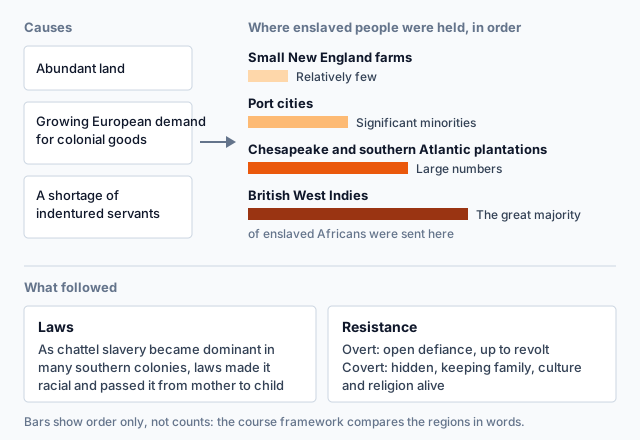 Tap to open the picture full size
Part 1 Think first Land for every servant or slave
Commit to a guess first. Being wrong now makes the right idea stick better.
Predict first
In 1664 John Berkeley and G. Carteret, the proprietors of New Jersey, offered land to settlers for each worker they brought. A master or mistress received land "for every weaker servant or slave, male or female," as well as for each servant. New Jersey was a middle colony, not a plantation colony. What does that suggest about slavery in the British colonies?
In short. Abundant land, growing European demand for colonial goods and a shortage of indentured servants drew every British colony into the Atlantic slave trade, to very different degrees by region; as chattel slavery became the main labor system in many southern colonies, laws made it racial and lifelong, and enslaved Africans resisted it openly and in hidden ways.
- Small New England farms used relatively few enslaved laborers, port cities held significant minorities of enslaved people, the plantation systems of the Chesapeake and southern Atlantic coast held large numbers, and the great majority of enslaved Africans were sent to the West Indies.
- New laws created a strict racial system that prohibited interracial relationships and defined the descendants of African American mothers as black and enslaved in perpetuity.
- Africans developed both overt and covert means to resist slavery's dehumanizing nature and to keep their family and gender systems, culture and religion.
Part 2 Learn it Slavery in the British colonies
2a. Land, demand and a shortage of servants
Why did every British colony take part in the Atlantic slave trade? Three causes worked together. Land was abundant, so what landowners lacked was workers. European demand for colonial goods kept growing, so planters wanted to grow and export more. And indentured servants, people bound to work for a set number of years, were in short supply. In the Chesapeake, tobacco was first grown by white, mostly male indentured servants and later by enslaved Africans (Topic 2.3).
Colonial land policy shows how land and labor were tied together. New Jersey's proprietors granted land "To every master or mistress that shall go before the first day of January" of 1665, and more land for each worker brought: "And for every able man servant, that he or she shall carry or send," and then:
The same section gives an able man servant "the like quantity of one hundred and twenty acres of land", so a weaker servant or slave counted for half: the grant priced workers by their value to the master, and rated an enslaved person like a weaker servant. The more workers a master brought, the more land he held. Behoof means benefit.
Quick check · Fill the statement
Read the situation, then complete the sentences.
Suppose a planter in a southern colony can claim far more land than his household can farm, and buyers in Europe want more of his crop each year. Fewer are arriving from England to work for him, so he buys instead.
2b. Every colony, to very different degrees
Every British colony took part in slavery, but not to the same degree. The course framework compares the regions in words, not counts, and so does this lesson.
- Small New England farms used relatively few enslaved laborers.
- All port cities held significant minorities of enslaved people.
- The emerging plantation systems of the Chesapeake and the southern Atlantic coast had large numbers of enslaved workers.
- The great majority of enslaved Africans were sent to the West Indies.
Read the list as a pattern. The more a region's economy rested on plantation crops grown for export, the more enslaved people it held. Topic 2.3 showed the colonies of the southern Atlantic coast and the British West Indies using long growing seasons to build plantation economies, where enslaved Africans often made up the majority of the population. New England's family farms and mixed economy of agriculture and commerce needed far fewer.
The mainland plantation colonies were not where most enslaved Africans went. Most were sent to the West Indies.
Quick check · Sort it
Tap a place, then how many enslaved people it held, in the course framework's words.
Relatively few
A significant minority
Large numbers
Where the great majority were sent
2c. Laws that made slavery racial and lifelong
Chattel slavery treated a person as property, held for life and bought and sold, with the status passed on to children. As it became the dominant labor system in many southern colonies, new laws created a strict racial system. They prohibited interracial relationships and defined the descendants of African American mothers as black and enslaved in perpetuity, that is, forever.
Compare a servant. New Jersey's 1664 terms promised land to "every Christian servant" once the servant's term was over, "after the expiration of their time of service." A servant's bondage ended. An enslaved person's did not, and it passed to the children.
Carolina's lords proprietors wrote a master's power into their plan of government for the colony, the Fundamental Constitutions of March 1, 1669:
Negro was the colonists' term for people of African descent. It is quoted because the word is the evidence: the proprietors tied enslavement to race. Another section of the plan let enslaved people join a church, then added: "But yet no slave shall hereby be exempted from that civil dominion his master hath over him."
Quick check · Multiple choice
Section 110 of Carolina's 1669 plan of government reads: "Every freeman of Carolina shall have absolute power and authority over his negro slaves, of what opinion or religion soever." What work does the phrase "of what opinion or religion soever" do?
2d. Resisting slavery
Enslaved Africans developed both overt and covert means to resist its dehumanizing nature. Overt means were open defiance, such as open flight or revolt. Covert means were hidden from enslavers, such as slowing work. Enslaved Africans also worked to maintain the family and gender systems, culture and religion that slavery tried to break: ties of marriage and kin, and the roles of men and women. Historians read keeping them alive as itself a form of resistance. Where enslaved Africans were the majority, in the southern Atlantic colonies and the West Indies, they developed their own forms of cultural and religious autonomy (Topic 2.3).
Why was keeping a family a form of resistance? Because sale tore families apart. In 1688 four men at Germantown, Pennsylvania, sent a protest to the monthly meeting held at Richard Worrell's. Slaveholders, they wrote, were "separating wives from their husbands, and giving them to others: and some sell the children of these poor creatures to other men."
The protest also repeats what was said of enslaved people, "which they say are so wicked and stubborn men," and imagines that they "should join themselves fight for their freedom." Its writers were colonists who called enslaved people "poor creatures" and worried about Pennsylvania's name in Europe. So the protest shows enslaved people's resistance only as outsiders saw it. A historian can read "stubborn" as resistance, seen through the eyes of those who complained of it.
Source: Resolutions of the Germantown Mennonites, 1688 (Avalon Project).
Quick check · Select all
Which two are covert means of resisting slavery? Select two.
Select 2 answers, then check.
Part 3 Watch it done Connect tobacco to slavery
Watch each step, then do the last one yourself.
Topic 2.3 showed that the Chesapeake grew prosperous exporting tobacco, a crop first grown by white, mostly male indentured servants and later by enslaved Africans. Identify the connection between that change and the causes of slavery's spread in the British colonies.
Predict first
Before the steps, what do you think drove the change from servants to enslaved Africans?
Step 1 · Name the first development
Tobacco made the Chesapeake prosperous, and it was labor-intensive: it took many workers. Its first workers were mostly white male indentured servants, bound for a term of years.
Why this step?
Why name each development on its own before linking them?
A connection is a claim about two things. Until you have said exactly what each one is, you cannot show how one led to the other or matched it.
Step 2 · Name the second development
Across the British colonies, land was abundant, European demand for colonial goods was growing, and indentured servants were in short supply. Those are the causes of the colonies' part in the Atlantic slave trade.
Your step · Decide and justify
Finish it. What is the connection?
Which evidence best supports the connection?
Part 4 Try it A pattern across regions
Topic 2.3 tied each region's economy to its environment. The colonies of the southern Atlantic coast and the British West Indies used long growing seasons to develop plantation economies that exported cash crops. The New England colonies developed around small towns with family farms and a mixed economy of agriculture and commerce. The middle colonies exported cereal crops.
Put those facts beside what you learned about where enslaved people were held, and look for the pattern.
Source: the AP U.S. History course framework, Topics 2.3 and 2.6.
Try it · Multiple choice
Which pattern best connects environment and slavery in the British colonies?
Try it · Spot the error
A student writes a paragraph connecting region and slavery. Which line is the first to go wrong?
Part 5 Explain it Write it like a document-based answer
Nothing you type leaves this page. Check your answer against the model and each scoring point.
Free-response practice · Question 1 style
A short practice in the shape of the document-based question: three documents instead of seven, and a thesis with one body paragraph instead of a full essay.
Evaluate the extent to which colonial governments supported slavery in British North America between 1664 and 1688.
Document 1. The Concession and Agreement of the Lords Proprietors of New Jersey, John Berkeley and G. Carteret, 1664: "And for every weaker servant or slave, male or female, exceeding the age of fourteen years, arriving there, sixty acres of land: And to every Christian servant to their own use and behoof sixty acres of land."
Document 2. The Fundamental Constitutions of Carolina, a plan of government agreed by the colony's lords proprietors, March 1, 1669: "Every freeman of Carolina shall have absolute power and authority over his negro slaves, of what opinion or religion soever."
Document 3. A protest by four men of Germantown, Pennsylvania, sent to the monthly meeting held at Richard Worrell's, 1688: "These are the reasons why we are against the traffic of men-body" ... enslaved people should be "set free as in Europe. Then is Pennsylvania to have a good report."
Write a thesis, one sentence of historical context, and one paragraph that uses at least two documents and explains the purpose, audience, point of view or situation of one of them.
Model answer
Thesis: Between 1664 and 1688 colonial governments supported slavery to a great extent, rewarding masters with land for enslaved people and writing a master's absolute power into a founding plan, in the middle colonies as well as the South, although colonists' protests show the support was not unanimous.
Context: abundant land, growing European demand for colonial goods and a shortage of indentured servants drew every British colony into the Atlantic slave trade.
New Jersey's proprietors granted "sixty acres of land" for each "servant or slave" a master brought (Document 1), so slavery earned land even in a middle colony. Carolina's proprietors went further, giving every freeman "absolute power and authority" over enslaved people and making clear that religion changed nothing (Document 2), a plan that tied enslavement to race. Not every colonist agreed. The Germantown protest opposed "the traffic of men-body" (Document 3). It was addressed to a religious meeting of fellow colonists, and its purpose was to persuade them, so it argues that Pennsylvania would win "a good report" abroad if enslaved people were "set free as in Europe." Its existence shows opposition, but it was a private appeal, while land grants and founding plans supported slavery.
Score your own answer. This is a self-check, not a grade. Tick each point your answer makes.
Part 6 Check yourself One colony's plan on religion and slavery
The case questions use the two sections. The others mix the ideas from the whole lesson.
Both sections come from the Fundamental Constitutions of Carolina of March 1, 1669, a plan of government written by the colony's lords proprietors. Source: Avalon Project, Yale Law School.
| Section | Excerpt |
|---|---|
| 107 | "it shall be lawful for slaves, as well as others, to enter themselves, and be of what church or profession any of them shall think best" ... "But yet no slave shall hereby be exempted from that civil dominion his master hath over him" |
| 110 | "Every freeman of Carolina shall have absolute power and authority over his negro slaves, of what opinion or religion soever." |
Case question 1 · Multiple choice
Read together, what do the two sections show?
Case question 2 · Multiple choice
A historian wants to know how enslaved people in Carolina practiced religion of their own. What can these two sections show?
The rest stand on their own and do not use the case.
Check yourself · Match
Match each document or set of laws to the development it shows best.
Check yourself · Put it in order
Put these steps in the order of cause and effect, first cause first.
Part 7 Keep it Bring back earlier ideas
This lesson stands on the Atlantic economy from Topic 2.4 and on alliances between Europeans and American Indians from Topic 2.5.
Bring it back · Multiple choice
A ship leaves an English port with manufactured goods, trades them on the West African coast for enslaved people, carries them to the Caribbean, and returns with crops valued in Europe. Which development does this voyage illustrate?
Bring it back · Fill the statement
Read the situation, then complete the sentences.
Suppose a Native nation, at war with a rival Native nation and that rival's English allies, seeks an alliance with French traders, who send it weapons. The Native nation is pursuing . The French are gaining .
In three lines
- Abundant land, growing European demand and a shortage of indentured servants drew every British colony into the slave trade, to very different degrees by region.
- As chattel slavery became dominant in many southern colonies, laws made it racial and lifelong, passed from mother to child.
- Enslaved Africans resisted overtly and covertly, keeping their family and gender systems, culture and religion alive.
Exam strategy for this topic
- Section I Part A, Multiple Choice: 55 questions in 55 minutes.
- Section I Part B, Short Answer: 3 questions in 40 minutes.
- Section II, Document-Based Question and Long Essay: 2 questions in 100 minutes.
- This lesson's Explain it is shaped like free-response question 1, Document-based.
When a question asks for a pattern or connection, name each development on its own first, then say how one led to, matched or differed from the other.
Questions students ask
Was there slavery in the northern colonies?
Yes. All the British colonies took part in the Atlantic slave trade. Small New England farms used relatively few enslaved laborers, but all port cities held significant minorities of enslaved people, and New Jersey's proprietors granted masters land for each enslaved person over fourteen they brought.
Where were most enslaved Africans sent?
The great majority were sent to the West Indies, not to the mainland colonies. The plantation systems of the Chesapeake and the southern Atlantic coast held large numbers, but not most.
How was an indentured servant different from an enslaved person?
A servant was bound for a term of years and then free; New Jersey promised land to servants after their time of service. Slavery was for life, and laws passed it from mother to child. A 1688 protest from Germantown asked who would want "to be sold or made a slave for all the time of his life?"
Why does this lesson quote a colonial text that uses a racial term?
Carolina's 1669 plan of government is quoted exactly as the archive prints it because the word is the evidence: it shows the proprietors tying slavery to race. The lesson uses enslaved people and people of African descent in its own words.
Why are there no numbers of enslaved people in this lesson?
The course framework compares the regions in words, not counts, and this lesson gives no figure it cannot trace to a primary source. Learn the order: relatively few in New England, significant minorities in port cities, large numbers on mainland plantations, the great majority in the West Indies.
Where can I read these documents in full?
Each excerpt links to its full text at the Avalon Project at Yale Law School, the primary-source collection this lesson was checked against.
Course alignment, for teachers
AP U.S. History topic 2.6, Unit 2: Period 2: 1607–1754.
- Skill 5.A: Identify patterns among or connections between historical developments and processes.
This lesson maps all 3 essential knowledge statements of the topic, and the 2 learning objectives with none of their own, to the part that teaches each one: 5 are checked by a scored question. The map is in the lesson file.