Unit 5 · Topic 5.4 · about 30 minutes · 7 parts · 13 scored checks, 5 of them multiple choice
AP U.S. History 5.4: The Compromise of 1850
Unit 5: 10 to 17% of the multiple-choice section
What you'll be able to do
- Explain how the attitudes of the North and the South shaped federal policy after the Mexican-American War, where the two regions agreed and where they differed, and place the Compromise of 1850 in the context that produced it.
Key vocabulary
| Term | What it means | The exam trap |
|---|---|---|
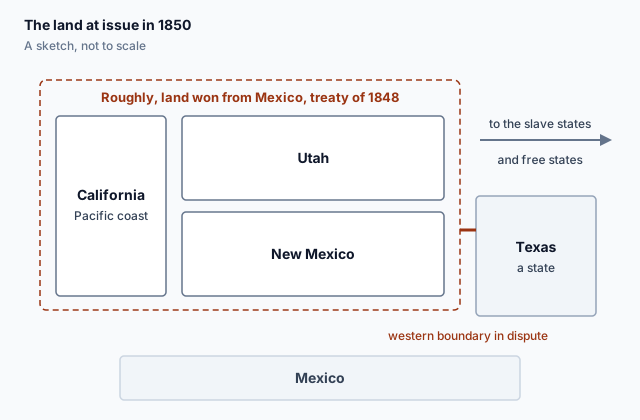
| Mexican Cession | The land Mexico gave up to the United States at the end of the Mexican-American War. | The cession is the land Mexico gave up in the treaty, not every western territory the nation held by 1850. |
| Free state | A state whose own laws banned slavery inside its borders. | The term describes a state's own law, not how its members of Congress voted on any federal measure. |
| Popular sovereignty | Letting the people of a territory decide for themselves whether to allow slavery. | The term names who decides the question, not which way the people will decide it. |
| Fugitive Slave Act of 1850 | The law, passed as part of the Compromise of 1850, that set up federal commissioners to hear claims against people said to have escaped from slavery. | A fugitive slave clause was in the Constitution from the founding; what was new in 1850 was the strength of the law. |
| Contextualization | Explaining how a document or event fits into the larger developments around it. | Context is a development outside the document itself, so restating the document's content does not count. |
 Tap to open the picture full size
Part 1 Think first One new state, two sections
Commit to a guess first. Being wrong now makes the right idea stick better.
Predict first
In 1849 California asked to join the Union as a free state, a state that banned slavery. Admitting it would break the balance between slave states and free states in the Senate, a balance that had held since the Missouri Compromise of 1820. What do you think Congress did?
In short. The Compromise of 1850 was a set of five laws, proposed in outline by Henry Clay and passed through Stephen A. Douglas's bills, that tried to settle whether slavery could spread into the land won from Mexico by giving the North and the South each part of what it wanted.
- The Mexican Cession raised a question Congress could not avoid: would slavery be allowed in the new territories? California's request to enter as a free state in 1849 threatened the balance between slave and free states.
- The laws of September 1850 admitted California as a free state, organized Utah and New Mexico without a ban on slavery, settled a Texas boundary dispute, ended the slave trade in Washington, DC, and passed a stricter fugitive slave law.
- Both regions wanted federal power when it served their view of slavery, so the settlement eased the immediate crisis while the Fugitive Slave Act angered many in the North.
Part 2 Learn it Slavery, the West and the bargain of 1850
2a. Land from Mexico, and one question
The Mexican-American War left the United States with a huge stretch of the West, the Mexican Cession. Each new territory raised the same question: would slavery be allowed there? The National Archives sums it up: "These tensions became especially critical when Congress began to consider whether western lands acquired after the Mexican-American War would permit slavery."
The two sections answered differently. Many Northerners wanted the new lands closed to slavery. Many white Southerners wanted them open, so that slaveholders could take enslaved people west. Each section also counted votes. In 1849 California asked to enter as a free state, which would break the balance of slave and free states in the Senate that had held since 1820.
On January 29, 1850, Senator Henry Clay of Kentucky offered a way through. His second resolution argued that "as slavery does not exist by law, and is not likely to be introduced into any of the territory acquired by the United States from the republic of Mexico," Congress should pass no law either way. Territories there should be organized "without the adoption of any restriction or condition on the subject of slavery."
Sources: Compromise of 1850 (National Archives).
Quick check · Multiple choice
Clay's second resolution of January 1850 says Congress should make no law for or against slavery in the land from Mexico. Which controversy was he trying to calm?
2b. Five laws, September 1850
The Senate at first voted Clay's package down. Douglas then offered it as separate bills, and they passed both houses. The Compromise of 1850 is five statutes, all enacted in September:
- California was "admitted into the Union on an equal footing with the original States in all respects whatever," as a free state.
- Utah and New Mexico became territories. When either became a state, it "shall be received into the Union, with or without slavery, as their constitution may prescribe at the time of their admission." Letting the people of a territory decide is called popular sovereignty.
- A boundary dispute between Texas and the United States was settled.
- The slave trade, the buying and selling of enslaved people, ended in Washington, DC. Slavery itself did not.
- A new, stricter fugitive slave law was passed.
The North got California and the end of the slave trade in the capital. The South got territories with no ban on slavery and a law to recover people who escaped from slavery. National leaders had made this attempt; the courts would make the next one, in a later topic.
Sources: Compromise of 1850, transcript of the five statutes (National Archives).
Quick check · Sort it
Tap each part of the Compromise of 1850, then the section whose demand it met.
Met a Northern demand
Met a Southern demand
2c. The Fugitive Slave Act: federal power in free states
The Fugitive Slave Act of September 18, 1850, reached into every state. Federal commissioners heard claims that a person had escaped from slavery, and "all good citizens are hereby commanded to aid and assist in the prompt and efficient execution of this law." The act also said: "In no trial or hearing under this act shall the testimony of such alleged fugitive be admitted in evidence." A commissioner was paid ten dollars for granting a claim, five for refusing. Anyone who hid a person who had escaped faced "a fine not exceeding one thousand dollars, and imprisonment not exceeding six months." The National Archives notes: "The enforcement of these strict requirements angered many in the North."
The sections were alike in one way: both wanted federal power when it served their side. Many Southern leaders wanted no restriction on slavery in the territories, yet wanted federal officers to act in free states. Many Northerners wanted slavery kept out of the West, yet were angered by federal enforcement at home. In June 1860 a Democratic Party divided over slavery in the territories ("difference of opinion exists in the Democratic party as to the nature and extent of the powers of a Territorial Legislature") condemned "the enactments of the State Legislatures to defeat the faithful execution of the Fugitive Slave Law."
Sources: Fugitive Slave Act (Avalon Project); Compromise of 1850 (National Archives); Democratic Party Platform, 1860 (Avalon Project).
Quick check · Fill the statement
Complete a historian's comparison of the two sections in 1850.
In the territories, many Southern leaders wanted Congress to place no on slavery. For people who escaped from slavery, they wanted federal power to .
Part 3 Watch it done Place the Fugitive Slave Act in its context
Watch each step, then do the last one yourself.
The Fugitive Slave Act, approved September 18, 1850, says "all good citizens are hereby commanded to aid and assist in the prompt and efficient execution of this law." Explain the broader context that produced this clause.
Predict first
Before the steps, where do you think the push for this clause came from?
Step 1 · Name the larger development
The Mexican-American War added the Mexican Cession, and Congress had to decide whether slavery could go there. California's request in 1849 to enter as a free state threatened the balance of slave and free states that had held since 1820.
Why this step?
Why start with the war and California, not with the words of the law?
Context is the larger story a document sits inside. A clause about people who escaped from slavery makes sense once you see what else Congress was trading in the same months.
Step 2 · Place the law in the package
Clay offered his resolutions on January 29, 1850. After seven months of debate, Douglas's separate bills passed in September, and the fugitive law was one of the five statutes.
Your step · Decide and justify
Finish it. Which statement best places the clause in its context?
Which evidence best supports your answer?
Part 4 Try it A new president defends the bargain
Franklin Pierce took office as president on March 4, 1853, less than three years after the five laws passed. In his inaugural address he said: "I believe that involuntary servitude, as it exists in different States of this Confederacy, is recognized by the Constitution." (By "Confederacy" he meant the Union of states.) He added that "the States where it exists are entitled to efficient remedies to enforce the constitutional provisions," which is a call for federal enforcement such as the Fugitive Slave Act, and said the laws of 1850 "are strictly constitutional and to be unhesitatingly carried into effect."
Source: Inaugural Address of Franklin Pierce (Avalon Project).
Try it · Multiple choice
Pierce's promise to carry out the laws of 1850 is best understood in the context of which development?
Try it · Spot the error
A student writes a paragraph placing Pierce's address in its context. Which line is the first to go wrong?
Part 5 Explain it Write it like a document-based answer
Nothing you type leaves this page. Check your answer against the model and each scoring point.
Free-response practice · Question 1 style
A short practice in the shape of the document-based question: three documents instead of seven, and a thesis with one body paragraph instead of a full essay.
Evaluate the extent to which the Compromise of 1850 settled the sectional conflict over slavery.
Document 1. Senator Henry Clay, resolutions introduced in the Senate, January 29, 1850: Congress should act "for the peace, concord, and harmony of the Union of these States, to settle and adjust amicably all existing questions of controversy between them arising out of the institution of slavery."
Document 2. Fugitive Slave Act, passed by Congress as part of the Compromise, September 18, 1850: "all good citizens are hereby commanded to aid and assist in the prompt and efficient execution of this law."
Document 3. Democratic Party Platform, June 18, 1860, adopted while the party was divided over slavery in the territories: it resolved that "the enactments of the State Legislatures to defeat the faithful execution of the Fugitive Slave Law" "are hostile in character, subversive of the Constitution, and revolutionary in their effect."
Write a thesis, one sentence of historical context, and one paragraph that uses at least two documents and explains the purpose, audience, point of view or situation of one of them.
Model answer
Thesis: The Compromise of 1850 settled the immediate crisis over California and the territories, but only to a small extent did it settle the sectional conflict over slavery, because its fugitive slave law carried the fight into the free states.
Context: the Mexican-American War added the Mexican Cession, and California's request in 1849 to enter as a free state threatened the balance of slave and free states that had held since the Missouri Compromise of 1820.
Clay framed his resolutions as a way to "settle and adjust amicably all existing questions of controversy" over slavery (Document 1), and the laws of September 1850 did let California in as a free state while leaving Utah and New Mexico open. But the same package commanded "all good citizens" to help return people who escaped from slavery (Document 2), so Northerners who had no slaves were now asked to enforce slavery. Ten years later, a Democratic platform condemned Northern state laws written "to defeat the faithful execution of the Fugitive Slave Law" (Document 3). The platform was written by Democrats who admitted a "difference of opinion" inside their own party, and a platform is written to win votes, so it blamed Northern legislatures rather than the law itself; even so, its charge shows that Northern resistance to the law was still alive in 1860. The Compromise moved the conflict more than it ended it.
Score your own answer. This is a self-check, not a grade. Tick each point your answer makes.
Part 6 Check yourself Two laws of September 9, 1850
The case questions use the two excerpts. The others mix the ideas from the whole lesson.
Both excerpts come from statutes of the Compromise of 1850, approved on September 9, 1850. Source: Compromise of 1850, transcript (National Archives).
| Law | Excerpt |
|---|---|
| Act for the admission of California, which entered as a free state | "admitted into the Union on an equal footing with the original States in all respects whatever" |
| Act to establish a territorial government for Utah | When admitted as a state, the territory "shall be received into the Union, with or without slavery, as their constitution may prescribe at the time of their admission" |
Case question 1 · Multiple choice
Read together, the two laws show which approach to slavery in the West?
Case question 2 · Multiple choice
The Utah law's phrase "with or without slavery" is best understood in the context of which development?
The rest stand on their own and do not use the case.
Check yourself · Put it in order
Put these events in the order they happened, earliest first.
Check yourself · Select all
Which two features of the laws of 1850 help explain why the Fugitive Slave Act angered many in the North? Select two.
Select 2 answers, then check.
Check yourself · Match
Match each document to the position it takes on the settlement of 1850.
Part 7 Keep it Bring back earlier ideas
This lesson stands on the push for western expansion from Topic 5.2 and the land won from Mexico in Topic 5.3.
Bring it back · Multiple choice
In his inaugural address of March 4, 1845, President James K. Polk praised settlers "establishing the blessings of self-government in valleys of which the rivers flow to the Pacific" and said: "The jurisdiction of our laws and the benefits of our republican institutions should be extended over them in the distant regions which they have selected for their homes." Which idea does this most directly express?
Bring it back · Fill the statement
Read the treaty excerpt, then complete the sentences.
Article VIII of the treaty of February 2, 1848, says that "Mexicans now established in territories previously belonging to Mexico" "shall be free to continue where they now reside, or to remove at any time to the Mexican Republic." The article answers a question about . The land itself came to the United States through victory in war and through .
In three lines
- The Mexican Cession raised a heated question, whether slavery would be allowed in the new territories, and California's request to enter free threatened the balance of slave and free states.
- The five laws of 1850 gave the North a free California and an end to the slave trade in the capital, and gave the South open territories and a stricter fugitive slave law.
- Each section wanted federal power when it served its view of slavery, so the Compromise eased the crisis but the fugitive law angered many in the North.
Exam strategy for this topic
- Section I Part A, Multiple Choice: 55 questions in 55 minutes.
- Section I Part B, Short Answer: 3 questions in 40 minutes.
- Section II, Document-Based Question and Long Essay: 2 questions in 100 minutes.
- This lesson's Explain it is shaped like free-response question 1, Document-based.
When a question asks for context, name a specific development from before or around the document, such as the Mexican Cession or California's request in 1849, and say how it led to what the document says.
Questions students ask
Who wrote the Compromise of 1850?
Senator Henry Clay of Kentucky proposed the resolutions in January 1850. After the Senate voted his package down, Senator Stephen A. Douglas of Illinois passed it as separate bills.
Did the Compromise of 1850 end slavery in Washington, DC?
No. It ended the slave trade there, the buying and selling of enslaved people in the capital. Slavery itself stayed legal in the District.
Was there a fugitive slave law before 1850?
Yes. The National Archives notes that a fugitive slave clause was in the Constitution and supported by legislation from the nation's founding. The 1850 law was stricter: it required officers in every state to enforce it and punished anyone who helped a person escape.
How is the Compromise of 1850 different from the Missouri Compromise?
The Missouri Compromise of 1820 kept the balance of slave and free states. The Compromise of 1850 dealt with the land won from Mexico, after California's request to enter as a free state threatened that balance.
Where can I read these documents in full?
Each excerpt links to its full text at the National Archives or the Avalon Project at Yale Law School, the primary-source collections this lesson was checked against.
Course alignment, for teachers
AP U.S. History topic 5.4, Unit 5: Period 5: 1844–1877.
- Skill 4.B: Explain how a specific historical development or process is situated within a broader historical context.
This lesson maps all 2 essential knowledge statements of the topic, and the one learning objective with none of its own, to the part that teaches each one: 3 are checked by a scored question. The map is in the lesson file.