Unit 1 · Topic 1.3 · about 30 minutes · 7 parts · 12 scored checks, 4 of them multiple choice
AP U.S. History 1.3: European Exploration in the Americas
Unit 1: 4 to 6% of the multiple-choice section
What you'll be able to do
- Explain the causes of exploration and conquest of the New World by various European nations, and identify each cause where it appears in a grant, treaty or charter of the time.
Key vocabulary
| Term | What it means | The exam trap |
|---|---|---|
| Royal charter | A document in which a monarch grants a person or group the right to explore, settle or govern lands, often on stated terms. | A charter states what a ruler hoped for and allowed; it does not prove that anything in it happened. |
| Treaty of Tordesillas | The 1494 agreement that drew a north to south line in the Atlantic to divide newly found lands between two kingdoms. | The line runs from pole to pole, so it splits lands into an eastern and a western share, not a northern and a southern one. |
| Conquest | Taking control of land and people by force, which the grants of this period name alongside discovery. | Discovery and conquest appear side by side in these documents; do not read discovery as a peaceful word on its own. |
| Motive | A reason that pushes a person or a nation to act, such as wealth, rivalry or religion. | A document can mention something, such as God, without that thing being its motive; look for what it sets out to gain. |
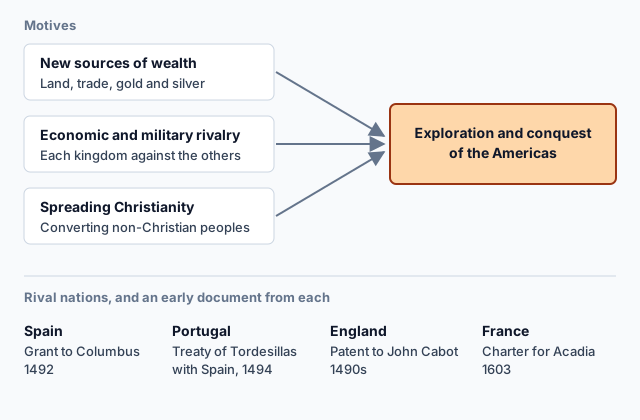 Tap to open the picture full size
Part 1 Think first Dividing lands no one had mapped
Commit to a guess first. Being wrong now makes the right idea stick better.
Predict first
In June 1494, less than two years after Columbus first crossed the Atlantic, Spain and Portugal signed a treaty at Tordesillas. It drew a line from pole to pole, "three hundred and seventy leagues west of the Cape Verde Islands." Newly found lands on one side would belong to Spain, and on the other side to Portugal. Why do you think two kingdoms agreed to divide lands they had barely seen?
In short. European nations explored and conquered in the Americas because they were searching for new sources of wealth, competing with each other for trade, land and military strength, and wanted to spread Christianity, and the grants and charters their rulers signed show all three motives at work together.
- Wealth: Spain's 1492 grant sent Columbus "to discover and subdue some Islands and Continent in the ocean" and promised him rewards, and later charters reserved a share of any gold and silver for the crown.
- Competition: Spain and Portugal divided newly found lands at Tordesillas in 1494, while England and France, which never signed, licensed voyages and colonies of their own.
- Christianity: English charters framed the lands open to claim as those of non-Christians, and the 1606 Virginia charter named spreading Christianity as a purpose, a view that also served as a reason to claim Native land.
Part 2 Learn it Why Europeans crossed the Atlantic
2a. Wealth: new lands, new riches
Christopher Columbus hoped to reach the rich trade of Asia by sailing west. On April 30, 1492, at Granada, Ferdinand and Isabella of Spain signed a grant for his voyage. It sent him "to discover and subdue some Islands and Continent in the ocean." To subdue is to bring under control, so the crown wanted land and rule, not only a sea route.
The grant also told Columbus what he would gain. Because he faced danger to serve the crown, "you should be rewarded for it." He would be admiral and governor of the lands he found, and he and his heirs would enjoy "the perquisites and salaries belonging to the said employments."
Later charters were just as direct about money. In 1584 Elizabeth I of England reserved for herself a fifth of all the gold and silver ore found in the lands her charter granted to Walter Raleigh. Rulers and explorers alike were searching for new sources of wealth: precious metals, land and trade.
Sources: Grant to Columbus, 1492 (Avalon Project); Charter to Raleigh, 1584 (Avalon Project).
Quick check · Multiple choice
Spain's 1492 grant promises Columbus high offices and "the perquisites and salaries belonging to the said employments" in the lands he will "discover and subdue." Which cause of exploration does this part of the grant most directly show?
2b. Competition between European nations
Spain was not alone. Portugal's sailors had been exploring the coast of Africa for decades, and the two kingdoms quarreled over who owned the lands found across the ocean. At Tordesillas on June 7, 1494, they agreed on a line "three hundred and seventy leagues west of the Cape Verde Islands." Lands west of the line went to Spain and lands east of it to Portugal. Neither would send ships into the other's half "for the purpose of trade, barter, or conquest of any kind."
Other kingdoms never signed. In the 1490s Henry VII of England licensed John Cabot to find and claim lands for England, and in 1603 Henry IV of France chartered a colony in Acadia, on the northeast coast of North America.
Competition was military as well as economic. The First Charter of Virginia, in 1606, gave the English colonists power to "encounter, expulse, repel, and resist, as well by Sea as by Land" anyone who tried to settle inside their grant without permission. Each kingdom feared that a rival would grow rich and strong on American land and trade.
Sources: Treaty of Tordesillas, 1494 (Avalon Project); 17th Century Documents (Avalon Project); First Charter of Virginia, 1606 (Avalon Project).
Quick check · Fill the statement
Complete the notes on the Treaty of Tordesillas.
The treaty gave newly found lands west of its line to and lands east of it to . It shows that exploration was driven in part by .
2c. Spreading Christianity
Rulers also framed their claims in religious terms. Henry VII licensed Cabot "to seeke out, discouer, and finde whatsoever isles, countreys, regions or prouinces of the heathen and infidels" (spelling as printed). Elizabeth I's 1584 charter let Raleigh claim "remote, heathen and barbarous lands, countries, and territories, not actually possessed of any Christian Prince, nor inhabited by Christian People." Neither document says the voyage is meant to convert anyone; both use religion to define which lands are open to claim.
The First Charter of Virginia went further. It praised the venture for "propagating of Christian Religion to such People, as yet live in Darkness and miserable Ignorance of the true Knowledge and Worship of God." Notice how all three documents see Native Americans: as people without the true faith, whose lands a Christian ruler could claim. The desire to spread Christianity was sincere for many Europeans, and it also gave them a reason to take land.
Religion fed the rivalry too. The Tordesillas treaty asked the pope to confirm it. By the late 1500s England was Protestant and Spain Catholic, so each side saw the other's empire as a threat to its faith.
Sources: Cabot patent (Avalon Project); Charter to Raleigh, 1584 (Avalon Project); First Charter of Virginia, 1606 (Avalon Project).
Quick check · Sort it
Each card comes from a grant or charter of 1492 to 1606. Tap a card, then the motive it shows most directly.
New sources of wealth
Economic and military competition
Spreading Christianity
Part 3 Watch it done Identify the motive in the grant to Columbus
Watch each step, then do the last one yourself.
Ferdinand and Isabella's grant to Columbus, signed at Granada on April 30, 1492, says he is going "to discover and subdue some Islands and Continent in the ocean," hopes this will happen "by God's assistance," and promises that "you should be rewarded for it." Identify the cause of exploration the grant shows most directly.
Predict first
Before the steps, which motive do you expect a royal grant like this one to put first?
Step 1 · Name who wrote it and why
The king and queen of Spain wrote it before the voyage, to set out what Columbus would do and what he would get. A grant is a deal, so read it for what each side gives and gains.
Why this step?
Why read it as a deal instead of just picking out the strongest words?
A grant exists to settle terms. What the crown asks for and what it promises in return show what both sides wanted, which is the motive. A word that sounds important, like God, may be there only as a formula.
Step 2 · List what each side gains
Spain gains islands and a continent "discovered and conquered" in its name. Columbus gains the offices of admiral and governor, and "the perquisites and salaries belonging to the said employments" for himself and his heirs. God appears once, as help for the voyage, and the grant never mentions converting anyone.
Your step · Decide and justify
Finish it. Which cause of exploration does the grant show most directly?
Which evidence from the grant best supports your answer?
Part 4 Try it England's turn
On March 25, 1584, Elizabeth I of England granted Walter Raleigh a charter to find and settle lands across the Atlantic. Spain had by then held an American empire for almost a century. The charter let Raleigh claim "remote, heathen and barbarous lands, countries, and territories, not actually possessed of any Christian Prince, nor inhabited by Christian People."
Try it · Select all
Which two causes of exploration does the passage from Raleigh's charter show? Select two.
Select 2 answers, then check.
Try it · Spot the error
A student writes a paragraph on the causes of European exploration. Which line is the first to go wrong?
Part 5 Explain it Write it like a document-based answer
Nothing you type leaves this page. Check your answer against the model and each scoring point.
Free-response practice · Question 1 style
A short practice in the shape of the document-based question: three documents instead of seven, and a thesis with one body paragraph instead of a full essay.
Evaluate the extent to which a desire to spread Christianity drove European exploration and conquest in the Americas from 1492 to 1606.
Document 1. Ferdinand and Isabella of Spain, grant to Christopher Columbus, April 30, 1492: Columbus is going "to discover and subdue some Islands and Continent in the ocean," and since he faces danger to serve the crown, "you should be rewarded for it."
Document 2. Elizabeth I of England, charter to Walter Raleigh, March 25, 1584: Raleigh may claim "remote, heathen and barbarous lands, countries, and territories, not actually possessed of any Christian Prince, nor inhabited by Christian People." The queen keeps a fifth of all gold and silver ore found there.
Document 3. James I of England, who styles himself "Defender of the Faith," First Charter of Virginia, April 10, 1606: the venture is praised for "propagating of Christian Religion to such People, as yet live in Darkness and miserable Ignorance of the true Knowledge and Worship of God." The colonists may "encounter, expulse, repel, and resist, as well by Sea as by Land" anyone who settles in their grant without permission.
Write a thesis, one sentence of historical context, and one paragraph that uses at least two documents and explains the purpose, audience, point of view or situation of one of them.
Model answer
Thesis: The desire to spread Christianity was a real cause of European exploration and conquest from 1492 to 1606, but it worked alongside, and was often outweighed by, the search for wealth and the competition among European kingdoms.
Context: in 1492, the year Spain's monarchs completed the conquest of Granada, the last Muslim kingdom in Spain, European rulers were looking for sea routes to the wealth of Asian trade, so a Christian victory over a Muslim kingdom and a hunt for Asian wealth shaped the same voyage, which is why religion and wealth have to be weighed together.
Spain's grant to Columbus never mentions converting anyone; it sends him to "discover and subdue" lands and promises that "you should be rewarded for it" (Document 1), terms of wealth and power. By 1584 Elizabeth I's charter used religion to define which lands were open, those "not actually possessed of any Christian Prince" (Document 2), but in the same charter she claimed a fifth of the gold and silver. The Virginia charter states a religious purpose most clearly, "propagating of Christian Religion" (Document 3). It was written by a king who called himself "Defender of the Faith" to license a colony, so its religious language also presented the venture as a noble work and justified taking Native land. That charter also armed the colony to resist rivals. Religion grew more prominent in the documents, but it always came joined to wealth and competition.
Score your own answer. This is a self-check, not a grade. Tick each point your answer makes.
Part 6 Check yourself One treaty, one rival's patent
The case questions use the two excerpts. The others mix the ideas from the whole lesson.
The first excerpt is from the treaty Spain and Portugal signed at Tordesillas. The second is from Henry VII of England's letters patent to John Cabot and his sons, issued in the 1490s; its spelling is as printed. Sources: Treaty of Tordesillas (Avalon Project); Cabot patent (Avalon Project).
| Document | Excerpt |
|---|---|
| Treaty between Spain and Portugal, Tordesillas, June 7, 1494 | A line is drawn "three hundred and seventy leagues west of the Cape Verde Islands." Neither kingdom will send ships into the other's half "for the purpose of trade, barter, or conquest of any kind." |
| Letters patent of Henry VII of England to John Cabot | Cabot and his sons may sail, "vpon their owne proper costs and charges," "to seeke out, discouer, and finde whatsoever isles, countreys, regions or prouinces of the heathen and infidels," and may "subdue, occupy and possesse" the towns and isles they find. |
Case question 1 · Multiple choice
Read the two excerpts together. What do they show about the competition for lands across the Atlantic?
Case question 2 · Multiple choice
According to the patent, who would pay for Cabot's voyages, and what does that suggest about why they sailed?
The rest stand on their own and do not use the case.
Check yourself · Put it in order
Put these documents in the order they were issued, earliest first.
Check yourself · Match
Match each document to what it granted or agreed.
Part 7 Keep it Bring back earlier ideas
This lesson stands on the North America Europeans reached, from Topic 1.1, and the native societies already living there, from Topic 1.2.
Bring it back · Multiple choice
Which statement best describes North America before European contact?
Bring it back · Fill the statement
Complete the sentences about native societies before European contact.
In the dry Great Basin and on the grasslands of the western Great Plains, many societies developed largely lifestyles. In the Southwest, the spread of cultivation from present-day Mexico supported settlement and advanced irrigation.
In three lines
- Europeans explored and conquered in the Americas in search of new sources of wealth: land, trade and precious metals for crowns and explorers.
- Economic and military rivalry drove them too: Spain and Portugal divided new lands in 1494, and England and France, outside that treaty, licensed claims of their own.
- Rulers framed their claims in religious terms, and the 1606 Virginia charter named spreading Christianity as a purpose, a sincere aim for many that also justified claiming Native land.
Exam strategy for this topic
- Section I Part A, Multiple Choice: 55 questions in 55 minutes.
- Section I Part B, Short Answer: 3 questions in 40 minutes.
- Section II, Document-Based Question and Long Essay: 2 questions in 100 minutes.
- This lesson's Explain it is shaped like free-response question 1, Document-based.
When a question asks why Europeans explored, name the specific motive and the nation, then point to evidence for it; most documents of the period show more than one motive, so say which one leads.
Questions students ask
What were the main causes of European exploration of the Americas?
A search for new sources of wealth, economic and military competition among European nations, and a desire to spread Christianity. The grants and charters of the time usually show more than one of these together.
Why did only Spain and Portugal sign the Treaty of Tordesillas?
The treaty settled a quarrel between those two kingdoms over lands found across the ocean. Other kingdoms were not parties to it, and England and France went on to license voyages and colonies of their own.
Was religion a real motive or just an excuse?
Both, depending on the person and the document. Many Europeans sincerely wanted to spread Christianity, and charters such as Virginia's in 1606 name it as a purpose. The same language also gave rulers a reason to claim lands held by people who were not Christian.
Why are some quotations in this lesson spelled strangely?
Every excerpt is copied exactly as the archive prints it, so you can check it against the source linked beside it. The Cabot patent keeps its old English spelling, such as discouer for discover.
Where can I read these documents in full?
Each excerpt links to its full text at the Avalon Project at Yale Law School, the primary-source collection this lesson was checked against.
Course alignment, for teachers
AP U.S. History topic 1.3, Unit 1: Period 1: 1491–1607.
- Skill 1.A: Identify a historical concept, development, or process.
This lesson maps the one essential knowledge statement of the topic, and the one learning objective with none of its own, to the part that teaches each one: 2 are checked by a scored question. The map is in the lesson file.