Unit 2 · Topic 2.8 · about 30 minutes · 7 parts · 13 scored checks, 4 of them multiple choice
AP U.S. History 2.8: Comparison in Period 2
Unit 2: 6 to 8% of the multiple-choice section
What you'll be able to do
- Compare the effects of the development of colonial society in the various regions of North America, and support the comparison with specific and relevant evidence.
Key vocabulary
| Term | What it means | The exam trap |
|---|---|---|
| Trade alliance | An agreement in which Europeans and an American Indian nation traded goods and supported each other, the basis of French and Dutch colonies. | An alliance describes a relationship between partners; check which side each party took in a conflict before calling them allies. |
| Mixed economy | An economy that combines farming with commerce, as in colonial New England. | In this period the phrase describes what people did for a living, not a mix of government and private ownership. |
| Cash crop | A crop grown mainly to sell, often for export, such as tobacco. | A cash crop is defined by its purpose, sale, not by which crop it is. |
| Specific evidence | A named document, law, person or event, with enough detail, such as a date, to identify it. | Being specific makes evidence usable; it still has to be connected to the claim. |
| Relevant evidence | Evidence whose connection to the argument is explained in your own words. | A true fact on the same subject is not automatically relevant; relevance comes from the link you write. |
 Tap to open the picture full size
Part 1 Think first Two documents, two colonies
Commit to a guess first. Being wrong now makes the right idea stick better.
Predict first
In November 1626 a letter written in Amsterdam to the Dutch government's "High and Mighty Lords" reported that a ship from New Netherland had arrived carrying "7246 beaver skins" and "17886 otter skins." In 1732 Britain's king chartered Georgia so that poor subjects without work at home "might not only gain a comfortable subsistence for themselves and families." If these two documents were all you had, what difference would you predict between the two colonies?
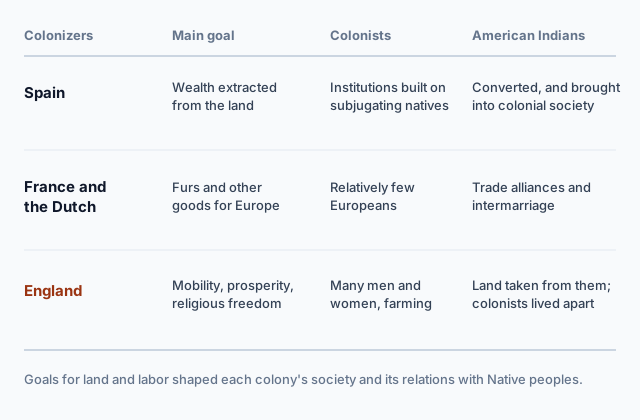
In short. Europeans colonized North America in different patterns, shaped by their goals, cultures and environments: Spain built colonies on subjugating and converting native peoples, France and the Dutch on trade and alliances with them, and England on large numbers of settlers farming land taken from them.
- Different goals for land and labor shaped each empire's society, politics and relations with American Indians, and competition for resources led both to trade and to conflict.
- Within British North America, regions differed by environment, economy, culture and population, from New England towns to middle-colony grain farms to Chesapeake and southern plantations.
- Exchanges with Britain built bonds and fed resistance, and every British region took part in a system of slavery shaped by its own economy, population and geography.
Part 2 Learn it Comparing colonial societies
2a. Four empires, three patterns
Europeans colonized North America in different patterns, shaped by their imperial goals, cultures and environments. Each empire's goals for land and labor shaped its colonies and its relations with American Indians.
Spain sought to extract wealth from the land. Its institutions subjugated native peoples, worked to convert them to Christianity, and incorporated them, along with enslaved and free Africans, into Spanish colonial society.
France and the Dutch Republic sent relatively few colonists. They relied on trade alliances and intermarriage with American Indians to acquire furs and other goods for Europe. French missionaries also sought converts, but the colonies' business was furs. France's 1603 charter commissioned the Sieur de Monts "to people and inhabit the lands, shores, and countries of Acadia," and paid for the venture with a ten-year monopoly on "trading or bartering in skins, and other things with the savages" (the charter's word for Native peoples). The Dutch West India Company's charter of 1621 let it "make contracts, engagements and alliances with the princes and natives" of the lands it reached.
England sent comparatively large numbers of men and women, along with other Europeans, who sought social mobility, prosperity, religious freedom and better living conditions. They farmed land taken from Native Americans and lived apart from them.
Sources: Charter of Acadia, 1603 (Avalon Project); Charter of the Dutch West India Company, 1621 (Avalon Project). The Spanish pattern is described from the AP course framework.
Quick check · Sort it
Each card describes a colonial society. Tap a card, then the colonizers it fits best.
Spanish
French and Dutch
English
2b. Regions within British North America
British colonies along the Atlantic coast also differed by environment, economy, culture and population.
- New England, first settled by Puritans, grew around small towns and family farms, with a mixed economy of farming and commerce.
- The middle colonies exported grain and drew migrants from across Europe, which made them more diverse and tolerant.
- The Chesapeake grew rich exporting tobacco, worked first by mostly male indentured servants and later by enslaved Africans.
- The southern Atlantic coast and the British West Indies used long growing seasons for plantations of cash crops worked by enslaved Africans, who were often the majority there.
Slavery followed the same regional lines. Every British colony took part in the Atlantic slave trade, but small New England farms used relatively few enslaved laborers, port cities held significant minorities of enslaved people, the Chesapeake and southern plantations held large numbers, and the great majority of enslaved Africans were sent to the West Indies. Other European empires took part in the Atlantic slave trade too, but their systems differed. Spain incorporated enslaved and free Africans into its colonial society. In many southern English colonies, as chattel slavery became the main labor system, new laws built a strict racial system: they banned interracial relationships and made the children of enslaved African American mothers enslaved for life.
The regions and the slavery comparison are described from the AP course framework.
Quick check · Match
Match each colonial society to the description that fits it best.
2c. Competition, conflict and ties to Britain
European rivals and American Indians competed for the same resources. That competition encouraged industry and trade, and it led to conflict across the Americas. Georgia's charter of 1732 justified the new colony partly by South Carolina's danger: its "whole southern frontier continueth unsettled, and lieth open to the said savages" (spelling as printed; "savages" is the charter's word for American Indians). That is the crown's account, written to justify a new colony: it names the danger and says nothing of why the Native nations fought.
The British colonies also took part in political, social, cultural and economic exchanges with Great Britain. Trade, religion, philosophy and politics crossed the Atlantic, and colonists' attitudes changed as they became more tied to Britain and to one another.
Those exchanges pulled two ways. They built stronger bonds: Pennsylvania's Assembly claimed its powers "according to the Rights of the free-born Subjects of England." They also encouraged resistance to Britain's control, because colonists who claimed English rights expected to use them. In 1725 the crown settled quarrels in Massachusetts over the House's Speaker in the royal governor's favor.
Sources: Charter of Georgia, 1732 (Avalon Project); Charter of Privileges, 1701 (Avalon Project); Explanatory Charter of Massachusetts Bay, 1725 (Avalon Project).
Quick check · Fill the statement
Complete a student's notes on two colonial charters.
Georgia's charter defends a new colony by pointing to raids on South Carolina's unsettled frontier, evidence of on the frontier. Pennsylvania's Assembly claiming the rights of English subjects is an exchange with Britain that built .
2d. Supporting a comparison with evidence
A comparison is an argument, and an argument needs evidence. The course asks for two moves: describe a specific example of historically relevant evidence, such as a named document, law, person or event with its date, and then explain how that example supports the argument, which makes it relevant.
Take the claim that French and Dutch colonies depended more on American Indian trading partners than English colonies did.
- Too general: The French and Dutch were traders. No example is named.
- Specific but not explained: In 1626 a Dutch ship brought 7246 beaver skins to Amsterdam. True, but the reader is left to guess why it matters.
- Specific and explained: In 1626 a single ship from New Netherland carried thousands of beaver and otter skins, furs the Dutch acquired through trade with American Indians, while English colonists such as Georgia's were sent to make a living on the land.
Also ask what kind of source you are using. A charter records what its authors intended; a ship's cargo or a protest records something that was happening. Evidence of a plan is not evidence of a result.
Quick check · Select all
Claim: English colonists lived more separately from American Indians than French colonists did. Which two pieces of evidence, as explained, best support the claim? Select two.
Select 2 answers, then check.
Part 3 Watch it done Test a claim against the Manhattan letter
Watch each step, then do the last one yourself.
Claim: New Netherland was built more on trade with American Indians than on farming. Test the claim against the letter written in Amsterdam on November 5, 1626, which reports that a ship from New Netherland carried "7246 beaver skins" and "17886 otter skins," and that the colonists "have purchased the island Manhattes from the Indians for the value of 60 guilders."
Predict first
Before the steps, how far do you think the letter supports the claim?
Step 1 · Describe the evidence
Name it exactly: a report written in Amsterdam on November 5, 1626, to the Dutch government's "High and Mighty Lords." The cargo it lists is furs by the thousands, plus "considerable oak, timber and hickory." It also says the colonists "had all their grain sowed by the middle of May" and reaped it by the middle of August.
Why this step?
Why note the grain as well as the furs?
Evidence that cuts against a claim is still evidence. Seeing it first lets you narrow the claim so the evidence supports it, instead of being caught out by it.
Step 2 · Connect it to the claim
The cargo is what the colony sent to Europe. Recall how the Dutch, like the French, acquired their furs. The grain shows the colonists also farmed.
Your step · Decide and justify
Finish it. What does the 1626 letter best support?
Which evidence best supports your answer?
Part 4 Try it Slavery beyond the plantations
In 1688 four men meeting at Germantown, in Pennsylvania, wrote to their monthly meeting "against this traffic of men-body," the trade in enslaved people. They compared Pennsylvania with their European homelands: "You surpass Holland and Germany in this thing." They argued that, as there was liberty of conscience, "here ought to be likewise liberty of the body," and warned that the trade gave the colony a bad name among Europeans, some of whom no longer wished to come.
Try it · Multiple choice
A student claims that slavery was part of colonial life outside the southern plantation colonies too. Which use of the Germantown protest best supports that claim?
Try it · Spot the error
A student writes a comparison of slavery across British colonial regions. Which line is the first to go wrong?
Part 5 Explain it Write it like a document-based answer
Nothing you type leaves this page. Check your answer against the model and each scoring point.
Free-response practice · Question 1 style
A short practice in the shape of the document-based question: three documents instead of seven, and a thesis with one body paragraph instead of a full essay.
Evaluate the extent to which European colonizers' goals shaped their relationships with American Indians in North America from 1603 to 1732.
Document 1. Charter of Acadia, granted by Henry IV of France to the Sieur de Monts, December 18, 1603: other French subjects are forbidden, for ten years, to go "trading or bartering in skins, and other things with the savages" without joining his company.
Document 2. Charter of the Dutch West India Company, June 3, 1621: the company may "make contracts, engagements and alliances with the princes and natives" of the lands it reaches.
Document 3. Charter of Georgia, issued by King George II, June 9, 1732: South Carolina's "whole southern frontier continueth unsettled, and lieth open to the said savages."
Write a thesis, one sentence of historical context, and one paragraph that uses at least two documents and explains the purpose, audience, point of view or situation of one of them.
Model answer
Thesis: Colonizers' goals largely shaped their relations with American Indians: French and Dutch trading goals made Native peoples partners in commerce, while English settlement on land taken from Native Americans made them rivals, though competition for resources pulled every empire into conflict at times.
Context: Europeans competed with one another and with American Indians for land and resources across North America, which encouraged trade and led to war.
France's 1603 charter guarded a monopoly on "trading or bartering in skins, and other things with the savages" (Document 1), so the colony's profit depended on Native trading partners. The Dutch West India Company was likewise empowered to "make contracts, engagements and alliances with the princes and natives" (Document 2), treating Native leaders as parties to agreements. Georgia's charter instead treats Native peoples as a danger, describing a frontier that lies "open to the said savages" (Document 3). The crown wrote it to justify founding a new colony, so its purpose was to make that danger sound urgent; it shows English fear and English aims more than the actual state of the frontier. Goals shaped the relationship, though Document 3 gives only the English side of how conflict arose.
Score your own answer. This is a self-check, not a grade. Tick each point your answer makes.
Part 6 Check yourself Virginia's first charter
The case questions use the two excerpts. The others mix the ideas from the whole lesson.
Both excerpts are from the First Charter of Virginia, granted by the English crown on April 10, 1606, to men who had asked leave to found a colony there. Sources: First Charter of Virginia (Avalon Project); Avalon Project, 17th Century Documents (date).
| Subject | Excerpt |
|---|---|
| Religion | "propagating of Christian Religion to such People, as yet live in Darkness and miserable Ignorance of the true Knowledge and Worship of God" |
| Mines | "to dig, mine, and search for all Manner of Mines of Gold, Silver, and Copper" |
Case question 1 · Multiple choice
As statements of goals, the two 1606 excerpts sound most like the goals of which empire's colonies?
Case question 2 · Multiple choice
A student cites these excerpts as proof that Virginia's colonists converted many American Indians and found gold. What is the main problem with that use of evidence?
The rest stand on their own and do not use the case.
Check yourself · Sort it
Each card is a development in the British colonies. Tap a card, then the effect it had on colonists' relationship with Britain.
Built stronger bonds with Britain
Encouraged resistance to Britain's control
Check yourself · Match
Match each piece of evidence to the claim it supports best.
Part 7 Keep it Bring back earlier ideas
This lesson stands on colonial society and culture from Topic 2.7 and on American Indian resistance to Spain from Topic 2.5.
Bring it back · Multiple choice
A colony in the 1740s has several kinds of Protestant churches. Traveling revival preachers draw crowds, and books from Europe are argued over in every congregation. Which development are the revival and the Enlightenment deepening here?
Bring it back · Fill the statement
Read the situation, then complete the sentences.
Years after the Pueblo Revolt, Spanish authorities in the Southwest allow Pueblo communities to keep some of their own customs. This is an example of Spanish , a change that followed American Indian .
In three lines
- Spanish, French, Dutch and English colonizers had different goals for land and labor, which shaped their colonies and their relations with American Indians.
- British regions differed by environment and economy, and slavery took a different shape in each, with most enslaved Africans sent to the West Indies.
- A comparison is an argument: support it with specific evidence, explain how it fits, and claim only what each kind of source can show.
Exam strategy for this topic
- Section I Part A, Multiple Choice: 55 questions in 55 minutes.
- Section I Part B, Short Answer: 3 questions in 40 minutes.
- Section II, Document-Based Question and Long Essay: 2 questions in 100 minutes.
- This lesson's Explain it is shaped like free-response question 1, Document-based.
In a comparison, name both sides in the same sentence, give one specific piece of evidence for each, and write the sentence that explains how the evidence supports the difference you claim.
Questions students ask
Why compare Spanish, French and Dutch colonies, and not only British ones?
The topic compares colonial society across the regions of North America. Spanish, French and Dutch colonizers had different goals from the English, and those goals shaped their colonies and their relations with American Indians.
Did the Dutch only trade, and never farm?
No. The 1626 letter that lists thousands of furs also says the colonists "had all their grain sowed by the middle of May." The Dutch colony's trade rested on furs, and its colonists still farmed to eat.
What makes evidence specific and relevant?
Specific evidence is a named document, law, person or event with enough detail to identify it. It becomes relevant when you explain, in your own words, how it supports your claim.
Why do some quoted documents call American Indians savages?
That was the word many European documents of the time used. Every excerpt is copied exactly as the archive prints it, so you can check it, and the lesson notes where a word is the document's and not ours.
Where can I read these documents in full?
Each excerpt links to its full text at the Avalon Project at Yale Law School, the primary-source collection this lesson was checked against.
Course alignment, for teachers
AP U.S. History topic 2.8, Unit 2: Period 2: 1607–1754.
- Skill 6.B: Support an argument using specific and relevant evidence.
This lesson maps all 7 essential knowledge statements of the topic, and the one learning objective with none of its own, to the part that teaches each one: 8 are checked by a scored question. The map is in the lesson file.